
Collaboration Network and Research Impact Eldon Y Li

Collaboration Network and Research Impact Eldon Y. Li Chair Professor Department of MIS Chung Yuan Christian University, Taiwan http: //www. calpoly. edu/~eli *** All right reserved. Video or audio recording is prohibited. Reference to this document should be made as follows: Li, E. Y. “Collaboration Network and Research Impact, ” unpublished lecture, Chung Yuan Christian University, 2019. *** Copyright © E. Y. Li 1 2020/9/16

About Me Eldon Y. Li is a chair professor and Director of Ph. D. Program in Business at Chung Yuan Christian University in Taiwan. He is former University Chair Professor and department chair of MIS at National Chengchi University, an adjunct chair professor of Asia University in Taiwan, and a former professor and coordinator of the MIS program at College of Business, California Polytechnic State University, San Luis Obispo, California, USA. He was the dean of College of Informatics and the director of Graduate Institute of Social Informatics at Yuan Ze University in Taiwan, as well as professor and founding director at the Graduate Institute of Information Management at the National Chung Cheng University in Chia-Yi, Taiwan. He received his Ph. D from Texas Tech University in 1982. He is the editor-in-chief of several international journals. He has published more than 300 papers in various topics related to innovation and technology management, human factors in information technology (IT), strategic IT planning, software quality management, and information systems management. His papers appear in Journal of Management Information Systems, Research Policy, Communications of the ACM, Internet Research, Expert Systems with Applications, Computers & Education, Decision Support Systems, Information & Management, International Journal of Medical Informatics, Organization, among others. Copyright E. Y. Li 2 2020/9/16
Prior Studies • Li, E. Y. (2009) "Journal Self-Citation III: Exploring the Self-Citation Patterns in MIS Journals, " Communications of the AIS (USA), Vol. 25, Article 3, July, pp. 21 -32. • Li, E. Y. * and Parker, M. (2013) "Citation Patterns in Organization and Management Journals: Margins and Centres, " Organization (Sage), Vol. 20, No. 2, March, pp. 299 -322. (SSCI)
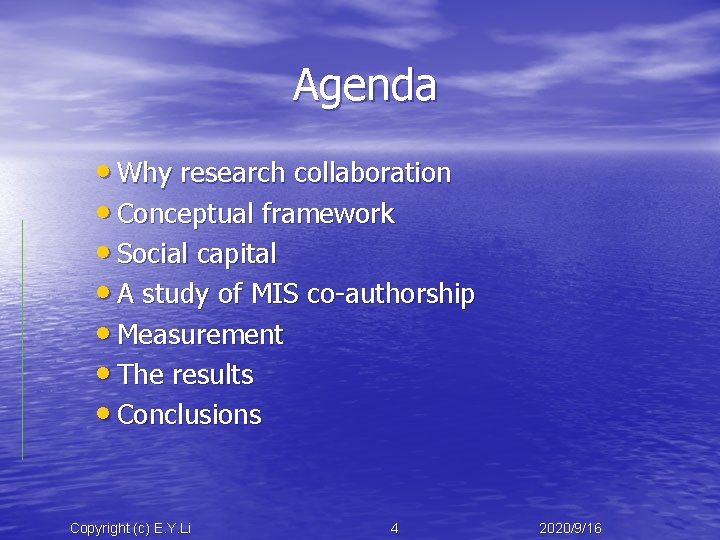
Agenda • Why research collaboration • Conceptual framework • Social capital • A study of MIS co-authorship • Measurement • The results • Conclusions Copyright (c) E. Y. Li 4 2020/9/16
Why Research Collaboration? 1. Each person has his or her own limited cognitive 2. 3. capabilities and bounded rationality. Research collaboration allows scholars to work together and achieve a common goal by sharing research workloads, specific expertise or particular skills, and equipment or resources. Studies have shown that research collaboration can bring co-authors greater research productivity and research impact.

Collaboration Network
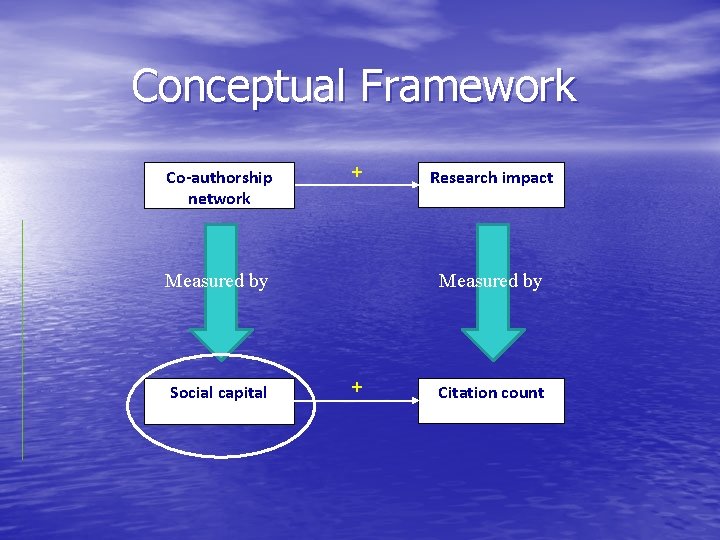
Conceptual Framework Co-authorship Collaboration network + Measured by Social capital Research impact Measured by + Citation count
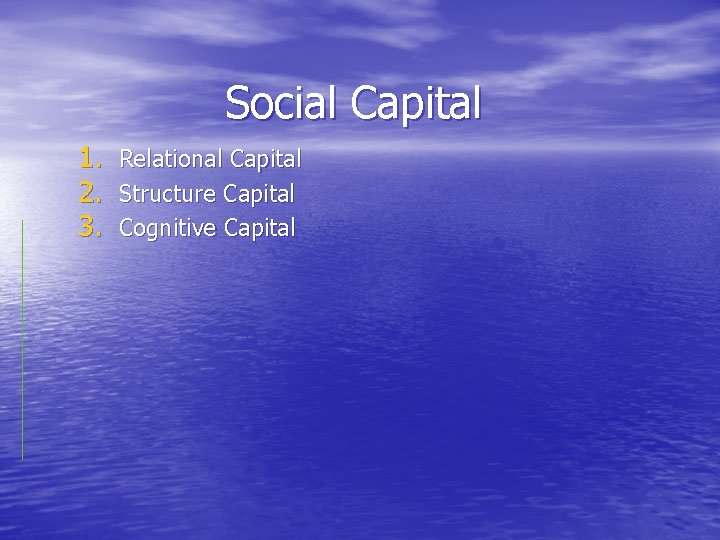
Social Capital 1. 2. 3. Relational Capital Structure Capital Cognitive Capital
Social Capital 1. Relational capital refers to the assets people create and leverage through ongoing personal relationships, and with which they change behaviors and fulfill social motives, such as sociability, approval, and prestige. It exists when members have a strong identification with the collective, trust others within the collective, perceive an obligation to participate in the collective, and recognize and abide by its cooperative norms. Therefore, past studies have operationalized relational capital as trust, commitment, and reciprocity within the collective.
Social Capital 2. Structural capital refers to structural embeddedness, such as the network ties, configuration, and density of connections among individuals. It describes the impersonal configuration of linkages between and among people or units and indicates the overall pattern of connections between actors, providing information about ‘whom you reach and how you reach them’. In a social network, centrality is an important structural attribute that indicates an actor’s formal power or prominence in the network relative to others.
Social Capital 3. Cognitive capital refers to those resources an individual develops over time as he or she interacts with others sharing understanding and expertise; learning the skills, knowledge, and specialized discourse; and forming the norms of practices within the collective. Engaging in a meaningful exchange of knowledge requires at least some level of shared understanding between parties, such as a shared language and vocabulary, expertise and longer tenure in the shared practice, and a shared vision.
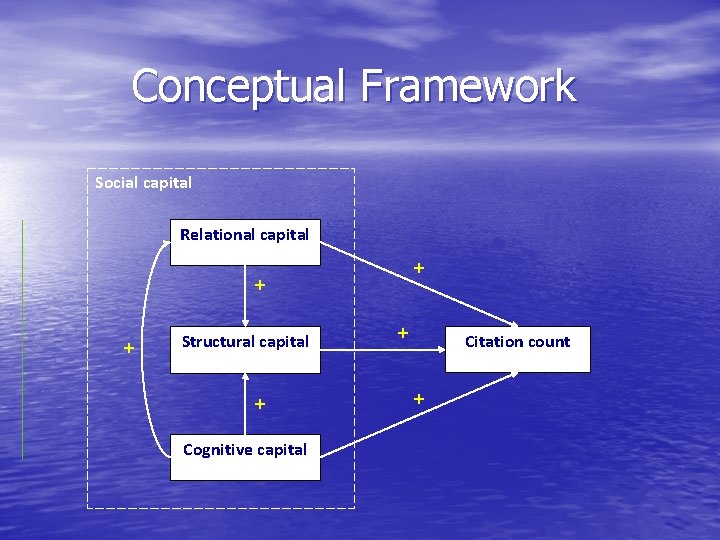
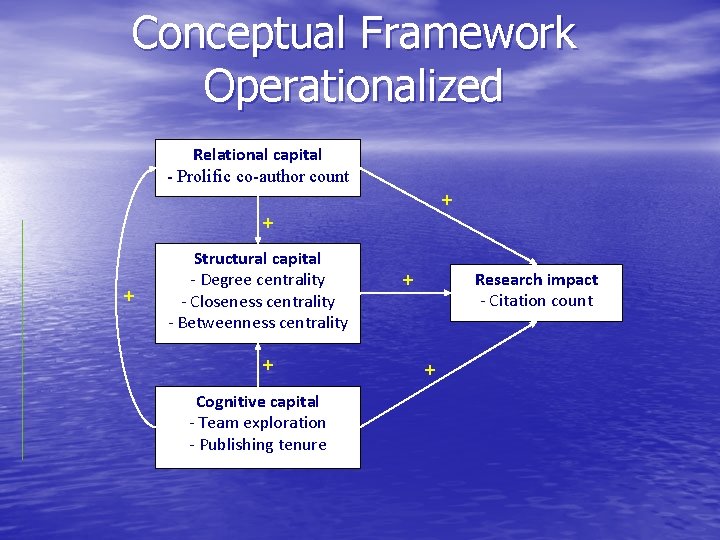
Conceptual Framework Social capital Relational capital + + + Structural capital + Cognitive capital + Citation count +
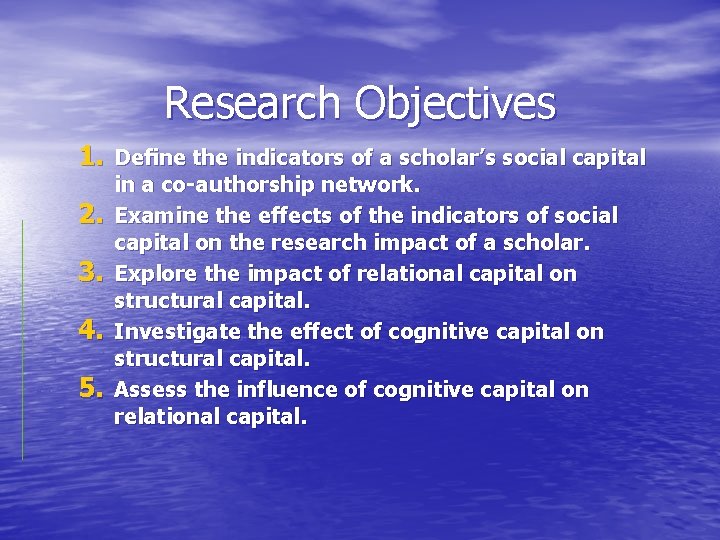
Research Objectives 1. Define the indicators of a scholar’s social capital 2. 3. 4. 5. in a co-authorship network. Examine the effects of the indicators of social capital on the research impact of a scholar. Explore the impact of relational capital on structural capital. Investigate the effect of cognitive capital on structural capital. Assess the influence of cognitive capital on relational capital.
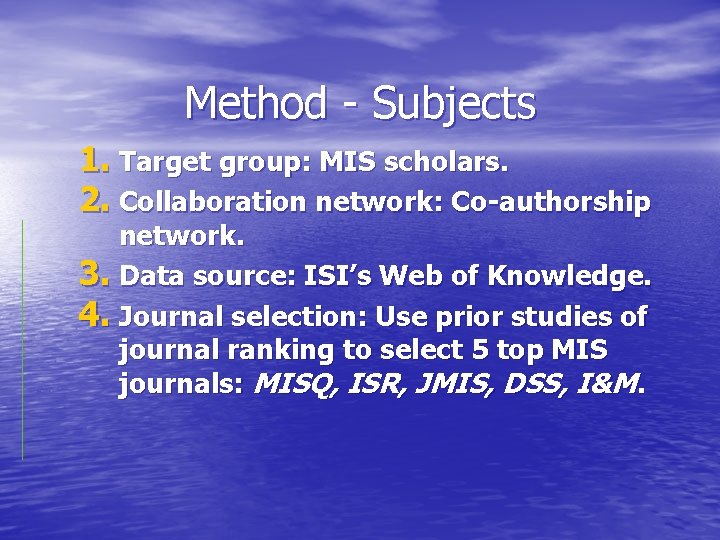
Method - Subjects 1. Target group: MIS scholars. 2. Collaboration network: Co-authorship network. 3. Data source: ISI’s Web of Knowledge. 4. Journal selection: Use prior studies of journal ranking to select 5 top MIS journals: MISQ, ISR, JMIS, DSS, I&M.
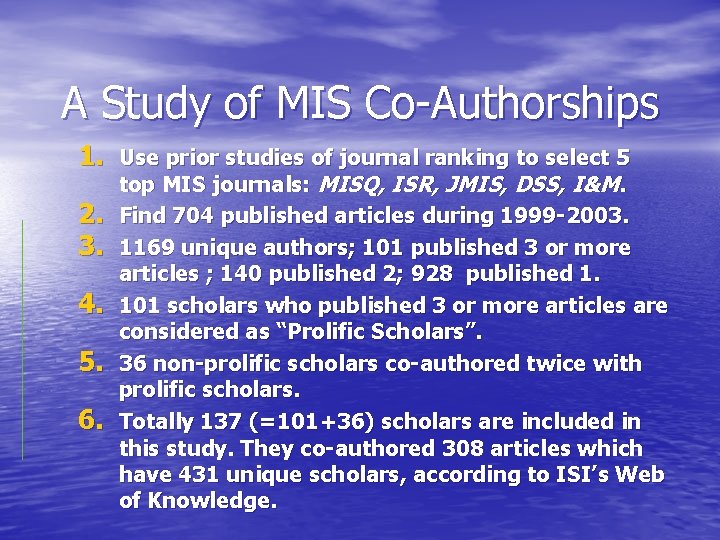
A Study of MIS Co-Authorships 1. Use prior studies of journal ranking to select 5 2. 3. 4. 5. 6. top MIS journals: MISQ, ISR, JMIS, DSS, I&M. Find 704 published articles during 1999 -2003. 1169 unique authors; 101 published 3 or more articles ; 140 published 2; 928 published 1. 101 scholars who published 3 or more articles are considered as “Prolific Scholars”. 36 non-prolific scholars co-authored twice with prolific scholars. Totally 137 (=101+36) scholars are included in this study. They co-authored 308 articles which have 431 unique scholars, according to ISI’s Web of Knowledge.
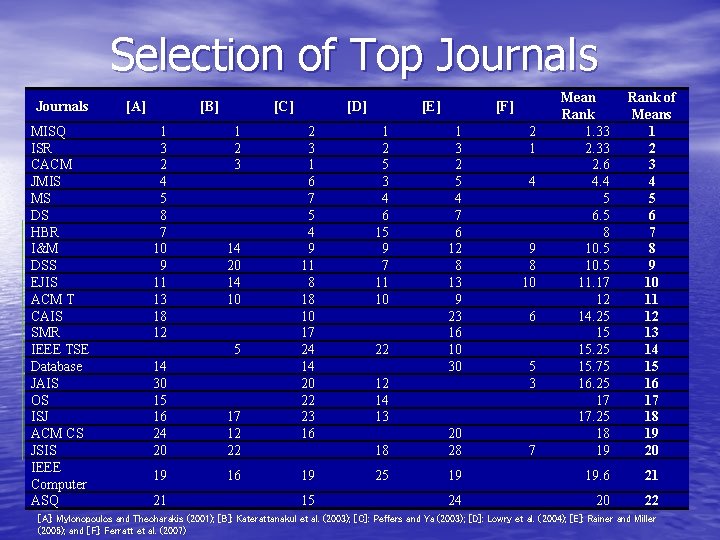
Selection of Top Journals MISQ ISR CACM JMIS MS DS HBR I&M DSS EJIS ACM T CAIS SMR IEEE TSE Database JAIS OS ISJ ACM CS JSIS IEEE Computer ASQ [A] [B] 1 3 2 4 5 8 7 10 9 11 13 18 12 [C] 1 2 3 14 20 14 10 5 14 30 15 16 24 20 17 12 22 19 16 21 [D] 2 3 1 6 7 5 4 9 11 8 18 10 17 24 14 20 22 23 16 19 15 [E] 1 2 5 3 4 6 15 9 7 11 10 22 [F] 1 3 2 5 4 7 6 12 8 13 9 23 16 10 30 12 14 13 2 1 4 9 8 10 6 5 3 Mean Rank 1. 33 2. 6 4. 4 5 6. 5 8 10. 5 11. 17 12 14. 25 15 15. 25 15. 75 16. 25 17 17. 25 18 19 Rank of Means 1 2 3 4 5 6 7 8 9 10 11 12 13 14 15 16 17 18 19 20 18 20 28 25 19 19. 6 21 24 20 22 7 [A]: Mylonopoulos and Theoharakis (2001); [B]: Katerattanakul et al. (2003); [C]: Peffers and Ya (2003); [D]: Lowry et al. (2004); [E]: Rainer and Miller (2005); and [F]: Ferratt et al. (2007)
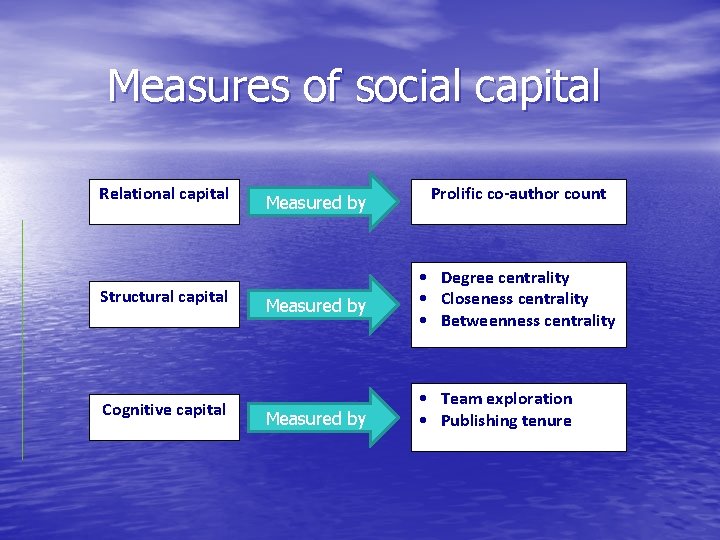
Measures of social capital Relational capital Structural capital Cognitive capital Measured by Prolific co-author count Measured by • Degree centrality • Closeness centrality • Betweenness centrality Measured by • Team exploration • Publishing tenure
Measures - Relational Capital 1. Prolific co-author count is the number of prolific scholars with whom a person has repeated co-authorships and gained access to the resources of them.
Measures - Structural Capital 1. Degree centrality is defined as the number of direct connections that a given actor (or node) has with other actors, without taking into account the strength of connection (i. e. , repeating frequency of a connection).
Measures - Structural Capital 2. Closeness centrality is defined as the mean shortest distance by which a given actor is separated from all other nodes in a network. It measures the speed a message originating from a position would spread throughout the entire network.
Measures - Structural Capital 3. Betweenness centrality is defined as the proportion of the shortest paths between all pairs of nodes that pass through a given actor in the network. It enables the actor to broker information and resources to other actors.
Measures - Cognitive Capital 1. Publishing tenure is the length of tenure publishing in a discipline which is useful for a scholar in promoting his or her shared language, understanding, and expertise of the discipline in a co-authorship network.
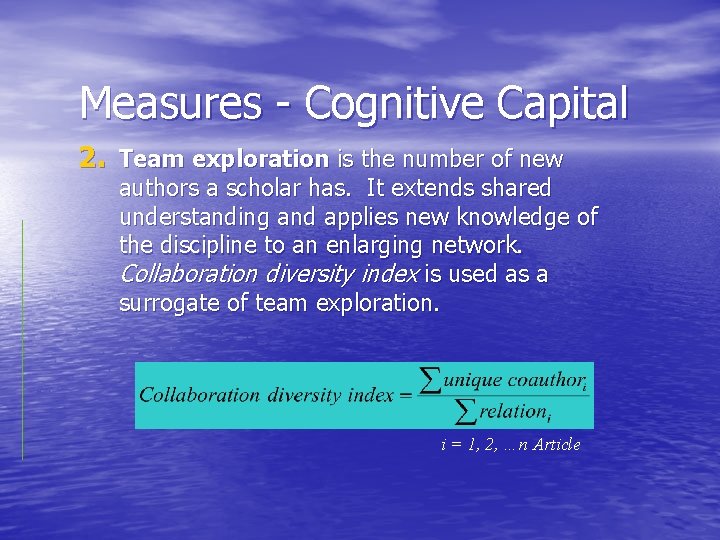
Measures - Cognitive Capital 2. Team exploration is the number of new authors a scholar has. It extends shared understanding and applies new knowledge of the discipline to an enlarging network. Collaboration diversity index is used as a surrogate of team exploration. i = 1, 2, …n Article
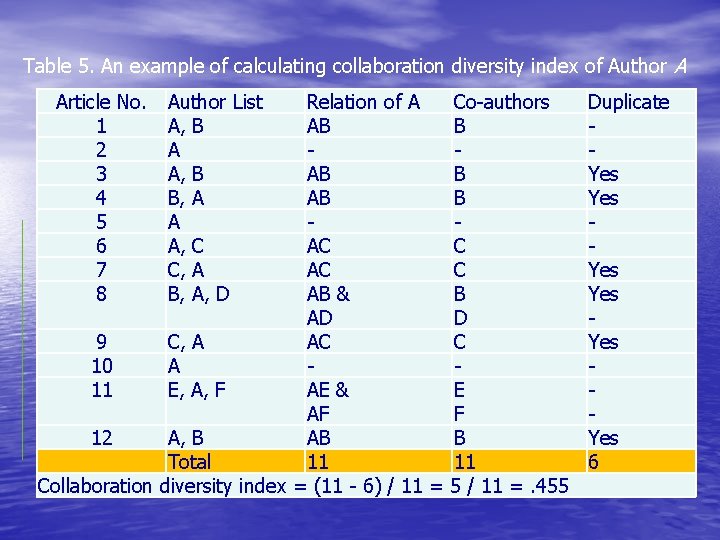
Table 5. An example of calculating collaboration diversity index of Author A Article No. 1 2 3 4 5 6 7 8 Author List A, B A A, B B, A A A, C C, A B, A, D Relation of A Co-authors AB B AC C AB & B AD D 9 C, A AC C 10 A 11 E, A, F AE & E AF F 12 A, B AB B Total 11 11 Collaboration diversity index = (11 - 6) / 11 = 5 / 11 =. 455 Duplicate Yes Yes Yes 6
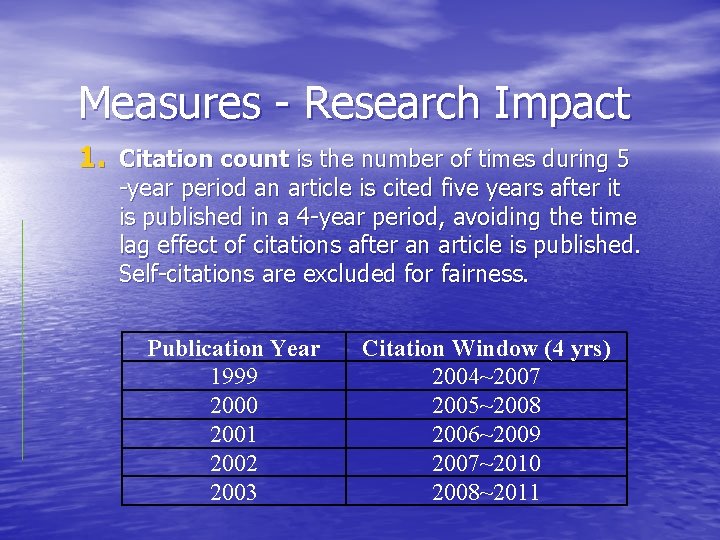
Measures - Research Impact 1. Citation count is the number of times during 5 -year period an article is cited five years after it is published in a 4 -year period, avoiding the time lag effect of citations after an article is published. Self-citations are excluded for fairness. Publication Year 1999 2000 2001 2002 2003 Citation Window (4 yrs) 2004~2007 2005~2008 2006~2009 2007~2010 2008~2011
Conceptual Framework Operationalized Relational capital - Prolific co-author count + + + Structural capital - Degree centrality - Closeness centrality - Betweenness centrality + Cognitive capital - Team exploration - Publishing tenure Research impact - Citation count + +
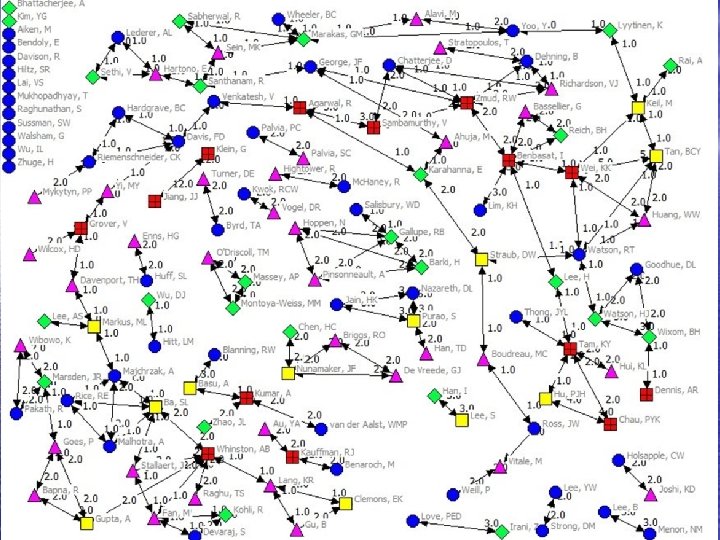
Co. Authorship Network (N=137)
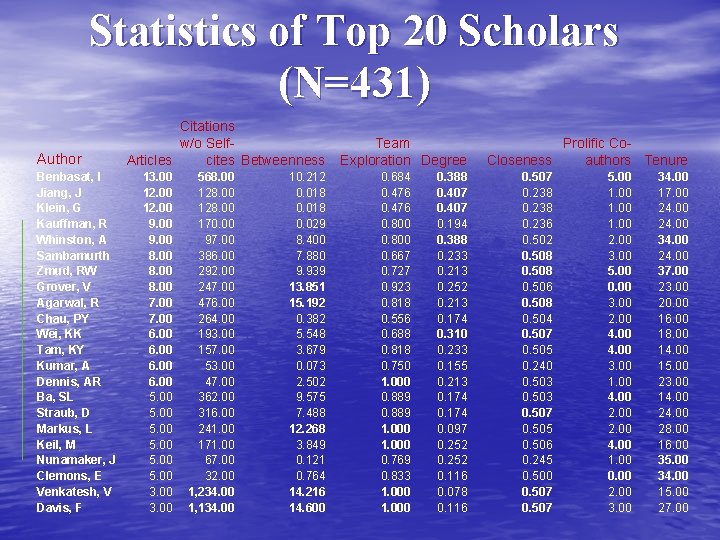
Statistics of Top 20 Scholars (N=431) Author Benbasat, I Jiang, J Klein, G Kauffman, R Whinston, A Sambamurth Zmud, RW Grover, V Agarwal, R Chau, PY Wei, KK Tam, KY Kumar, A Dennis, AR Ba, SL Straub, D Markus, L Keil, M Nunamaker, J Clemons, E Venkatesh, V Davis, F Citations w/o Selfcites Betweenness Articles 13. 00 12. 00 9. 00 8. 00 7. 00 6. 00 5. 00 3. 00 568. 00 128. 00 170. 00 97. 00 386. 00 292. 00 247. 00 476. 00 264. 00 193. 00 157. 00 53. 00 47. 00 362. 00 316. 00 241. 00 171. 00 67. 00 32. 00 1, 234. 00 1, 134. 00 10. 212 0. 018 0. 029 8. 400 7. 880 9. 939 13. 851 15. 192 0. 382 5. 548 3. 679 0. 073 2. 502 9. 575 7. 488 12. 268 3. 849 0. 121 0. 764 14. 216 14. 600 Team Exploration Degree 0. 684 0. 476 0. 800 0. 667 0. 727 0. 923 0. 818 0. 556 0. 688 0. 818 0. 750 1. 000 0. 889 1. 000 0. 769 0. 833 1. 000 0. 388 0. 407 0. 194 0. 388 0. 233 0. 213 0. 252 0. 213 0. 174 0. 310 0. 233 0. 155 0. 213 0. 174 0. 097 0. 252 0. 116 0. 078 0. 116 Prolific Coauthors Tenure Closeness 0. 507 0. 238 0. 236 0. 502 0. 508 0. 506 0. 508 0. 504 0. 507 0. 505 0. 240 0. 503 0. 507 0. 505 0. 506 0. 245 0. 500 0. 507 5. 00 1. 00 2. 00 3. 00 5. 00 0. 00 3. 00 2. 00 4. 00 3. 00 1. 00 4. 00 2. 00 4. 00 1. 00 0. 00 2. 00 34. 00 17. 00 24. 00 34. 00 24. 00 37. 00 23. 00 20. 00 16. 00 18. 00 14. 00 15. 00 23. 00 14. 00 28. 00 16. 00 35. 00 34. 00 15. 00 27. 00
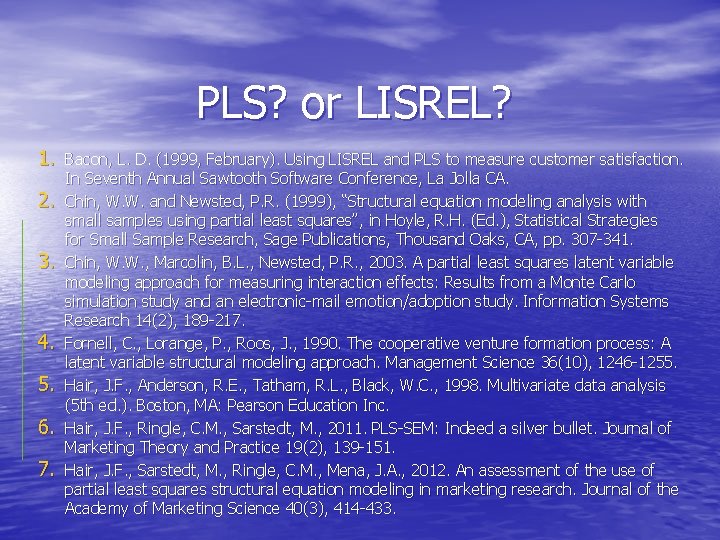
PLS? or LISREL? 1. Bacon, L. D. (1999, February). Using LISREL and PLS to measure customer satisfaction. 2. 3. 4. 5. 6. 7. In Seventh Annual Sawtooth Software Conference, La Jolla CA. Chin, W. W. and Newsted, P. R. (1999), “Structural equation modeling analysis with small samples using partial least squares”, in Hoyle, R. H. (Ed. ), Statistical Strategies for Small Sample Research, Sage Publications, Thousand Oaks, CA, pp. 307 -341. Chin, W. W. , Marcolin, B. L. , Newsted, P. R. , 2003. A partial least squares latent variable modeling approach for measuring interaction effects: Results from a Monte Carlo simulation study and an electronic-mail emotion/adoption study. Information Systems Research 14(2), 189 -217. Fornell, C. , Lorange, P. , Roos, J. , 1990. The cooperative venture formation process: A latent variable structural modeling approach. Management Science 36(10), 1246 -1255. Hair, J. F. , Anderson, R. E. , Tatham, R. L. , Black, W. C. , 1998. Multivariate data analysis (5 th ed. ). Boston, MA: Pearson Education Inc. Hair, J. F. , Ringle, C. M. , Sarstedt, M. , 2011. PLS-SEM: Indeed a silver bullet. Journal of Marketing Theory and Practice 19(2), 139 -151. Hair, J. F. , Sarstedt, M. , Ringle, C. M. , Mena, J. A. , 2012. An assessment of the use of partial least squares structural equation modeling in marketing research. Journal of the Academy of Marketing Science 40(3), 414 -433.
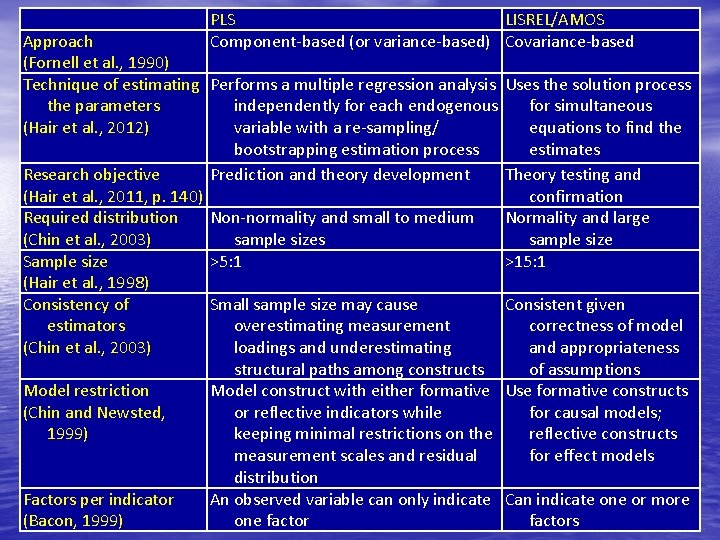
PLS LISREL/AMOS Component-based (or variance-based) Covariance-based Approach (Fornell et al. , 1990) Technique of estimating Performs a multiple regression analysis the parameters independently for each endogenous (Hair et al. , 2012) variable with a re-sampling/ bootstrapping estimation process Research objective Prediction and theory development (Hair et al. , 2011, p. 140) Required distribution Non-normality and small to medium (Chin et al. , 2003) sample sizes Sample size >5: 1 (Hair et al. , 1998) Consistency of Small sample size may cause estimators overestimating measurement (Chin et al. , 2003) loadings and underestimating structural paths among constructs Model restriction Model construct with either formative (Chin and Newsted, or reflective indicators while 1999) keeping minimal restrictions on the measurement scales and residual distribution Factors per indicator An observed variable can only indicate (Bacon, 1999) one factor Uses the solution process for simultaneous equations to find the estimates Theory testing and confirmation Normality and large sample size >15: 1 Consistent given correctness of model and appropriateness of assumptions Use formative constructs for causal models; reflective constructs for effect models Can indicate one or more factors
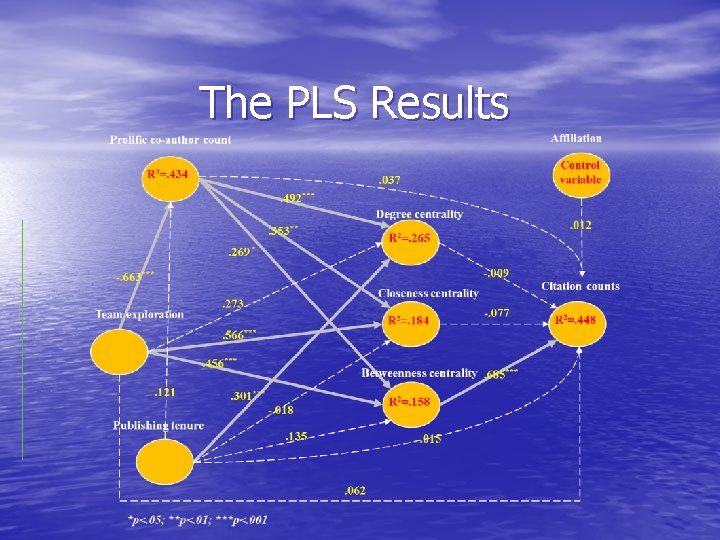
The PLS Results
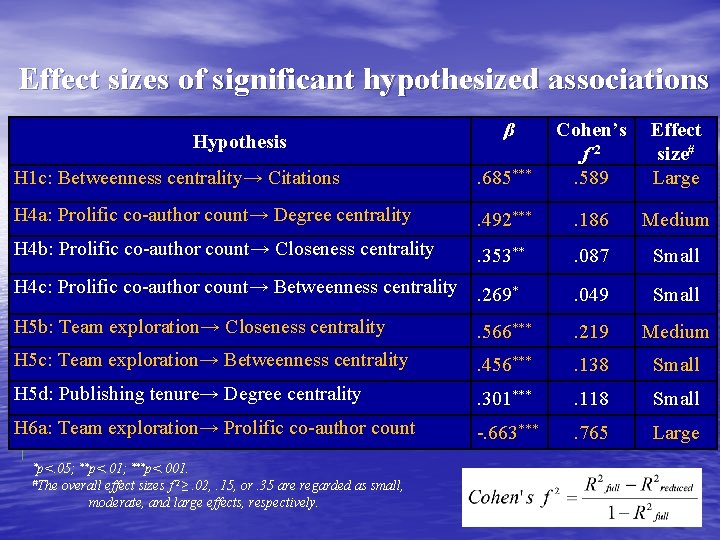
Effect sizes of significant hypothesized associations H 1 c: Betweenness centrality→ Citations . 685*** Cohen’s f 2. 589 H 4 a: Prolific co-author count→ Degree centrality . 492*** . 186 Medium H 4 b: Prolific co-author count→ Closeness centrality . 353** . 087 Small H 4 c: Prolific co-author count→ Betweenness centrality. 269* . 049 Small H 5 b: Team exploration→ Closeness centrality . 566*** . 219 Medium H 5 c: Team exploration→ Betweenness centrality . 456*** . 138 Small H 5 d: Publishing tenure→ Degree centrality . 301*** . 118 Small H 6 a: Team exploration→ Prolific co-author count -. 663*** . 765 Large Hypothesis *p<. 05; **p<. 01; ***p<. 001. #The overall effect sizes f 2≥. 02, . 15, or. 35 are regarded as small, moderate, and large effects, respectively. β Effect size# Large
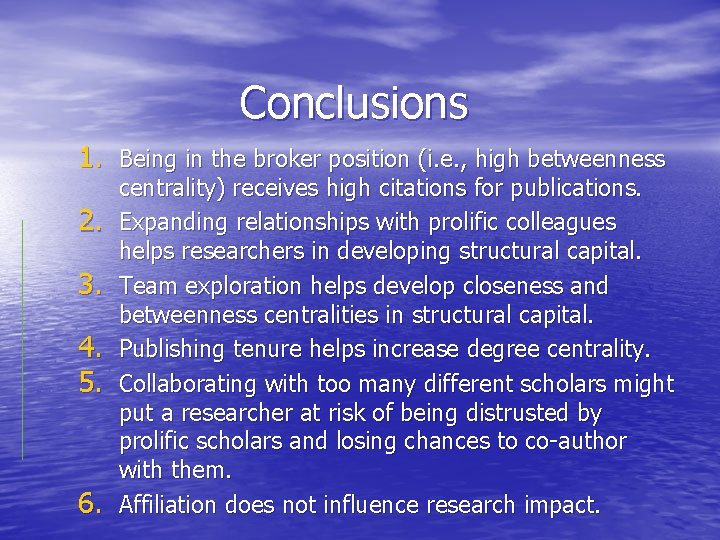
Conclusions 1. Being in the broker position (i. e. , high betweenness 2. 3. 4. 5. 6. centrality) receives high citations for publications. Expanding relationships with prolific colleagues helps researchers in developing structural capital. Team exploration helps develop closeness and betweenness centralities in structural capital. Publishing tenure helps increase degree centrality. Collaborating with too many different scholars might put a researcher at risk of being distrusted by prolific scholars and losing chances to co-author with them. Affiliation does not influence research impact.
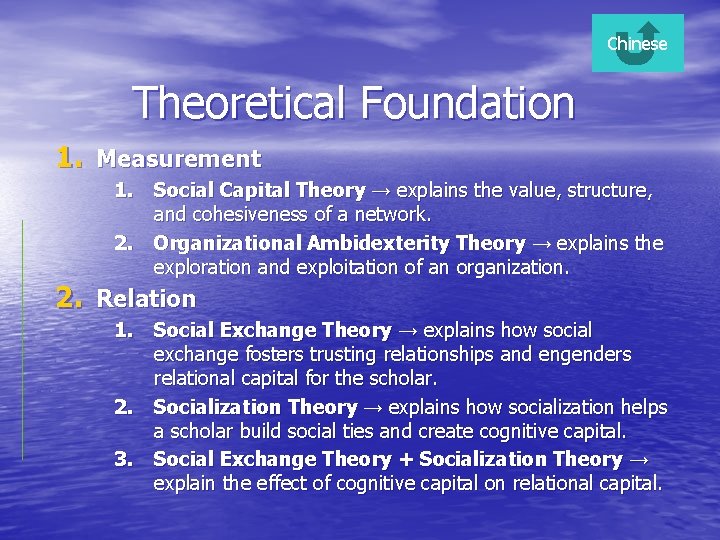
Chinese Theoretical Foundation 1. Measurement 1. Social Capital Theory → explains the value, structure, and cohesiveness of a network. 2. Organizational Ambidexterity Theory → explains the exploration and exploitation of an organization. 2. Relation 1. Social Exchange Theory → explains how social exchange fosters trusting relationships and engenders relational capital for the scholar. 2. Socialization Theory → explains how socialization helps a scholar build social ties and create cognitive capital. 3. Social Exchange Theory + Socialization Theory → explain the effect of cognitive capital on relational capital.
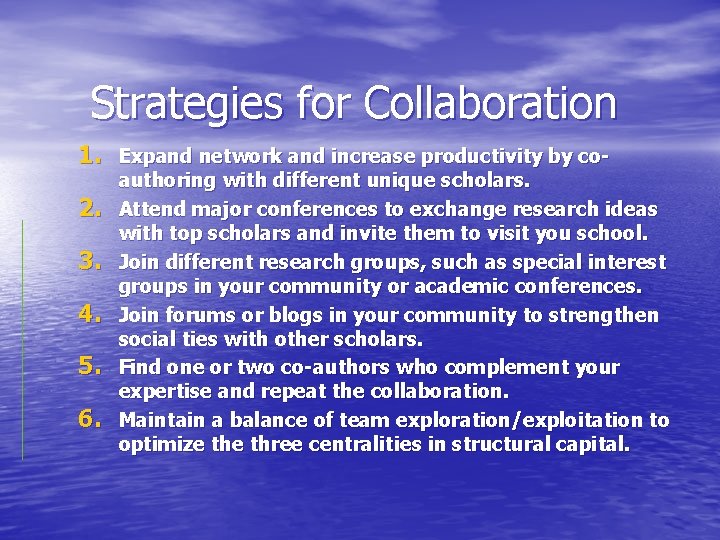
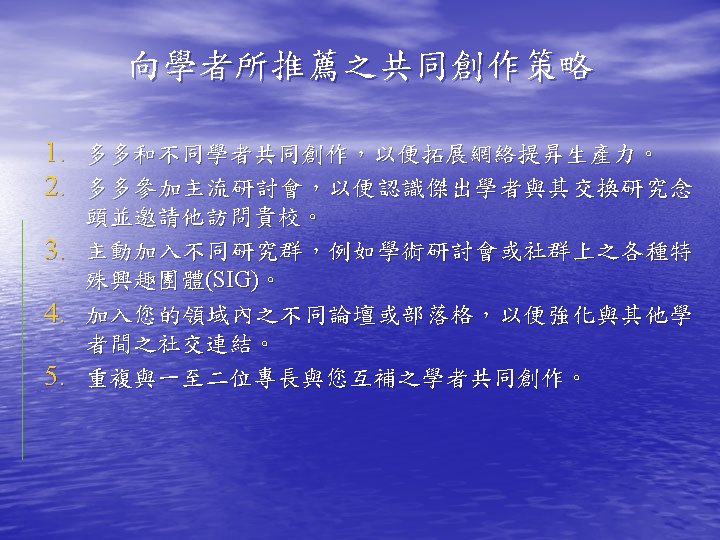
Strategies for Collaboration 1. Expand network and increase productivity by co 2. 3. 4. 5. 6. authoring with different unique scholars. Attend major conferences to exchange research ideas with top scholars and invite them to visit you school. Join different research groups, such as special interest groups in your community or academic conferences. Join forums or blogs in your community to strengthen social ties with other scholars. Find one or two co-authors who complement your expertise and repeat the collaboration. Maintain a balance of team exploration/exploitation to optimize three centralities in structural capital.

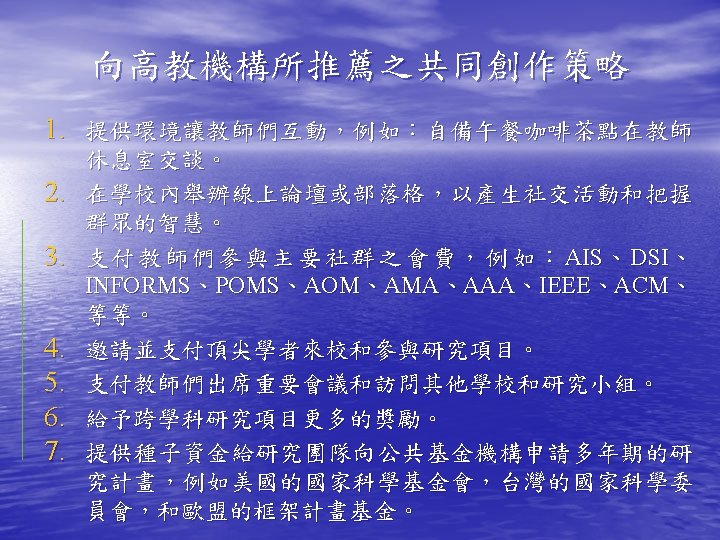
How Can Your School Help? 1. Provide environment for faculties to interact, such as having 2. 3. 4. 5. 6. 7. brown bag lunches, coffee breaks in a faculty lounge Host forum or blog in your school to engender social interactions and to capitalize the wisdom of crowd. Fund membership fees of major academic communities, e. g. , AIS, DSI, INFORMS, POMS, AOM, AMA, AAA, IEEE, ACM. Invite top scholars to school and to join research projects. Fund faculties to attend major conferences and to visit other schools and research groups. Give more reward to cross-disciplinary research project. Provide seed funding for proposing multiyear integrated team project from public fund agencies, such as s National Science Foundation in the U. S. , National Science Council in Taiwan, and Framework Programme in the European Union.
Abstract Chinese This study proposes that utilizing social capital embedded in a social structure is an effective way to achieve more research impact. The contribution of this study is to define six indicators of social capital (degree centrality, closeness centrality, betweenenss centrality, prolific co-author count, team exploration, and publishing tenure) and investigate how these indicators interact and affect citations for publications. A total of 137 Information Systems scholars from the Social Science Citation Index database were selected to test the hypothesized relationships. The results show that betweenness centrality plays the most important role in taking advantage of non-redundant resources in a co-authorship network, thereby significantly affecting citations for publications. In addition, we found that prolific co-author count, team exploration, and publishing tenure all have indirect effects on citation count. Specifically, co-authoring with prolific scholars helps researchers develop centralities and, in turn, generate higher numbers of citations. Researchers with longer publishing tenure tend to have higher degree centrality. When they collaborate more with different scholars, they achieve more closeness and betweenness centralities, but risk being distrusted by prolific scholars and losing chances to co-author with them. Finally, implications of findings and recommendations for future research are discussed.
Reference This lecture is adapted from Li, E. Y. , Liao, C. H. , Yen, H. J. R. (2013) "Co-Authorship Networks and Research Impact: A Social Capital Perspective, " Research Policy (Elsevier), Vol. 42, No. 9, November, pp. 1515 -1530. Copyright (c) E. Y. Li 41 2020/9/16
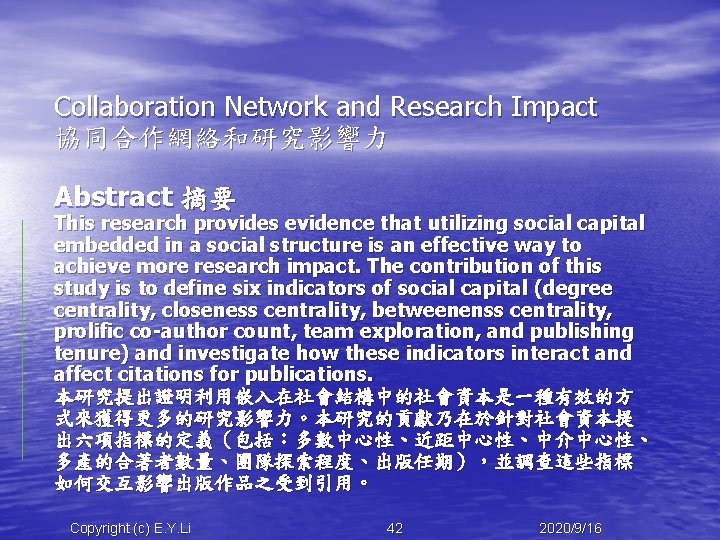
Collaboration Network and Research Impact 協同合作網絡和研究影響力 Abstract 摘要 This research provides evidence that utilizing social capital embedded in a social structure is an effective way to achieve more research impact. The contribution of this study is to define six indicators of social capital (degree centrality, closeness centrality, betweenenss centrality, prolific co-author count, team exploration, and publishing tenure) and investigate how these indicators interact and affect citations for publications. 本研究提出證明利用嵌入在社會結構中的社會資本是一種有效的方 式來獲得更多的研究影響力。本研究的貢獻乃在於針對社會資本提 出六項指標的定義(包括:多數中心性、近距中心性、中介中心性、 多產的合著者數量、團隊探索程度、出版任期),並調查這些指標 如何交互影響出版作品之受到引用。 Copyright (c) E. Y. Li 42 2020/9/16
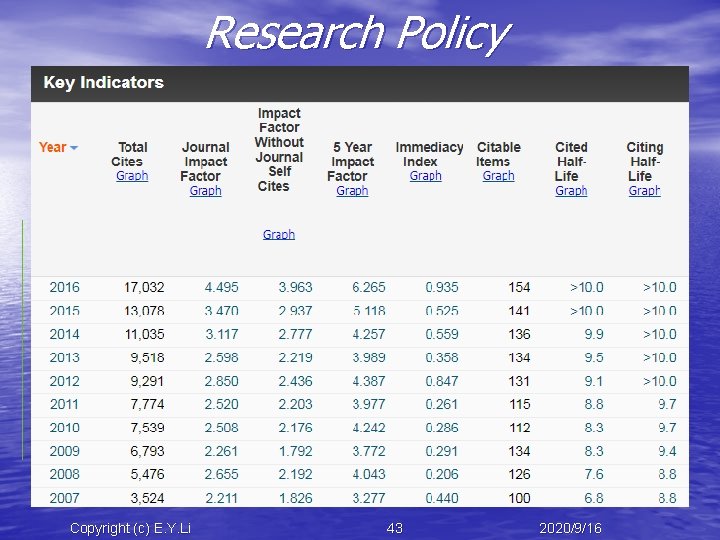
Research Policy Copyright (c) E. Y. Li 43 2020/9/16
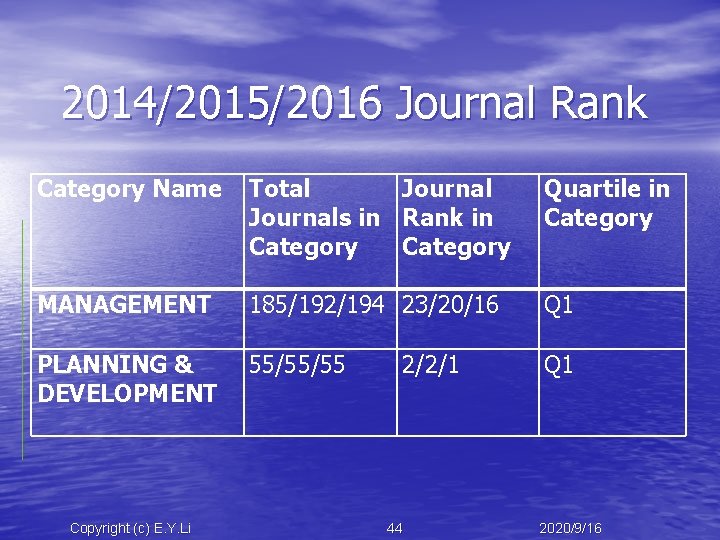
2014/2015/2016 Journal Rank Category Name Total Journals in Rank in Category Quartile in Category MANAGEMENT 185/192/194 23/20/16 Q 1 PLANNING & DEVELOPMENT 55/55/55 Q 1 Copyright (c) E. Y. Li 2/2/1 44 2020/9/16

2016 Journal Rank (P&D Cat. ) Copyright (c) E. Y. Li 45 2020/9/16

Copyright (c) E. Y. Li 46 2020/9/16

Copyright (c) E. Y. Li 47 2020/9/16
- Slides: 47