
Collaboration for Advanced Nuclear Simulation Predictive Reactor Simulation
Collaboration for Advanced Nuclear Simulation: Predictive Reactor Simulation for GNEP Presented by Kevin Clarno Energy and Engineering Sciences Directorate Nuclear Science and Technology
Nuclear reactors have operated safely for decades throughout the world Many operating nuclear reactors worldwide Immediate response to global warming Designs static for 20 years · More than 400 commercial power plants worldwide · No CO 2, sulfur, or mercury releases to the atmosphere · ~200 nuclear propulsion plants on Navy vessels worldwide · The only carbon-free, high-energy-density electricity source · Mostly water-cooled “thermal” reactors fueled by uranium from ore · More than 100 research reactors on every continent · Greenpeace founder Patrick Moore supports expansion of nuclear energy 2 Clarno_GNEP_0611 · Optimized using more than 10, 000 reactoryears of experience · Not sustainable now because they use more fuel than they produce
Global Nuclear Energy Partnership (GNEP) will expand sustainable nuclear energy worldwide International consensus Global benefits · Enables expanded use of economical, carbon-free nuclear energy · Provides abundant energy without generating greenhouse gases · Recycles nuclear fuel for energy security and international safety · Recycles used nuclear fuel to minimize waste and reduce proliferation concerns · Establishes user-supplier nuclear fuel services strategy: · Safely and securely allows developing nations to deploy nuclear power to meet energy needs - Supplier nations provide fresh fuel and recovery of used fuel - User nations receive economical reactors and fuel for power generation purposes only 3 · Maximizes energy recovery from still-valuable used nuclear fuel · Requires only one U. S. geologic waste repository for the rest
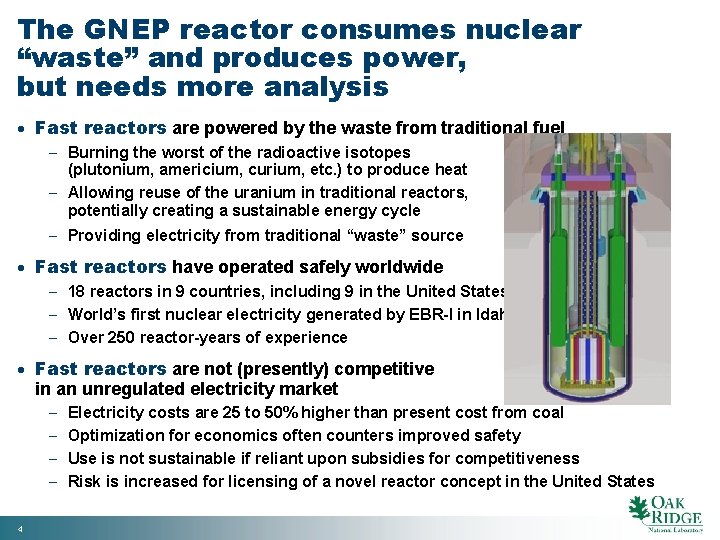
The GNEP reactor consumes nuclear “waste” and produces power, but needs more analysis · Fast reactors are powered by the waste from traditional fuel - Burning the worst of the radioactive isotopes (plutonium, americium, curium, etc. ) to produce heat - Allowing reuse of the uranium in traditional reactors, potentially creating a sustainable energy cycle - Providing electricity from traditional “waste” source · Fast reactors have operated safely worldwide - 18 reactors in 9 countries, including 9 in the United States - World’s first nuclear electricity generated by EBR-I in Idaho - Over 250 reactor-years of experience · Fast reactors are not (presently) competitive in an unregulated electricity market 4 Electricity costs are 25 to 50% higher than present cost from coal Optimization for economics often counters improved safety Use is not sustainable if reliant upon subsidies for competitiveness Risk is increased for licensing of a novel reactor concept in the United States

GNEP will not succeed without optimization of fast reactors for safety and economics Optimization through experience Inherent versus engineered safety · Thermal reactors have >10, 000 years of commercial experience · Thermal reactors have added expensive engineered safety systems because of high-profile accidents - It took decades of poor performance to learn best practices · Fast reactors have very little commercial experience - Test reactor experience does little to help a commercial entity optimize 5 5 Clarno_GNEP_0611 - New thermal reactor designs incorporate inexpensive systems designed to be inherently safe - Fast reactor designs must reduce their reliance on expensive engineered systems in favor of passively safe systems for inherent safety and improved economics Predictive simulation of fast reactors to aid competitiveness · High-fidelity simulation to replicate years of operating experience - Incorporate all of the physics that are integrated within the system - Use an as-built design with accurate data · Flexible simulation tool for optimization of many concepts - May require thousands of independent computations of the full system - Easily scalable, but
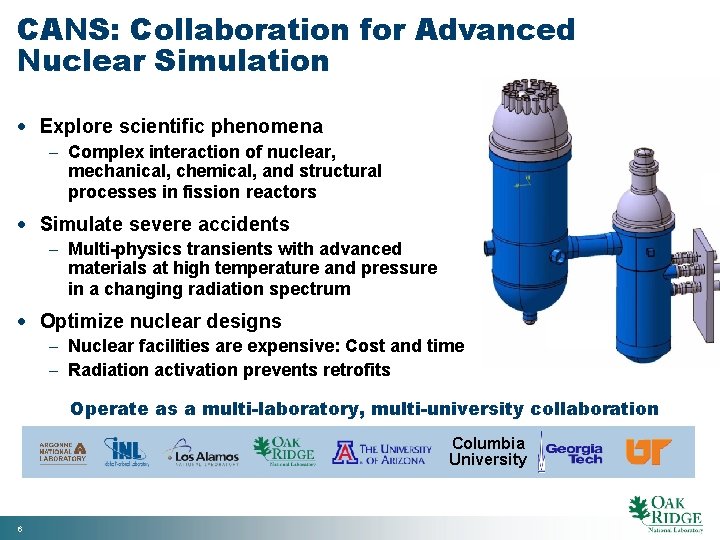
CANS: Collaboration for Advanced Nuclear Simulation · Explore scientific phenomena - Complex interaction of nuclear, mechanical, chemical, and structural processes in fission reactors · Simulate severe accidents - Multi-physics transients with advanced materials at high temperature and pressure in a changing radiation spectrum · Optimize nuclear designs - Nuclear facilities are expensive: Cost and time - Radiation activation prevents retrofits Operate as a multi-laboratory, multi-university collaboration Columbia University 6
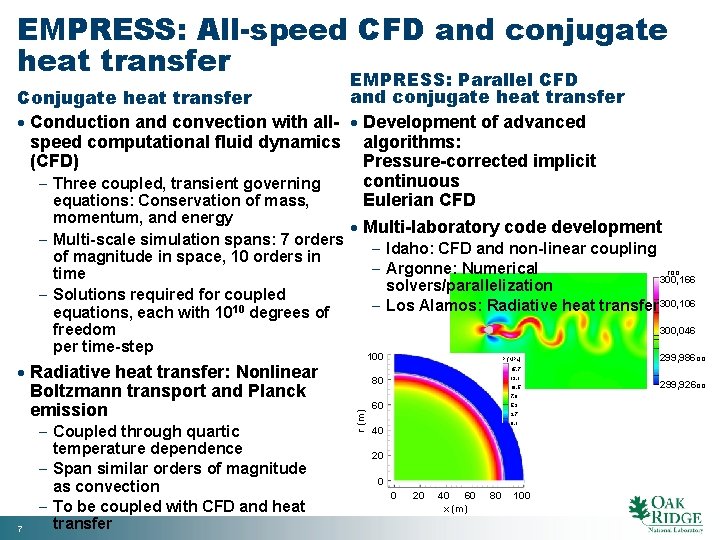
EMPRESS: All-speed CFD and conjugate heat transfer EMPRESS: Parallel CFD and conjugate heat transfer Conjugate heat transfer · Conduction and convection with all- · Development of advanced speed computational fluid dynamics algorithms: Pressure-corrected implicit (CFD) continuous - Three coupled, transient governing equations: Conservation of mass, Eulerian CFD momentum, and energy · Multi-laboratory code development - Multi-scale simulation spans: 7 orders of magnitude in space, 10 orders in time - Solutions required for coupled equations, each with 1010 degrees of freedom per time-step 7 - Coupled through quartic temperature dependence - Span similar orders of magnitude as convection - To be coupled with CFD and heat transfer T�� 300, 046 100 P (MPa) 299, 986�� 15. 7 80 13. 1 10. 5 7. 9 r (m) · Radiative heat transfer: Nonlinear Boltzmann transport and Planck emission - Idaho: CFD and non-linear coupling - Argonne: Numerical 300, 166 solvers/parallelization - Los Alamos: Radiative heat transfer 300, 106 60 5. 3 2. 7 0. 1 40 20 0 0 20 40 60 x (m) 80 100 299, 926��
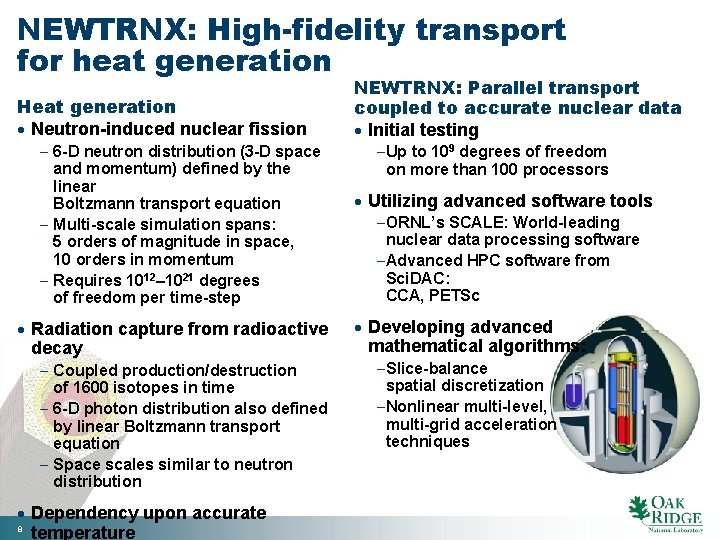
NEWTRNX: High-fidelity transport for heat generation Heat generation · Neutron-induced nuclear fission - 6 -D neutron distribution (3 -D space and momentum) defined by the linear Boltzmann transport equation - Multi-scale simulation spans: 5 orders of magnitude in space, 10 orders in momentum - Requires 1012– 1021 degrees of freedom per time-step · Radiation capture from radioactive decay - Coupled production/destruction of 1600 isotopes in time - 6 -D photon distribution also defined by linear Boltzmann transport equation - Space scales similar to neutron distribution · Dependency upon accurate 8 temperature NEWTRNX: Parallel transport coupled to accurate nuclear data · Initial testing -Up to 109 degrees of freedom on more than 100 processors · Utilizing advanced software tools -ORNL’s SCALE: World-leading nuclear data processing software -Advanced HPC software from Sci. DAC: CCA, PETSc · Developing advanced mathematical algorithms: -Slice-balance spatial discretization -Nonlinear multi-level, multi-grid acceleration techniques
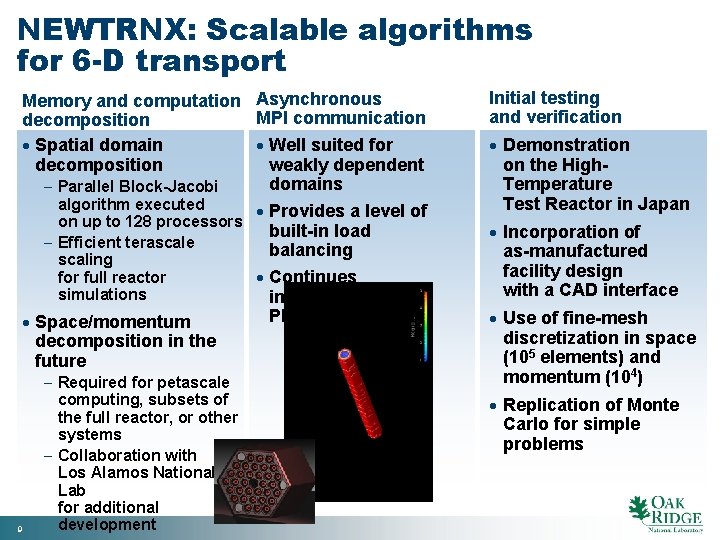
NEWTRNX: Scalable algorithms for 6 -D transport Memory and computation Asynchronous MPI communication decomposition · Spatial domain · Well suited for decomposition weakly dependent domains - Parallel Block-Jacobi algorithm executed · Provides a level of on up to 128 processors built-in load - Efficient terascale balancing scaling for full reactor simulations · Space/momentum decomposition in the future 9 - Required for petascale computing, subsets of the full reactor, or other systems - Collaboration with Los Alamos National Lab for additional development · Continues improvement with PEAC end-station Initial testing and verification · Demonstration on the High. Temperature Test Reactor in Japan · Incorporation of as-manufactured facility design with a CAD interface · Use of fine-mesh discretization in space (105 elements) and momentum (104) · Replication of Monte Carlo for simple problems
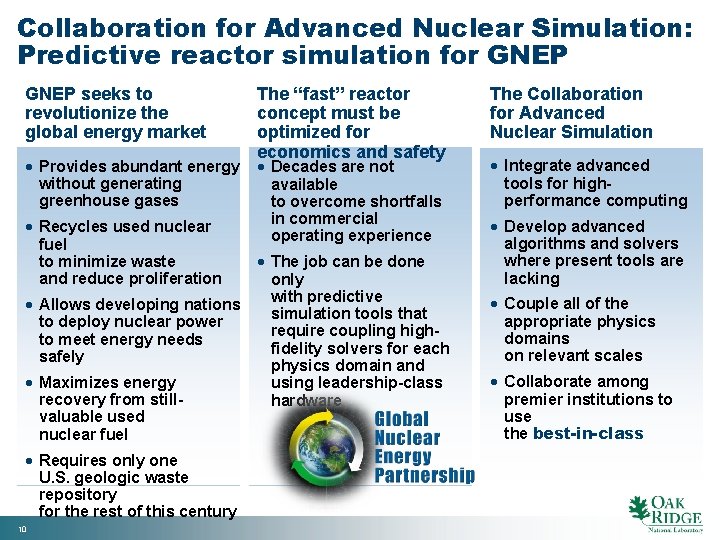
Collaboration for Advanced Nuclear Simulation: Predictive reactor simulation for GNEP seeks to revolutionize the global energy market · Provides abundant energy without generating greenhouse gases · Recycles used nuclear fuel to minimize waste and reduce proliferation The “fast” reactor concept must be optimized for economics and safety · Decades are not available to overcome shortfalls in commercial operating experience · The job can be done only with predictive · Allows developing nations simulation tools that to deploy nuclear power require coupling highto meet energy needs fidelity solvers for each safely physics domain and · Maximizes energy using leadership-class recovery from stillhardware valuable used nuclear fuel · Requires only one U. S. geologic waste repository for the rest of this century 10 The Collaboration for Advanced Nuclear Simulation · Integrate advanced tools for highperformance computing · Develop advanced algorithms and solvers where present tools are lacking · Couple all of the appropriate physics domains on relevant scales · Collaborate among premier institutions to use the best-in-class
Contacts Kevin Clarno Nuclear Science and Technology Division (865) 241 -1894 clarnokt@ornl. gov 11 Clarno_GNEP_0611
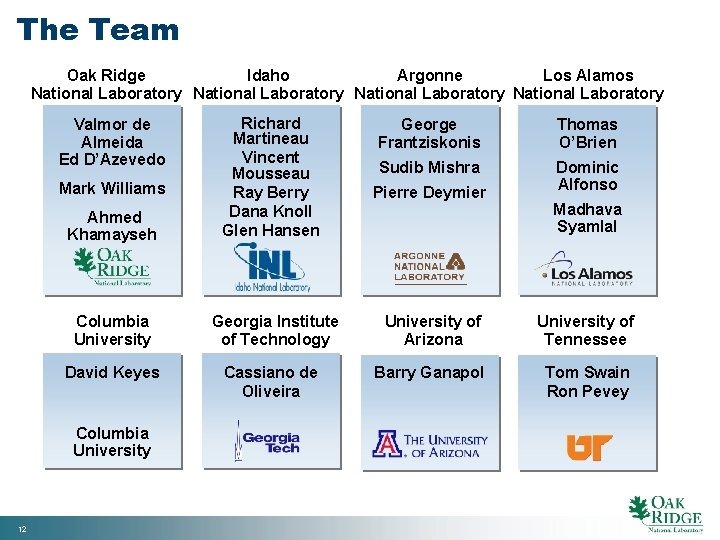
The Team Oak Ridge Idaho Argonne Los Alamos National Laboratory Ahmed Khamayseh Richard Martineau Vincent Mousseau Ray Berry Dana Knoll Glen Hansen Columbia University Georgia Institute of Technology University of Arizona University of Tennessee David Keyes Cassiano de Oliveira Barry Ganapol Tom Swain Ron Pevey Valmor de Almeida Ed D’Azevedo Mark Williams Columbia University 12 George Frantziskonis Thomas O’Brien Sudib Mishra Dominic Alfonso Pierre Deymier Madhava Syamlal
- Slides: 12