
Collaboration Challenges and Opportunities for Developing Analysis Scripts

Collaboration: Challenges and Opportunities for Developing Analysis Scripts Mat Soukup, Ph. D. Team Lead Biometrics 7 FDA/CDER
Disclaimer • The views and opinions expressed in the following Power. Point slides are those of the individual presenter and should not be attributed to the Food and Drug Administration. 46 th Annual Meeting Washington, DC - 2010 2
Outline I. Defining Today’s Statistical Environment II. Capitalizing on The Wiki Way III. Working Towards a Solution 46 th Annual Meeting Washington, DC - 2010
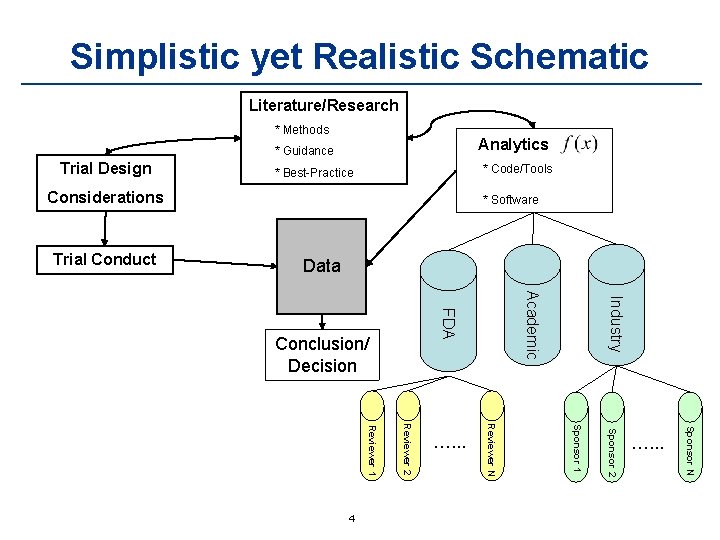
Simplistic yet Realistic Schematic Literature/Research * Methods Analytics * Guidance Trial Design * Code/Tools * Best-Practice Considerations Trial Conduct * Software Data Industry …. . . Sponsor N Sponsor 2 Sponsor 1 4 …. . . Reviewer N Washington, DC - 2010 Reviewer 2 Reviewer 1 46 th Annual Meeting Academic FDA Conclusion/ Decision
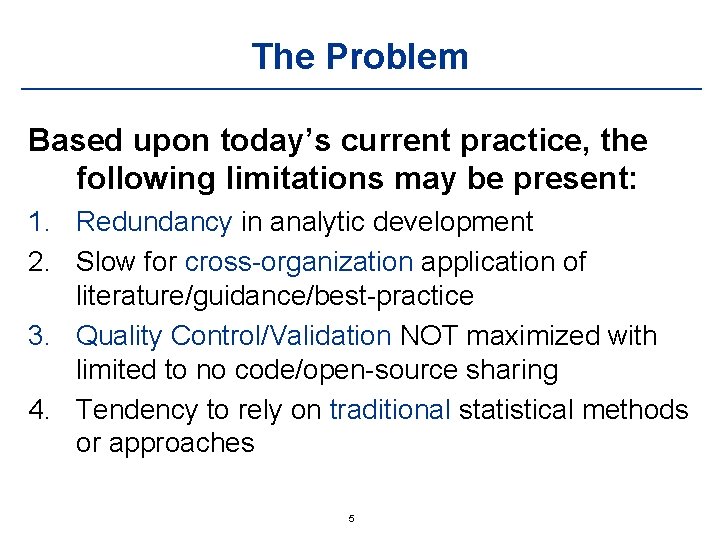
The Problem Based upon today’s current practice, the following limitations may be present: 1. Redundancy in analytic development 2. Slow for cross-organization application of literature/guidance/best-practice 3. Quality Control/Validation NOT maximized with limited to no code/open-source sharing 4. Tendency to rely on traditional statistical methods or approaches 46 th Annual Meeting Washington, DC - 2010 5
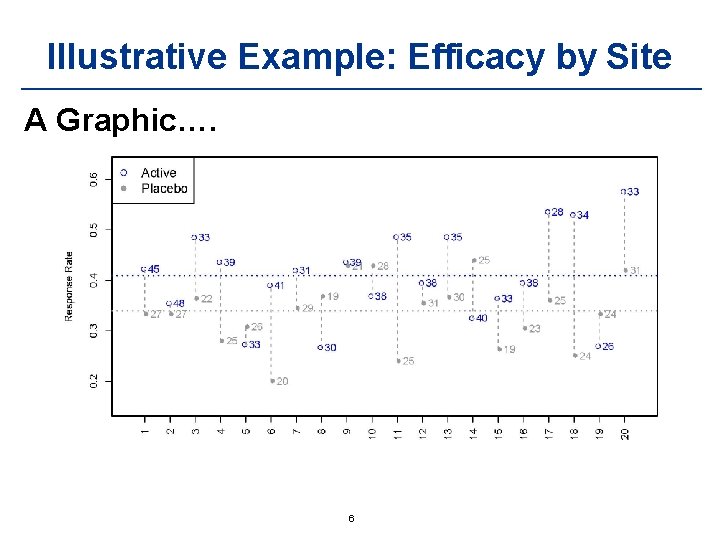
Illustrative Example: Efficacy by Site A Graphic…. 46 th Annual Meeting Washington, DC - 2010 6

Illustrative Example: Efficacy by Site "efficacy. by. site" <function(yy, site, trt, type="b", legend=FALSE, . . . ){ nms <- names(list(. . . )) ss <- summarize(yy, llist(site, trt), mean) n <- summarize(yy, llist(site, trt), length) R Code sdat <- data. frame(ss, n[, 3]) names(sdat) <- c("Site", "Trt", "Mean", "N") 46 th Annual Meeting Washington, DC - 2010 if(type=="b"){ nsn <- length(unique(sdat$Site)) ut <- unique(sdat$Trt) rnx <- tabulate(as. factor(sdat$Site)) sdat$plotx <- rep(1: nsn, rnx[rnx>0]) # Creation of the figure. if("ylab" %in% nms) plot(c(. 5, nsn+. 5), c(min(sdat$Mean)-. 05, max(sdat$Mean)+. 05), type="n", axes=FALSE, . . . ) else plot(c(. 5, nsn+. 5), c(min(sdat$Mean)-. 05, max(sdat$Mean)+. 05), type="n", ylab=paste(deparse(substitute(yy))), axes=FALSE) axis(1, at=1: nsn, labels=as. character(unique(sdat$Site)), cex. axis=. 75, las=3) axis(2) box() if(length(ut)==2) sdat$plotx <- sdat$plotx + rep(c(-. 05, . 05), length(sdat[, 1])/2) if(length(ut)==3) sdat$plotx <- sdat$plotx + rep(c(-. 1, 0, . 1), length(sdat[, 1])/3) if(length(ut)==4) sdat$plotx <- sdat$plotx + rep(c(-. 15, -. 05, . 15), length(sdat[, 1])/4) for(k in 1: length(ut)){ subdat <- subset(sdat, sdat$Trt==ut[k]) points(subdat$plotx, subdat$Mean, pch=trellis. par. get("superpose. symbol")$pch[k], col=trellis. par. get("superpose. symbol")$col[k]) for(j in 1: length(subdat$N)){ text(subdat$plotx[j]+. 3, subdat$Mean[j], labels=subdat$N[j], col=trellis. par. get("superpose. symbol")$col[k], cex=. 7) } } for(i in 1: nsn){ subdat <- subset(sdat, sdat$Site==unique(sdat$Site)[i]) lines(c(i, i), c(min(subdat$Mean), max(subdat$Mean)), lty=2, col='gray 60') } } if(type=="nonly"){ nsn <- length(unique(sdat$Site)) 7 ut <- unique(sdat$Trt) rnx <- tabulate(as. factor(sdat$Site))
Illustrative Example: Efficacy by Site • Is the approach publicly available or does the public know about it? – Potentially, it’s been presented at several professional meetings. • How to reproduce this visual representation? – Write your own code; ask the author. • What if there are ways to improve the representations? – Publish/present at public meetings • What if you have written sleek code, can you share it? – Not really; potentially with the author • What if the code is written in a language my closed system does not run? – Rewrite it! 46 th Annual Meeting Washington, DC - 2010 8
What We Know 1. 2. 3. Current environment can be improved upon There is a large pool of talented and experienced researchers/biostatisticians/programmers that can be utilized Collaboration among FDA, academia, and industry has the potential to alleviate/solve some of the current problems. But HOW do we solve it? 46 th Annual Meeting Washington, DC - 2010 9
Outline I. Defining Today’s Environment II. Capitalizing on The Wiki Way III. Working Towards a Solution 46 th Annual Meeting Washington, DC - 2010

The Wiki Way • Most popular and HIGHLY successful Wiki: Wikipedia • Definition: A wiki is a website that uses wiki software, allowing the easy creation and editing of any number of interlinked Web pages, using a simplified markup language [source: Wikipedia]. • Creation/Editing is done via the web browser - no fancy software is required. • Community of users add/edit content → pages/website is not static but ALIVE! • Invokes user participation to create or collaborate. • Subject to GNU-GPL regulations making them free software programs. 46 th Annual Meeting Washington, DC - 2010 11

Wikipedia Screenshot Edit Discussion History Navigation Search 46 th Annual Meeting Washington, DC - 2010 12
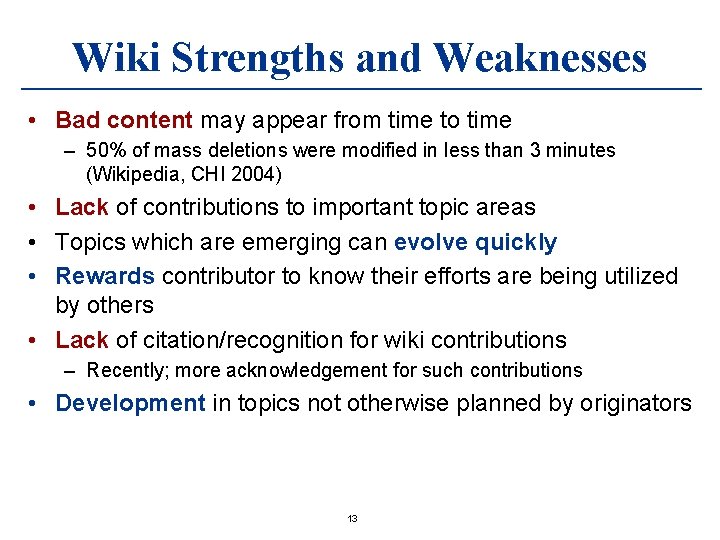
Wiki Strengths and Weaknesses • Bad content may appear from time to time – 50% of mass deletions were modified in less than 3 minutes (Wikipedia, CHI 2004) • Lack of contributions to important topic areas • Topics which are emerging can evolve quickly • Rewards contributor to know their efforts are being utilized by others • Lack of citation/recognition for wiki contributions – Recently; more acknowledgement for such contributions • Development in topics not otherwise planned by originators 46 th Annual Meeting Washington, DC - 2010 13

What We Learned 1. 2. 3. 4. Wikis provide open access to information which is provided by a community of users The technology is straight-forward and can be easy to use The technology is dynamic and offers advantages to static websites A wiki can be highly successful as a medium for others to collaborate But HOW do we apply it to our problem? 46 th Annual Meeting Washington, DC - 2010 14

Outline I. Defining Today’s Environment II. Capitalizing on The Wiki Way III. Working Towards a Solution 46 th Annual Meeting Washington, DC - 2010
Collaborative Schematic 46 th Annual Meeting Washington, DC - 2010

Relying on a Community • Advantages – – – • Transparency Increase in the talent pool Current; documents/materials/code can evolve Efficient; evolution towards improvement (not reproduction) Addresses needs of participants; tailored towards them Disadvantages – – Trustworthiness? Lack of authority? Content is driven by willingness of the community to share Too much information? 46 th Annual Meeting Washington, DC - 2010 17
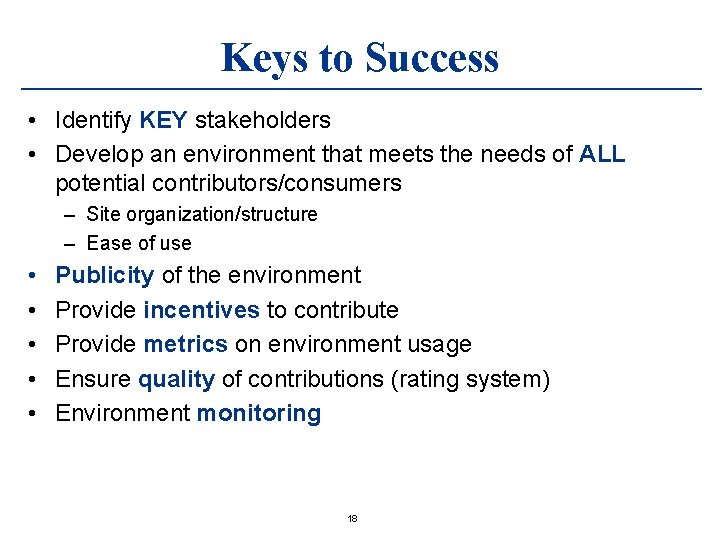
Keys to Success • Identify KEY stakeholders • Develop an environment that meets the needs of ALL potential contributors/consumers – Site organization/structure – Ease of use • • • Publicity of the environment Provide incentives to contribute Provide metrics on environment usage Ensure quality of contributions (rating system) Environment monitoring 46 th Annual Meeting Washington, DC - 2010 18
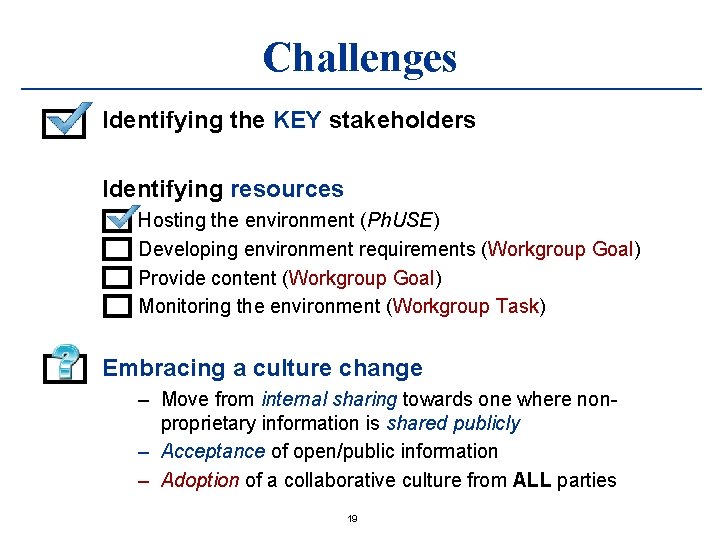
Challenges Identifying the KEY stakeholders Identifying resources Hosting the environment (Ph. USE) Developing environment requirements (Workgroup Goal) Provide content (Workgroup Goal) Monitoring the environment (Workgroup Task) Embracing a culture change – Move from internal sharing towards one where nonproprietary information is shared publicly – Acceptance of open/public information – Adoption of a collaborative culture from ALL parties 46 th Annual Meeting Washington, DC - 2010 19
- Slides: 19