
COLLABORATING WITH STUDENT SERVICES TO IMPROVE RETENTION NSCCS
COLLABORATING WITH STUDENT SERVICES TO IMPROVE RETENTION: NSCC’S STUDENT SUCCESS SURVEYS
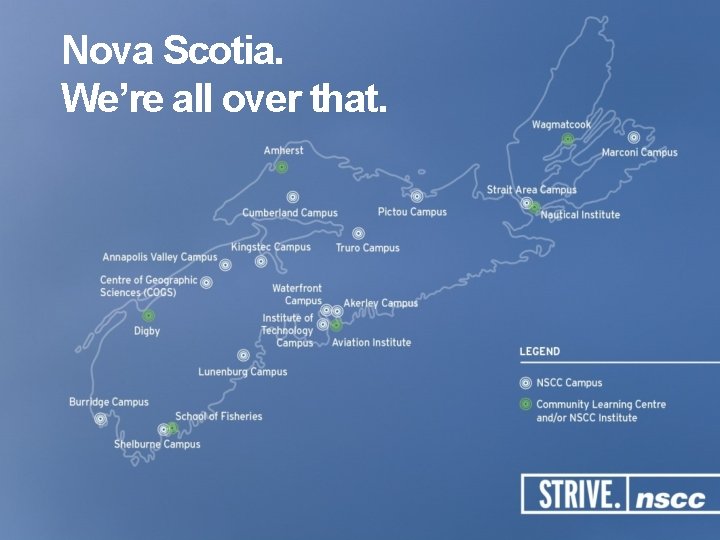
Nova Scotia. We’re all over that.
Nova Scotia. We’re all over that.
COLLABORATING WITH STUDENT SERVICES TO IMPROVE RETENTION AGENDA: § § § History Purpose Methodology Plan of action Results
COLLABORATING WITH STUDENT SERVICES TO IMPROVE RETENTION History: § Previous surveys: - NSCC’s N. E. W. (2004, 2006, 2008, 2010, 2012) - CCSSE (2008, 2010, 2012) - SENSE (2011, 2012) § Created our own incoming survey in 2013
COLLABORATING WITH STUDENT SERVICES TO IMPROVE RETENTION Purpose: § To use survey responses to drive retention efforts - Early identification of “at-risk” students so supports can be offered
COLLABORATING WITH STUDENT SERVICES TO IMPROVE RETENTION Methodology: § Questions - Topics that help predict attrition: • First generation • Employment • Commute time • Dependent children • Connection to the institution • Confidence in academic abilities
COLLABORATING WITH STUDENT SERVICES TO IMPROVE RETENTION Methodology: § The 2016 surveys - Incoming Student Success: (May 26 -Sep 5) - Fall Student Success: (Sep 26 -Oct 10) § Survey method - Online vs paper § Email message - Recognizable sender
COLLABORATING WITH STUDENT SERVICES TO IMPROVE RETENTION Methodology: § Incentives - Cost effectiveness § The data
COLLABORATING WITH STUDENT SERVICES TO IMPROVE RETENTION Plan of Action: § Student Services Advisors’ caseloads § Phone calls, emails, workshops § Student profiles
COLLABORATING WITH STUDENT SERVICES TO IMPROVE RETENTION Results: Incoming Student Success Survey: § 46% response rate § 21 reports § Highlights
COLLABORATING WITH STUDENT SERVICES TO IMPROVE RETENTION Highlights: Background: • 44% came to NSCC with some postsecondary experience • 34% are first generation college students • 36% planned to move in order to attend • 19% have dependent children
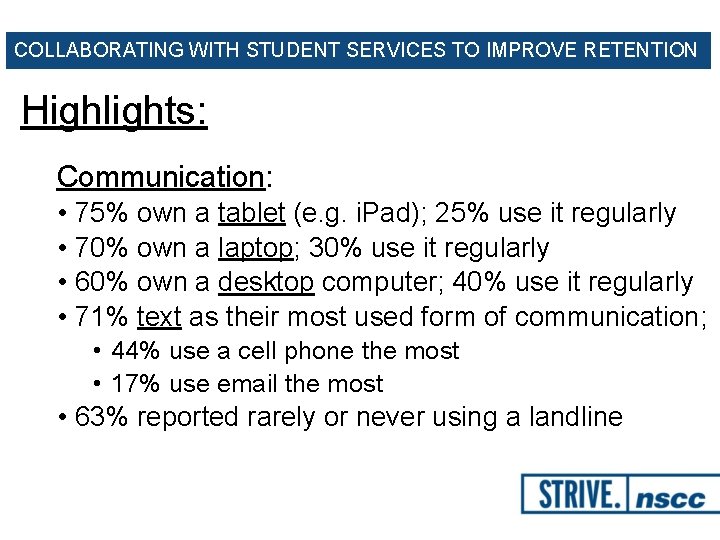
COLLABORATING WITH STUDENT SERVICES TO IMPROVE RETENTION Highlights: Communication: • 75% own a tablet (e. g. i. Pad); 25% use it regularly • 70% own a laptop; 30% use it regularly • 60% own a desktop computer; 40% use it regularly • 71% text as their most used form of communication; • 44% use a cell phone the most • 17% use email the most • 63% reported rarely or never using a landline
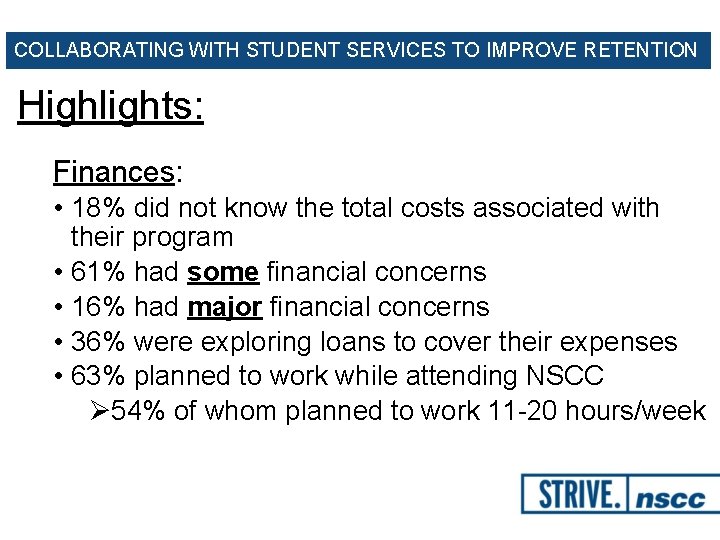
COLLABORATING WITH STUDENT SERVICES TO IMPROVE RETENTION Highlights: Finances: • 18% did not know the total costs associated with their program • 61% had some financial concerns • 16% had major financial concerns • 36% were exploring loans to cover their expenses • 63% planned to work while attending NSCC Ø 54% of whom planned to work 11 -20 hours/week
COLLABORATING WITH STUDENT SERVICES TO IMPROVE RETENTION What worked: § § Weekly uploads and exports of data Higher response rate Demographic info being pre-loaded Levels of reports
COLLABORATING WITH STUDENT SERVICES TO IMPROVE RETENTION What needs improvement: § Buy-in from Student Services § Modify questions for online students § Reports were late due to formatting issues with Blue
COLLABORATING WITH STUDENT SERVICES TO IMPROVE RETENTION Results: Fall Student Success Survey: § 21% response rate § Reports § Rich data collected - “Grit” questions - Individual targeted action with students
COLLABORATING WITH STUDENT SERVICES TO IMPROVE RETENTION Fall Student Success Survey: Highlights: § Of those who did both surveys, 59% thought they would work during school year while 41% are actually employed § Two themes from comments section: - Parking availability - Cafeteria prices
COLLABORATING WITH STUDENT SERVICES TO IMPROVE RETENTION What worked: § “Grit” data § Open-ended comments
COLLABORATING WITH STUDENT SERVICES TO IMPROVE RETENTION What needs improvement: § Buy-in from Academic Chairs and faculty to provide class time for survey § Modify questions for online students § Clarifying to students that this is a follow-up survey
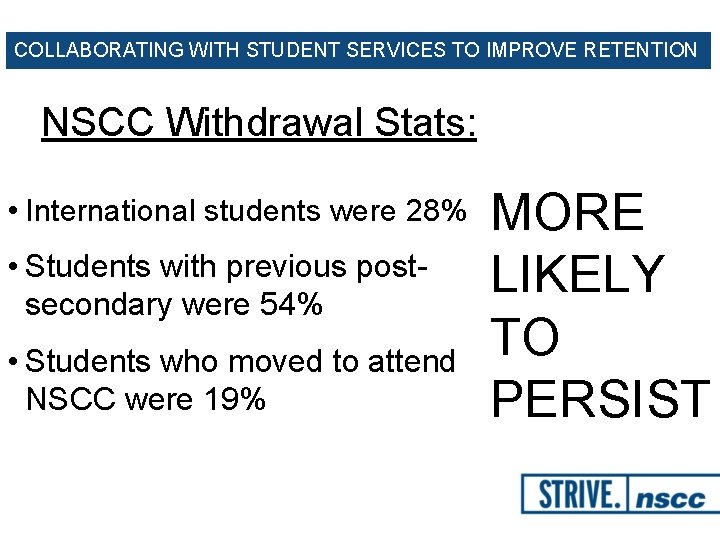
COLLABORATING WITH STUDENT SERVICES TO IMPROVE RETENTION NSCC Withdrawal Stats: • International students were 28% • Students with previous postsecondary were 54% • Students who moved to attend NSCC were 19% MORE LIKELY TO PERSIST
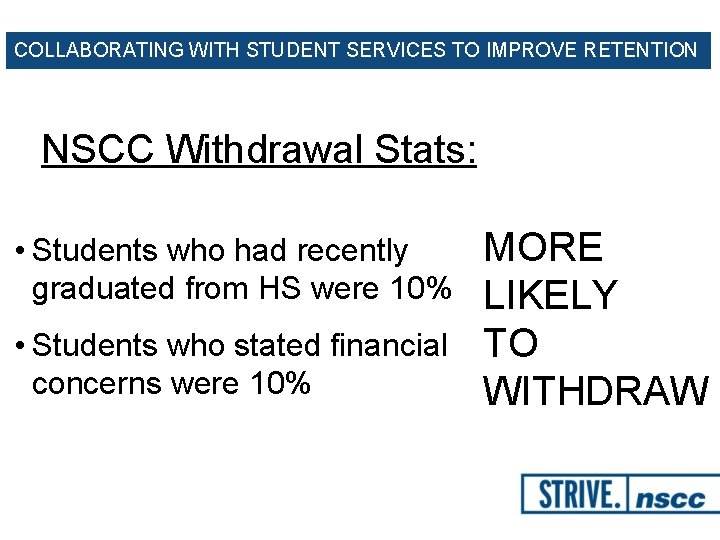
COLLABORATING WITH STUDENT SERVICES TO IMPROVE RETENTION NSCC Withdrawal Stats: • Students who had recently graduated from HS were 10% • Students who stated financial concerns were 10% MORE LIKELY TO WITHDRAW
QUESTIONS? Contact info: Antonia (Nonie) Sly Nichols Institutional Research Analyst Nova Scotia Community College Antonia. Sly. Nichols@nscc. ca
COLLABORATING WITH STUDENT SERVICES TO IMPROVE RETENTION Resources: Augustana College (n. d. ). Student Readiness Survey. In: Developing a Comprehension Retention Plan: Academic Impressions conference binder. Clarkberg, M. & Einarson, M. (n. d. ). Improving response rates through better design: rethinking a web-based survey instrument. Retrieved from http: //www. dpb. cornell. edu/documents/1000421. pdf Ciotti, G. (2013). 10 essential tactics for creating valuable customer surveys. Retrieved from http: //www. helpscout. net/blog/customer-survey/
COLLABORATING WITH STUDENT SERVICES TO IMPROVE RETENTION Resources: Hansen, M. J. & Graunke, S. S. (2014). Creating and validating an entering student survey. Association for Institutional Research. Retrieved from http: //irds. iupui. edu/Portals/SDAE/Files/Documents/AIR %202014%20 ESS%20 Final. pdf Molasso, W. R. (2005). Ten tangible and practical tips to improve student participation in web surveys. Retrieved from Student Affairs Online, 6(4): http: //studentaffairs. com/ejournal/Fall_2005/Student Participationin. Web. Surveys. htm Perkins, R. A. (2011). Using research-based practices to increase response rates of web-based surveys. Retrieved from EDUCAUSE Review: http: //er. educause. edu/articles/2011/6/usingresearchbased-practices-to-increase-response-rates-ofwebbased-surveys
COLLABORATING WITH STUDENT SERVICES TO IMPROVE RETENTION Resources: Noel-Levitz (2012). 2012 National freshman attitudes report. Retrieved from http: //www. noellevitz. com/freshmanreport Sharkness, J. A. (2012). Why don’t they respond? An investigation of longitudinal survey nonresponse among college students attending four-year institutions. Retrieved from: http: //gradworks. umi. com/35/18/3518318. html
- Slides: 26