
Coll Spotting Big Beautiful Data Andrew Grant STFC
Coll. Spotting: Big, Beautiful Data Andrew Grant STFC Jean-Marie le Goff CERN
Intro to Coll. Spotting How does it work? What problem does it solve? Model What’s next?
Developed at CERN by Physicists An FP 7 project that addresses infrastructures required for detector development for future particle physics experiments • We developed the program to help us figure out who the key players at the cutting edge of the 100 s of research fields CERN is active in are. • Realised this could be much more widely applicable – which is where you can help!

What is Coll. Spotting? • Software developed at CERN • Identifies relationships between institutions and visualises them • Visualise clusters, who works with whom and who is active in your field of interest • Find closely related topics and hidden connections • Powerful data-mining and visualisation algorithms can be expanded to new areas
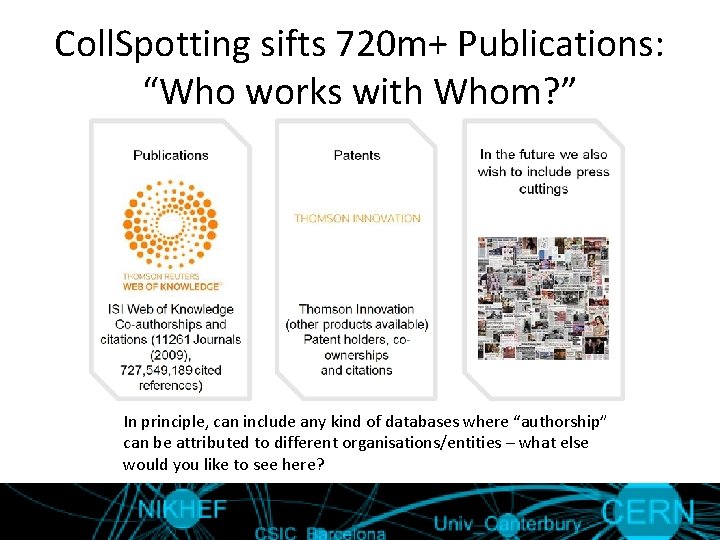
Coll. Spotting sifts 720 m+ Publications: “Who works with Whom? ” In principle, can include any kind of databases where “authorship” can be attributed to different organisations/entities – what else would you like to see here?
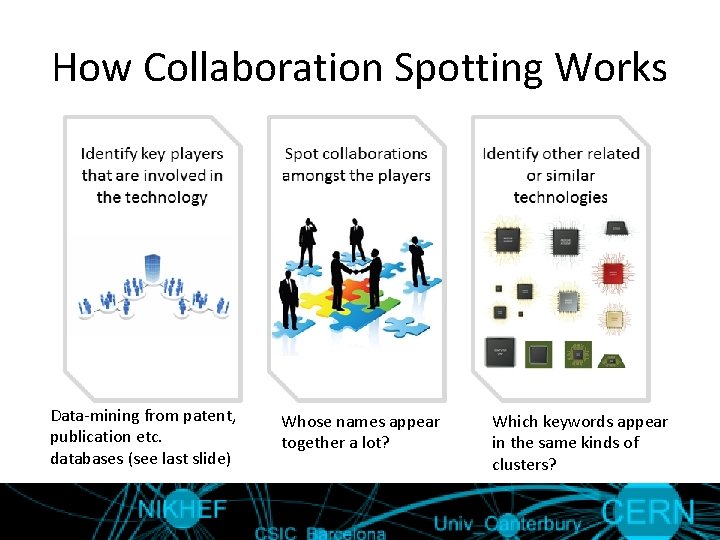
How Collaboration Spotting Works Data-mining from patent, publication etc. databases (see last slide) Whose names appear together a lot? Which keywords appear in the same kinds of clusters?
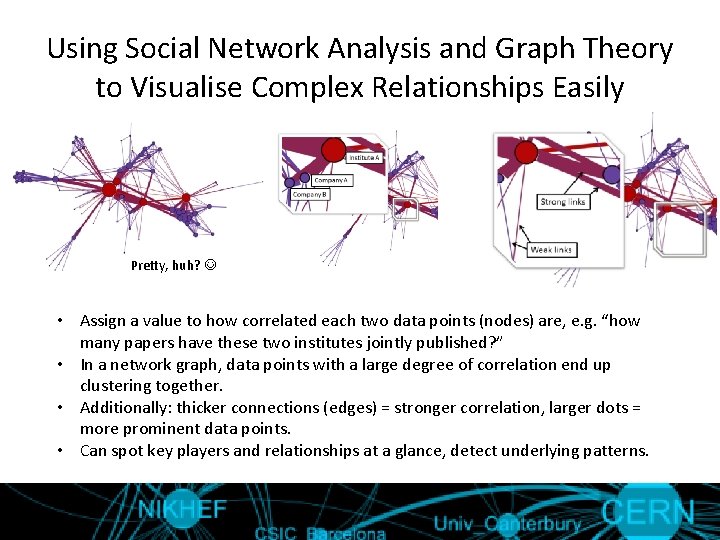
Using Social Network Analysis and Graph Theory to Visualise Complex Relationships Easily Pretty, huh? • Assign a value to how correlated each two data points (nodes) are, e. g. “how many papers have these two institutes jointly published? ” • In a network graph, data points with a large degree of correlation end up clustering together. • Additionally: thicker connections (edges) = stronger correlation, larger dots = more prominent data points. • Can spot key players and relationships at a glance, detect underlying patterns.
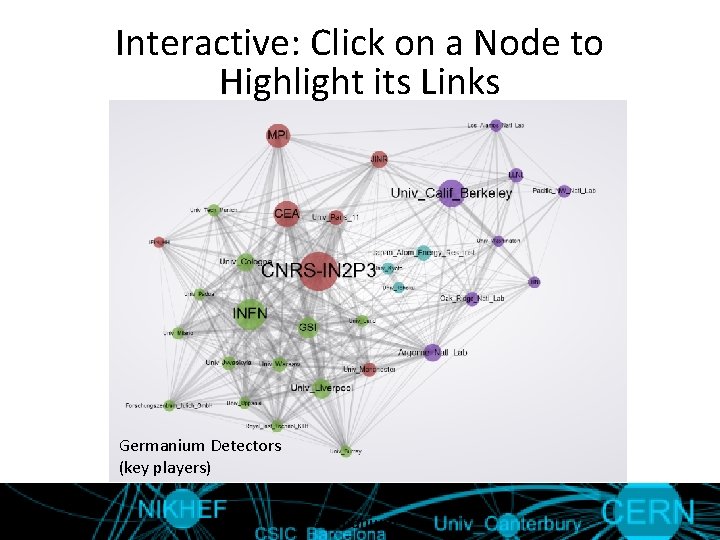
Interactive: Click on a Node to Highlight its Links Germanium Detectors (key players) Germanium
What problems can you solve with it? • Identify potential collaborators and competitors. • Identify important economic and research clusters • Who’s patenting in this space? Where is there still room for me to operate? • Assess the strength of your technologies • Look for me-too technologies • Spot technology trends using timeline • What else?
How do people currently spot these connections and trends? • Specialist search engines for patents (Thomson Reuters), publications (ISI Wo. K), unstructured data (Autonomy) • Attend conferences and workshops • Consultancies to do the leg-work for you There’s currently no easy way to do this!
Some examples • • Researchers: find relevant collaborators Industry: target less-contested areas for R&D Lawyers: Patent landscapes Investors: Spot opportunities and buyers Basically anyone who wants a rapid, easily digestible summary of who is who in an area of interest and all the hidden links between them.
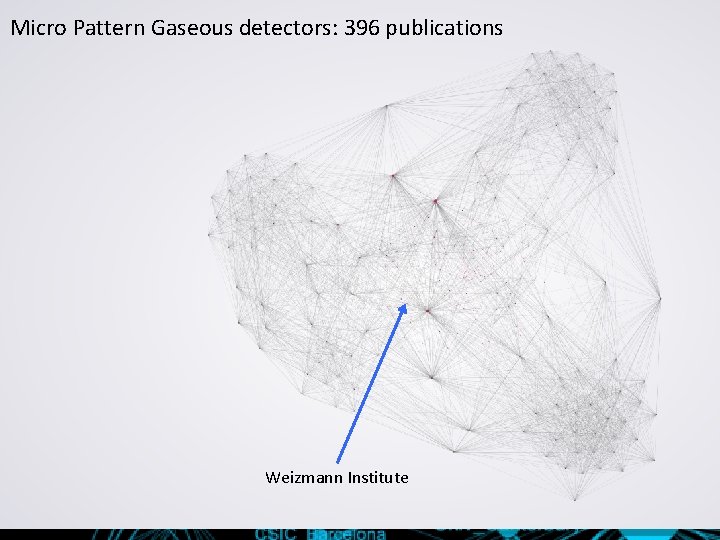
Micro Pattern Gaseous detectors: 396 publications Weizmann Institute
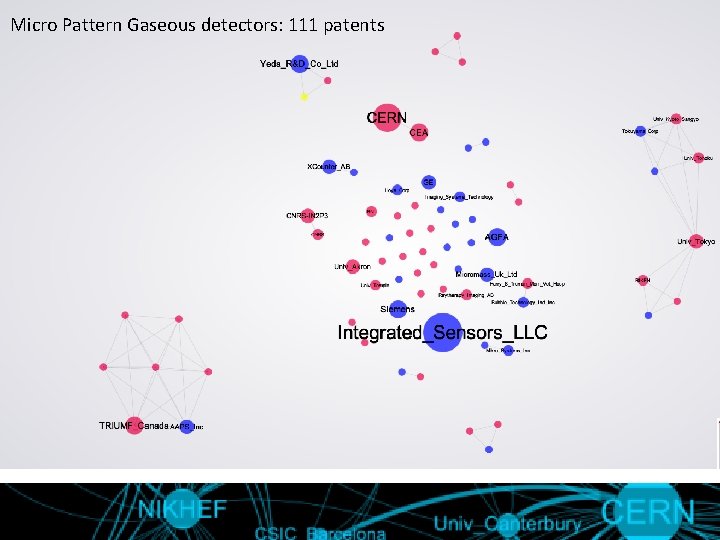
Micro Pattern Gaseous detectors: 111 patents
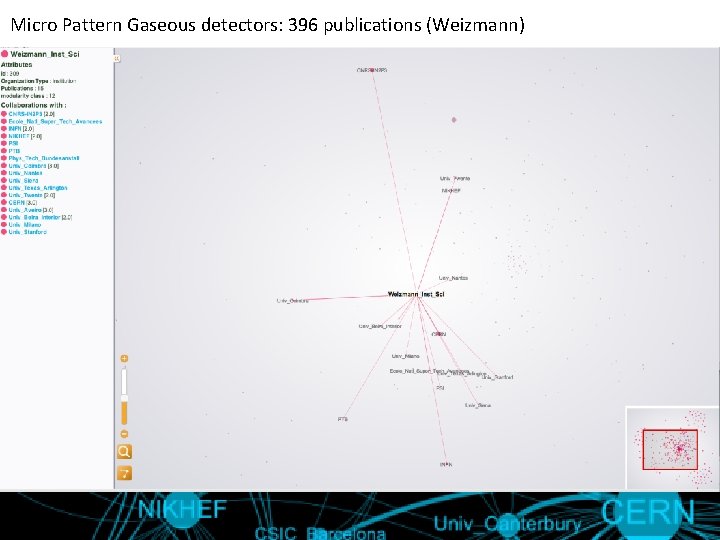
Micro Pattern Gaseous detectors: 396 publications (Weizmann)
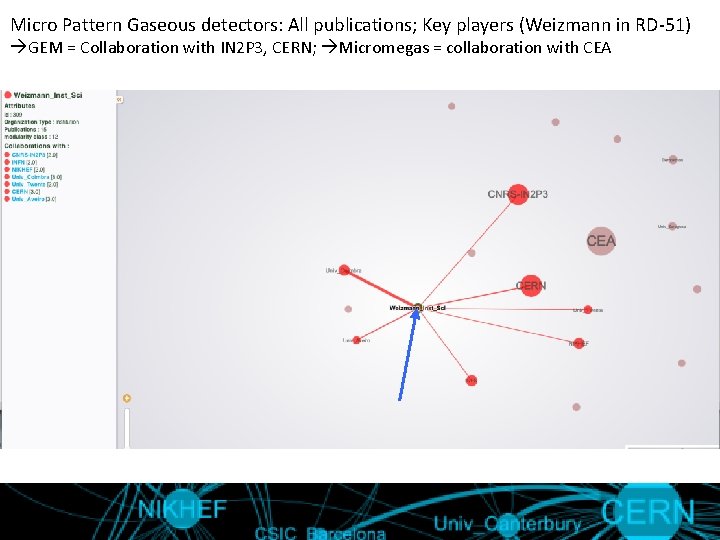
Micro Pattern Gaseous detectors: All publications; Key players (Weizmann in RD-51) GEM = Collaboration with IN 2 P 3, CERN; Micromegas = collaboration with CEA
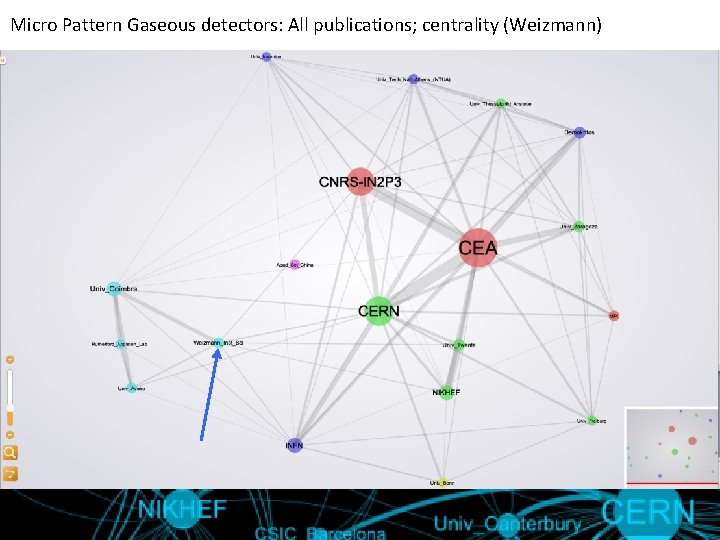
Micro Pattern Gaseous detectors: All publications; centrality (Weizmann)
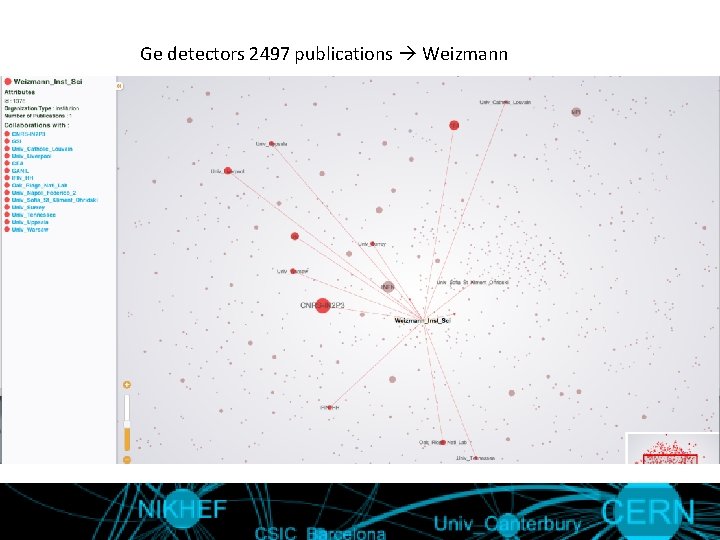
Ge detectors 2497 publications Weizmann
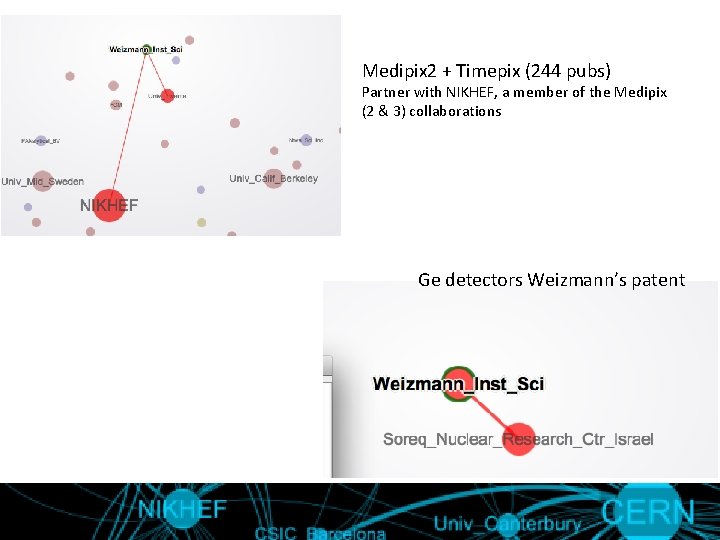
Medipix 2 + Timepix (244 pubs) Partner with NIKHEF, a member of the Medipix (2 & 3) collaborations Ge detectors Weizmann’s patent
Conclusion • The current incarnation of the software could be used to solve some big problems related to the big data challenge • Possibility to extend the software’s scope to be useful in new settings And remember, just use it and give feedback in our blog! http: //collspotting. web. cern. ch
- Slides: 19