
COLEGIO AGUSTINIANO EL BOSQUE Un Proyecto Educativo nico
COLEGIO AGUSTINIANO – EL BOSQUE Un Proyecto Educativo Único y Propio Inglés, 2° Año Medio PAST OF THE PAST Two types of past
OBJECTIVE S Contents • To narrate events from the past of the past • Narrations • Reading comprehension • Sequencing
GENERAL INDICATIONS • Use your copybook Remember that your copybook is essential, the digital material is the representation of the teacher. ALWAYS work in your copybook and take notes • Concentrate Work in a quiet and comfortable place if possible. This will help you concentrate more and the results are better, and faster too. • Get your materials now You need your copybook, school book, this material with the exercises, pens and others. I also recommend a flask with water or any beverage.
TELLING PAST EVENTS • We know that when we are telling a story we usually use the past. For example: �� � Once upon a time, a boy named Cecilio lived in a small house next to a big garden. There was a beautiful tree which had wonderful fruit and was located in the center of the garden, usually illuminated in the mornings when the sun appeared from the east. � � �� � • Look at this example: � • The problem with English (not only English) is that there are infinite moments in the past, and it may be difficult to indicate the correct order of events. I turned off the TV; Pasapalabra ended
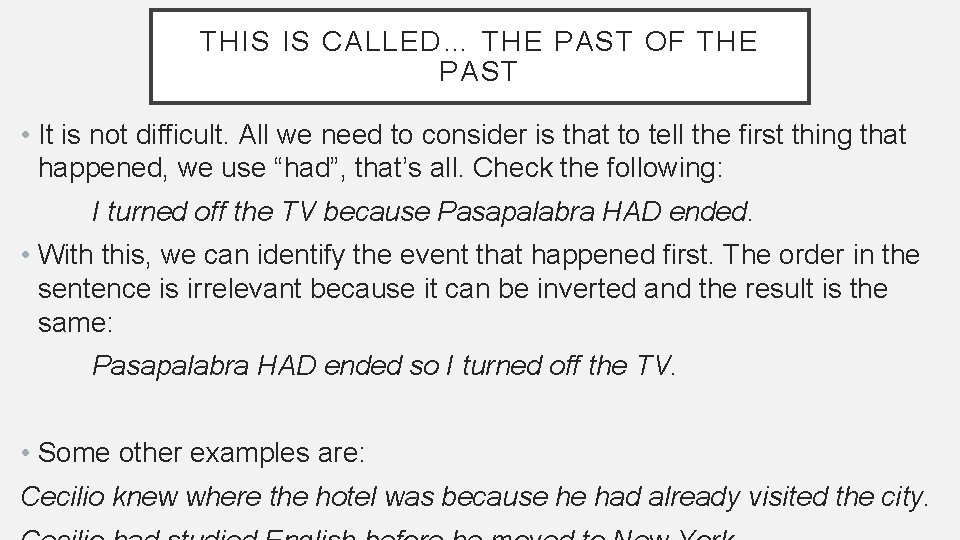
THIS IS CALLED… THE PAST OF THE PAST • It is not difficult. All we need to consider is that to tell the first thing that happened, we use “had”, that’s all. Check the following: I turned off the TV because Pasapalabra HAD ended. • With this, we can identify the event that happened first. The order in the sentence is irrelevant because it can be inverted and the result is the same: Pasapalabra HAD ended so I turned off the TV. • Some other examples are: Cecilio knew where the hotel was because he had already visited the city.
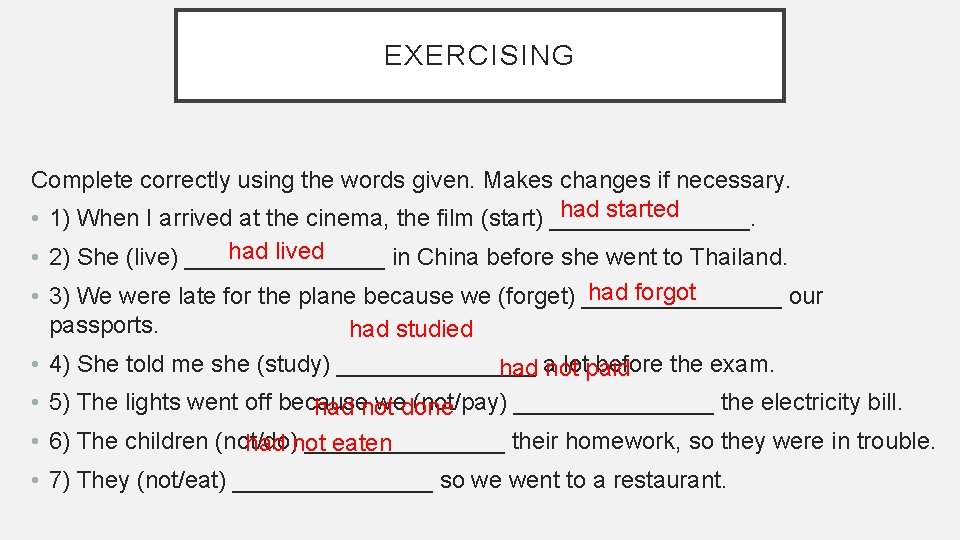
EXERCISING Complete correctly using the words given. Makes changes if necessary. had started • 1) When I arrived at the cinema, the film (start) ________. had lived • 2) She (live) ________ in China before she went to Thailand. had forgot • 3) We were late for the plane because we (forget) ________ our passports. had studied • 4) She told me she (study) ________ lotpaid before the exam. had anot • 5) The lights went off because wedone (not/pay) ________ the electricity bill. had not • 6) The children (not/do) ________ their homework, so they were in trouble. had not eaten • 7) They (not/eat) ________ so we went to a restaurant.
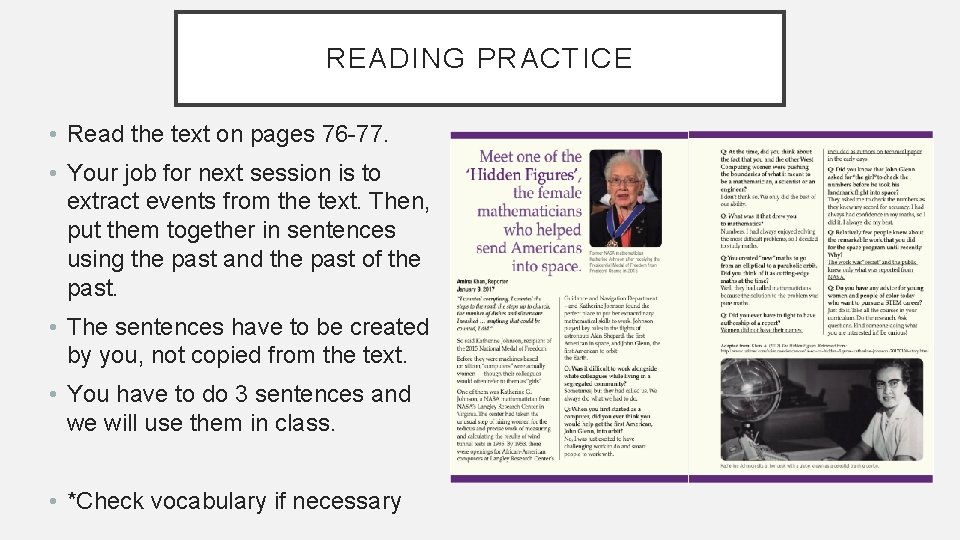
READING PRACTICE • Read the text on pages 76 -77. • Your job for next session is to extract events from the text. Then, put them together in sentences using the past and the past of the past. • The sentences have to be created by you, not copied from the text. • You have to do 3 sentences and we will use them in class. • *Check vocabulary if necessary
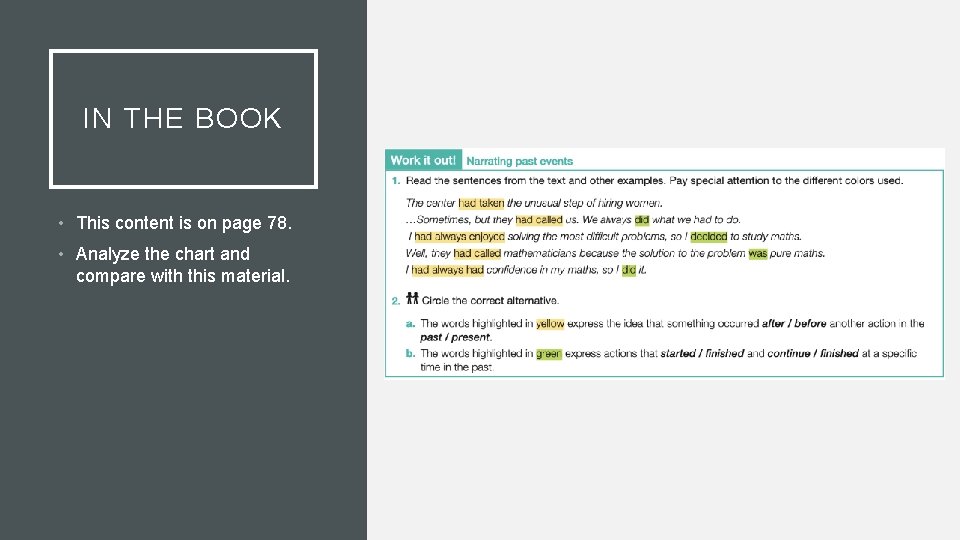
IN THE BOOK • This content is on page 78. • Analyze the chart and compare with this material.
PERFECT, YOU’RE GOOD TO GO • Go to the material in order to work. Remember that is it important to take notes in your copybook. • In MEET, you have to bring your homework about the past of the past from the text ready and written because we are going to use it. • You can find more information about the Past Perfect (past of the past) here. • Until next time, Mr. G is out. Bye-bye, see you in Meet.
- Slides: 9