
Cold War Thinking the Unthinking Lesson Objectives Build
Cold War: Thinking the Unthinking
Lesson Objectives • Build a foundation for understanding the genesis, issues, and strategies of the Cold War. • Understand the strategy of containment and become familiar with the conflicts and confrontations that resulted. • Be able to describe and discuss the concepts of countervalue and counterforce targeting. • Begin to understand the concept of deterrence in the Cold War. • Understand the impact of the Cold War nuclear standoff on US society.
Nuclear Forces & Strategies

NSC-68 April 14, 1950 Classified National Security Council document Full analysis of US-USSR relationship Defined initial US Cold War strategy: Containment Implemented the Truman Doctrine Note: Korean War began June 25, 1950

Impact of NSC-68 Immediate increase in defense spending FY 1950: Defense budget $14. 1 billion 33% of national budget, 5% 0 f GNP FY 1951: Defense budget $33. 6 billion 73% of national budget, 10% 0 f GNP Demonstrated American commitment to win the Cold War Source

Impact of NSC-68 Source
US Cold War Policy Stem the tide of worldwide Soviet expansionism Insure security of Europe through a strong NATO Prevent global nuclear war through deterrence • Emphasis on defense Colonel John Osgood, USA, Retired United States Nuclear Strategy 1945 -1995
US Cold War Policy Stem the tide of worldwide Soviet expansionism Insure security of Europe through a strong NATO Prevent global nuclear war through deterrence • Emphasis on defense Colonel John Osgood, USA, Retired United States Nuclear Strategy 1945 -1995
Nuclear Targeting Theories Counterforce : target warfighting capability Countervalue : target cities and industry
Nuclear Targeting Strategies Truman: Countervalue • US had nuclear monopoly, then preeminence • Believed nuclear weapons most valuable against cities Eisenhower: Counterforce • Soviet nuclear weapons became a concern • Massive retaliation was public doctrine Kennedy/Johnson: Flexible Response • Public face: assured destruction (countervalue) • Counterforce (war fighting) retained as an option Colonel John Osgood, USA, Retired United States Nuclear Strategy 1945 -1995
Nuclear Targeting Strategies Nixon: Counterforce • Publicly promoted position • Developed warfighting weapons (MIRV, ABM) Carter: Counterforce • Pursued decapitation strategy (targeted C 3, leadership) Regan/Bush: Counterforce • Combined counterforce and strategic defense • Blended arms negotiations (SALT) with SDI Colonel John Osgood, USA, Retired United States Nuclear Strategy 1945 -1995
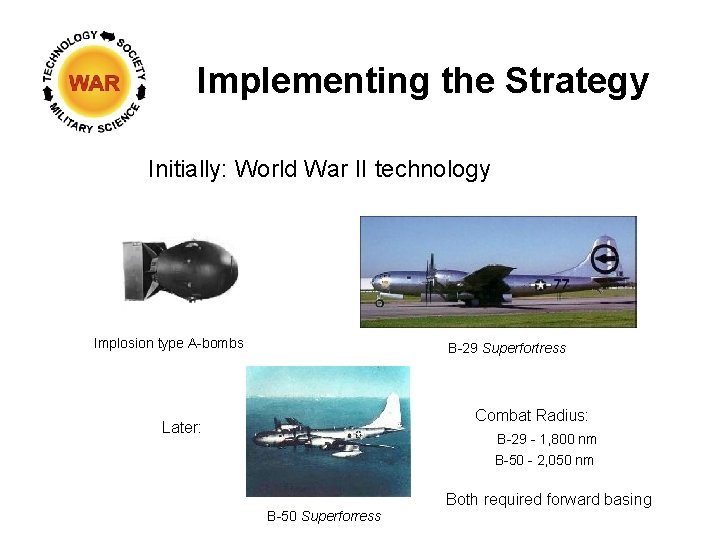
Implementing the Strategy Initially: World War II technology Implosion type A-bombs B-29 Superfortress Combat Radius: Later: B-29 - 1, 800 nm B-50 - 2, 050 nm Both required forward basing B-50 Superforress
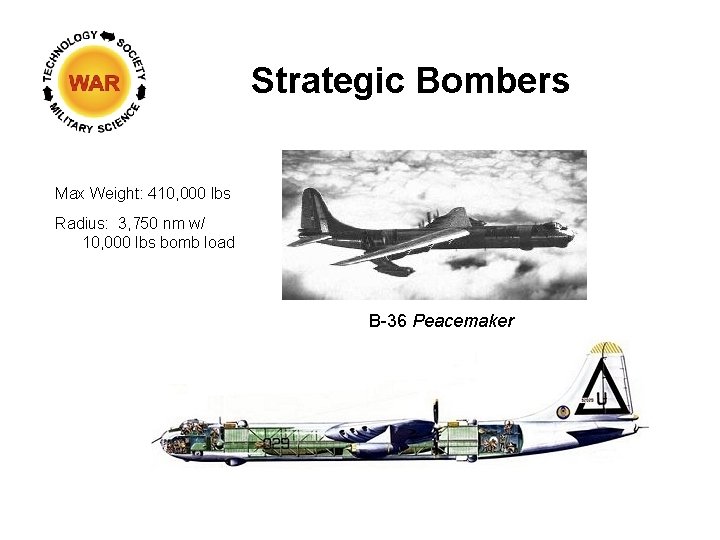
Strategic Bombers Max Weight: 410, 000 lbs Radius: 3, 750 nm w/ 10, 000 lbs bomb load B-36 Peacemaker
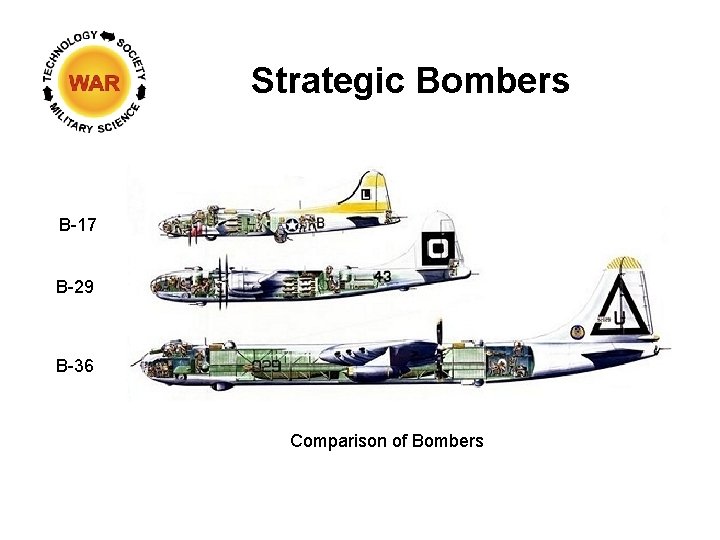
Strategic Bombers B-17 B-29 B-36 Comparison of Bombers
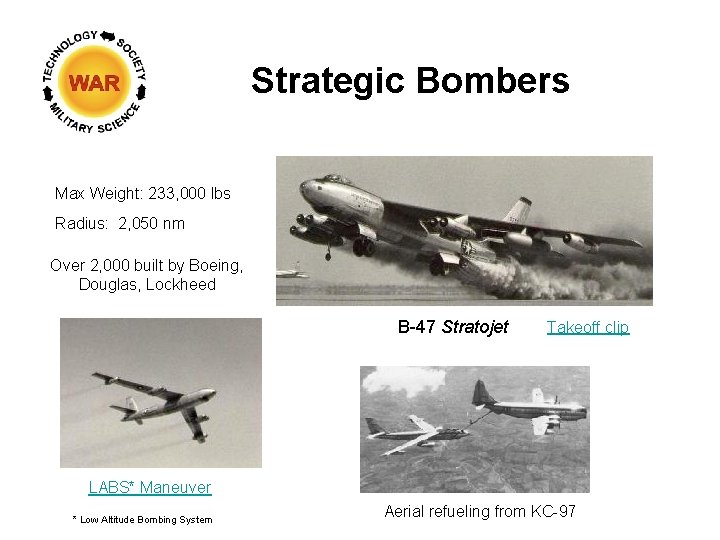
Strategic Bombers Max Weight: 233, 000 lbs Radius: 2, 050 nm Over 2, 000 built by Boeing, Douglas, Lockheed B-47 Stratojet Takeoff clip LABS* Maneuver * Low Altitude Bombing System Aerial refueling from KC-97
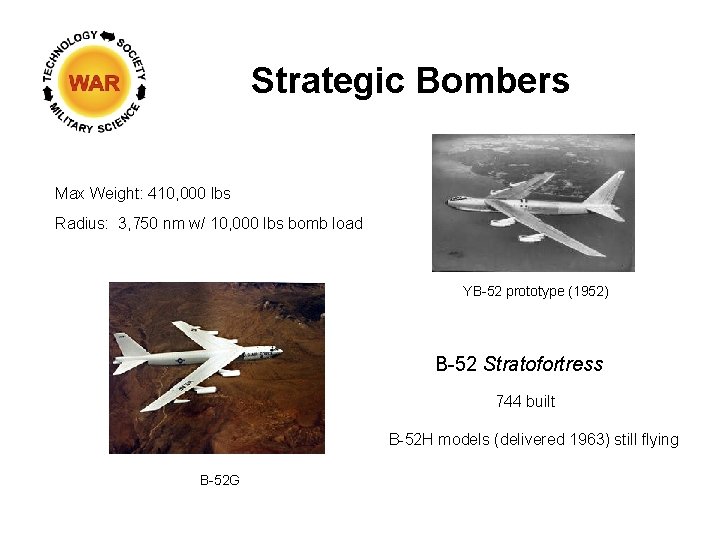
Strategic Bombers Max Weight: 410, 000 lbs Radius: 3, 750 nm w/ 10, 000 lbs bomb load YB-52 prototype (1952) B-52 Stratofortress 744 built B-52 H models (delivered 1963) still flying B-52 G
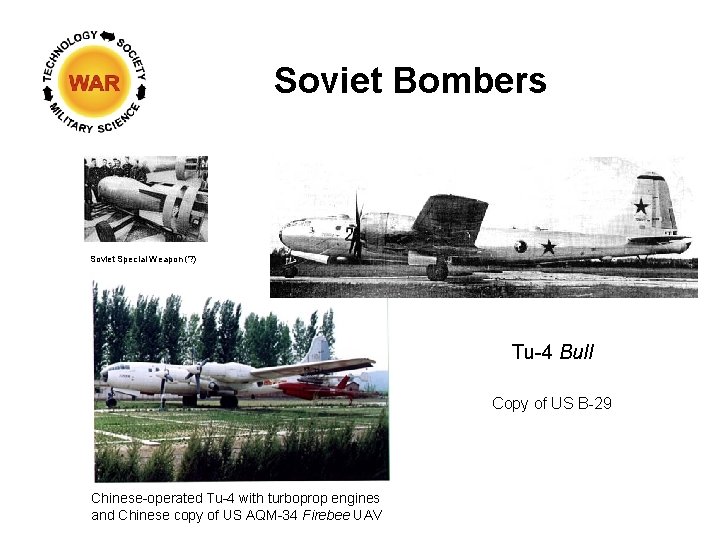
Soviet Bombers Soviet Special Weapon (? ) Tu-4 Bull Copy of US B-29 Chinese-operated Tu-4 with turboprop engines and Chinese copy of US AQM-34 Firebee UAV
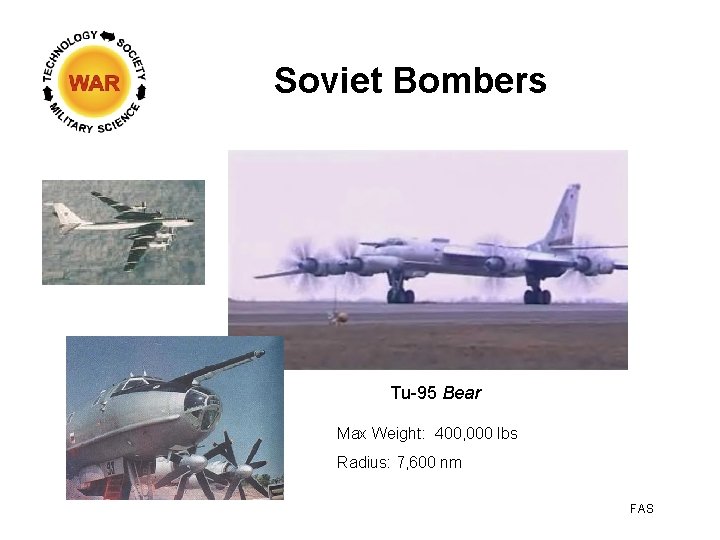
Soviet Bombers Tu-95 Bear Max Weight: 400, 000 lbs Radius: 7, 600 nm FAS
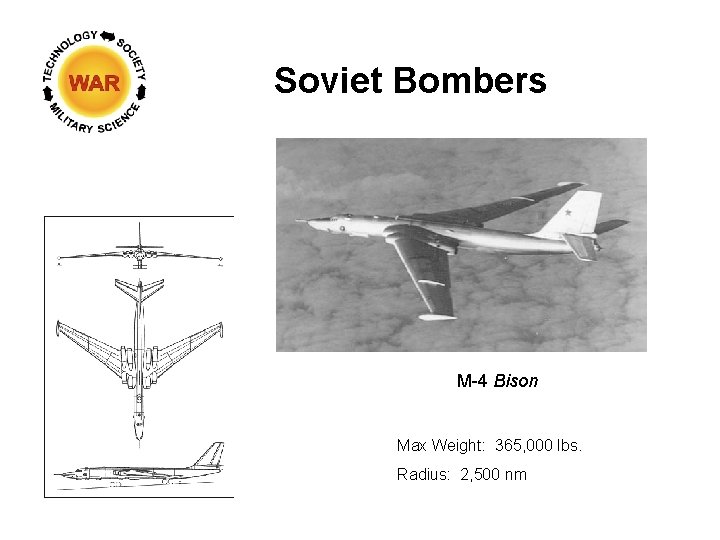
Soviet Bombers M-4 Bison Max Weight: 365, 000 lbs. Radius: 2, 500 nm
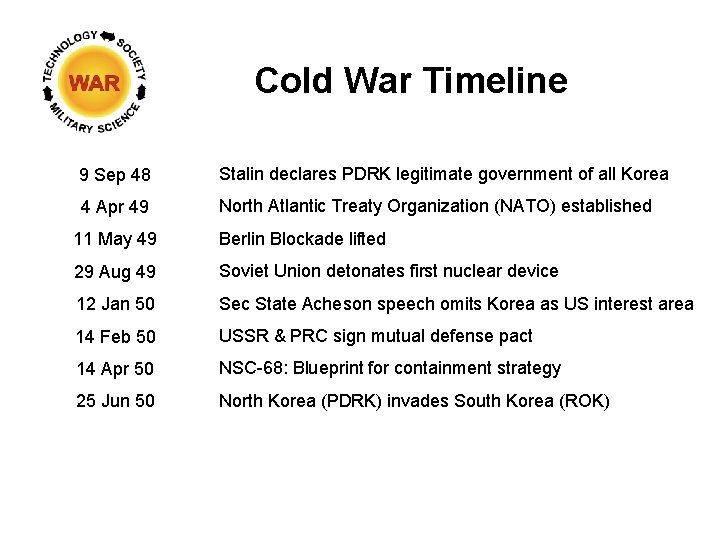
Cold War Timeline 9 Sep 48 Stalin declares PDRK legitimate government of all Korea 4 Apr 49 North Atlantic Treaty Organization (NATO) established 11 May 49 Berlin Blockade lifted 29 Aug 49 Soviet Union detonates first nuclear device 12 Jan 50 Sec State Acheson speech omits Korea as US interest area 14 Feb 50 USSR & PRC sign mutual defense pact 14 Apr 50 NSC-68: Blueprint for containment strategy 25 Jun 50 North Korea (PDRK) invades South Korea (ROK)
Cold War Timeline 9 Sep 48 Stalin declares PDRK legitimate government of all Korea 4 Apr 49 North Atlantic Treaty Organization (NATO) established 11 May 49 Berlin Blockade lifted 29 Aug 49 Soviet Union detonates first nuclear device 12 Jan 50 Sec State Acheson speech omits Korea as US interest area . 50 31 Jan 50 14 Feb . USSR & PRC sign mutual defense pact Truman announces US intent to develop hydrogen bomb 14 Feb Apr 50 USSR & Blueprint PRC signfor mutual defense strategy pact NSC-68: containment 14 Jun Apr 50 NSC-68: Blueprint forinvades containment North Korea (PDRK) Southstrategy Korea (ROK) 25 25 Jun 50 North Korea (PDRK) invades South Korea (ROK)
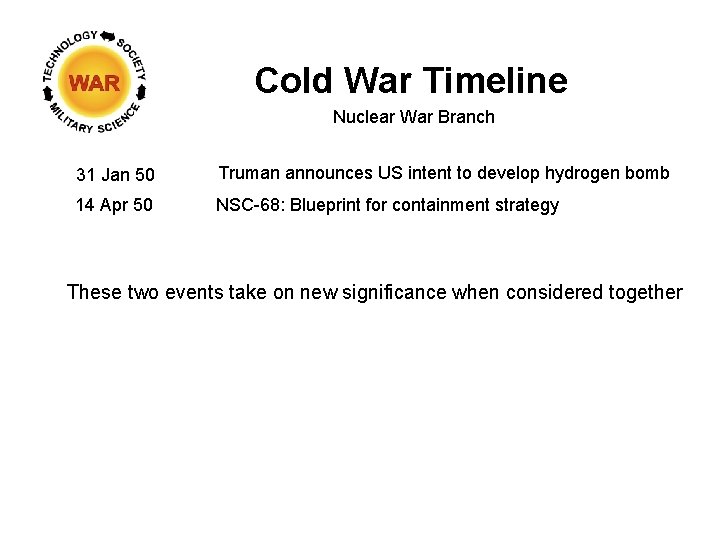
Cold War Timeline Nuclear War Branch 31 Jan 50 Truman announces US intent to develop hydrogen bomb 14 Apr 50 NSC-68: Blueprint for containment strategy These two events take on new significance when considered together
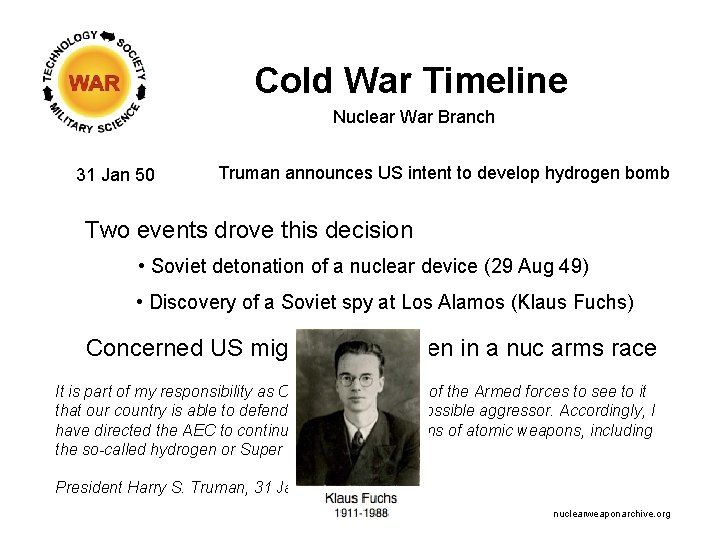
Cold War Timeline Nuclear War Branch 31 Jan 50 Truman announces US intent to develop hydrogen bomb Two events drove this decision • Soviet detonation of a nuclear device (29 Aug 49) • Discovery of a Soviet spy at Los Alamos (Klaus Fuchs) Concerned US might be overtaken in a nuc arms race It is part of my responsibility as Commander in Chief of the Armed forces to see to it that our country is able to defend itself against any possible aggressor. Accordingly, I have directed the AEC to continue its work on all forms of atomic weapons, including the so-called hydrogen or Super bomb. President Harry S. Truman, 31 January 1950 nuclearweaponarchive. org
Cold War Timeline Nuclear War Branch 31 Jan 50 Truman announces US intent to develop hydrogen bomb 14 Apr 50 NSC-68: Blueprint for containment strategy Two events drove this decision • Soviet detonation of a nuclear device (29 Aug 49) • Discovery of a Soviet spy at Los Alamos (Klaus Fuchs) Concerned US might be overtaken in a nuc arms race It is part of my responsibility as Commander in Chief of the Armed forces to see to it that our country is able to defend itself against any possible aggressor. Accordingly, I have directed the AEC to continue its work on all forms of atomic weapons, including the so-called hydrogen or Super bomb. President Harry S. Truman, 31 January 1950 nuclearweaponarchive. org
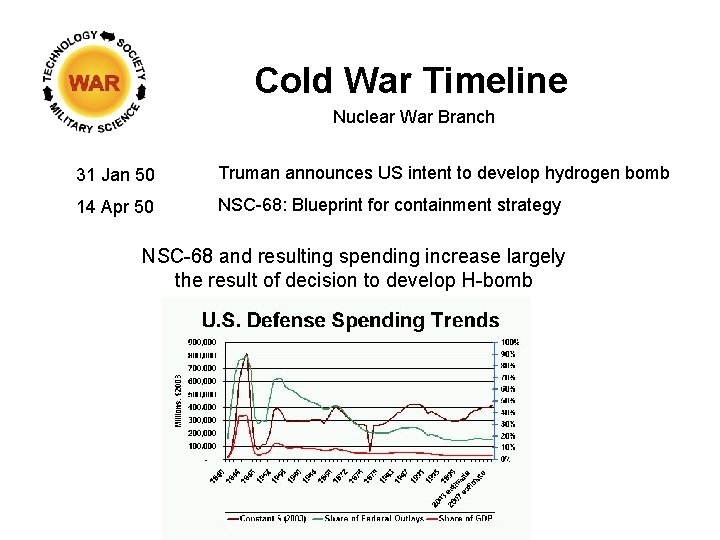
Cold War Timeline Nuclear War Branch 31 Jan 50 Truman announces US intent to develop hydrogen bomb 14 Apr 50 NSC-68: Blueprint for containment strategy NSC-68 and resulting spending increase largely the result of decision to develop H-bomb
Cold War Timeline Nuclear War Branch 31 Jan 50 Truman announces US intent to develop hydrogen bomb 14 Apr 50 NSC-68: Blueprint for containment strategy 1 Nov 52 First thermonuclear device detonated, Enewetak Atoll, Marshall Islands
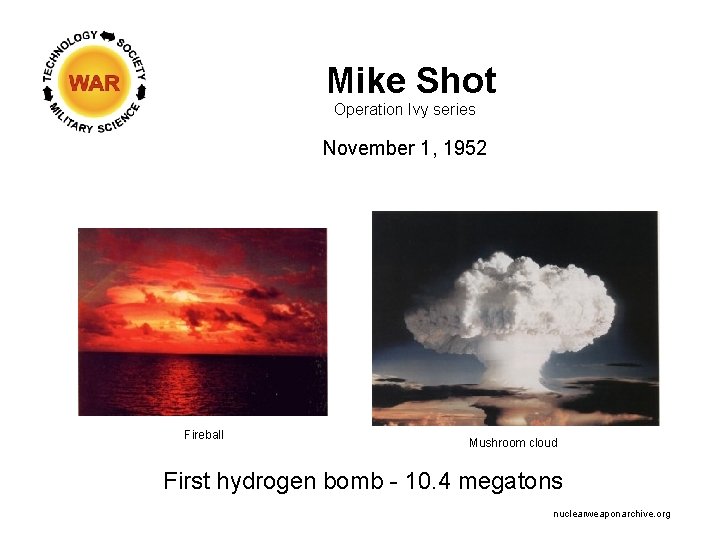
Mike Shot Operation Ivy series November 1, 1952 Fireball Mushroom cloud First hydrogen bomb - 10. 4 megatons nuclearweaponarchive. org
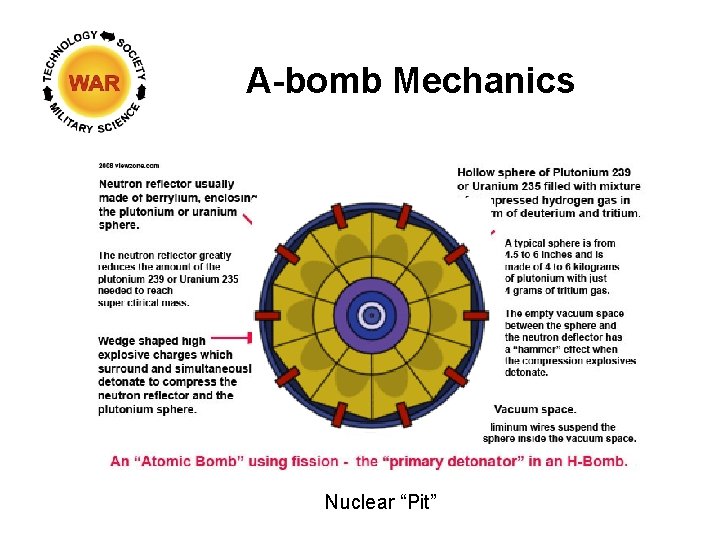
A-bomb Mechanics Nuclear “Pit”
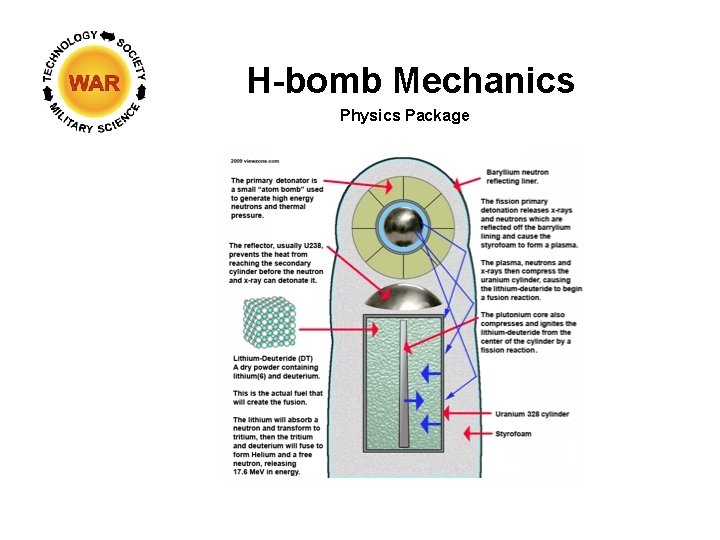
H-bomb Mechanics Physics Package
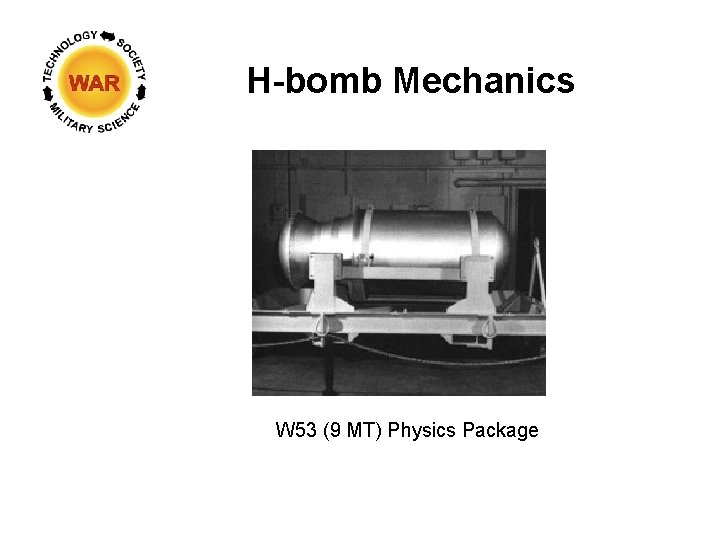
H-bomb Mechanics W 53 (9 MT) Physics Package
Mike Shot Operation Ivy series November 1, 1952 First Thermonuclear (Fusion) Device 10 MT Video
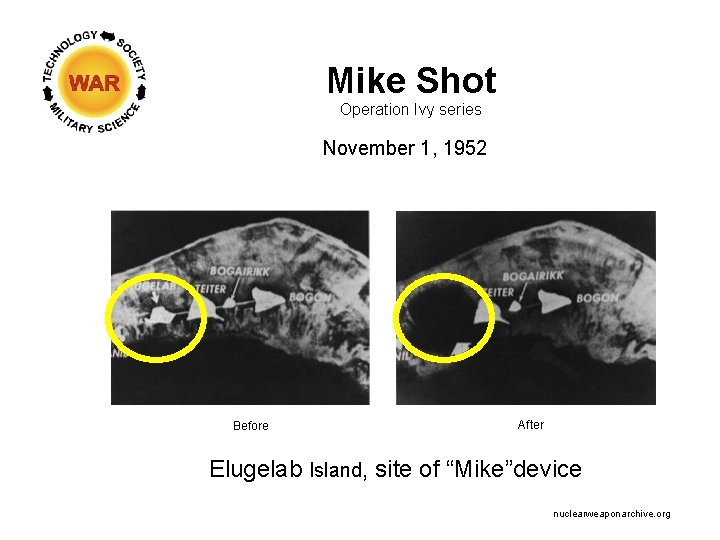
Mike Shot Operation Ivy series November 1, 1952 Before After Elugelab Island, site of “Mike”device nuclearweaponarchive. org
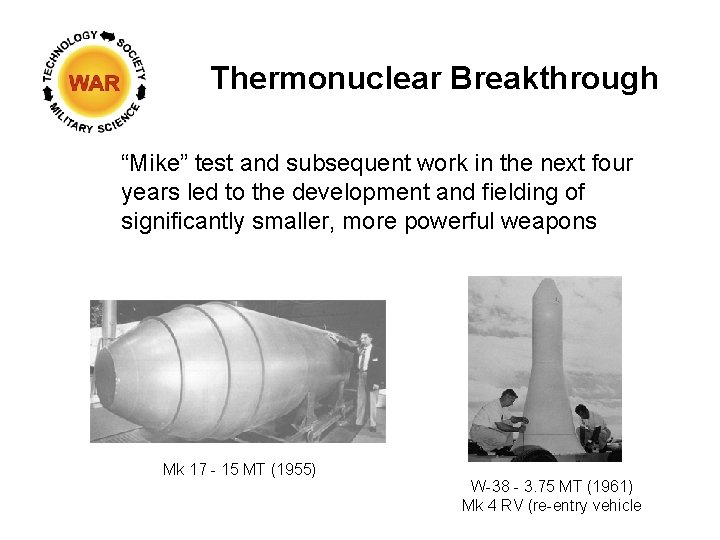
Thermonuclear Breakthrough “Mike” test and subsequent work in the next four years led to the development and fielding of significantly smaller, more powerful weapons Mk 17 - 15 MT (1955) W-38 - 3. 75 MT (1961) Mk 4 RV (re-entry vehicle
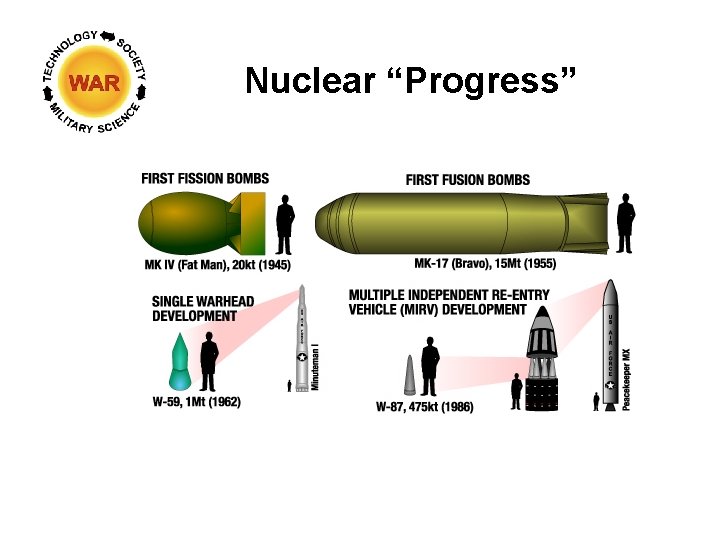
Nuclear “Progress”
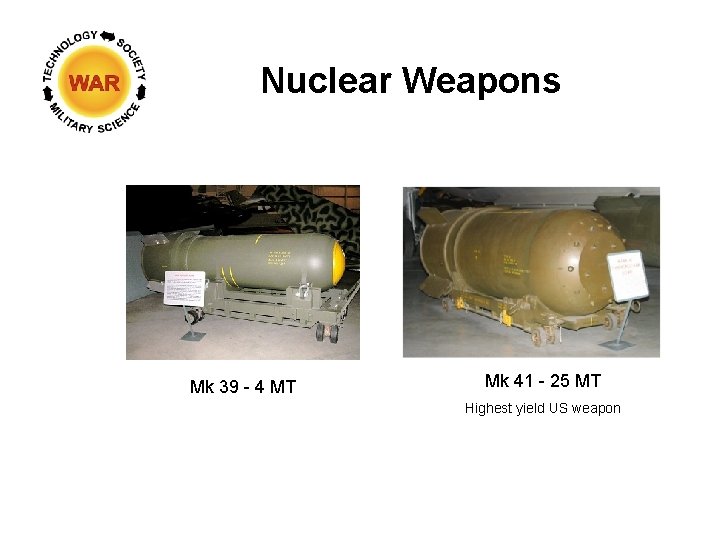
Nuclear Weapons Mk 39 - 4 MT Mk 41 - 25 MT Highest yield US weapon
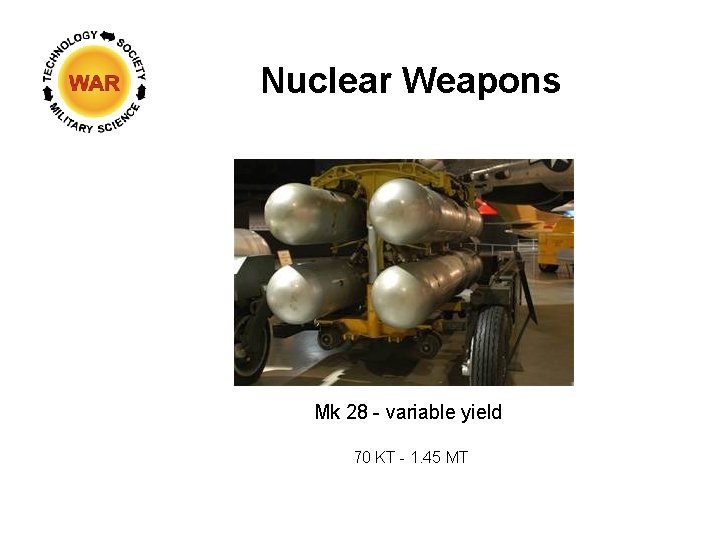
Nuclear Weapons Mk 28 - variable yield 70 KT - 1. 45 MT
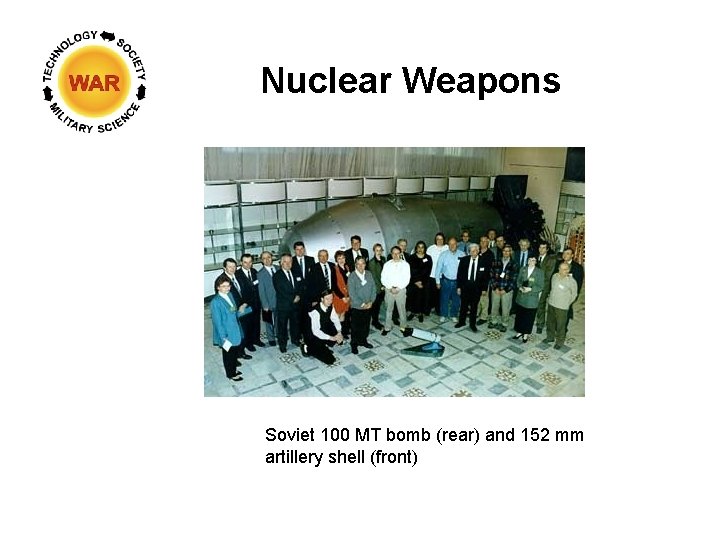
Nuclear Weapons Soviet 100 MT bomb (rear) and 152 mm artillery shell (front)
Nuclear Weapons US Nuclear Weapon Designations http: //nuclearweaponarchive. org/Usa/Weapons/Allbombs. html
Ballistic Missiles Go to
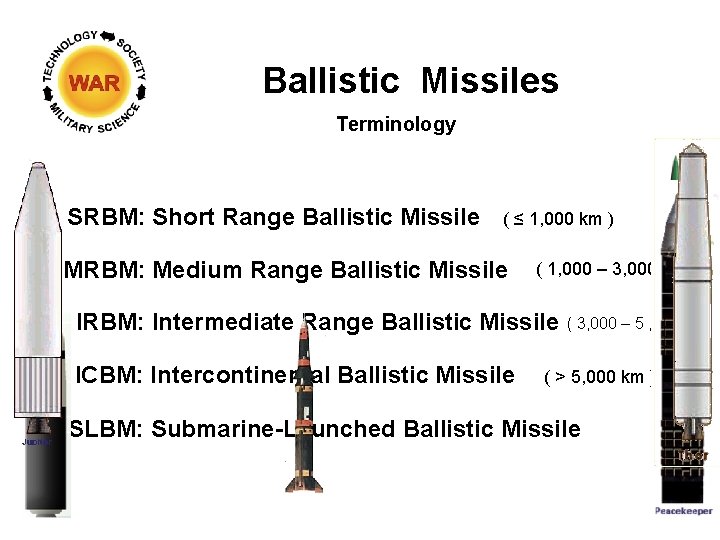
Ballistic Missiles Terminology SRBM: Short Range Ballistic Missile ( ≤ 1, 000 km ) MRBM: Medium Range Ballistic Missile ( 1, 000 – 3, 000 km ) IRBM: Intermediate Range Ballistic Missile ICBM: Intercontinental Ballistic Missile ( 3, 000 – 5 , 000 km ) ( > 5, 000 km ) SLBM: Submarine-Launched Ballistic Missile
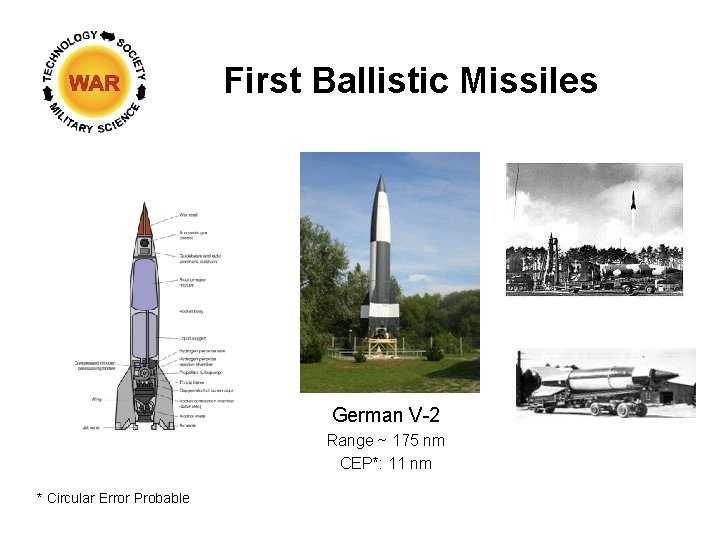
First Ballistic Missiles German V-2 Range ~ 175 nm CEP*: 11 nm * Circular Error Probable
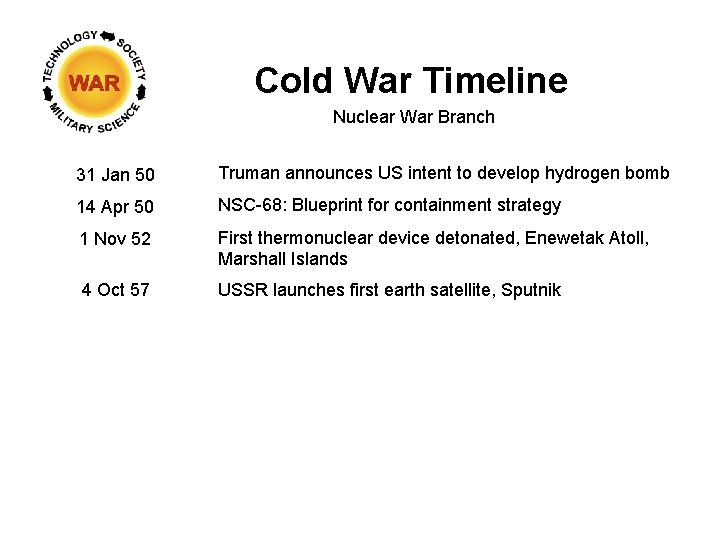
Cold War Timeline Nuclear War Branch 31 Jan 50 Truman announces US intent to develop hydrogen bomb 14 Apr 50 NSC-68: Blueprint for containment strategy 1 Nov 52 First thermonuclear device detonated, Enewetak Atoll, Marshall Islands 4 Oct 57 USSR launches first earth satellite, Sputnik
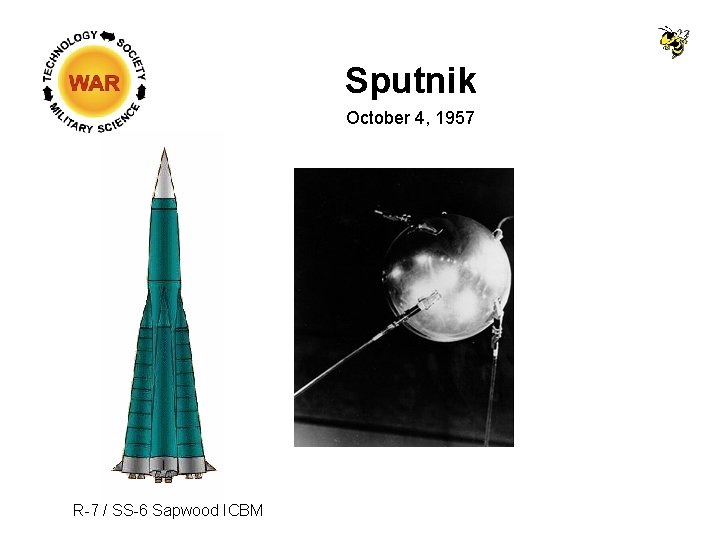
Sputnik October 4, 1957 R-7 / SS-6 Sapwood ICBM
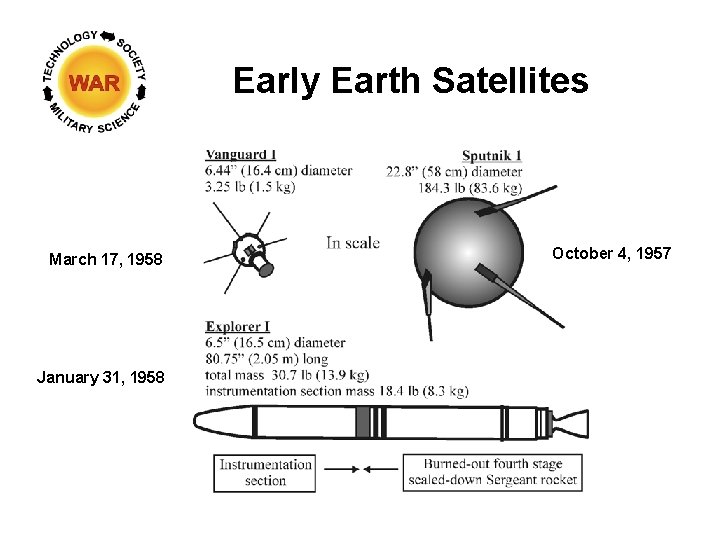
Early Earth Satellites March 17, 1958 January 31, 1958 October 4, 1957
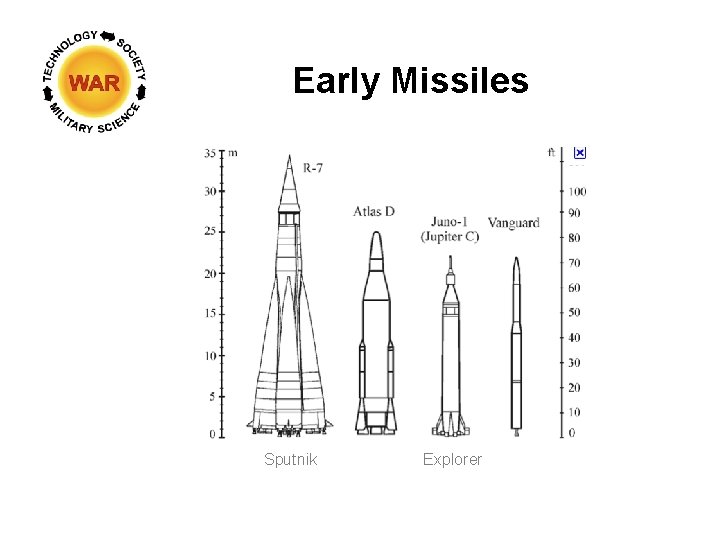
Early Missiles Sputnik Explorer
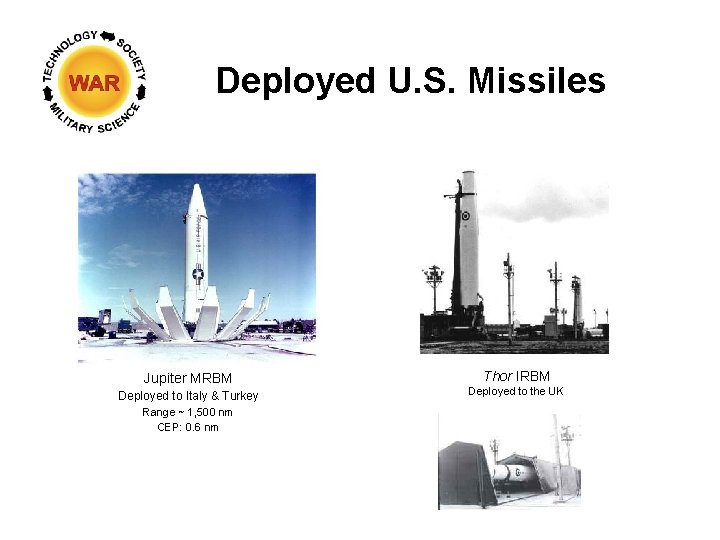
Deployed U. S. Missiles Jupiter MRBM Deployed to Italy & Turkey Range ~ 1, 500 nm CEP: 0. 6 nm Thor IRBM Deployed to the UK
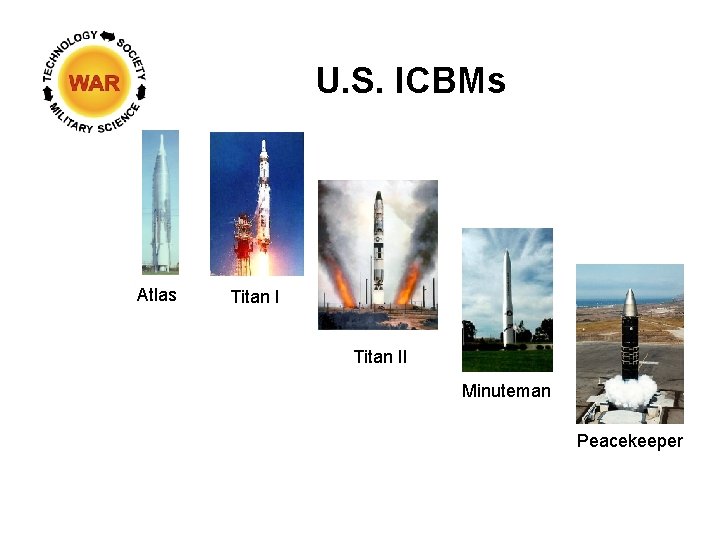
U. S. ICBMs Atlas Titan II Minuteman Peacekeeper
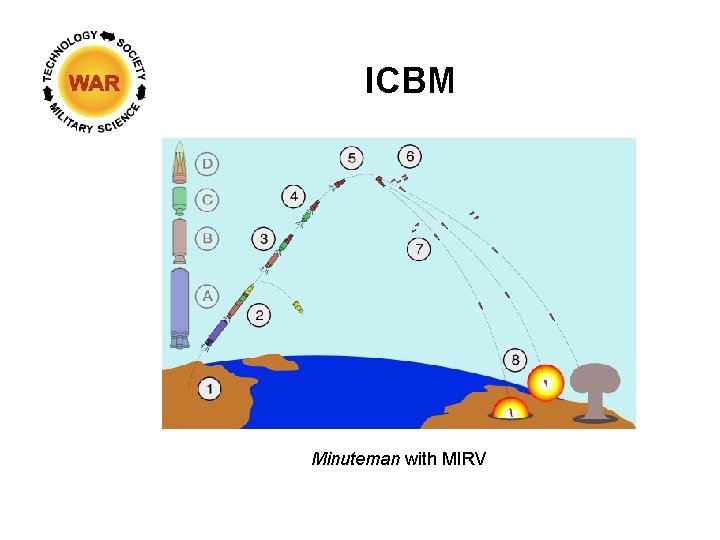
ICBM Minuteman with MIRV
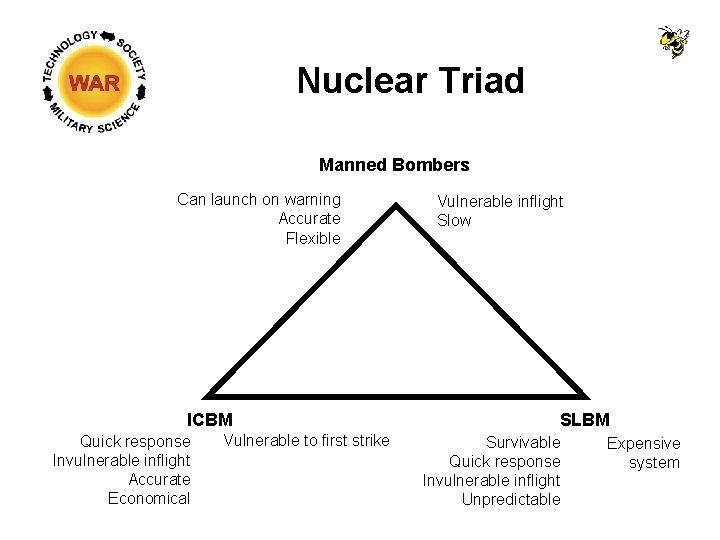
Nuclear Triad Manned Bombers Can launch on warning Accurate Flexible ICBM Quick response Invulnerable inflight Accurate Economical Vulnerable to first strike Vulnerable inflight Slow SLBM Survivable Quick response Invulnerable inflight Unpredictable Expensive system
Nuclear Forces SAC (c 1950) Cassette 42: Modern Marvels
Fighting a Nuclear War Issues: Warfighting Strategy
Nuclear Targeting Strategies Nixon: Counterforce • Publicly promoted position • Developed warfighting weapons (MIRV, ABM) Carter: Counterforce • Pursued decapitation strategy (targeted leadership, C 3) Regan/Bush: Counterforce • Combined counterforce and strategic defense initiative (SDI) • Blended arms negotiations (SALT) with SDI Colonel John Osgood, USA, Retired United States Nuclear Strategy 1945 -1995
Fighting a Nuclear War Issues: Warfighting Strategy Second Strike Capability Retaliatory forces must be able to ride out a first strike and still respond with decisive force Survivability becomes key consideration
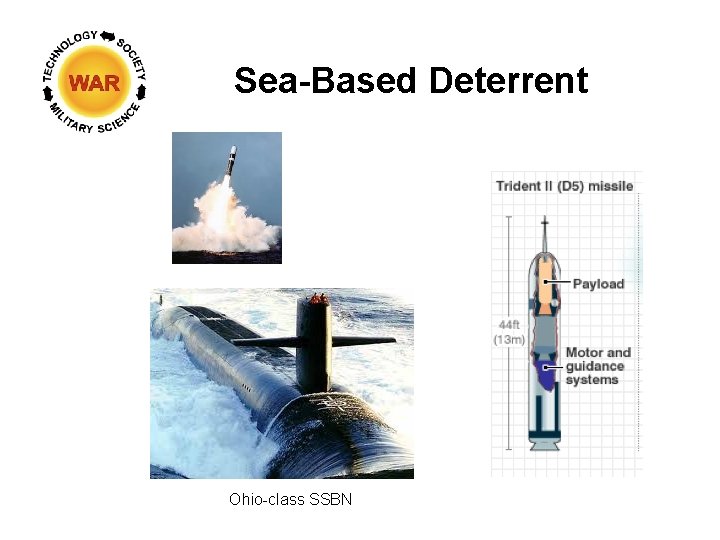
Sea-Based Deterrent Ohio-class SSBN
Fighting a Nuclear War Issues: Warfighting Strategy Second Strike Capability Continuity of Government
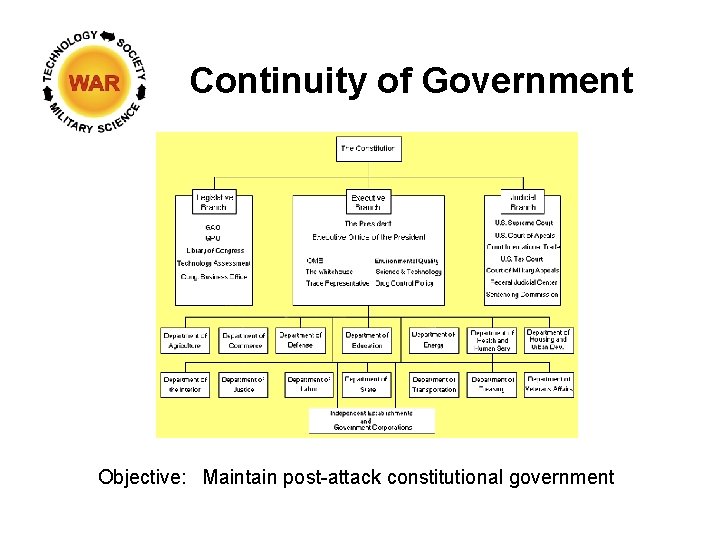
Continuity of Government Objective: Maintain post-attack constitutional government
Undisclosed Locations Video
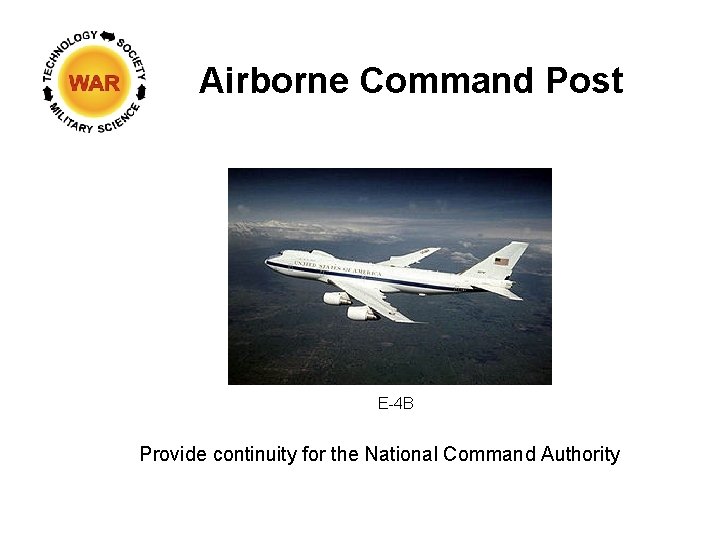
Airborne Command Post E-4 B Provide continuity for the National Command Authority
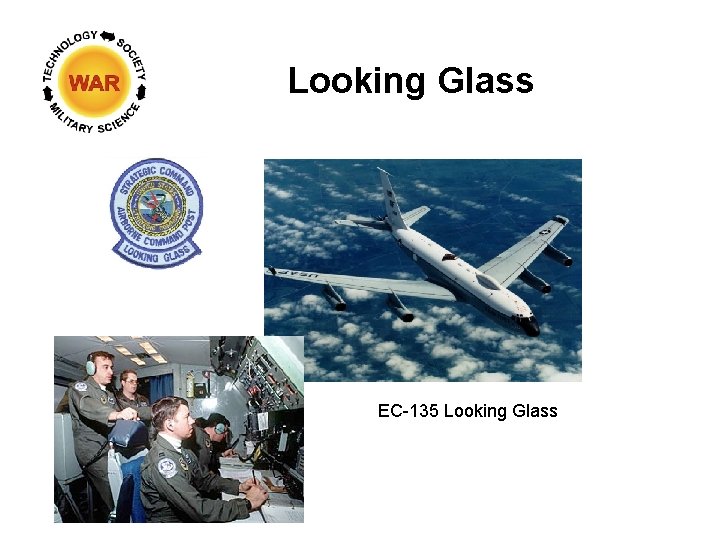
Looking Glass EC-135 Looking Glass
Fighting a Nuclear War Issues: Warfighting Strategy Second Strike Capability Continuity of Government War Plan
SIOP Single Integrated Operational Plan
SIOP: Single Integrated Operational Plan "The Circle of Modern War" and logo © Thomas D. Pilsch 2007 -2013
Cold War: Defending the Homeland Air Defense & Civil Defense Go To
The Threat 1950’s on: Manned Bombers 1960’s on: Ballistic Missiles • Land-based ICBM’s initially • SLBM’s* added later * Submarine-Launched Ballistic Missile
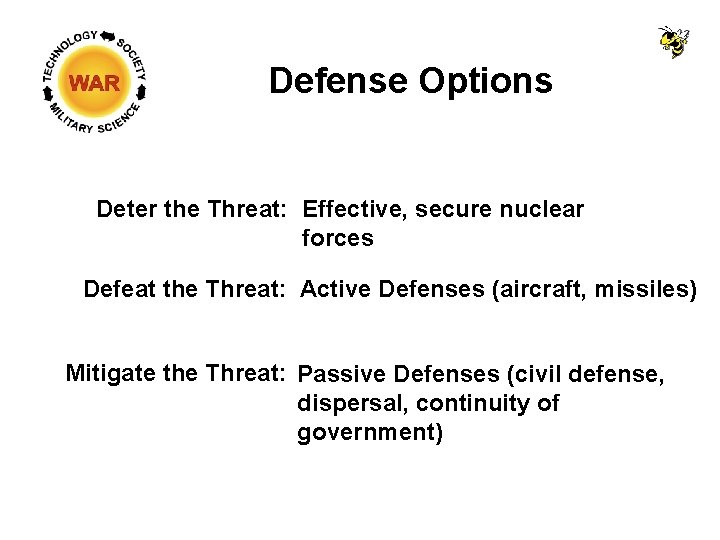
Defense Options Effective, secure nuclear Deter the Threat: forces Defeat the Threat: Active Defenses (aircraft, missiles) Mitigate the Threat: Passive Defenses (civil defense, dispersal, continuity of government)
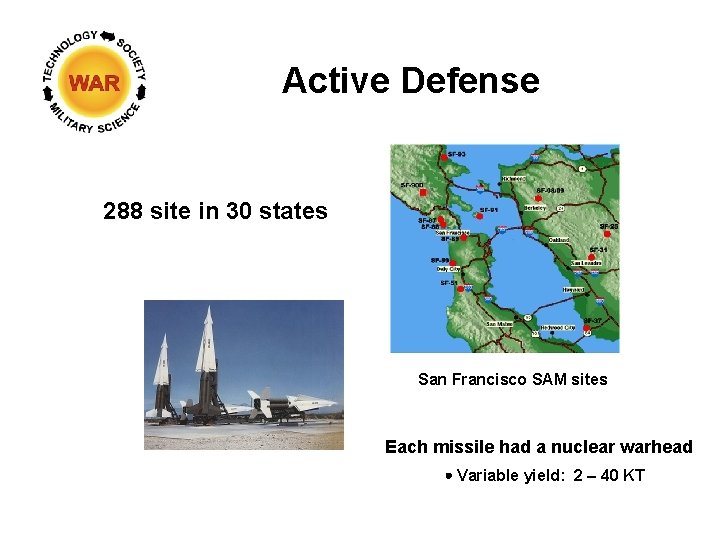
Active Defense 288 site in 30 states San Francisco SAM sites Each missile had a nuclear warhead Variable yield: 2 – 40 KT
Civil Defense Living With the Bomb
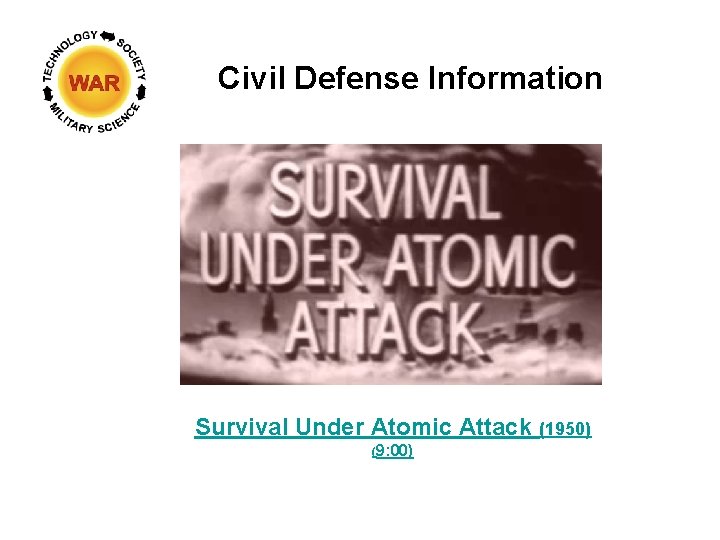
Civil Defense Information Survival Under Atomic Attack (1950) (9: 00)
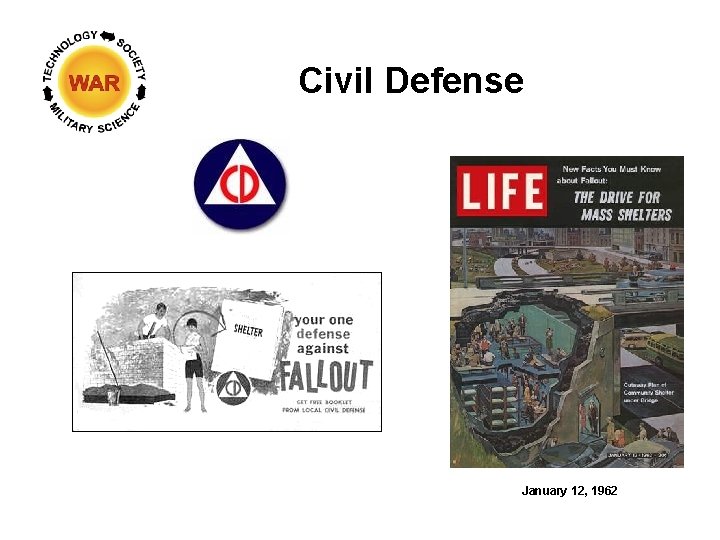
Civil Defense January 12, 1962
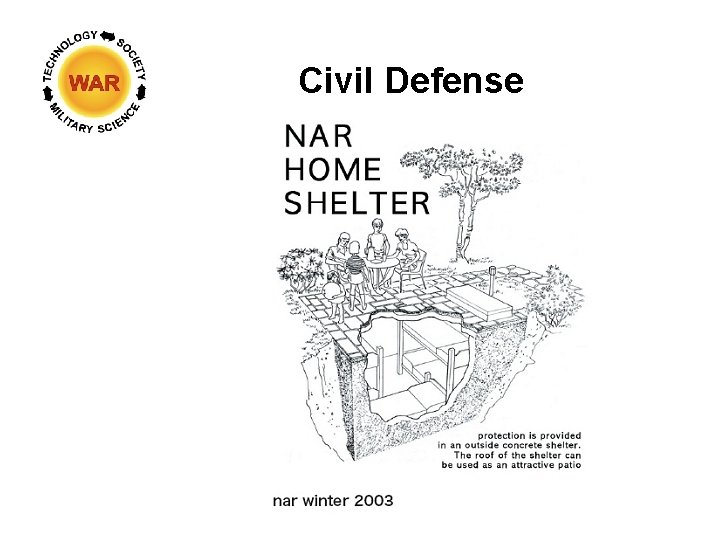
Civil Defense
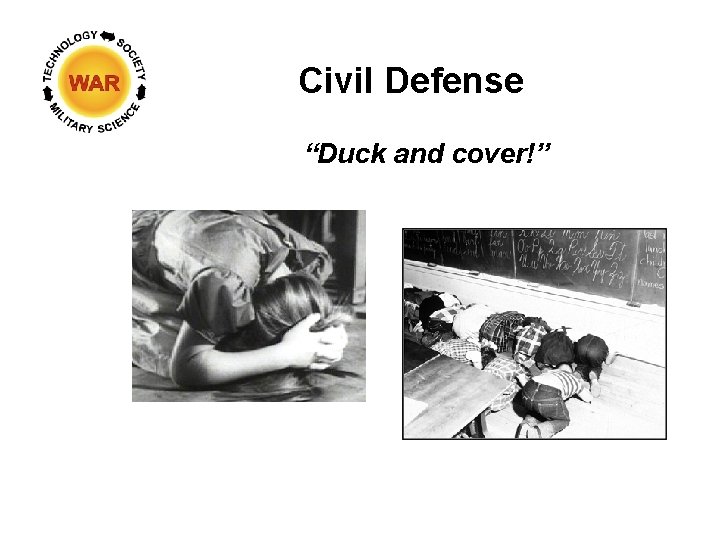
Civil Defense “Duck and cover!”
Civil Defense Updated Video (9: 16)
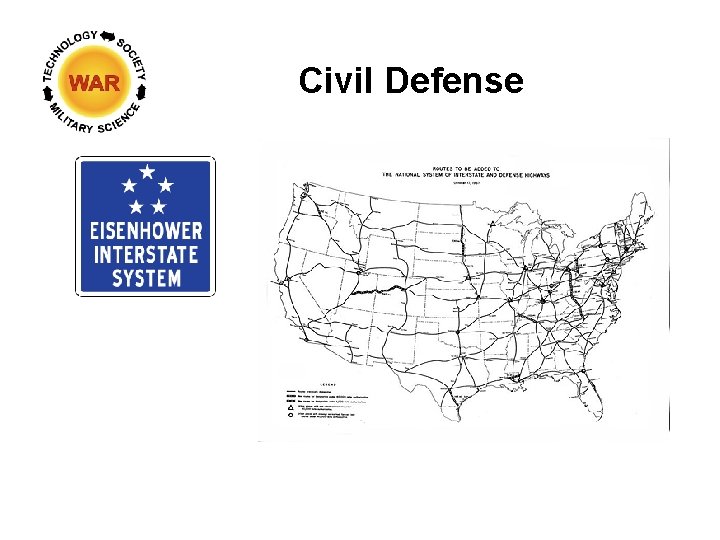
Civil Defense
Cold War: Cuban Missile Crisis
Vietnam: Into the Abyss
Lesson Objectives • Understand the Vietnam War as part of the Cold War. • Be able to describe the evolution of U. S. policy toward Indochina from Presidents Roosevelt to Eisenhower. • Understand describe the challenges posed by the Democratic Republic of Vietnam (DRV) against the south. • Understand describe the situation in the Republic of Vietnam (RVN) after 1959 and the RVN reaction to the challenge from the north. • Understand the doctrine of limited war and counterinsurgency as espoused by the Kennedy Administration. • Understand the timeline of events that led to U. S. involvement in Southeast Asia.

End
- Slides: 77