
Cold War Tensions 1950 1956 The United Nations
- Slides: 15
Cold War Tensions 1950 – 1956
The United Nations • Definition: An international organization of nations for world peace and security. • Precursor = The League of Nations
• The League of Nations – Origins: • Treaty of Versailles (1919 – end of WWI) • Wilson’s 14 Points • U. S. never ratified
– Goal: Handle disputes among countries, avoid another world conflict – Ineffective because: • Unable to intervene in acts of aggression • Dissolved itself during WWII
• Paving the way… – June 12, 1941 Inter-allied Declaration – Aug. 14, 1941 Atlantic Charter – Jan. 1, 1942 Declaration by the United Nations – Late 1943; Meeting of “Big 3” outlined responsibility of a United Nations org.
– Aug. 1944 Dumbarton Oaks Conference – Feb. 1945 Yalta Conference – June 26, 1945 UN chartered in San Fran. – Oct. 24, 1945 UN officially started with 50 signatures.
Causes of the Cold War
Background • After WWII, US and USSR = superpowers • Differences lead to the cold war
Definition of: • Era of political tensions b/wn US and USSR • competed for world influence w/o armed conflict • “weapons” = threat of force, propaganda, military/economic aid to weaker countries
1. Competing Ideologies • Capitalism vs. Communism • Dislikes resurface after WWII
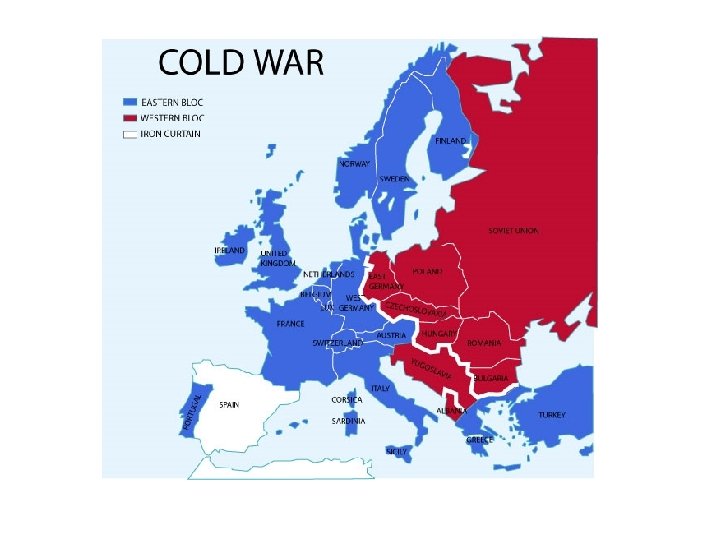
2. Soviet Union Presence in Eastern Europe • After WWII, The S. U. ’s army occuppied eastern Europe and parts of Germany. • Fear of Communism and Soviet influence spreading
3. Rise of the Nuclear Age and Atomic Diplomacy • In 1945 the U. S. had sole possession of the atomic bomb. • US would NOT share info • USSR was suspicious of motives
4. Political instability in the 3 rd World • WWII quickened the collapse of colonial empires • American-Soviet rivalry for these areas occurred for markets and military bases
The conflict b/wn ISMs and the dispute over eastern Europe would be the center of the first phase of the Cold War.