
COLD WAR FOREIGN POLICY 1945 1993 Fundamental Questions

- Slides: 25
COLD WAR FOREIGN POLICY (1945 -1993)
Fundamental Questions Discuss the United States as a global superpower from 1945 -1992. } Analyze the American government response to foreign developments. } Analyze how the American public responded to foreign developments. }
Understanding the Cold War After WWII, the traditional powers of the world regressed and the United States and the Soviet Union arose as the dominant superpowers. } Both nations were polar opposites in ideologies. } § Soviet Union = communism, police state § United States = capitalism, democracy The relationship began under mistrust and tensions increased as time moved on. } Cold War meant a “war of words” rather than outright conflict } § However, the Cold War includes episodes of “hot” conflicts in various regions around the world.
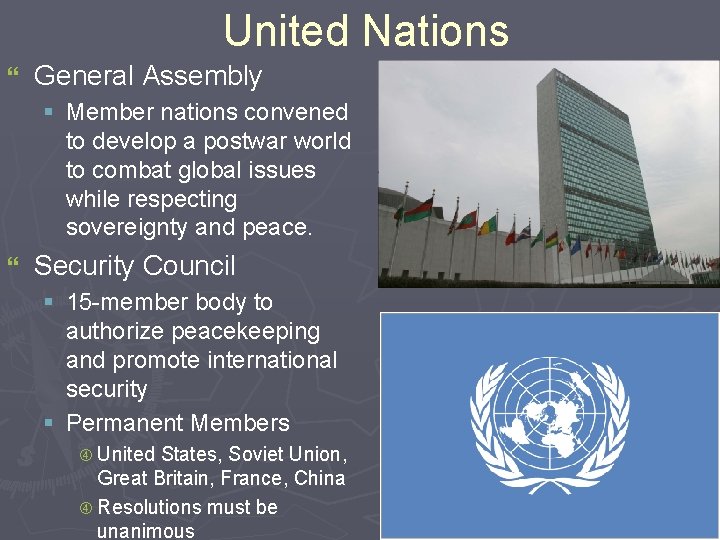
United Nations } General Assembly § Member nations convened to develop a postwar world to combat global issues while respecting sovereignty and peace. } Security Council § 15 -member body to authorize peacekeeping and promote international security § Permanent Members United States, Soviet Union, Great Britain, France, China Resolutions must be unanimous
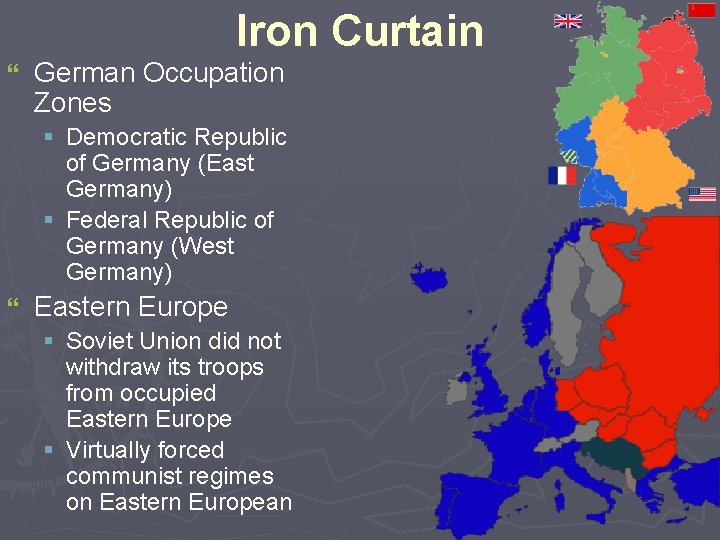
Iron Curtain } German Occupation Zones § Democratic Republic of Germany (East Germany) § Federal Republic of Germany (West Germany) } Eastern Europe § Soviet Union did not withdraw its troops from occupied Eastern Europe § Virtually forced communist regimes on Eastern European
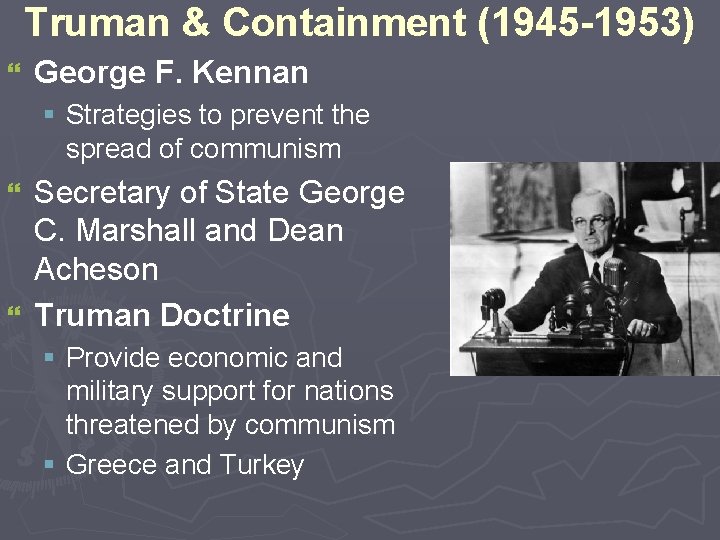
Truman & Containment (1945 -1953) } George F. Kennan § Strategies to prevent the spread of communism Secretary of State George C. Marshall and Dean Acheson } Truman Doctrine } § Provide economic and military support for nations threatened by communism § Greece and Turkey
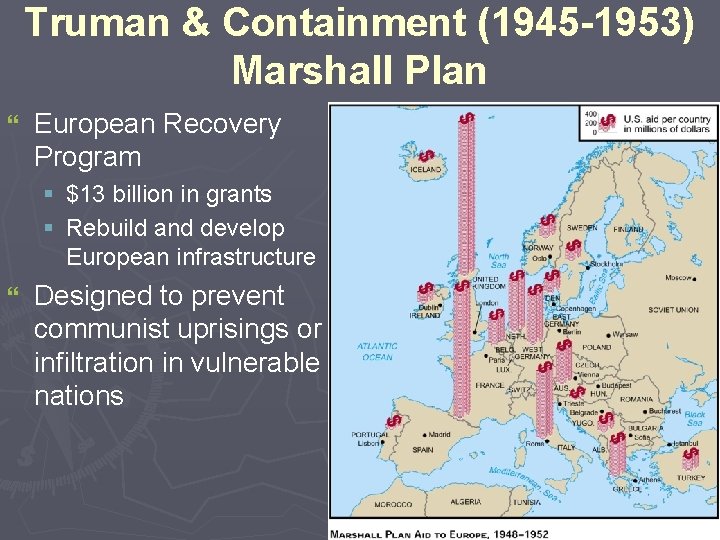
Truman & Containment (1945 -1953) Marshall Plan } European Recovery Program § $13 billion in grants § Rebuild and develop European infrastructure } Designed to prevent communist uprisings or infiltration in vulnerable nations
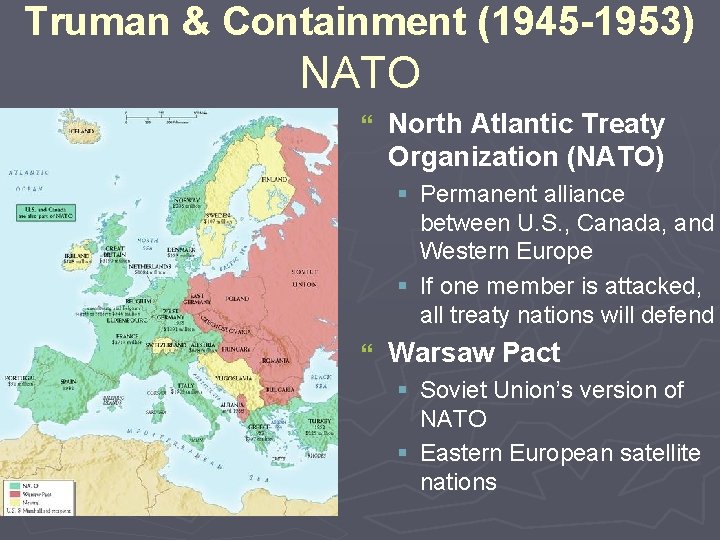
Truman & Containment (1945 -1953) NATO } North Atlantic Treaty Organization (NATO) § Permanent alliance between U. S. , Canada, and Western Europe § If one member is attacked, all treaty nations will defend } Warsaw Pact § Soviet Union’s version of NATO § Eastern European satellite nations
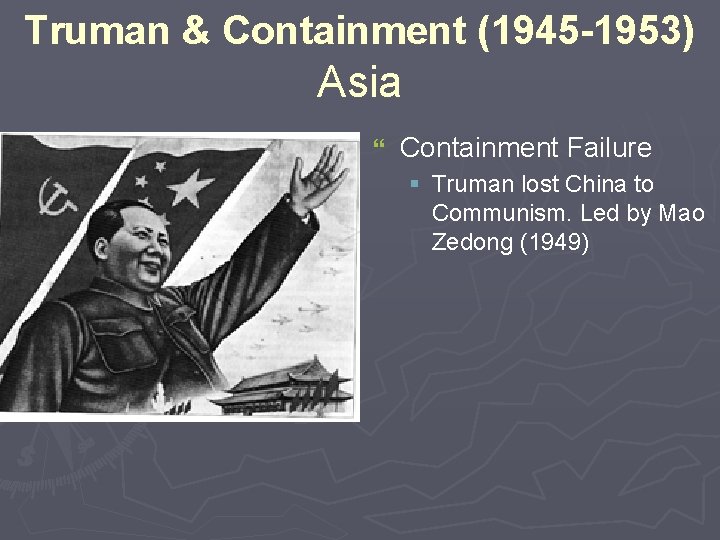
Truman & Containment (1945 -1953) Asia } Containment Failure § Truman lost China to Communism. Led by Mao Zedong (1949)
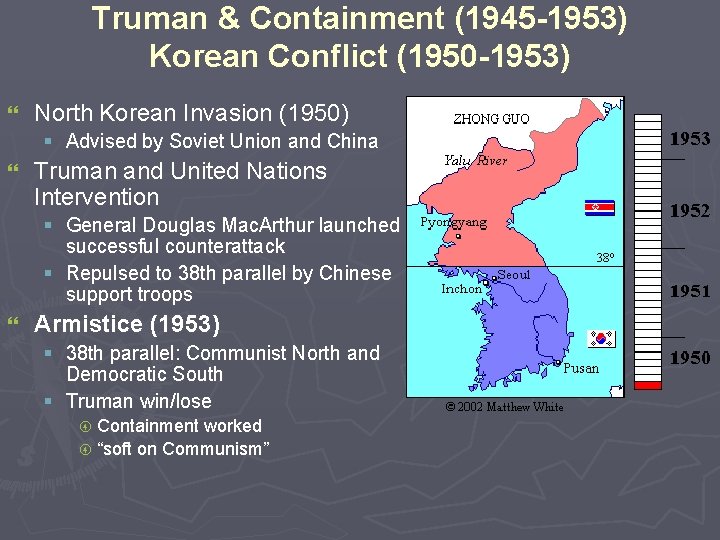
Truman & Containment (1945 -1953) Korean Conflict (1950 -1953) } North Korean Invasion (1950) § Advised by Soviet Union and China } Truman and United Nations Intervention § General Douglas Mac. Arthur launched successful counterattack § Repulsed to 38 th parallel by Chinese support troops } Armistice (1953) § 38 th parallel: Communist North and Democratic South § Truman win/lose Containment worked “soft on Communism”
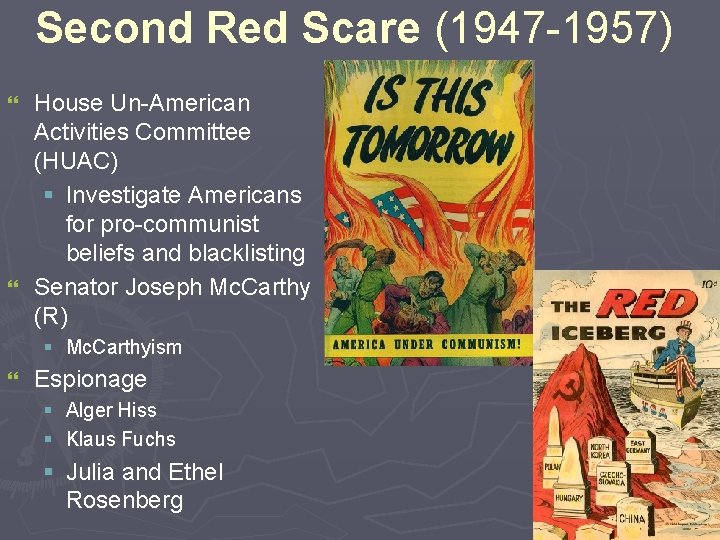
Second Red Scare (1947 -1957) House Un-American Activities Committee (HUAC) § Investigate Americans for pro-communist beliefs and blacklisting } Senator Joseph Mc. Carthy (R) } § Mc. Carthyism } Espionage § Alger Hiss § Klaus Fuchs § Julia and Ethel Rosenberg
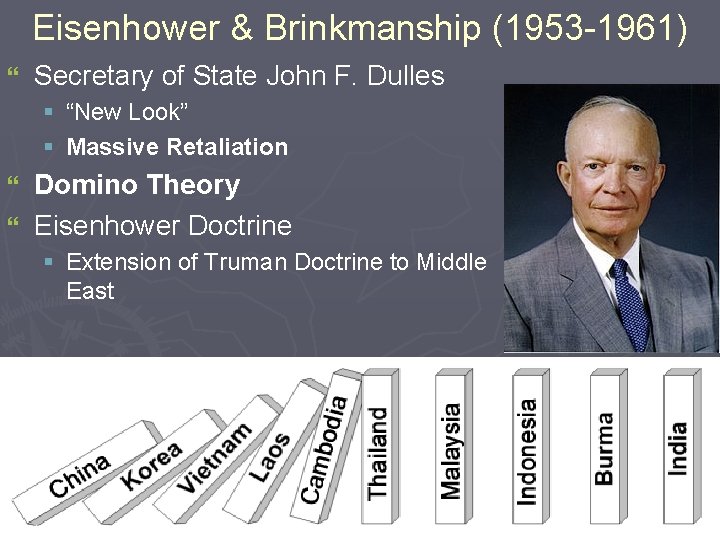
Eisenhower & Brinkmanship (1953 -1961) } Secretary of State John F. Dulles § “New Look” § Massive Retaliation Domino Theory } Eisenhower Doctrine } § Extension of Truman Doctrine to Middle East
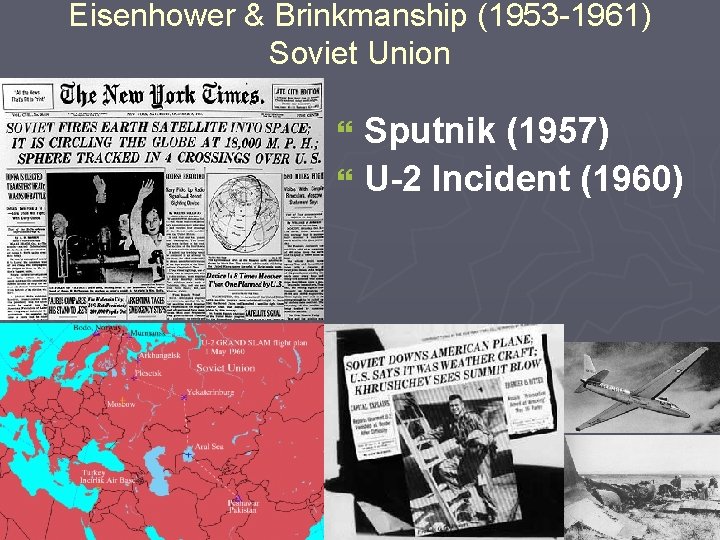
Eisenhower & Brinkmanship (1953 -1961) Soviet Union Sputnik (1957) } U-2 Incident (1960) }
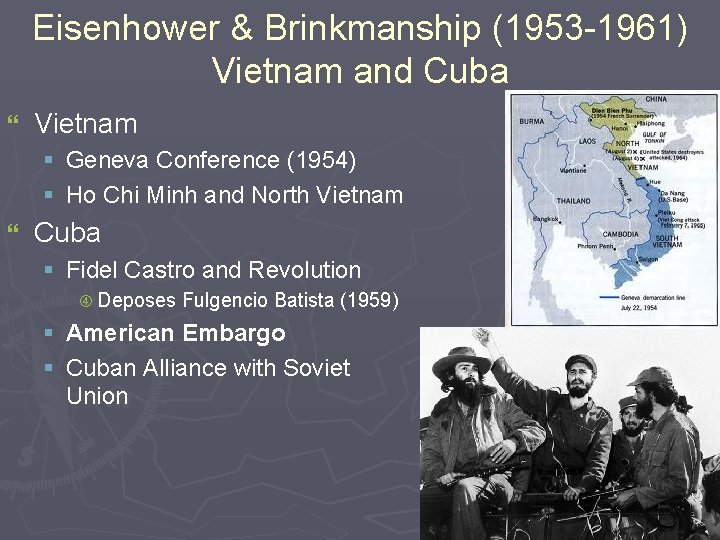
Eisenhower & Brinkmanship (1953 -1961) Vietnam and Cuba } Vietnam § Geneva Conference (1954) § Ho Chi Minh and North Vietnam } Cuba § Fidel Castro and Revolution Deposes Fulgencio Batista (1959) § American Embargo § Cuban Alliance with Soviet Union
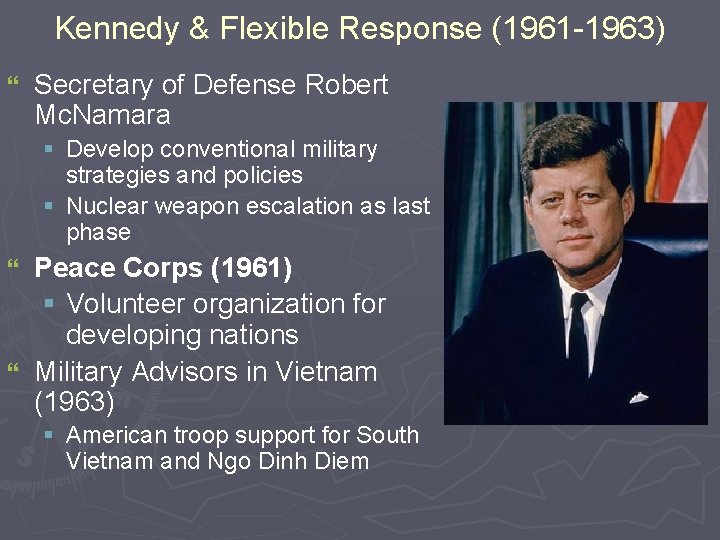
Kennedy & Flexible Response (1961 -1963) } Secretary of Defense Robert Mc. Namara § Develop conventional military strategies and policies § Nuclear weapon escalation as last phase Peace Corps (1961) § Volunteer organization for developing nations } Military Advisors in Vietnam (1963) } § American troop support for South Vietnam and Ngo Dinh Diem
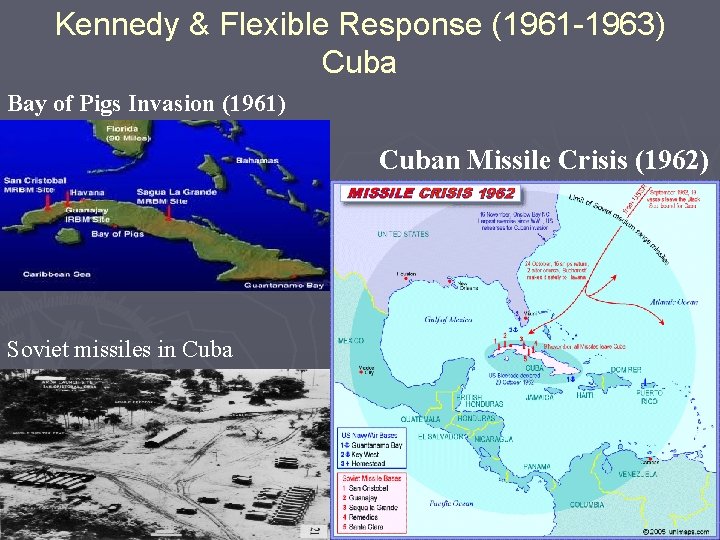
Kennedy & Flexible Response (1961 -1963) Cuba Bay of Pigs Invasion (1961) Cuban Missile Crisis (1962) Soviet missiles in Cuba
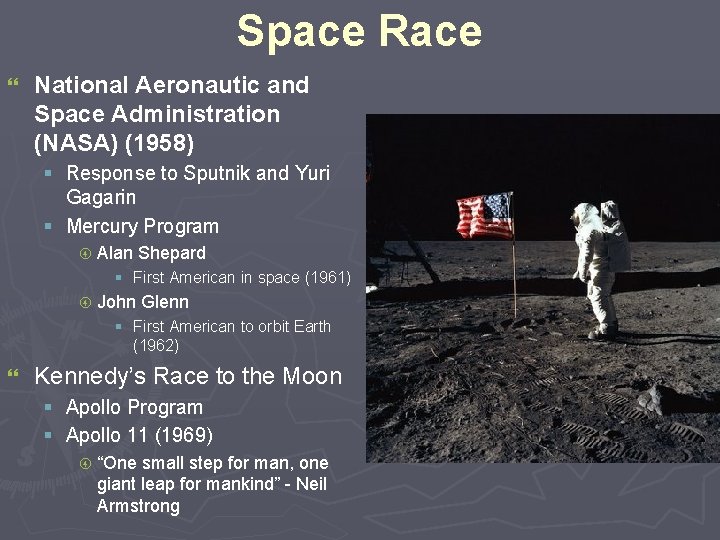
Space Race } National Aeronautic and Space Administration (NASA) (1958) § Response to Sputnik and Yuri Gagarin § Mercury Program Alan Shepard § First American in space (1961) John Glenn § First American to orbit Earth (1962) } Kennedy’s Race to the Moon § Apollo Program § Apollo 11 (1969) “One small step for man, one giant leap for mankind” - Neil Armstrong
Johnson & Vietnam (1963 -1969) } } Gulf of Tonkin (August 1964) § Incident - North Vietnamese fired upon U. S. warships § Resolution - Congress authorized combat troops through Johnson’s urging Escalation § Operation Rolling Thunder § Troops increases from 1964 to 1969 540, 000 at most during Vietnam Conflict Hawks and Doves § Hawks - contain communist aggression § Doves - internal conflict and unpopular draft and results Tet Offensive (January 1968) § Vietcong launch surprise attack § U. S. military victory but political and popular victory for Minh and North Vietnamese
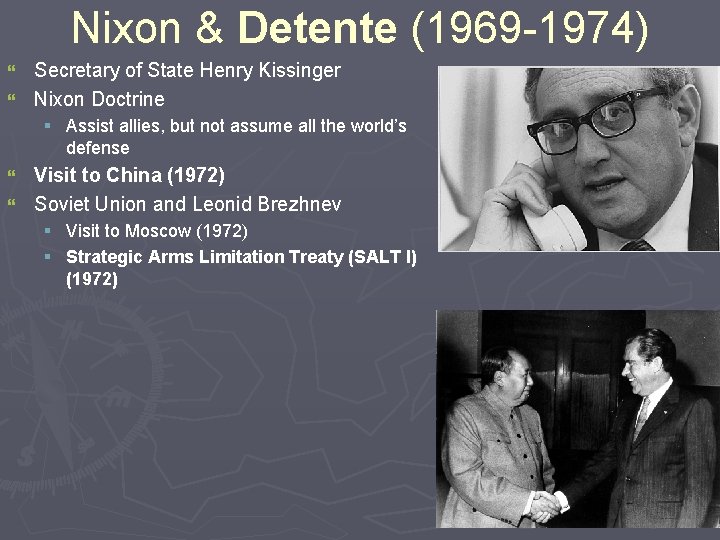
Nixon & Detente (1969 -1974) Secretary of State Henry Kissinger } Nixon Doctrine } § Assist allies, but not assume all the world’s defense Visit to China (1972) } Soviet Union and Leonid Brezhnev } § Visit to Moscow (1972) § Strategic Arms Limitation Treaty (SALT I) (1972)
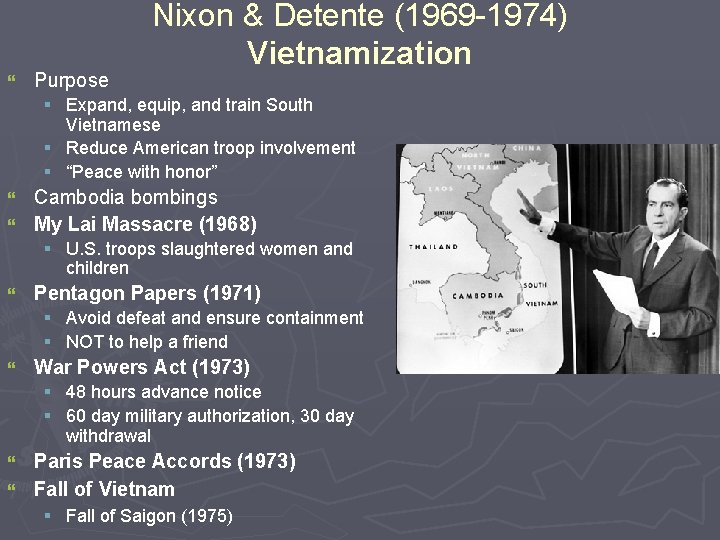
} Purpose Nixon & Detente (1969 -1974) Vietnamization § Expand, equip, and train South Vietnamese § Reduce American troop involvement § “Peace with honor” Cambodia bombings } My Lai Massacre (1968) } § U. S. troops slaughtered women and children } Pentagon Papers (1971) § Avoid defeat and ensure containment § NOT to help a friend } War Powers Act (1973) § 48 hours advance notice § 60 day military authorization, 30 day withdrawal Paris Peace Accords (1973) } Fall of Vietnam } § Fall of Saigon (1975)
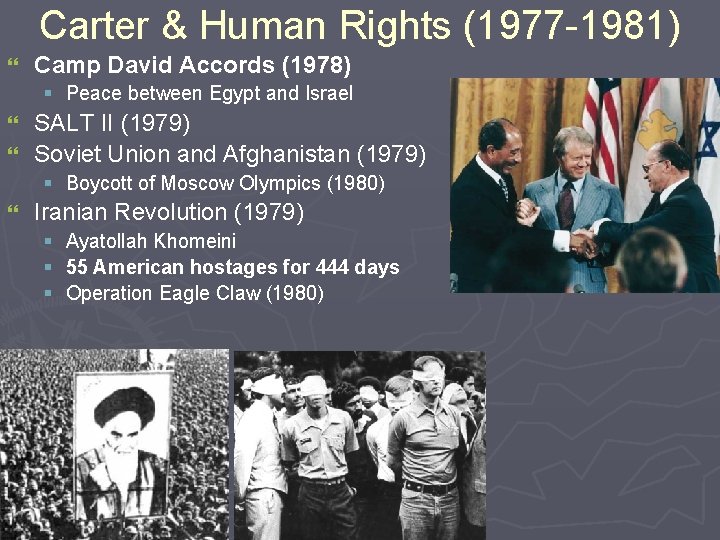
Carter & Human Rights (1977 -1981) } Camp David Accords (1978) § Peace between Egypt and Israel SALT II (1979) } Soviet Union and Afghanistan (1979) } § Boycott of Moscow Olympics (1980) } Iranian Revolution (1979) § Ayatollah Khomeini § 55 American hostages for 444 days § Operation Eagle Claw (1980)
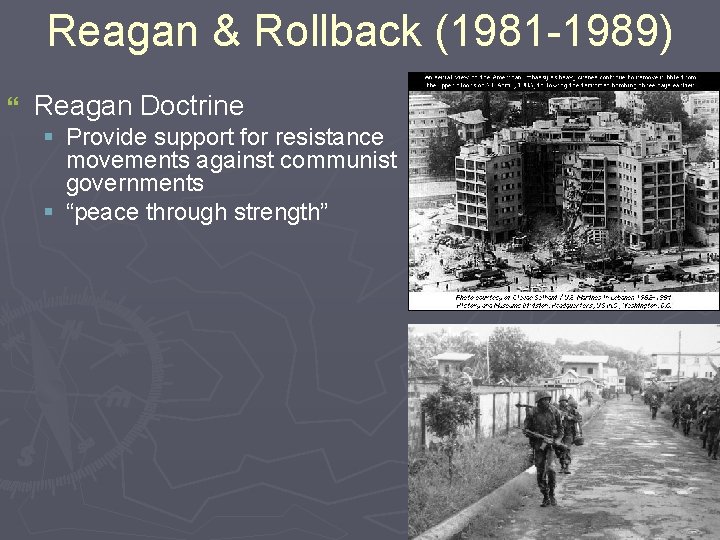
Reagan & Rollback (1981 -1989) } Reagan Doctrine § Provide support for resistance movements against communist governments § “peace through strength”
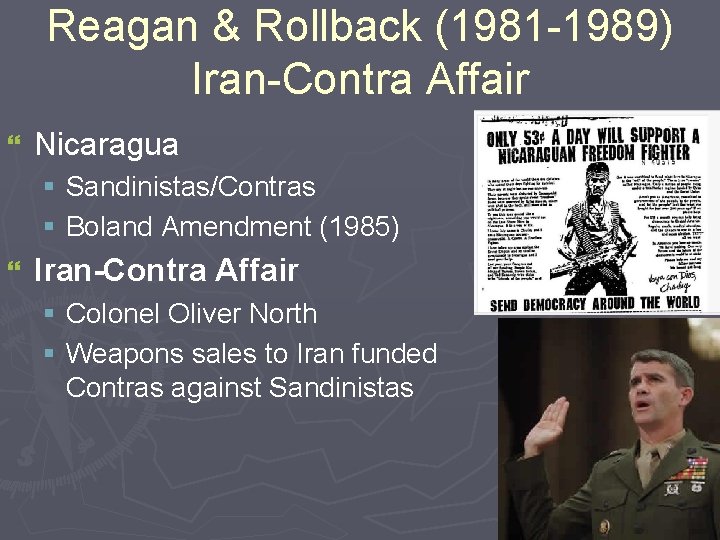
Reagan & Rollback (1981 -1989) Iran-Contra Affair } Nicaragua § Sandinistas/Contras § Boland Amendment (1985) } Iran-Contra Affair § Colonel Oliver North § Weapons sales to Iran funded Contras against Sandinistas
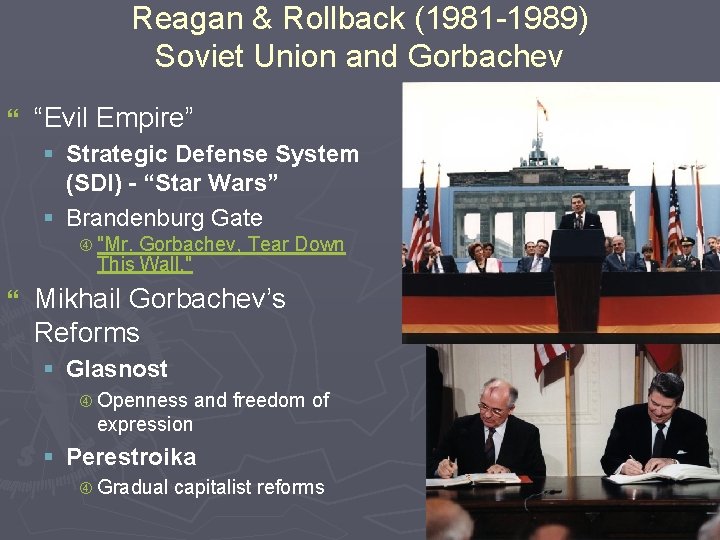
Reagan & Rollback (1981 -1989) Soviet Union and Gorbachev } “Evil Empire” § Strategic Defense System (SDI) - “Star Wars” § Brandenburg Gate "Mr. Gorbachev, Tear Down This Wall. " } Mikhail Gorbachev’s Reforms § Glasnost Openness and freedom of expression § Perestroika Gradual capitalist reforms
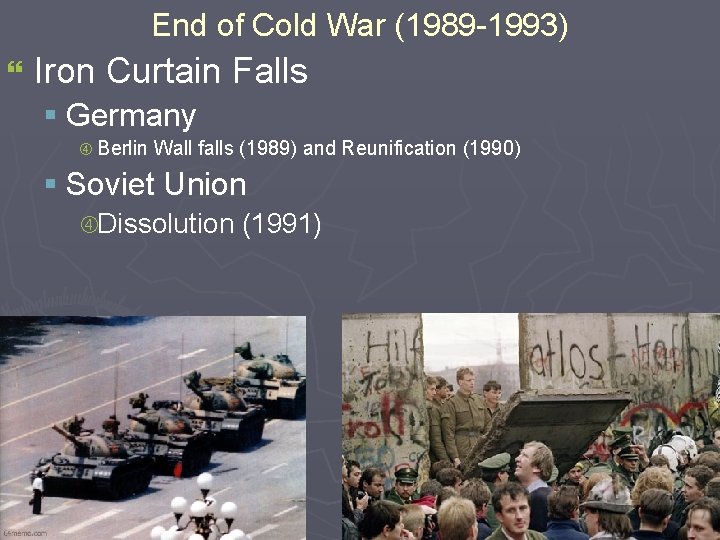
End of Cold War (1989 -1993) } Iron Curtain Falls § Germany Berlin Wall falls (1989) and Reunification (1990) § Soviet Union Dissolution (1991)