
Cold War China Throughout WWII there was an
- Slides: 7
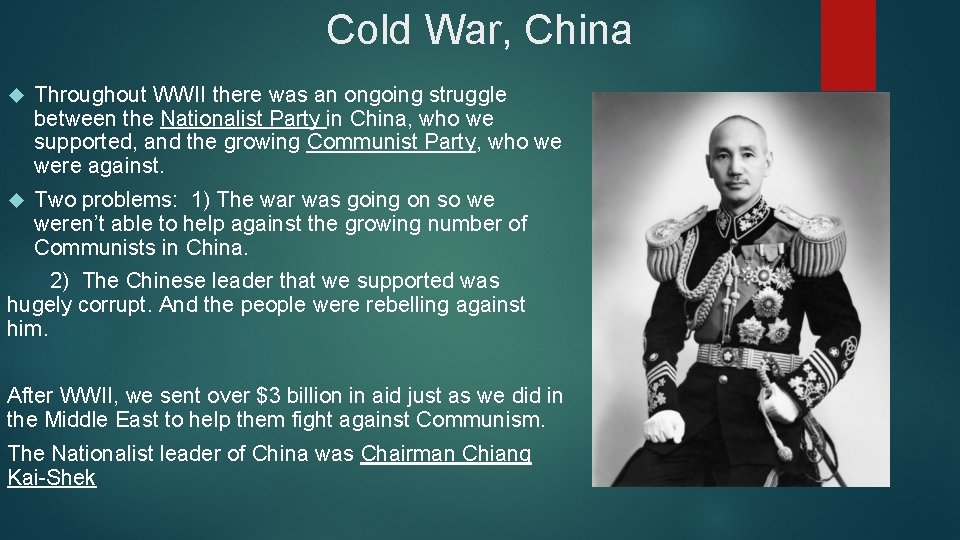
Cold War, China Throughout WWII there was an ongoing struggle between the Nationalist Party in China, who we supported, and the growing Communist Party, who we were against. Two problems: 1) The war was going on so we weren’t able to help against the growing number of Communists in China. 2) The Chinese leader that we supported was hugely corrupt. And the people were rebelling against him. After WWII, we sent over $3 billion in aid just as we did in the Middle East to help them fight against Communism. The Nationalist leader of China was Chairman Chiang Kai-Shek
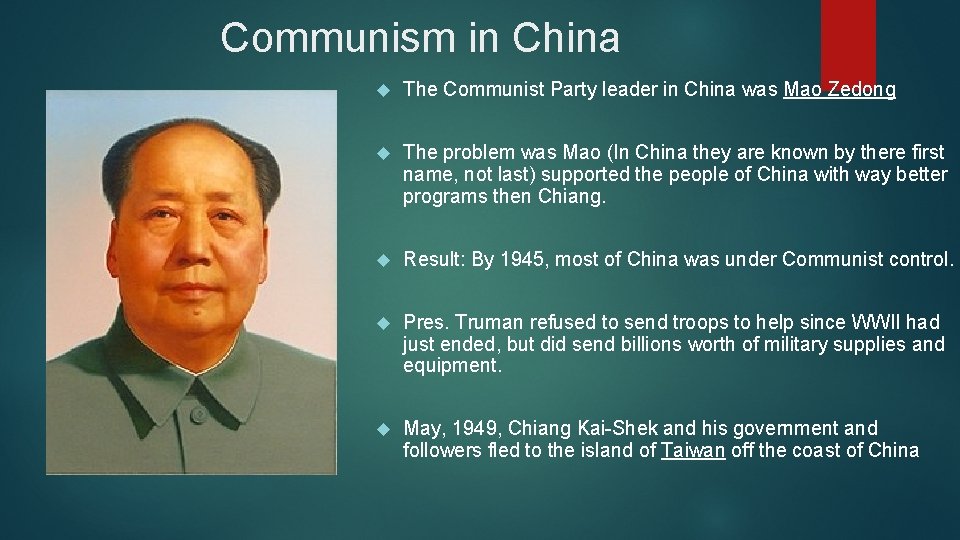
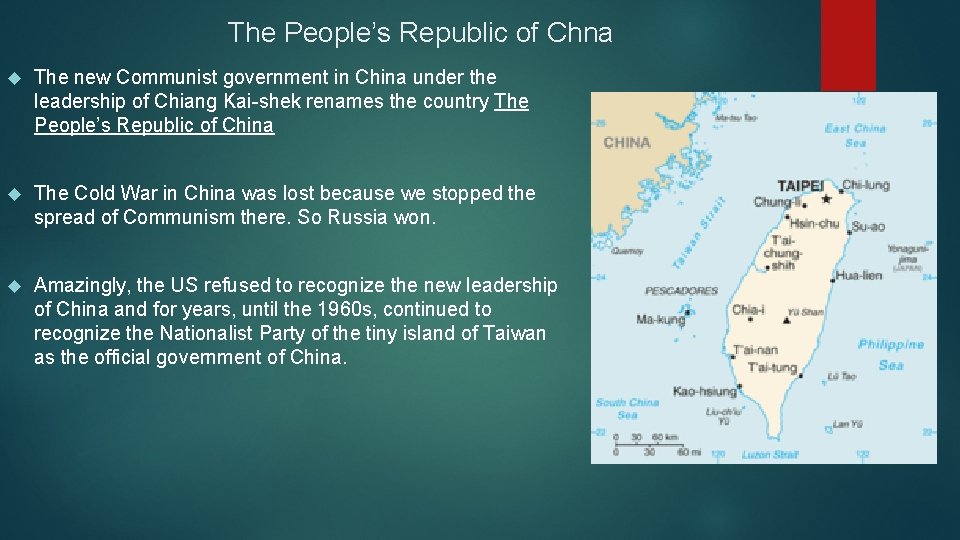
Communism in China The Communist Party leader in China was Mao Zedong The problem was Mao (In China they are known by there first name, not last) supported the people of China with way better programs then Chiang. Result: By 1945, most of China was under Communist control. Pres. Truman refused to send troops to help since WWII had just ended, but did send billions worth of military supplies and equipment. May, 1949, Chiang Kai-Shek and his government and followers fled to the island of Taiwan off the coast of China
The People’s Republic of Chna The new Communist government in China under the leadership of Chiang Kai-shek renames the country The People’s Republic of China The Cold War in China was lost because we stopped the spread of Communism there. So Russia won. Amazingly, the US refused to recognize the new leadership of China and for years, until the 1960 s, continued to recognize the Nationalist Party of the tiny island of Taiwan as the official government of China.
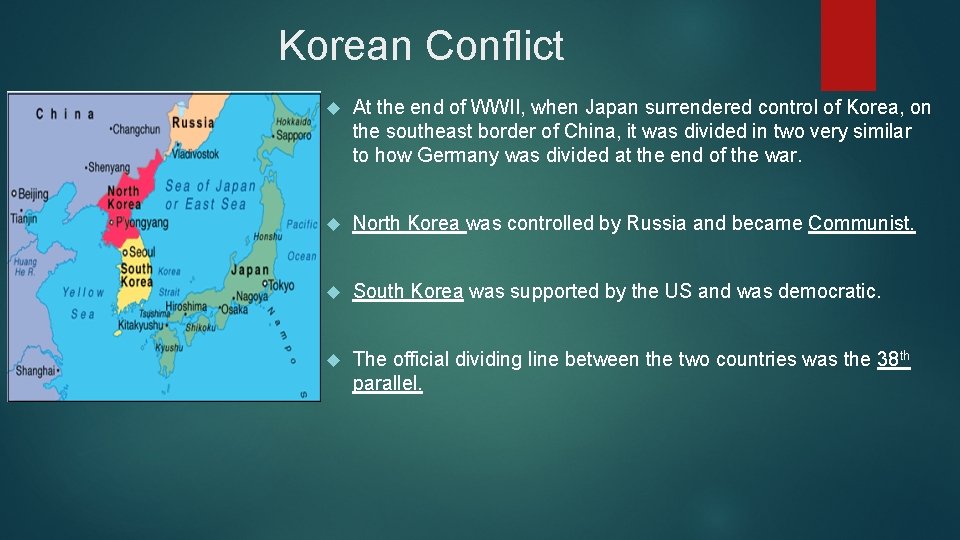
Korean Conflict At the end of WWII, when Japan surrendered control of Korea, on the southeast border of China, it was divided in two very similar to how Germany was divided at the end of the war. North Korea was controlled by Russia and became Communist. South Korea was supported by the US and was democratic. The official dividing line between the two countries was the 38 th parallel.
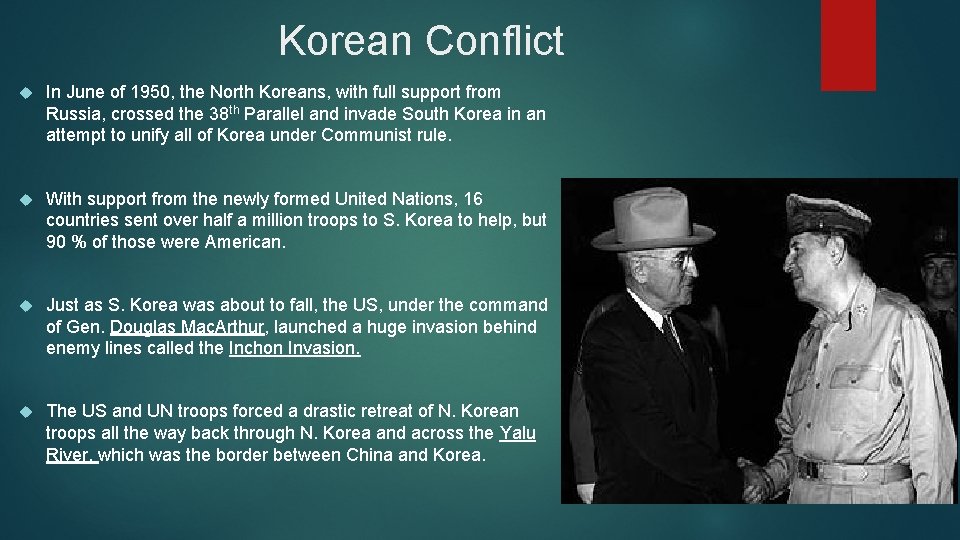
Korean Conflict In June of 1950, the North Koreans, with full support from Russia, crossed the 38 th Parallel and invade South Korea in an attempt to unify all of Korea under Communist rule. With support from the newly formed United Nations, 16 countries sent over half a million troops to S. Korea to help, but 90 % of those were American. Just as S. Korea was about to fall, the US, under the command of Gen. Douglas Mac. Arthur, launched a huge invasion behind enemy lines called the Inchon Invasion. The US and UN troops forced a drastic retreat of N. Korean troops all the way back through N. Korea and across the Yalu River, which was the border between China and Korea.
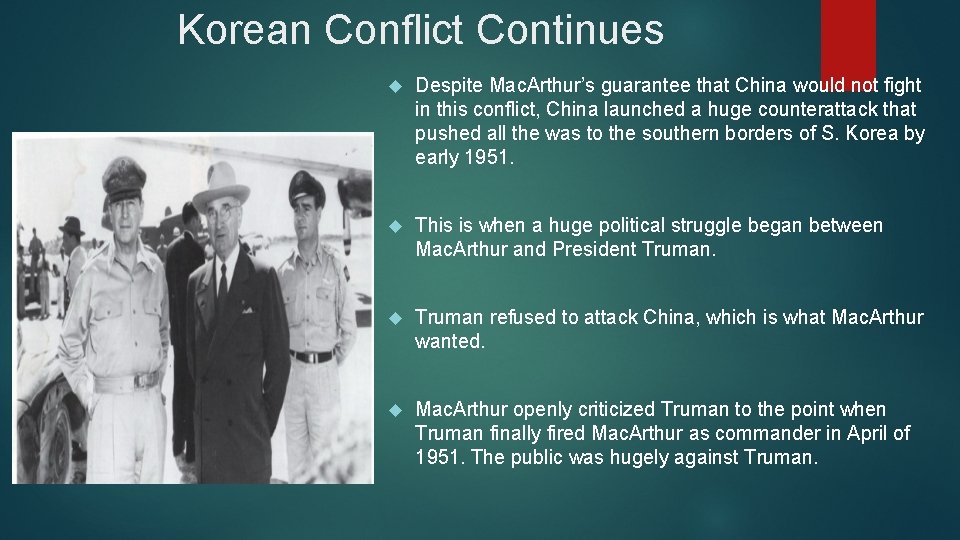
Korean Conflict Continues Despite Mac. Arthur’s guarantee that China would not fight in this conflict, China launched a huge counterattack that pushed all the was to the southern borders of S. Korea by early 1951. This is when a huge political struggle began between Mac. Arthur and President Truman refused to attack China, which is what Mac. Arthur wanted. Mac. Arthur openly criticized Truman to the point when Truman finally fired Mac. Arthur as commander in April of 1951. The public was hugely against Truman.
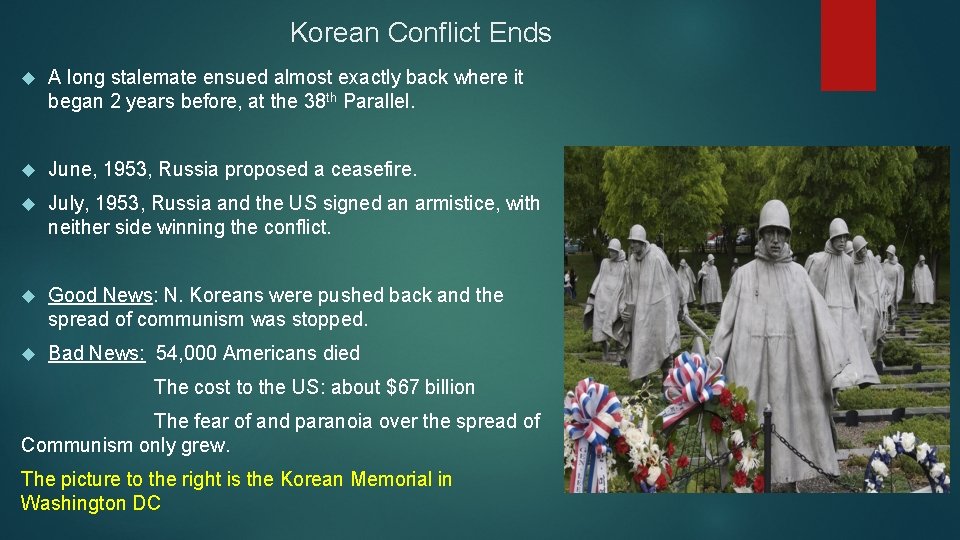
Korean Conflict Ends A long stalemate ensued almost exactly back where it began 2 years before, at the 38 th Parallel. June, 1953, Russia proposed a ceasefire. July, 1953, Russia and the US signed an armistice, with neither side winning the conflict. Good News: N. Koreans were pushed back and the spread of communism was stopped. Bad News: 54, 000 Americans died The cost to the US: about $67 billion The fear of and paranoia over the spread of Communism only grew. The picture to the right is the Korean Memorial in Washington DC