
Cold Temperate Desert Shrublands Reading Knight Ch 6
Cold (Temperate) Desert Shrublands Reading: Knight, Ch. 6 and p. 133 -140 10/10/07 1
Climatic conditions • Warm deserts grade up into cold deserts, with some overlap in species (figure from UNLV up) • Cold desert shrublands may receive less precip than warm deserts, but have lower evaporation rates, hence higher P/E ratios • Warm desert P/E averages 0. 3 • Cold desert P/E about 0. 5 -0. 7 • Much precip falls as snow, melts in spring and is stored in soil profile; snow distribution patterns play a major role in vegetation mosaic • Elevation range: ~1000 meters to lower treeline 10/10/07 2
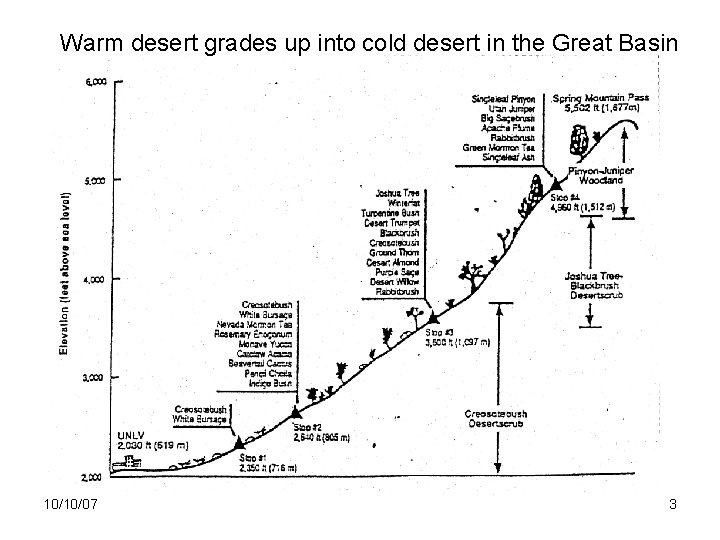
Warm desert grades up into cold desert in the Great Basin 10/10/07 3
Not all cold desert ecosystems are the same • Intermountain basins west of the Great Plains are dominated by shrublands • Sagebrush vegetation types are most common – Historically there were 44 million ha of sagebrush (West and Young 2000) – largest semi-arid ecosystem in North America (~10% of land area) • Saltbush-greasewood vegetation – Saline areas – 17 million ha 10/10/07 4
Halophytic shrublands Many basins and playas have “haloseres, ” following gradients of soil salinity and water table depth Most saline/shallower water table Saltwort > inland saltgrass, alkali sacaton > greasewood > saltbushes, kochia > winterfat > horsebrush > sagebrush Least saline/deeper water table 10/10/07 5

Two subdivisions of sagebrush vegetation type Sagebrush ecosystems have different properties, depending on their species composition, stand structure, and age 10/10/07 After Kuchler 1970 6
Two subdivisions of sagebrush vegetation type • Sagebrush steppe: moister, contains codominant bunchgrass component, greater biodiversity – Sagebrush steppe was once more extensive; has been converted to farmland or degraded by excessive grazing – More pristine sites have up to 80% cover, with microphytic crust of lichen, algae and moss – Sagebrush steppe evolved with browsers such as Shasta ground sloth, mastodon, and camels, which disappeared ~12, 000 BP 10/10/07 7
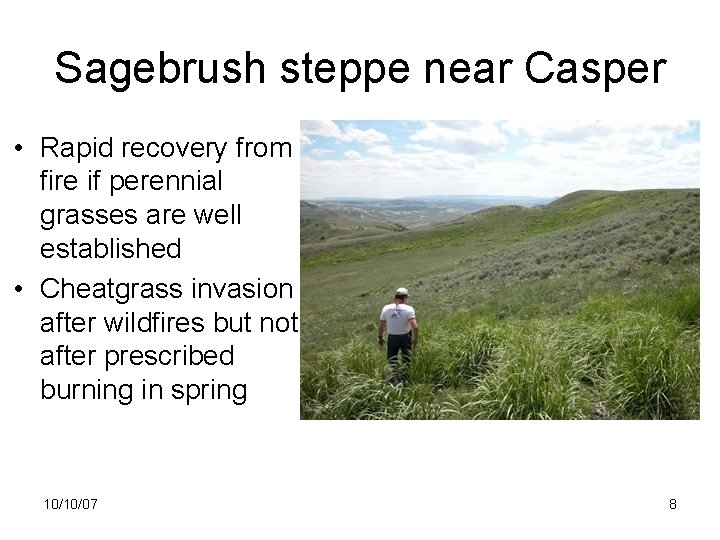
Sagebrush steppe near Casper • Rapid recovery from fire if perennial grasses are well established • Cheatgrass invasion after wildfires but not after prescribed burning in spring 10/10/07 8
Two subdivisions… • Great Basin Sagebrush: more arid, more bare ground, fewer taxa with more intraspecific variation – More cool-season grasses in western part of range, more warm-season sod-forming grasses in eastern part of range – “Islands of fertility” have developed, with much lower grass cover between shrubs; herbs grow under shrubs, nutrients accumulate there – Great Basin sagebrush type is thus more susceptible to erosion and degradation than sagebrush steppe 10/10/07 9
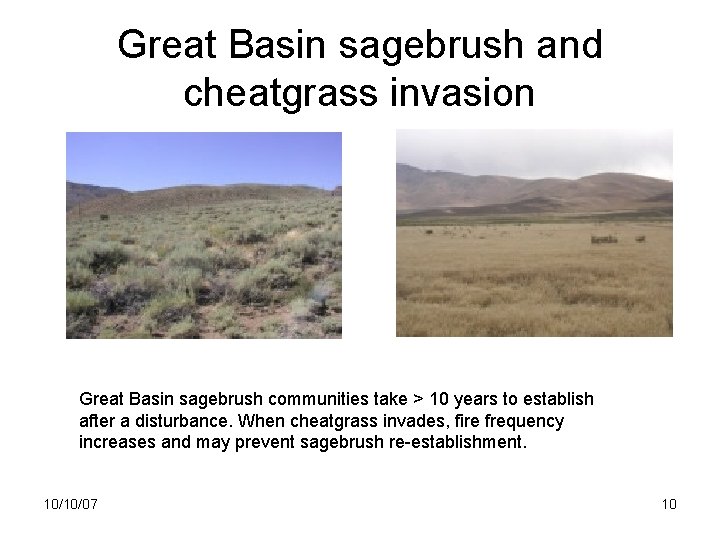
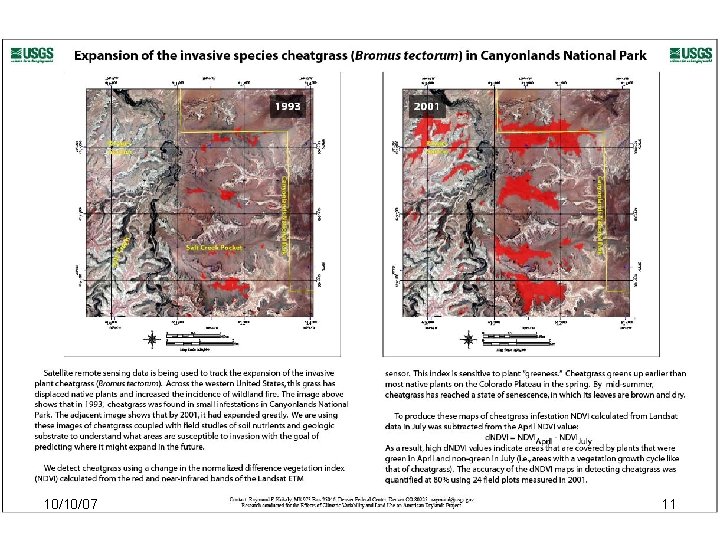
Great Basin sagebrush and cheatgrass invasion Great Basin sagebrush communities take > 10 years to establish after a disturbance. When cheatgrass invades, fire frequency increases and may prevent sagebrush re-establishment. 10/10/07 10
10/10/07 11
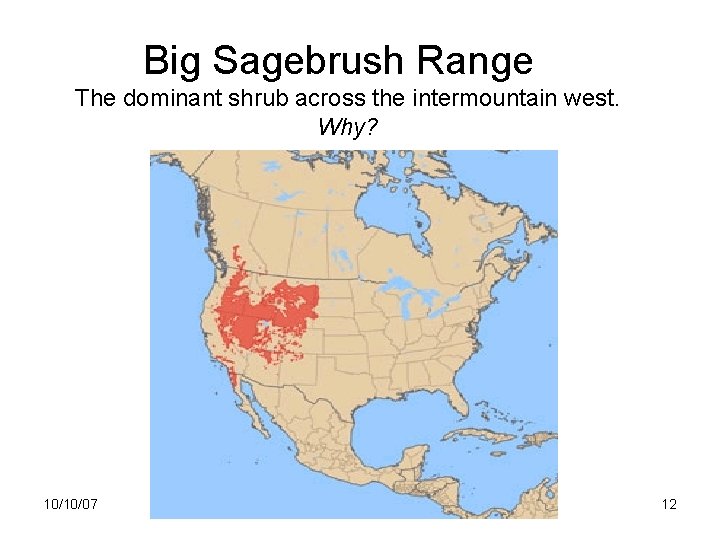
Big Sagebrush Range The dominant shrub across the intermountain west. Why? 10/10/07 12
Some sagebrush drought adaptations • Artemesia leaves are very hairy • Also seasonally dimorphic – Spring leaves are large, fall off when soil dries out – Early summer leaves are small, persist through winter – Photosynthesis occurs during winter • A. tridentata has 2 root systems: taproot for obtaining deep water; shallow, fibrous roots for rapid acquisition of nutrients and water • Plant hydraulics: small xylem vessels, low water potential, high resistance to cavitation 10/10/07 13
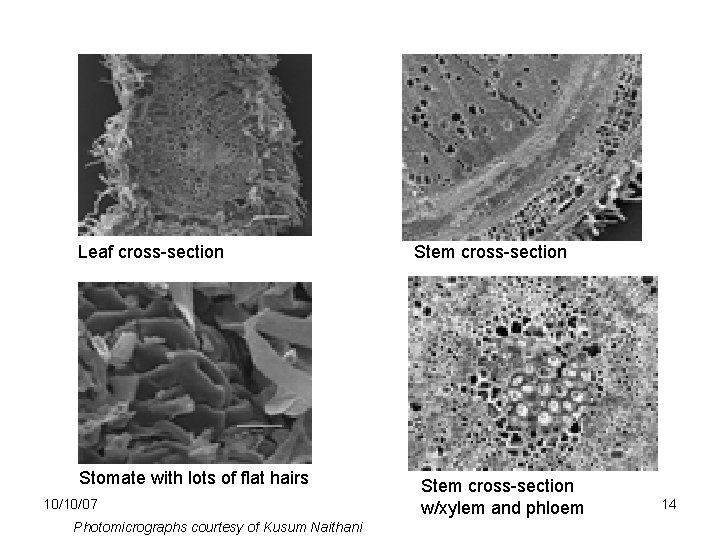
Leaf cross-section Stomate with lots of flat hairs 10/10/07 Photomicrographs courtesy of Kusum Naithani Stem cross-section w/xylem and phloem 14
More Sagebrush Adaptations • Seedling recruitment is likely to coincide with wet episodes • Plants are long-lived (100 years or more) but most species do not resprout after burning • Is sagebrush r-selected or K-selected? • Terpenes reduce herbivory defenses – Terpenoids are qualitative and not quantitative defenses – Livestock avoid sagebrush but native ungulates utilize for winter browse 10/10/07 15
Sagebrush species groups • Two main groups of sagebrush species: tall and low • Different species can be segregated along soil moisture and temperature gradients • Seedling establishment is critical in determining distributions – A. tridentata ssp. wyomingensis seeds germinate readily in moist hollows in early spring, but not if any salts are present – Many don’t survive the dry summer – 6 months later, no viable seeds are present 10/10/07 16
Ordination of major sagebrush types against elevation and moisture gradients (Knight, 1994, Fig. 6. 3) 10/10/07 17
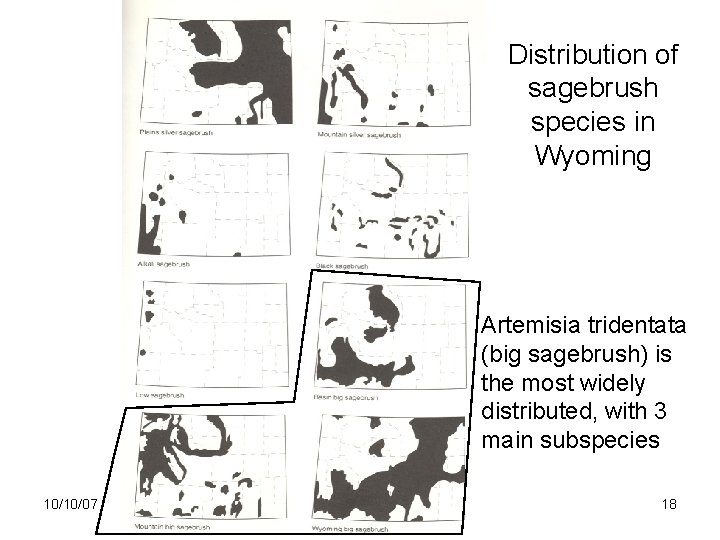
Distribution of sagebrush species in Wyoming Artemisia tridentata (big sagebrush) is the most widely distributed, with 3 main subspecies 10/10/07 18
Big Sagebrush Subspecies • There are three subspecies of sagebrush found along elevation and moisture gradients – Morphological and physiological differences are maintained in common garden experiments • Wyoming big sagebrush (spp. Wyomingensis) – Consistently tetraploid – Low elevation and dry end of moisture limit • Basin big sagebrush (spp. tridentata) – Diploid or tetraploid – Intermediate elevation and moisture limit • Mountain big sagebrush (spp. vaseyana) – Consistently diploid – High elevation and moisture limit 10/10/07 19
- Slides: 19