
Cold Spray Additive Manufacturing C Garion Outline Cold


- Slides: 19
Cold Spray Additive Manufacturing C. Garion Outline Cold spray technology: • • Principle Advantage Possible applications in accelerators: • • • Local coating Additive manufacturing New materials Applications of cold spray to UHV systems • • Thermal outgassing Leak tightness Conclusion Vacuum, Surfaces & Coatings Group Technology Department C. Garion, FCC week, 12 th April 2018 2
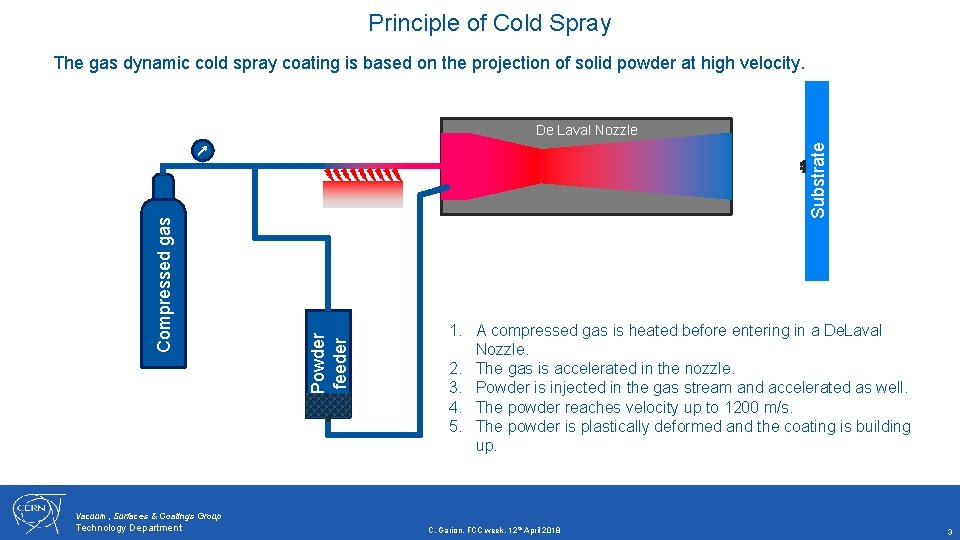
Principle of Cold Spray The gas dynamic cold spray coating is based on the projection of solid powder at high velocity. Substrate Powder feeder Compressed gas De Laval Nozzle 1. A compressed gas is heated before entering in a De. Laval Nozzle. 2. The gas is accelerated in the nozzle. 3. Powder is injected in the gas stream and accelerated as well. 4. The powder reaches velocity up to 1200 m/s. 5. The powder is plastically deformed and the coating is building up. Vacuum, Surfaces & Coatings Group Technology Department C. Garion, FCC week, 12 th April 2018 3
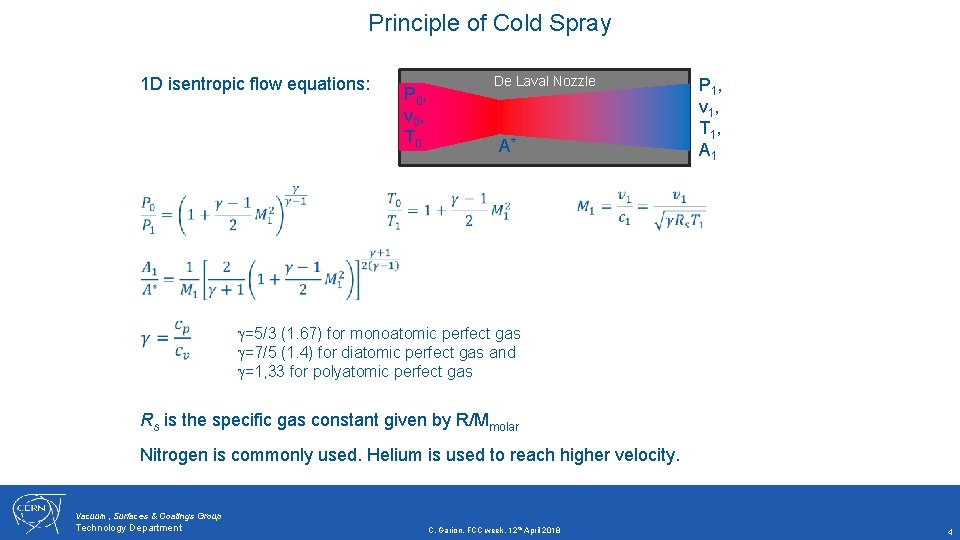
Principle of Cold Spray 1 D isentropic flow equations: P 0, v 0, T 0 De Laval Nozzle A* P 1, v 1, T 1 , A 1 g=5/3 (1. 67) for monoatomic perfect gas g=7/5 (1. 4) for diatomic perfect gas and g=1, 33 for polyatomic perfect gas Rs is the specific gas constant given by R/Mmolar Nitrogen is commonly used. Helium is used to reach higher velocity. Vacuum, Surfaces & Coatings Group Technology Department C. Garion, FCC week, 12 th April 2018 4
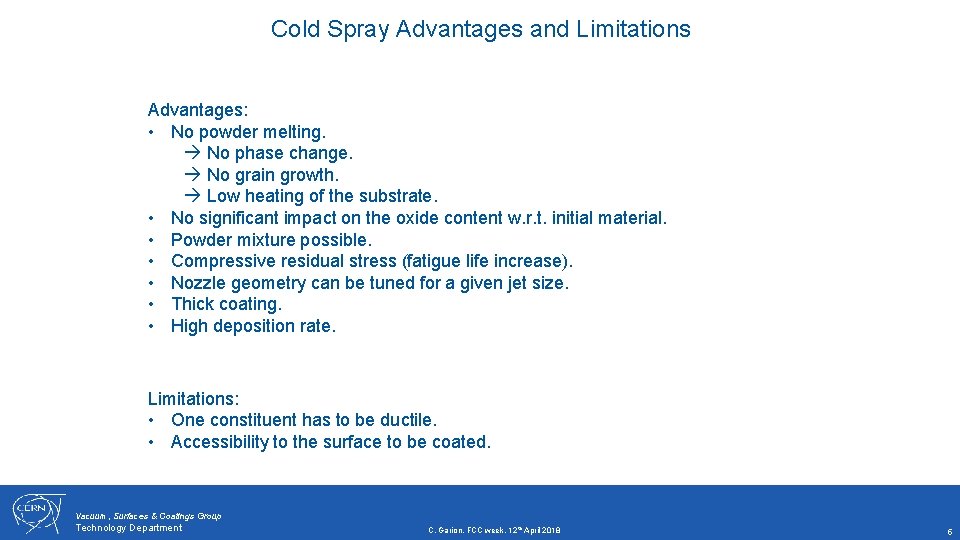
Cold Spray Advantages and Limitations Advantages: • No powder melting. No phase change. No grain growth. Low heating of the substrate. • No significant impact on the oxide content w. r. t. initial material. • Powder mixture possible. • Compressive residual stress (fatigue life increase). • Nozzle geometry can be tuned for a given jet size. • Thick coating. • High deposition rate. Limitations: • One constituent has to be ductile. • Accessibility to the surface to be coated. Vacuum, Surfaces & Coatings Group Technology Department C. Garion, FCC week, 12 th April 2018 5
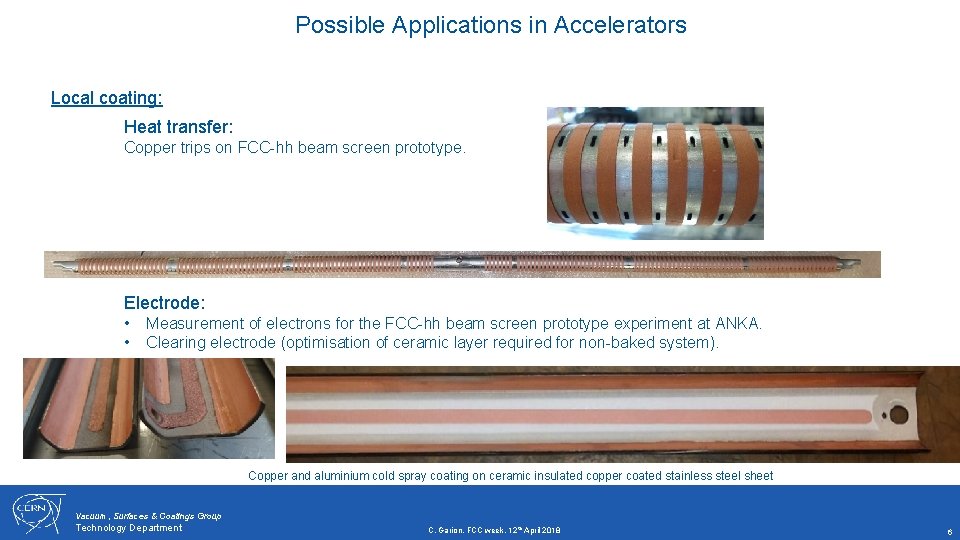
Possible Applications in Accelerators Local coating: Heat transfer: Copper trips on FCC-hh beam screen prototype. Electrode: • • Measurement of electrons for the FCC-hh beam screen prototype experiment at ANKA. Clearing electrode (optimisation of ceramic layer required for non-baked system). Copper and aluminium cold spray coating on ceramic insulated copper coated stainless steel sheet Vacuum, Surfaces & Coatings Group Technology Department C. Garion, FCC week, 12 th April 2018 6
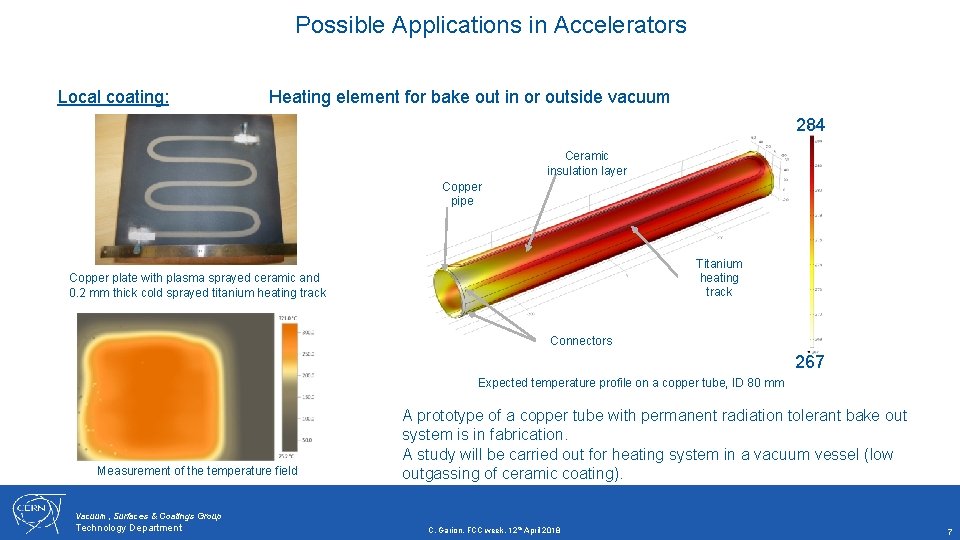
Possible Applications in Accelerators Local coating: Heating element for bake out in or outside vacuum 284 Ceramic insulation layer Copper pipe Titanium heating track Copper plate with plasma sprayed ceramic and 0. 2 mm thick cold sprayed titanium heating track Connectors 267 Expected temperature profile on a copper tube, ID 80 mm Measurement of the temperature field A prototype of a copper tube with permanent radiation tolerant bake out system is in fabrication. A study will be carried out for heating system in a vacuum vessel (low outgassing of ceramic coating). Vacuum, Surfaces & Coatings Group Technology Department C. Garion, FCC week, 12 th April 2018 7
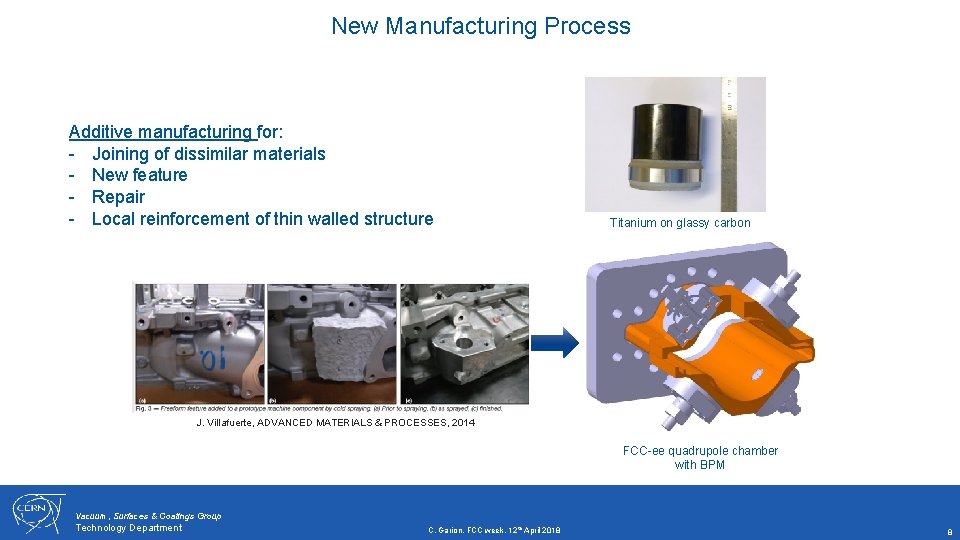
New Manufacturing Process Additive manufacturing for: - Joining of dissimilar materials - New feature - Repair - Local reinforcement of thin walled structure Titanium on glassy carbon J. Villafuerte, ADVANCED MATERIALS & PROCESSES, 2014 FCC-ee quadrupole chamber with BPM Vacuum, Surfaces & Coatings Group Technology Department C. Garion, FCC week, 12 th April 2018 8
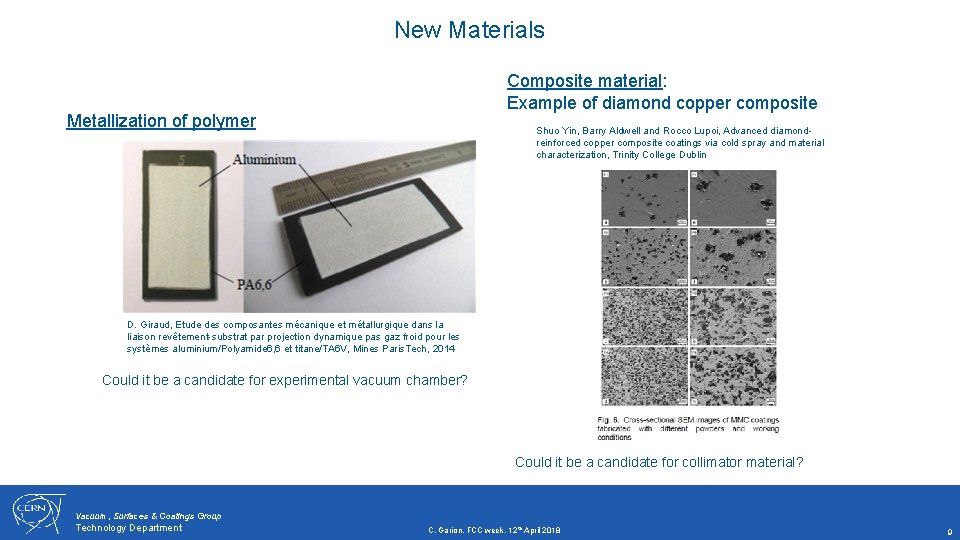
New Materials Composite material: Example of diamond copper composite Metallization of polymer Shuo Yin, Barry Aldwell and Rocco Lupoi, Advanced diamondreinforced copper composite coatings via cold spray and material characterization, Trinity College Dublin D. Giraud, Etude des composantes mécanique et métallurgique dans la liaison revêtement-substrat par projection dynamique pas gaz froid pour les systèmes aluminium/Polyamide 6, 6 et titane/TA 6 V, Mines Paris. Tech, 2014 Could it be a candidate for experimental vacuum chamber? Could it be a candidate for collimator material? Vacuum, Surfaces & Coatings Group Technology Department C. Garion, FCC week, 12 th April 2018 9
Application of Cold Spray for UHV system Requirements for UHV applications: • Outside vacuum chamber: not relevant. • In vacuum applications: low outgassing rate. • Vacuum barrier: - Low outgassing rate. - Leak tightness. Ceramic plasma spray underlayer might be applied for some applications. Same requirements apply. Vacuum, Surfaces & Coatings Group Technology Department C. Garion, FCC week, 12 th April 2018 10
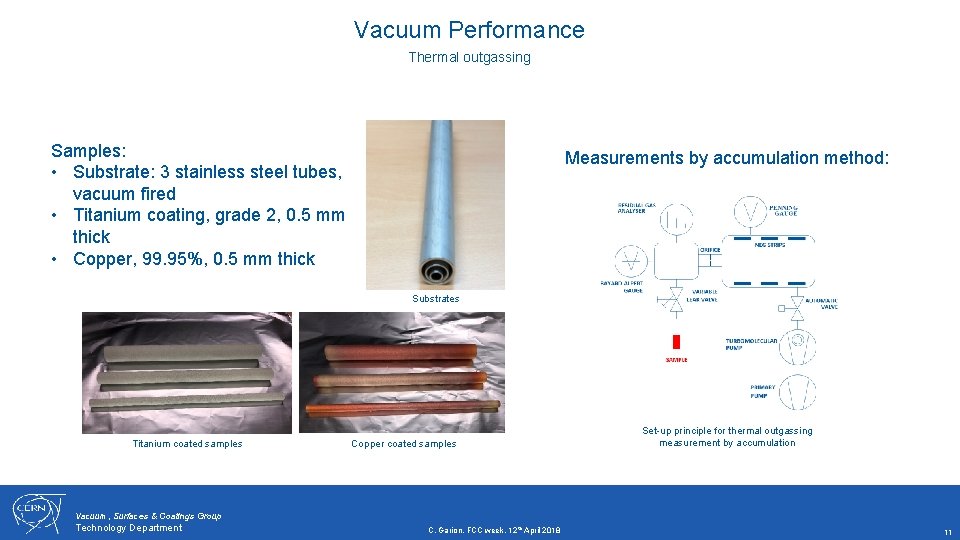
Vacuum Performance Thermal outgassing Samples: • Substrate: 3 stainless steel tubes, vacuum fired • Titanium coating, grade 2, 0. 5 mm thick • Copper, 99. 95%, 0. 5 mm thick Measurements by accumulation method: Substrates Titanium coated samples Copper coated samples Set-up principle for thermal outgassing measurement by accumulation Vacuum, Surfaces & Coatings Group Technology Department C. Garion, FCC week, 12 th April 2018 11
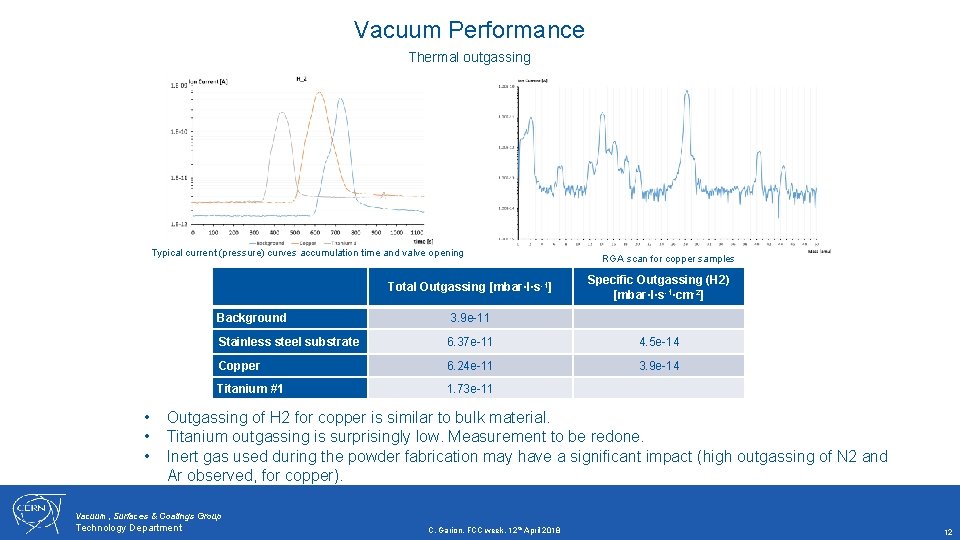
Vacuum Performance Thermal outgassing Typical current (pressure) curves accumulation time and valve opening Total Outgassing [mbar·l·s-1] Specific Outgassing (H 2) [mbar·l·s-1·cm-2] Background 3. 9 e-11 Stainless steel substrate 6. 37 e-11 4. 5 e-14 Copper 6. 24 e-11 3. 9 e-14 Titanium #1 1. 73 e-11 • • • RGA scan for copper samples Outgassing of H 2 for copper is similar to bulk material. Titanium outgassing is surprisingly low. Measurement to be redone. Inert gas used during the powder fabrication may have a significant impact (high outgassing of N 2 and Ar observed, for copper). Vacuum, Surfaces & Coatings Group Technology Department C. Garion, FCC week, 12 th April 2018 12
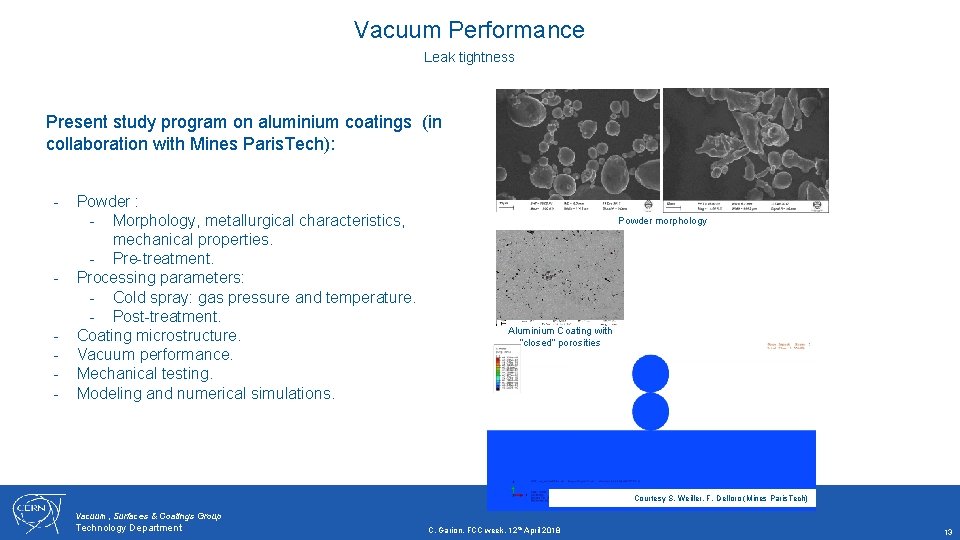
Vacuum Performance Leak tightness Present study program on aluminium coatings (in collaboration with Mines Paris. Tech): - - Powder : - Morphology, metallurgical characteristics, mechanical properties. - Pre-treatment. Processing parameters: - Cold spray: gas pressure and temperature. - Post-treatment. Coating microstructure. Vacuum performance. Mechanical testing. Modeling and numerical simulations. Powder morphology Aluminium Coating with “closed” porosities Courtesy S. Weiller, F. Delloro (Mines Paris. Tech) Vacuum, Surfaces & Coatings Group Technology Department C. Garion, FCC week, 12 th April 2018 13
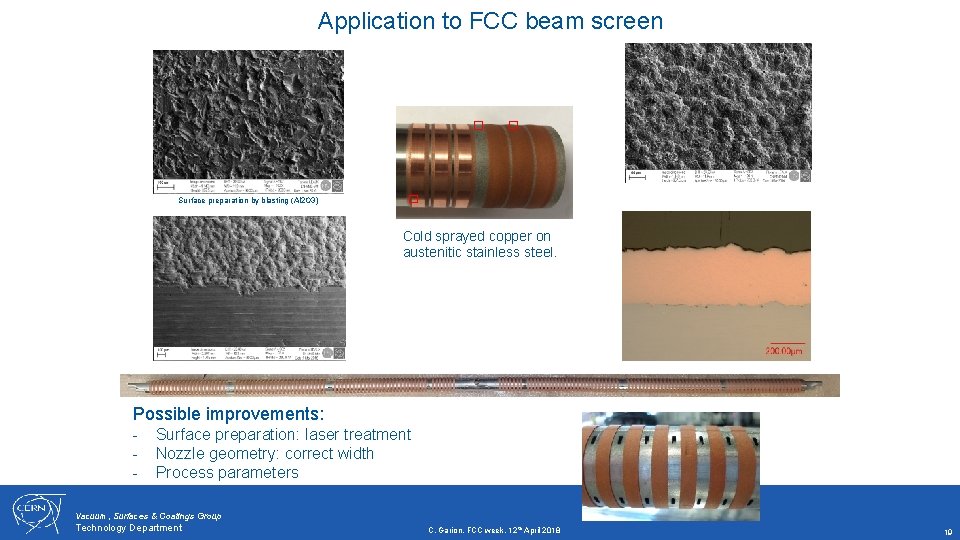
Conclusions Gas dynamic cold spray is a coating method based on supersonic jet of powders, heavily plastically deformed during the impact. Ductile materials are well suitable for this manufacturing process. Cold sprayed copper coating has been successfully been applied on a first FCC-hh beam screen prototype. Other applications have been identified in different field of high energy particle accelerators. First tests are ongoing. A study is carried out at CERN to assess the vacuum performance of cold sprayed materials. Vacuum, Surfaces & Coatings Group Technology Department C. Garion, FCC week, 12 th April 2018 14
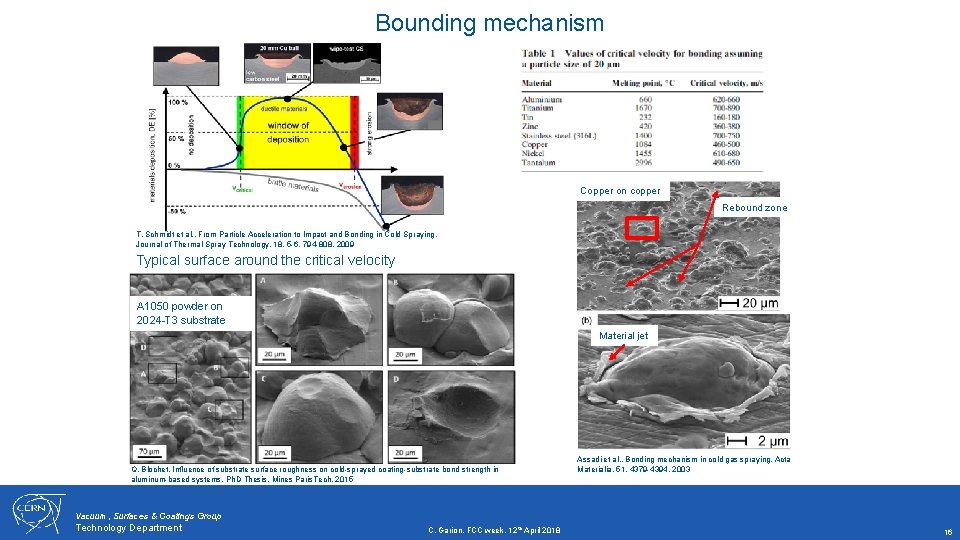
Bounding mechanism Copper on copper Rebound zone T. Schmidt et al. , From Particle Acceleration to Impact and Bonding in Cold Spraying, Journal of Thermal Spray Technology, 18, 5 -6, 794 -808, 2009 Typical surface around the critical velocity A 1050 powder on 2024 -T 3 substrate Material jet Q. Blochet, Influence of substrate surface roughness on cold-sprayed coating-substrate bond strength in aluminum-based systems, Ph. D Thesis, Mines Paris. Tech, 2015 Assadi et al. , Bonding mechanism in cold gas spraying, Acta Materialia, 51, 4379 -4394, 2003 Vacuum, Surfaces & Coatings Group Technology Department C. Garion, FCC week, 12 th April 2018 16
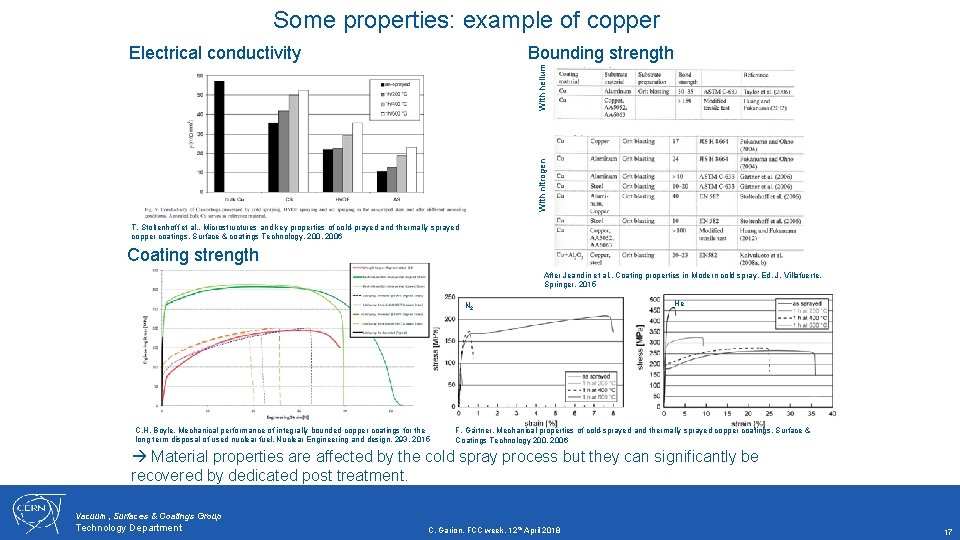
Some properties: example of copper Bounding strength With nitrogen With helium Electrical conductivity T. Stoltenhoff et al. , Microstructures and key properties of cold-prayed and thermally sprayed copper coatings, Surface & coatings Technology, 2006 Coating strength After Jeandin et al. , Coating properties in Modern cold spray, Ed. J. Villafuerte, Springer, 2015 N 2 C. H. Boyle, Mechanical performance of integrally bounded copper coatings for the long term disposal of used nuclear fuel, Nuclear Engineering and design, 293, 2015 He F. Gärtner, Mechanical properties of cold-sprayed and thermally sprayed copper coatings, Surface & Coatings Technology 200, 2006 Material properties are affected by the cold spray process but they can significantly be recovered by dedicated post treatment. Vacuum, Surfaces & Coatings Group Technology Department C. Garion, FCC week, 12 th April 2018 17
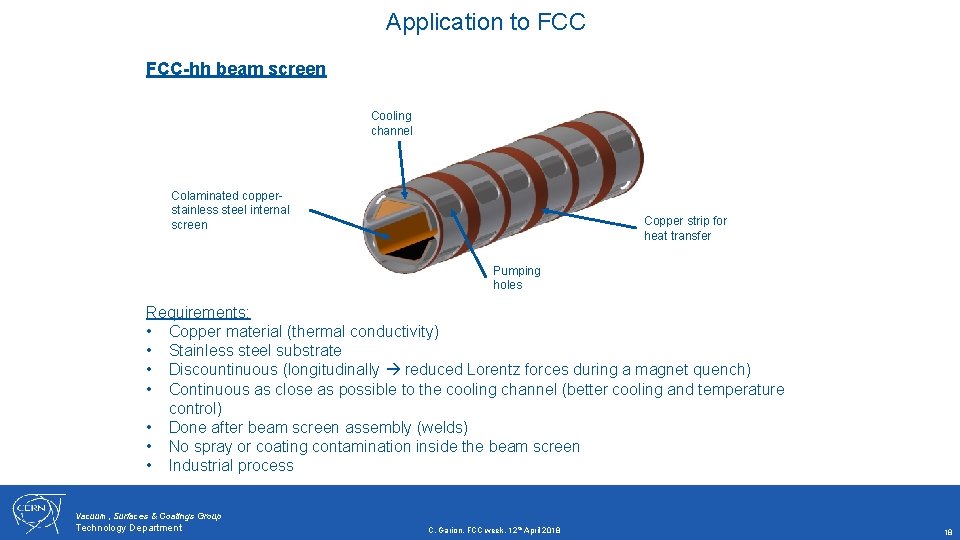
Application to FCC-hh beam screen Cooling channel Colaminated copper- stainless steel internal screen Copper strip for heat transfer Pumping holes Requirements: • Copper material (thermal conductivity) • Stainless steel substrate • Discountinuous (longitudinally reduced Lorentz forces during a magnet quench) • Continuous as close as possible to the cooling channel (better cooling and temperature control) • Done after beam screen assembly (welds) • No spray or coating contamination inside the beam screen • Industrial process Vacuum, Surfaces & Coatings Group Technology Department C. Garion, FCC week, 12 th April 2018 18
Application to FCC beam screen Surface preparation by blasting (Al 2 O 3) Cold sprayed copper on austenitic stainless steel. Possible improvements: - Surface preparation: laser treatment Nozzle geometry: correct width Process parameters Vacuum, Surfaces & Coatings Group Technology Department C. Garion, FCC week, 12 th April 2018 19