
Cold Emergencies Prepared by Steven Jones EMTP Thermoregulation
Cold Emergencies Prepared by: Steven Jones, EMT-P
Thermoregulation Homeostasis requires stable temperature ~98. 6ºF
Thermoregulation n Control mechanism 4 Hypothalamus 4 Peripheral n thermoreceptors Balance between heat production, heat loss
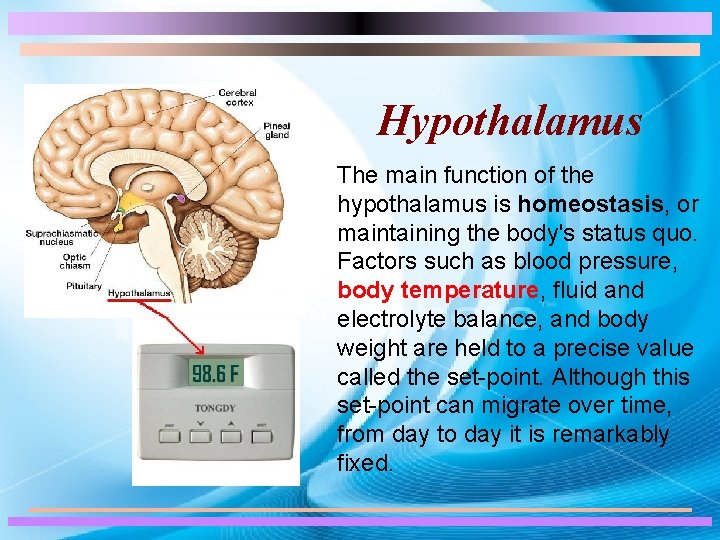
Hypothalamus The main function of the hypothalamus is homeostasis, or maintaining the body's status quo. Factors such as blood pressure, body temperature, fluid and electrolyte balance, and body weight are held to a precise value called the set-point. Although this set-point can migrate over time, from day to day it is remarkably fixed.
Heat Production n Metabolism Voluntary large muscle movement Shivering
Heat Loss n n Conduction Convection Radiation Evaporation 4 Skin 4 Respiratory tract
Heat Loss > Heat Production Decreased Body Temperature
Cold Induced Illness n Results from: 4 Decrease in body temperature outside normal range 4 Prolonged efforts to compensate
Cold-Related Illness n n Local cold injury Generalized cooling
Localized Cold Injury n Nonfreezing 4 Chilblains 4 Trench n foot Freezing 4 Frostnip 4 Frostbite
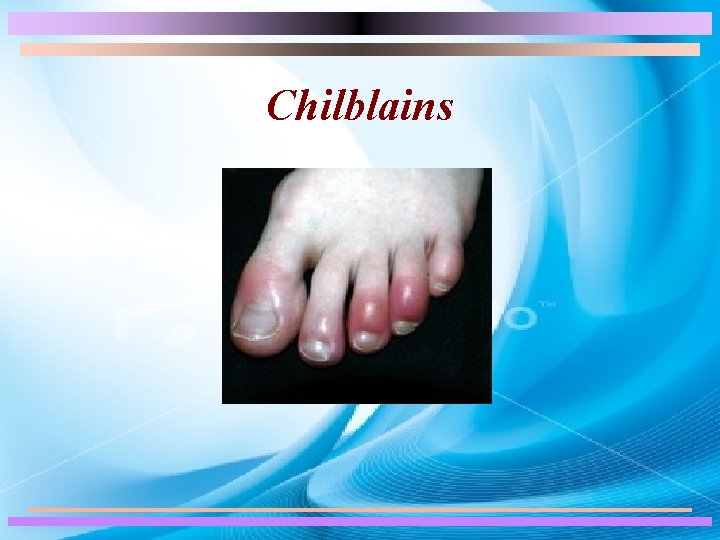
Chilblains n n n Caused by chronic exposure to damp, nonfreezing ambient temperatures Painful, inflammatory lesions on skin Hands, ears, lower legs, feet common sites Pruritus, burning, paresthesias Tends to recur Rewarm, bandage, elevate
Chilblains
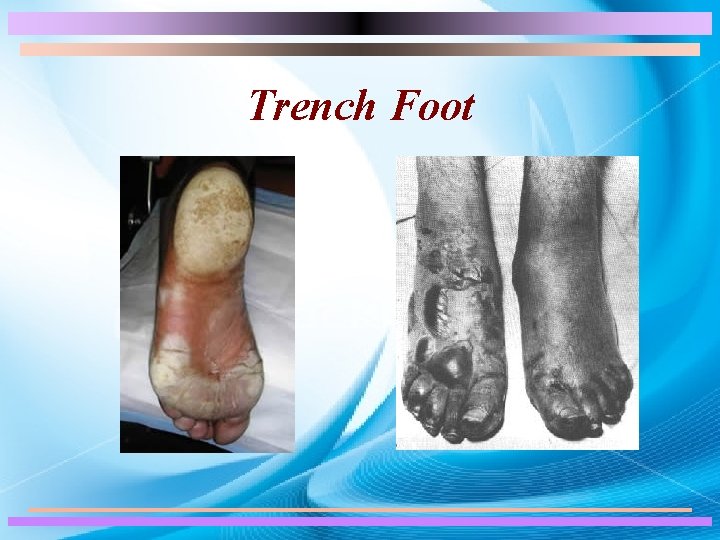
Trench Foot n n Caused by prolonged skin exposure to cool, wet conditions Skin becomes pale and mottled Sloughing, gangrene may occur Clean, warm, dry bandages; elevation
Trench Foot
Frostnip/Frostbite n n Local freezing of tissue Commonly affected areas: 4 Toes, feet 4 Hands, fingers 4 Nose 4 Ears
Frostnip/Frostbite n Risk Factors 4 Poor clothing 4 Poor nutrition 4 Diabetes 4 Decreased tissue perfusion » Tobacco, tight clothing 4 Vasodilation » ETOH, medications
Frostnip/Frostbite n Pathophysiology: Phase I 4 Exposure to cold 4 Vasoconstriction 4 Decreased blood flow to periphery 4 Ice crystal formation in extracellular space, ischemia 4 Cellular dehydration, hyperosmolarity
Frostnip/Frostbite n Pathophysiology: Phase I 4 Edema 4 Increased pressure, blood vessel damage 4 Worsened ischemia 4 Destruction of cellular components
Frostnip/Frostbite n Pathophysiology: Phase II 4 Tissue is rewarmed 4 Blood flow returns 4 Damaged capillaries leak fluid 4 Swelling occurs 4 Sludging of blood, thrombus formation occurs
Frostnip n n Extremity appears pale, discomfort present No extracellular ice crystal formation Symptoms resolve on rewarming Tissue loss does not occur
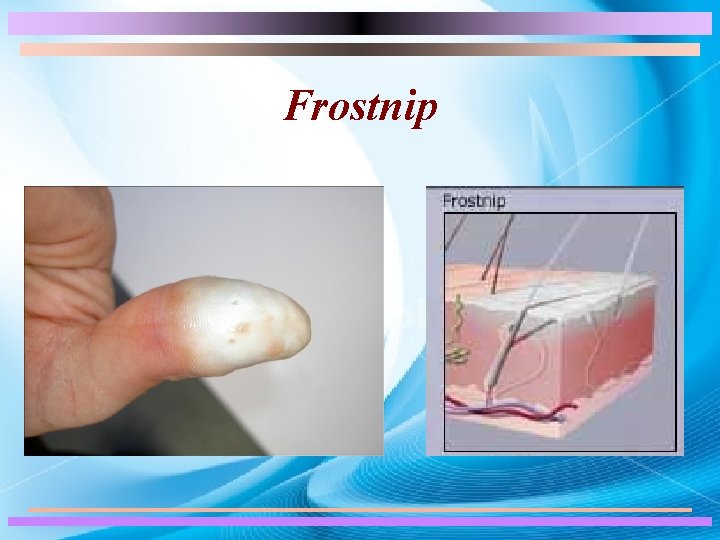
Frostnip
Frostbite Extent of injury frequently cannot be determined until rewarming occurs
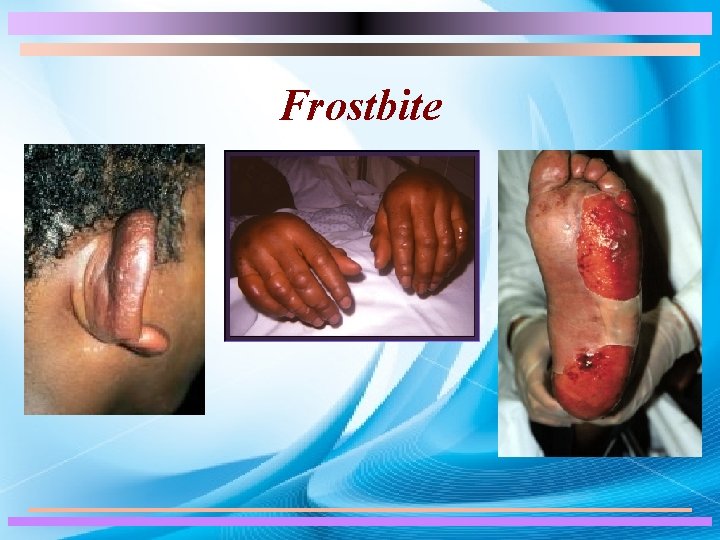
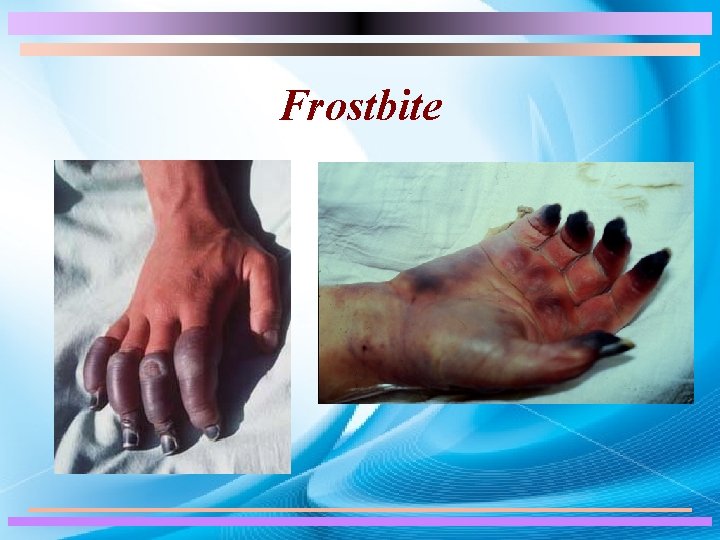
Frostbite n Signs/Symptoms 41 st degree » Partial skin freezing; redness, mild edema; lack of blisters 42 nd degree » Full thickness freezing; substantial edema, formation of clear blisters
Frostbite n Signs/Symptoms 43 rd degree » Full-thickness skin and subcutaneous freezing; hemorrhagic blisters, skin necrosis, bluish-gray discoloration 44 th degree » Full-thickness damage affecting muscles, tendons, bones; little edema, initially mottled or cyanotic, eventually dry, black, mummified
Frostbite
Frostbite
Frostbite n Management: Short transport 4 ABCs 4 Protect affected area » Bandage » Avoid rewarming, thawing 4 Prevent, treat hypothermia » Remove wet or constrictive clothing » Dry patient » Warm IV fluids 4 Minimal analgesics (NSAIDS) for pain
Frostbite n Management: Long transport 4 Remove patient from cold 4 Remove clothing from affected area 4 Rewarm in water 100 - 1050 F until flushing/tingling present 4 Dry gently, bandage 4 Treat concurrent hypothermia 4 Analgesia for pain
Frostbite n Do NOT: 4 Allow refreezing 4 Massage injured part 4 Allow patient to smoke 4 Puncture or drain blebs
Hypothermia n n Core Temp < 95 ºF May be caused by: 4 Decreased heat production 4 Excess heat loss n Various associated factors 4 Environment (temperature, wet vs. dry) 4 Energy (food, water) 4 Ambulatory ability
Hypothermia n Risk factors 4 Extremes of age 4 Those outdoors 4 Hypothyroidism 4 Diabetes, hypoglycemia 4 Alcohol, depressant drug abuse 4 Poor nutrition
Hypothermia n Pathophysiology 4 Immediate vasoconstriction 4 Catecholamine release 4 Increased HR, RR, BP 4 Shivering until » glucose depleted » temperature below 90 o. F 4 Shivering stops rapid cooling 4 Eventual in RR, HR, BP 4 Cardiac Arrest < 86 ºF
Hypothermia n Pathophysiology 4 Decreased oxygen release to tissues 4 Depression of insulin release, effectiveness 4 Hyperglycemia 4 Depression of ADH release 4 Increased urine output, “cold diuresis”
Hypothermia n Signs/Symptoms 4 Pallor, shivering 4 Ataxic gait 4 Apathy, drowsiness, coma 4 Slowing pulse rate, respirations 4 Cardiac arrest
Hypothermia Altered LOC + Cool Environment = THINK Hypothermia
Hypothermia n ECG changes (mostly late) 4 Bradycardia (possibly unresponsive to atropine) 4 Small, absent P wave 4 Abnormal ST segments, T waves 4 J wave (Osborn Wave)
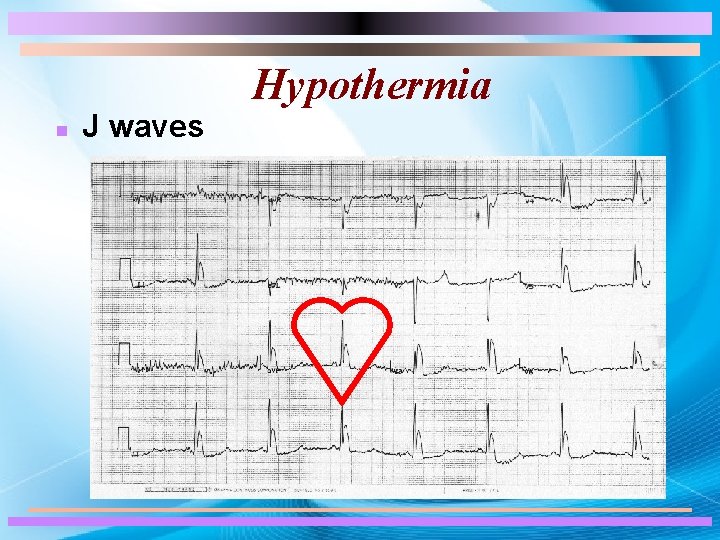
n J waves Hypothermia
Hypothermia n Management 4 Mild = core temperature 90 -95 o. F 4 Moderate = core temperature 86 -89 o. F 4 Severe = core temperature <86 o. F
Hypothermia n Management: Mild Hypothermia 4 Handle gently 4 Prevent further heat loss 4 Insulate from cold 4 Add heat to head, neck, chest, groin 4 Warm oral fluids after uncontrolled shivering stops
Hypothermia n Management: Moderate Hypothermia 4 Prevent further heat loss » Remove wet clothing » Cover with blankets 4 Avoid active rewarming 4 IV with NS 4 EKG
Hypothermia n Management: Severe Hypothermia 4 Secure airway/assist ventilations 4 Do NOT hyperventilate 4 Avoid rough handling 4 Prevent further heat loss » Remove wet clothing » Cover with blankets 4 EKG, IV with NS 4 Internal rewarming only
Hypothermia n Hypothermic Cardiac Arrest 4< 86 ºF » Limit 3 shocks » No medications 4> 86 ºF » drug dosing intervals » Repeat shocks as core temp rises
Hypothermia n Hypothermic Cardiac Arrest 4 Resuscitate aggressively 4 Little consideration given to terminating resuscitation efforts
Hypothermia They’re not dead until they’re warm and dead !!
- Slides: 44