
COLD CHAIN IN KENYA BY DUNCAN SEDA DEPUTY
COLD CHAIN IN KENYA BY DUNCAN SEDA DEPUTY NATIONAL LOGISTICIAN/ NATIONAL COLD CHAIN TECHNOLOGIST INCHARGE 19 TH November 2008
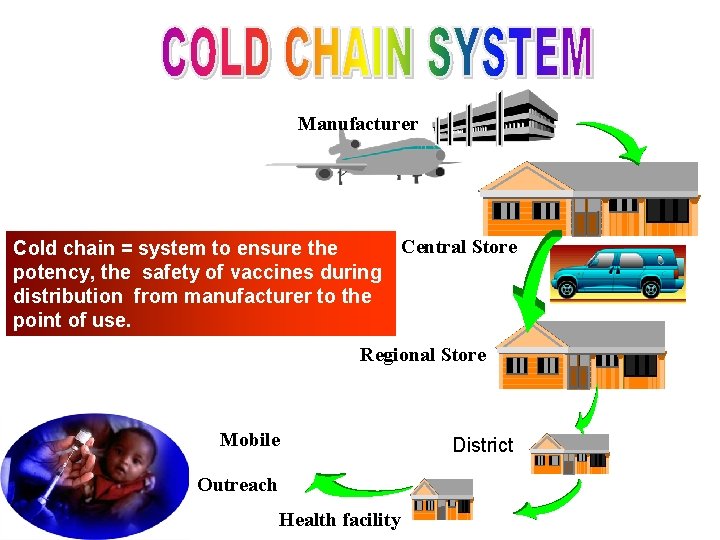
Manufacturer Central Store Cold chain = system to ensure the potency, the safety of vaccines during distribution from manufacturer to the point of use. Regional Store Mobile Outreach Health facility District
History of immunization • The earliest vaccination known is the deliberate variolation practices which was being practiced in Africa, China and Asia to protect the natives from contracting small pox from those who were already infected with small pox • Variolation means A deliberate inoculation of a person with small pox materials in order to prevent the person from getting small pox This practice was introduced in Europe by LADY WORTLEY MONTANGU in 1721 the wife of the English Ambassador in Turkey in 1721 • 1796 Edward Jenner developed this further and gave the first inoculation to an 8 year boy with cowpox material and the boy developed immunity against small pox
History of immunization Cont. • The word vaccination was derived from a Latin word for cow the vacca which replaced the word variolation after Jenner announced his findings after the use of the cowpox material to protect the natives from small pox
Kenyan situation • Immunization started in Kenya far back in – 1906 specifically against small pox – followed by BCG sometimes just before the second world war in 1949. – Against Polio and measles in the early 60 s – DPT were introduced in the late 60 s – And Penta valent in 2001
Introduction of EPI • The birth of EPI was far back in 1974 • In Africa it was in 1978 in Accra Ghana
Why was EPI started • Out of the 15 million children born in Africa annually 1 million were dying due to one or more of the vaccine preventable diseases while almost • 500, 000 were disabled due to the same childhood vaccine preventable diseases. • In Kenya about 250 children were dying monthly because of measles
Why cont. …. . • Low immunization coverage which ranged to as low as 5% to 20 % • Frequent use of non potent vaccines due to limited cold chain facilities. • Inadequate managerial skills among the health workers • Shortage of human and materials resources • Limited community participation • Lack of regular monitoring and periodic evaluations
Broad objectives of EPI when it was conceived • To provide immunization against the Six target diseases to all children of the world and tetanus toxoid for all pregnant women of child bearing age • To promote self reliance in immunization services in terms of vaccines production, funding and quality control • To integrate immunization services to the existing maternal and child health
Birth of KEPI It was started on and launched on 27 th June 1980 with the following specific objectives 1. Improve coverage for BCG and Measles to 75% by 1985 and 60% DPT, Polio and Tetanus toxoid 2. Establish cold chain in all the districts by equipping all hospitals, all health centres and 30% of all dispensaries from the 600 which were existing by then 3. Train 500 DHMT, 3000 HCs and Dispensary staff on EPI operational training and 1500 on cold chain by the end of 1986 4. Integration of KEPI to MCH/FP 5. Improve on social mobilization to increase the immunization demand 6. Monitoring and evaluation of all the immunization activities 7. Carry out periodical operational researches to address the programmes developments and challenges
Implementation -phases of KEPI There were 3 phases 1. The preparatory phase-1980 -1981 2. Demonstration and pre-testing phase-1981 -1982 3. Operational phase-1982 -1986 4. Consolidation phase-1987 -1990 5. Full implementations, sustainability and phase in of Government and phasing out of donors 1990 and beyond
Current Kenyan situation • The immunization system of Kenya has since changed to DVI with effect from 12 th July 2007 • Vision – To have a Nation free from vaccines preventable Diseases • Mission – To provide appropriates and equitable immunization services to the people of Kenya
DVI MANDATE • To provide policy and guidelines • Ensure adequate and timely logistics • Improve knowledge and skills of health workers • Monitor performance and increase demand for immunization services in Kenya
Rationale and Justification for the change from KEPI to DVI • The Ministry Health growth • Restructuring to improve efficiency, effectiveness of delivering of the health services • Increase in demand • Future global health challenges ie MDGs, 2030 health Strategy, and new vaccines
Which are these vaccines(Tradional EPI vaccines Routine) 1. 2. 3. 4. 5. 6. BCG OPV DPT-Hep. B-Hib Measles Yellow Fever TT for pregnant women and child bearing age women
Emergency Vaccines 1. Anti Rabies Vaccines 2. Ant-Snake Venom 3. Tetanus Toxoid for injuries/outpatient
Vaccines for risk Groups 1. Typhoid vaccines for food handlers ie in hotels, food productions firms Schools, food kiosks etc 2. Yellow fever for travellers 3. Hepatitis B for health workers
Aim and objectives 1. To provide full vaccination to more than 90% of all children below one in the country 2. To immunize pregnant women with at least two doses of Tetanus Toxoid. 3. To provide timely access to emergency vaccinations to all Kenyans
The Main Objectives of DVI 1. To ensure equitable access to emergency vaccinations for all Kenyans in need of this services 2. To ensure timely universal immunization of all infants with the Ministry of Health supported Vaccines 3. To ensure equitable access to recommended vaccines services for special risk groups such as health workers, institutionalized groups and travelers
DVI Pillars • • • LOGISTICS AND COLD CHAIN TRAINING COMMUNICATION AND SOCIAL MOBILIZATION MONITORING AND EVALUATION OPERATION RESEARCH SEASONAL SUPPLIMENTAL ACTIVITIES
Role of Medical Engineering • Medical Engineering staff form part of EPI logistics and cold chain team.
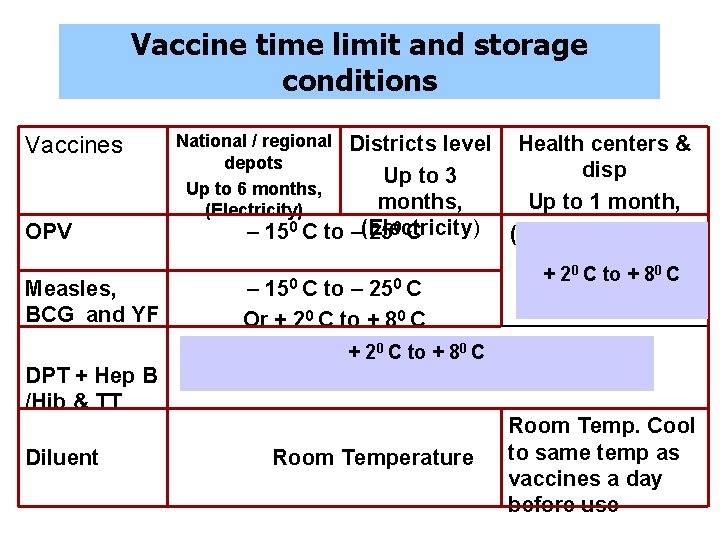
Vaccine time limit and storage conditions Vaccines OPV Measles, BCG and YF DPT + Hep B /Hib & TT Diluent National / regional depots Up to 6 months, (Electricity) Districts level Health centers & disp Up to 3 months, Up to 1 month, – 150 C to –(Electricity) 250 C (electricity or gas) – 150 C to – 250 C Or + 20 C to + 80 C Room Temperature Room Temp. Cool to same temp as vaccines a day before use
Management of Kenyan cold chain system • There are five levels of cold chain system – Central level (1) – Regional levels (6) – District levels (149) – Immunizing facility level (3300+) • The central level acts as referral and has 5 technical staffs. • The regional and districts levels depend on the provincial and districts staff.
Equipment and Spare parts procurement • Centralized to ensure quality is maintained. • Only equipment that are WHO/UNICEF approved have been recommended for use in the country • Equipment are supplied to all immunizing facilities irrespective of ownership • Equipment type have been standardized to ease spares procurement and maintenance
Training Continuous trainings are normally provided at two levels 1. Cold chain for Health workers 2. Cold chain for Medical Engineering staff
Challenges • All service delivery equipment are absorption systems. These pose the following challenges – High cost of fuel gas – High power consumption if on electricity • Cold chain equipment are basically refrigeration, this posses the following challenges – Undermined as people want to work on more sophisticated equipment – Not considered as medical equipment but general equipment.
Challenges Cont. • Sudden increase in the number of districts – Requires more equipment – Need maintenance staff – Some unable to solicit maintenance support from their mother districts forcing them to bring equipment to Nairobi or ask for direct support.
Conclusion • Immunization can only be achieved if there is a properly functional cold chain system. • Medical Engineers must see it as one the most important component of Medical Engineering.
END Thank you For enq: duncanseda 2004@yahoo. com
- Slides: 29