
Cohort study biases Akbar soltani Assistant Professor of

Cohort study: biases Akbar soltani Assistant Professor of Medicine and Endocrinology Evidence-Based Medicine Working Team (EBMWT) Tehran University of Medical Sciences (TUMS) Shariati Hospital EBMWT A. SOLTANI TUMS
Critical appraisal: Cohort Studies • Definition and Purpose • Types • Strengths & Weaknesses • PECO • Biases in Cohort Studies • Analysis EBMWT A. SOLTANI TUMS
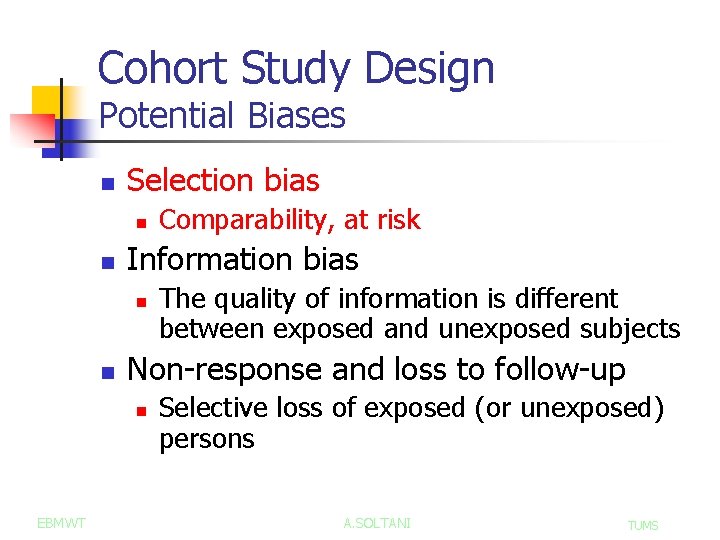
Cohort Study Design Potential Biases n Selection bias n n Information bias n n The quality of information is different between exposed and unexposed subjects Non-response and loss to follow-up n EBMWT Comparability, at risk Selective loss of exposed (or unexposed) persons A. SOLTANI TUMS
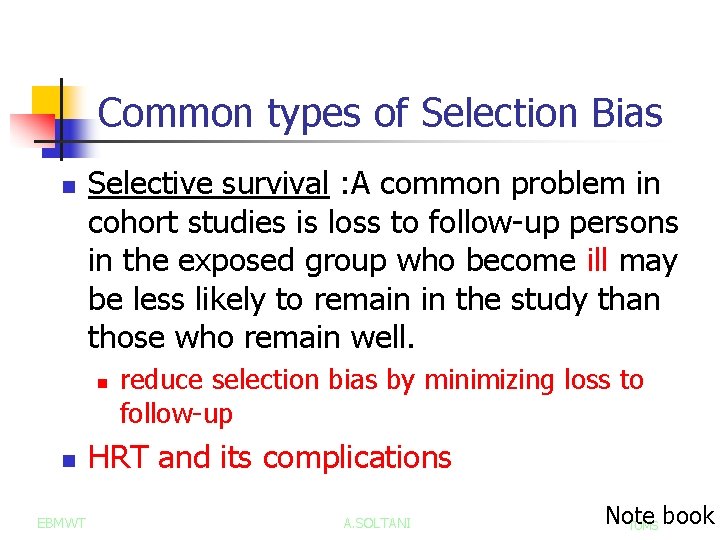
Common types of Selection Bias n Selective survival : A common problem in cohort studies is loss to follow-up persons in the exposed group who become ill may be less likely to remain in the study than those who remain well. n n EBMWT reduce selection bias by minimizing loss to follow-up HRT and its complications A. SOLTANI Note book TUMS

Common types of Selection Bias n n n EBMWT The procedure used to identify disease status varies with exposure status : For example, bias might occur in a study comparing incidence of HIV infection at two clinics if one used a verification test to determine HIV status and the other did not. Healthy worker effect: is a particular problem in occupational studies Therefore, in occupational exposure studies, where cases (or exposed subjects) are workers, controls (or nonexposed subjects) should also be workers, otherwise the association between exposure and disease will tend to be biased towards the null. A. SOLTANI TUMS
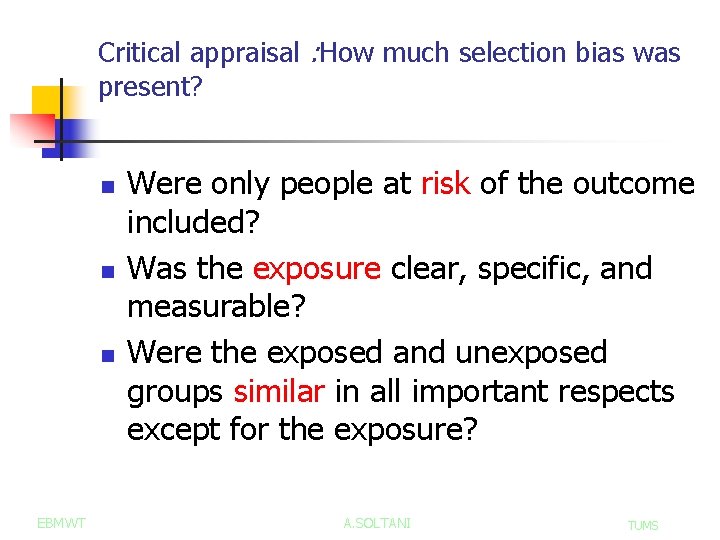
Critical appraisal : How much selection bias was present? n n n EBMWT Were only people at risk of the outcome included? Was the exposure clear, specific, and measurable? Were the exposed and unexposed groups similar in all important respects except for the exposure? A. SOLTANI TUMS
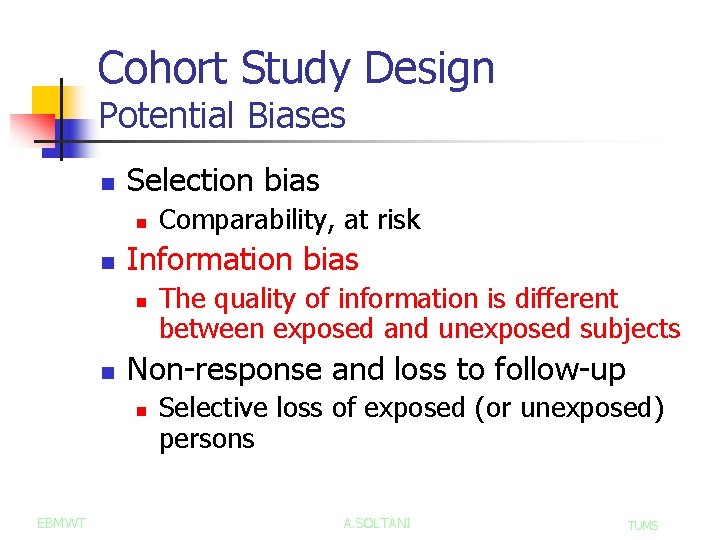
Cohort Study Design Potential Biases n Selection bias n n Information bias n n The quality of information is different between exposed and unexposed subjects Non-response and loss to follow-up n EBMWT Comparability, at risk Selective loss of exposed (or unexposed) persons A. SOLTANI TUMS

Information Bias : Misclassification of Exposure n Non-differential or random misclassification: n n Differential or non-random misclassification: n n n EBMWT Net effect is to increase similarity between exposed and nonexposed group Dilutes or underestimates the effect of the exposure, if present. Likely to occur in historical cohort studies (past records) Quality & extent of information obtained is different for exposed people than for nonexposed people Errors of classification related to exposure status (systematic error) Yields biased risk estimates: over or under estimates risk. A. SOLTANI TUMS
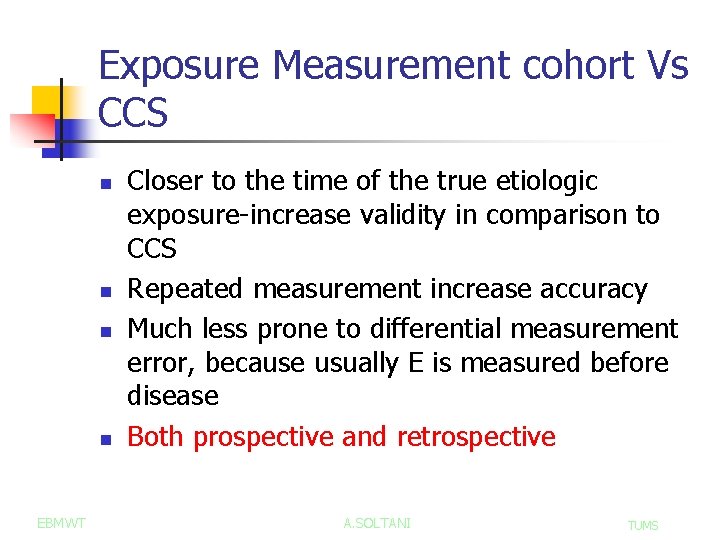
Exposure Measurement cohort Vs CCS n n EBMWT Closer to the time of the true etiologic exposure-increase validity in comparison to CCS Repeated measurement increase accuracy Much less prone to differential measurement error, because usually E is measured before disease Both prospective and retrospective A. SOLTANI TUMS
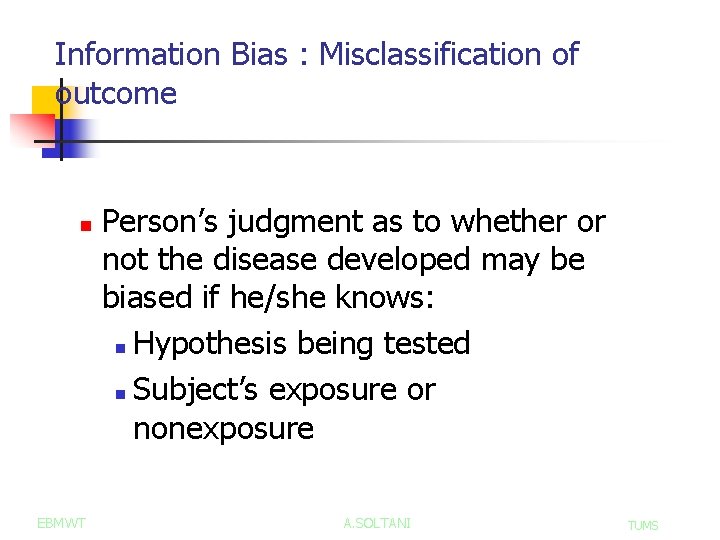
Information Bias : Misclassification of outcome n EBMWT Person’s judgment as to whether or not the disease developed may be biased if he/she knows: n Hypothesis being tested n Subject’s exposure or nonexposure A. SOLTANI TUMS
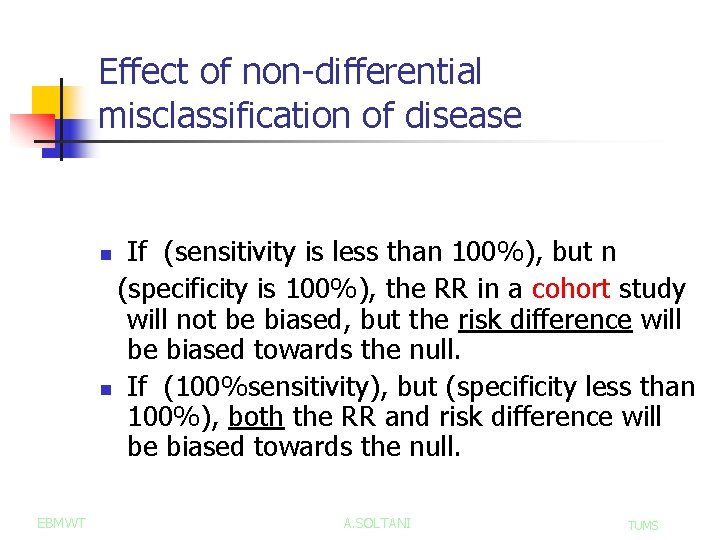
Effect of non-differential misclassification of disease If (sensitivity is less than 100%), but n (specificity is 100%), the RR in a cohort study will not be biased, but the risk difference will be biased towards the null. n If (100%sensitivity), but (specificity less than 100%), both the RR and risk difference will be biased towards the null. n EBMWT A. SOLTANI TUMS
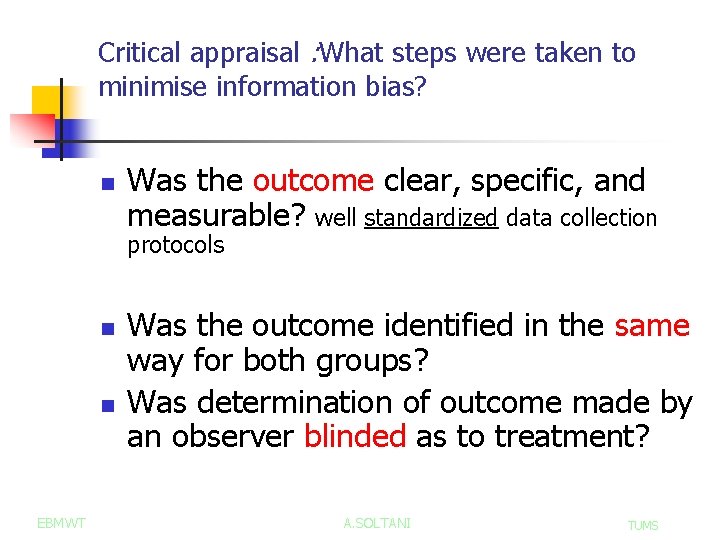
Critical appraisal : What steps were taken to minimise information bias? n Was the outcome clear, specific, and measurable? well standardized data collection protocols n n EBMWT Was the outcome identified in the same way for both groups? Was determination of outcome made by an observer blinded as to treatment? A. SOLTANI TUMS
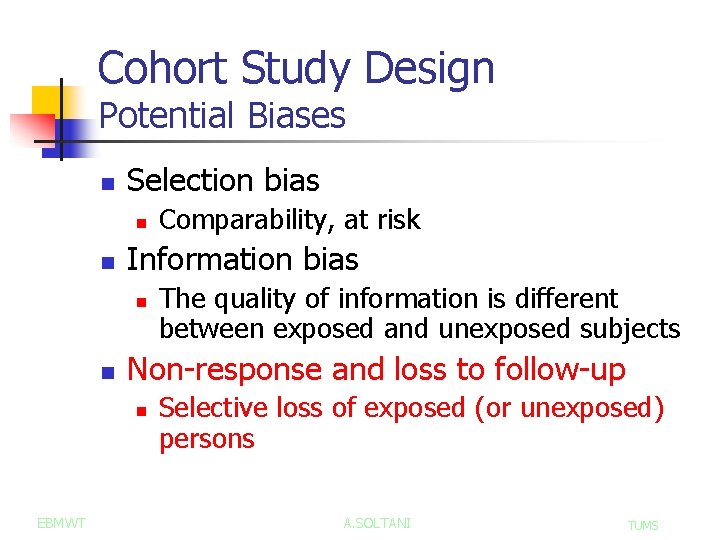
Cohort Study Design Potential Biases n Selection bias n n Information bias n n The quality of information is different between exposed and unexposed subjects Non-response and loss to follow-up n EBMWT Comparability, at risk Selective loss of exposed (or unexposed) persons A. SOLTANI TUMS
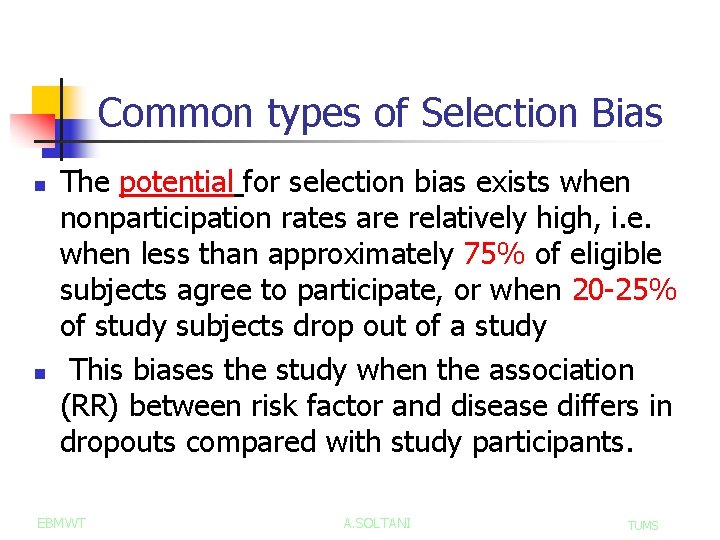
Common types of Selection Bias n n The potential for selection bias exists when nonparticipation rates are relatively high, i. e. when less than approximately 75% of eligible subjects agree to participate, or when 20 -25% of study subjects drop out of a study This biases the study when the association (RR) between risk factor and disease differs in dropouts compared with study participants. EBMWT A. SOLTANI TUMS
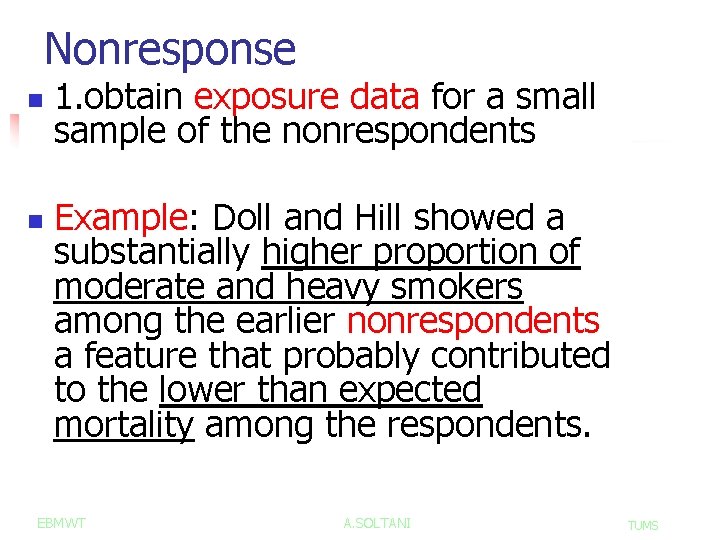
Nonresponse n n 1. obtain exposure data for a small sample of the nonrespondents Example: Doll and Hill showed a substantially higher proportion of moderate and heavy smokers among the earlier nonrespondents a feature that probably contributed to the lower than expected mortality among the respondents. EBMWT A. SOLTANI TUMS
Nonresponse n n n 2. Comparison of nonrespondents with respect to any ancillary information (e. g. . Age, gender, ethnic group). Nonrespondents usually have more comorbid conditions 3. Follow-up of nonrespondents as well as respondents is done so that certain outcomes can be compared in the two groups. (coronary artery diseasemonitor deaths) EBMWT A. SOLTANI TUMS
lost-to-follow-up n occurs when patients drop out of the study n n n these factors are often related to prognosis. asses extent of bias by using a best/worst case analysis. patients can also cross-over from one exposure group to another n EBMWT if cross-over occurs at random = non-differential misclassification of exposure A. SOLTANI TUMS
Critical appraisal : How complete was the followup of both groups? n n EBMWT What efforts were made to limit loss to follow-up? Was loss to follow-up similar in both groups? A. SOLTANI TUMS
THANK YOU EBMWT A. SOLTANI TUMS
- Slides: 19