
cohesion institute Data Warehouse Architecture Best Practices December
cohesion institute Data Warehouse Architecture Best Practices December 5, 2005 Speaker: R. Michael Pickering DW Architecture Best President, Cohesion Systems Consulting Inc. Practices
cohesion institute Agenda n n Introductions Business Intelligence Background Architecture Best Practices Questions & Answers 11/5/2020 DW Architecture Best Practices 2
cohesion institute Data Warehouse Architecture Best Practices Introductions DW Architecture Best Practices
cohesion institute Presenter Biography n R. Michael Pickering President and Chief Architect, Cohesion Systems Consulting Inc. n n over 8 years DW experience n n previously, Managing Consultant, BI&W, Oracle Consulting (Canada) before that, Red Brick Systems, Inc. Manulife Reinsurance, Bell Canada, USDA, Kraft Foods, LCBO, Telecom Argentina, Nortel Networks, Procter & Gamble, Bayer, Syncrude, OMo. HLTC… Mr. Pickering has had DW articles published in The Handbook of Data Management 11/5/2020 DW Architecture Best Practices 4
cohesion institute Cohesion Systems Consulting n Provides DW and BI services, specializing in: n n n Architecture & Implementation Consulting Project Management Databases, Appliances & Emerging Technology Training & Mentoring Sinception in 2000, clients have included Enbridge, CIBC, The Bank of New York, Loyalty Management Group, Canada Post Borderfree, Katz Group 11/5/2020 DW Architecture Best Practices 5
cohesion institute Audience Survey n By a show of hands, please indicate your experience with: n n n normalization dimensional modeling operational data store data consolidation Extract Transform Load (ETL) metadata architecture DW appliances 11/5/2020 DW Architecture Best Practices 6
cohesion institute Data Warehouse Architecture Best Practices Business Intelligence Background DW Architecture Best Practices
cohesion institute What is Business Intelligence? n n A Data Warehouse is usually one component of an overall business intelligence solution IT people may be tempted to think in terms of products and technologies BUT. . . 11/5/2020 DW Architecture Best Practices 8
cohesion institute Overarching Goal n n 11/5/2020 The overarching goal of business intelligence is to provide the information necessary to MANAGE a business This means providing information in support of management decision making, which is why BI is also called “Decision Support” DW Architecture Best Practices 9
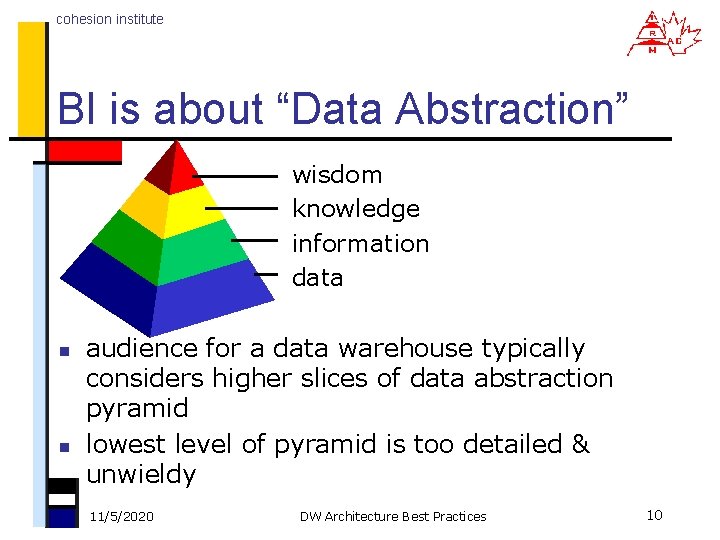
cohesion institute BI is about “Data Abstraction” Stages (4) n n wisdom knowledge information data audience for a data warehouse typically considers higher slices of data abstraction pyramid lowest level of pyramid is too detailed & unwieldy 11/5/2020 DW Architecture Best Practices 10
cohesion institute It’s Not Technology n Business Intelligence is about delivering business value n provide tangible benefit by answering important questions that can help the business to achieve its strategic focus n Improving profitability n n n Reducing cost n n n Who are our five most profitable clients? What are our least profitable products? Who are our lowest cost suppliers? Which materials incur highest spoilage costs? Improving customer satisfaction n 11/5/2020 What factors may lead to lost customers? DW Architecture Best Practices 11
cohesion institute Business of BI n n In some cases, legislation such as Sarbanes. Oxley or Basel II makes some kind of BI fundamental to doing business Many leading companies use BI to achieve competitive advantage n E. g. Walmart, Dell, Amazon. com, Kraft, American Express, etc… 11/5/2020 DW Architecture Best Practices 12
cohesion institute Data Warehouse Architecture n architecture is about delivering an elegant solution that meets the solution requirements n n this means really understanding the problem DW architecture is part art, part science 11/5/2020 DW Architecture Best Practices 13
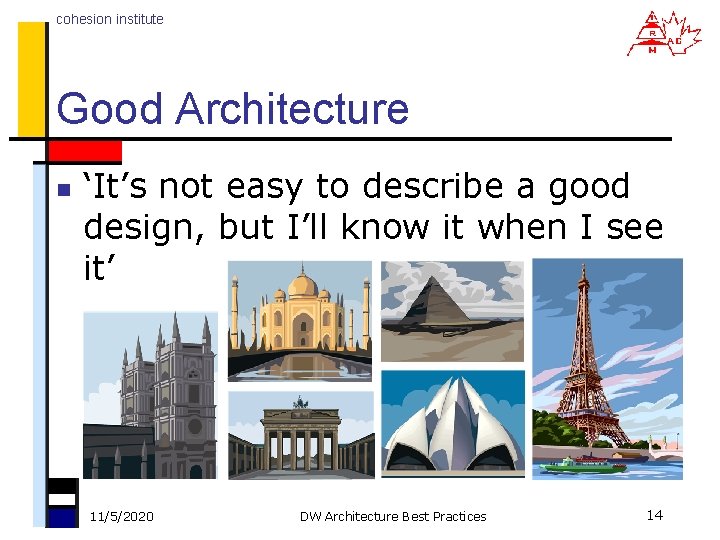
cohesion institute Good Architecture n ‘It’s not easy to describe a good design, but I’ll know it when I see it’ 11/5/2020 DW Architecture Best Practices 14
cohesion institute BI Architecture Requirements n n must recognize change as a constant take incremental development approach existing applications must continue to work need to allow more data and new types of data to be added 11/5/2020 DW Architecture Best Practices 15
cohesion institute End User Acceptance n understandability n n n understandability is in the eyes of the beholder want to hide the complexity try to make it: n n 11/5/2020 intuitive, obvious visible, memorable DW Architecture Best Practices 16
cohesion institute End User Acceptance n performance n n n 11/5/2020 don’t want to interrupt the thinking process provide one click, instantaneous access warehouse must be available, “production” system DW Architecture Best Practices 17
cohesion institute Data Warehouse Architecture Best Practices DW Architecture Best Practices
cohesion institute High Level Architecture n remember the different “worlds” n n n on-line transaction processing (OLTP) business intelligence systems (BIS) users are different data content is different data structures are different architecture & methodology must be different 11/5/2020 DW Architecture Best Practices 19
cohesion institute Two Different Worlds n On-Line Transaction Processing n Entity Relational Data Model n n n created in 1960’s to address performance issues with relational database implementations normalized to most efficiently get data in divides the data into many discrete entities many relationships between these entities this approach was documented by C. J. Date in An Introduction to Database Systems 11/5/2020 DW Architecture Best Practices 20
cohesion institute Two Different Worlds n Business Intelligence Systems n Dimensional Data Model n n 11/5/2020 also called star schema designed to easily get information out fewer relationships than ERD, the only table with multiple joins connecting to other tables is the central table developed in 1960’s by data service providers, formalized by Ralph Kimball in The Data Warehouse Toolkit DW Architecture Best Practices 21
cohesion institute Entity Relation Disadvantages n n n all tables look the same people can’t visualize/remember diagrams software can’t navigate as schema becomes too complex business processes mixed together many artificial keys created 11/5/2020 DW Architecture Best Practices 22
cohesion institute Dimensional Model Advantages n n n simplicity humans can navigate and remember software can navigate deterministically business process explicitly separated (Data Mart) not so many keys (keys = # of attendant tables) 11/5/2020 DW Architecture Best Practices 23
cohesion institute Best Practice #1 Ø Use a data model that is optimized for information retrieval n n n dimensional model denormalized hybrid approach 11/5/2020 DW Architecture Best Practices 24
cohesion institute Data Acquisition Processes n Extract Transform Load (ETL) n n n the process of unloading or copying data from the source systems, transforming it into the format and data model required in the BI environment, and loading it to the DW also, a software development tool for building ETL processes (an ETL tool) many production DWs use COBOL or other general-purpose programming languages to implement ETL 11/5/2020 DW Architecture Best Practices 25
cohesion institute Data Quality Assurance n data cleansing n n n the process of validating and enriching the data as it is published to the DW also, a software development tool for building data cleansing processes (a data cleansing tool) many production DWs have only very rudimentary data quality assurance processes 11/5/2020 DW Architecture Best Practices 26
cohesion institute Data Acquisition & Cleansing n getting data loaded efficiently and correctly is critical to the success of your DW n n implementation of data acquisition & cleansing processes represents from 50 to 80% of effort on typical DW projects inaccurate data content can be ‘the kiss of death’ for user acceptance 11/5/2020 DW Architecture Best Practices 27
cohesion institute Best Practice #2 Ø Carefully design the data acquisition and cleansing processes for your DW n n n Ensure the data is processed efficiently and accurately Consider acquiring ETL and Data Cleansing tools Use them well! 11/5/2020 DW Architecture Best Practices 28
cohesion institute Data Model n n Already discussed the benefits of a dimensional model No matter whether dimensional modeling or any other design approach is used, the data model must be documented 11/5/2020 DW Architecture Best Practices 29
cohesion institute Documenting the Data Model n The best practice is to use some kind of data modeling tool n n n n CA ERwin Sybase Power. Designer Oracle Designer IBM Rational Rose Etc. Different tools support different modeling notations, but they are more or less equivalent anyway Most tools allow sharing of their metadata with an ETL tool 11/5/2020 DW Architecture Best Practices 30
cohesion institute Data Model Standards n n n data model standards appropriate for the environment and tools chosen in your data warehouse should be adopted considerations should be given to data access tool(s) and integration with overall enterprise standards must be documented and enforced within the DW team n n someone must ‘own’ the data model to ensure a quality data model, all changes should be reviewed thru some formal process 11/5/2020 DW Architecture Best Practices 31
cohesion institute Data Model Metadata n n Business definitions should be recorded for every field (unless they are technical fields only) Domain of data should be recorded Sample values should be included As more metadata is populated into the modeling tool it becomes increasingly important to be able to share this data across ETL and Data Access tools 11/5/2020 DW Architecture Best Practices 32
cohesion institute Metadata Architecture n n The strategy for sharing data model and other metadata should be formalized and documented Metadata management tools should be considered & the overall metadata architecture should be carefully planned 11/5/2020 DW Architecture Best Practices 33
cohesion institute Best Practice #3 Ø Design a metadata architecture that allows sharing of metadata between components of your DW n consider metadata standards such as OMG’s Common Warehouse Metamodel (CWM) 11/5/2020 DW Architecture Best Practices 34
cohesion institute Alternative Architecture Approaches n n Bill Inmon: “Corporate Information Factory” Hub and Spoke philosophy “JBOC” – just a bunch of cubes Let it evolve naturally 11/5/2020 DW Architecture Best Practices 35
cohesion institute What We Want (Architectural Principal) n n n In most cases, business and IT agree that the data warehouse should provide a ‘single version of the truth’ Any approach that can result in disparate data marts or cubes is undesireable This is known as data silos or… 11/5/2020 DW Architecture Best Practices 36
cohesion institute Enterprise DW Architecture n n how to design an enterprise data warehouse and ensure a ‘single version of the truth’? according to Kimball: n n n start with an overall data architecture phase use “Data Warehouse Bus” design to integrate multiple data marts use incremental approach by building one data mart at a time 11/5/2020 DW Architecture Best Practices 37
cohesion institute Data Warehouse Bus Architecture n named for the bus in a computer n n standard interface that allows you to plug in cdrom, disk drive, etc. these peripherals work together smoothly provides framework for data marts to fit together allows separate data marts to be implemented by different groups, even at different times 11/5/2020 DW Architecture Best Practices 38
cohesion institute Data Mart Definition n data mart is a complete subset of the overall data warehouse n n n a single business process OR a group of related business processes think of a data mart as a collection of related fact tables sharing conformed dimensions, aka a ‘fact constellation’ 11/5/2020 DW Architecture Best Practices 39
cohesion institute Designing The DW Bus n n determine which dimensions will be shared across multiple data marts conform the shared dimensions n n n produce a master suite of shared dimensions determine which facts will be shared across data marts conform the facts n standardize the definitions of facts 11/5/2020 DW Architecture Best Practices 40
cohesion institute Dimension Granularity n conformed dimensions will usually be granular n n n makes it easy to integrate with various base level fact tables easy to extend fact table by adding new facts no need to drop or reload fact tables, and no keys have to be changed 11/5/2020 DW Architecture Best Practices 41
cohesion institute Conforming Dimensions n n n by adhering to standards, the separate data marts can be plugged together n e. g. customer, product, time they can even share data usefully, for example in a drill across report ensures reports or queries from different data marts share the same context 11/5/2020 DW Architecture Best Practices 42
cohesion institute Conforming Dimensions (cont’d) n accomplish this by adding any dimension attribute(s) needed in any data mart(s) to the standard dimension definition n n attributes not needed everywhere can always be ignored typically harder to determine how to load conformed dimensions than to design them initially n need a single integrated ETL process what is the SOR for each attribute? how do we deal with attributes for which there is more than one possible SOR? 11/5/2020 DW Architecture Best Practices 43
cohesion institute Conforming Facts n n in an enterprise, some metrics may not have the same generally accepted definition across all business units conforming facts is generally a bigger design challenge than conforming dimensions n why? 11/5/2020 DW Architecture Best Practices 44
cohesion institute Conforming Facts - Benefits n n n ensures the constituent data marts can as clearly as possible represent fact data expressed on the same basis using consistent definitions ensures reports or queries from different data marts share consistent content success of an Enterprise DW hinges on successfully conformed facts n n any perceived inconsistencies in fact definitions across data marts will generally be considered to be a DW bug or data problem by users if users don’t have full confidence in data quality they may stop using the DW 11/5/2020 DW Architecture Best Practices 45
cohesion institute Data Consolidation n n a current trend in BI/DW is ‘data consolidation’ from a software vendor perspective, it is tempting to simplify this: n ‘we can keep all the tables for all your disparate applications in one physical database’ 11/5/2020 DW Architecture Best Practices 46
cohesion institute Data Integration n n To truly achieve ‘a single version of the truth’, must do more than simply consolidating application databases Must integrate data models and establish common terms of reference 11/5/2020 DW Architecture Best Practices 47
cohesion institute Best Practice #4 Ø Take an approach that consolidates data into ‘a single version of the truth’ n Data Warehouse Bus n n conformed dimensions & facts OR? 11/5/2020 DW Architecture Best Practices 48
cohesion institute Operational Data Store (ODS) n n a single point of integration for disparate operational systems contains integrated data at the most detailed level (transactional) may be loaded in ‘near real time’ or periodically can be used for centralized operational reporting 11/5/2020 DW Architecture Best Practices 49
cohesion institute Role of an ODS in DW Architecture n n In the case where an ODS is a necessary component of the overall DW, it should be carefully integrated into the overall architecture Can also be used for: n n n Staging area Master/reference data management Etc… 11/5/2020 DW Architecture Best Practices 50
cohesion institute ODS Data Model n Not clear if any design approach for an ODS data model has emerged as a best practice n n normalized dimensional denormalized/hybrid any suggestions? 11/5/2020 DW Architecture Best Practices 51
cohesion institute Best Practice #5 Ø Consider implementing an ODS only when information retrieval requirements are near the bottom of the data abstraction pyramid and/or when there are multiple operational sources that need to be accessed n n n Must ensure that the data model is integrated, not just consolidated May consider 3 NF data model Avoid at all costs a ‘data dumping ground’ 11/5/2020 DW Architecture Best Practices 52
cohesion institute Capacity Planning n n n DW workloads are typically very demanding, especially for I/O capacity Successful implementations tend to grow very quickly, both in number of users and data volume Rules of thumb do exist for sizing the hardware platform to provide adequate initial performance n typically based on estimated ‘raw’ data size of proposed database e. g. 100 -150 Gb per modern CPU 11/5/2020 DW Architecture Best Practices 53
cohesion institute SMP Server Scale Up n n n Scaling performance within a single SMP server is referred to as ‘scale up’ Database benchmarks suggest Windows scalability is near that of Linux IBM claims near-linear scalability for Linux (on commodity hardware) up to about 4 processors n n Probably not cost effective to scale up Linux much beyond 4 processors IBM claims near-linear scalability for AIX on POWER 5 up to about 8 processors 11/5/2020 DW Architecture Best Practices 54
cohesion institute Scale Out n n n There is an increasing trend in IT to ‘scale out’ processing capacity by deploying many small, commodity servers rather than a single large SMP system This strategy tends to work well for relatively simple applications such as network or web servers For very complex workloads such as a data warehouse, this strategy is much more difficult to effectively implement n Especially so for the database server itself 11/5/2020 DW Architecture Best Practices 55
cohesion institute Scale Up vs. Scale Out n n To obtain the total number of processors required for the estimated DW workload, must plan either to scale up or scale out Both options are viable but, all other things being equal, scaling up is less disruptive to end users and requires less work to implement n n scaling up can offer lower hardware investment, if practical however, network bandwidth or latency issues can limit effectiveness of parallelism 11/5/2020 DW Architecture Best Practices 56
cohesion institute Best Practice #6 Ø Ø Create a capacity plan for your BI application & monitor it carefully Consider future additional performance demands n n Establish standard performance benchmark queries and regularly run them Implement capacity monitoring tools Build scalability into your architecture May need to allow for scaling both up and out! 11/5/2020 DW Architecture Best Practices 57
cohesion institute Open Source Affordability n Another emerging trend in IT generally is to utilize Open Source software running on commodity hardware n n n this is expected to offer lower total cost of ownership certainly, GNU/Linux and other Open Source initiatives do provide very good functionality and quality for minimal cost This trend also applies to BI & DW: n n most traditional rdbms’s are now supported on Linux however, open source rdbms’s lag behind on providing good performance for DW queries 11/5/2020 DW Architecture Best Practices 58
cohesion institute DW Appliances n n DW appliances, consisting of packaged solutions providing all required software and hardware, are beginning to offer very promising price/performance production experience is limited so far, so this is not yet a ‘best practice’ 11/5/2020 DW Architecture Best Practices 59
cohesion institute Data Warehouse Architecture Best Practices Q & A DW Architecture Best Practices
cohesion institute cohesion systems consulting inc the modern art of data abstraction DW Architecture Best Practices
- Slides: 61