
COHESION AND COHERENCE Teacher Cristiane de Brito Cruz
COHESION AND COHERENCE Teacher Cristiane de Brito Cruz
Cohesi on Cohesion relates to the micro level of the text, i. e. , the words and sentences and how they join and link together. Adj. Cohesive: - united and working together; - fitting together well. https: //www. youtube. com/watch? v=3 Ez. JICqv 3 WY

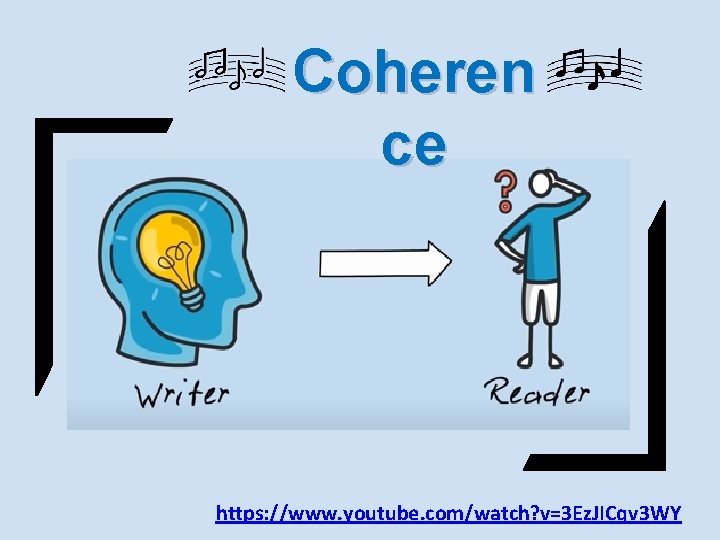
Coheren ce Coherence relates to the macro level features of a text which help it to make sense as a whole. Adj. Coherent: - logically ordered and connected; - clear and consistent; - understandable. https: //www. youtube. com/watch? v=3 Ez. JICqv 3 WY

Cohesi on through the Good Cohesion is achieved following five main methods: - Reference words; Repeated words/ideas; Transition signals; Substitution; Ellipsis. https: //www. youtube. com/watch? v=3 Ez. JICqv 3 WY

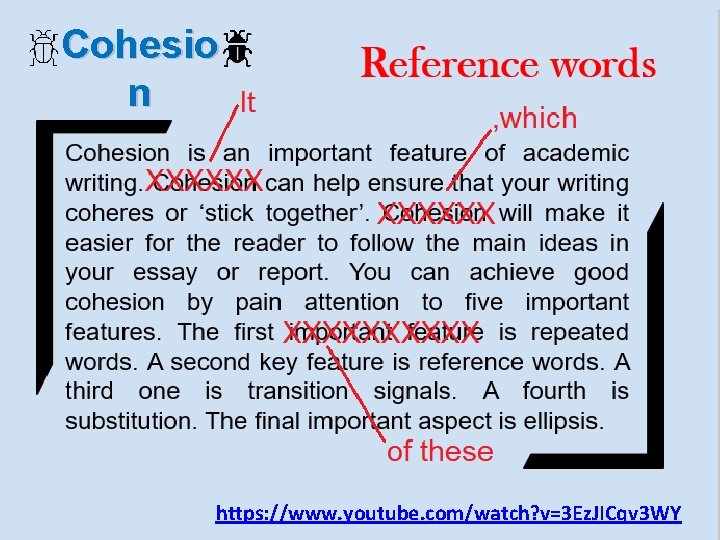
Cohesi on What are reference words? - words that do not make sense on their own; - refer to something else in the text; - this/ that/ these/ those; - it/ they/ them/ he/ she/ which. https: //www. youtube. com/watch? v=3 Ez. JICqv 3 WY
Cohesion is an important on feature of academic writing. Cohesion can help ensure that your writing coheres or ‘stick together’. Cohesion will make it easier for the reader to follow the main ideas in your essay or report. You can achieve good cohesion by pain attention to five important features. The first important feature is repeated words. A second key feature is reference words. A third one is transition signals. A fourth is substitution. The final important aspect is ellipsis. https: //www. youtube. com/watch? v=3 Ez. JICqv 3 WY
Cohesio n https: //www. youtube. com/watch? v=3 Ez. JICqv 3 WY
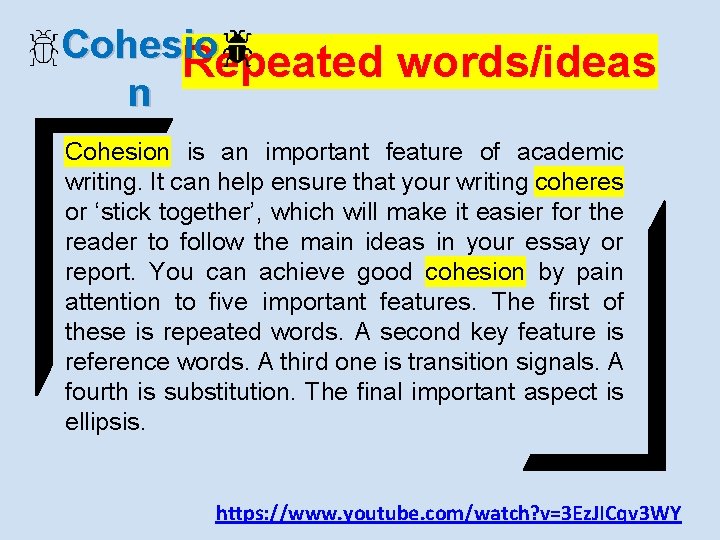
Cohesio Repeated words/ideas n Cohesion is an important feature of academic writing. It can help ensure that your writing coheres or ‘stick together’, which will make it easier for the reader to follow the main ideas in your essay or report. You can achieve good cohesion by pain attention to five important features. The first of these is repeated words. A second key feature is reference words. A third one is transition signals. A fourth is substitution. The final important aspect is ellipsis. https: //www. youtube. com/watch? v=3 Ez. JICqv 3 WY
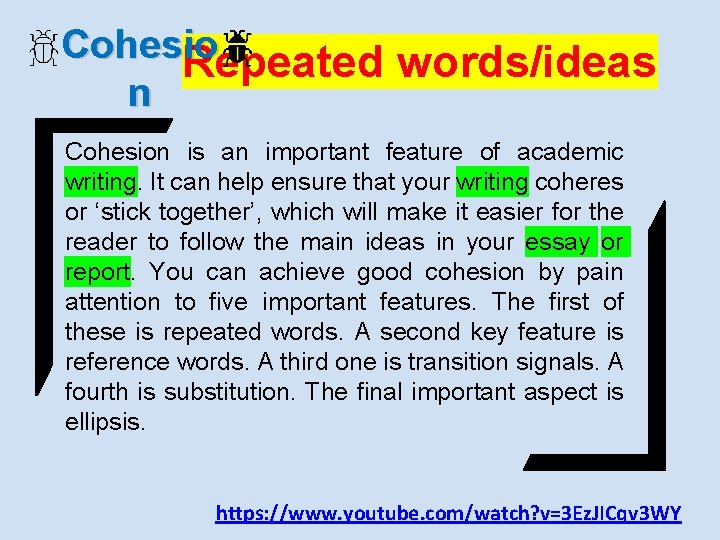
Cohesio Repeated words/ideas n Cohesion is an important feature of academic writing. It can help ensure that your writing coheres or ‘stick together’, which will make it easier for the reader to follow the main ideas in your essay or report. You can achieve good cohesion by pain attention to five important features. The first of these is repeated words. A second key feature is reference words. A third one is transition signals. A fourth is substitution. The final important aspect is ellipsis. https: //www. youtube. com/watch? v=3 Ez. JICqv 3 WY

Cohesio Repeated words/ideas n Cohesion is an important feature of academic writing. It can help ensure that your writing coheres or ‘stick together’, which will make it easier for the reader to follow the main ideas in your essay or report. You can achieve good cohesion by pain attention to five important features. The first of these is repeated words. A second key feature is reference words. A third one is transition signals. A fourth is substitution. The final important aspect is ellipsis. https: //www. youtube. com/watch? v=3 Ez. JICqv 3 WY
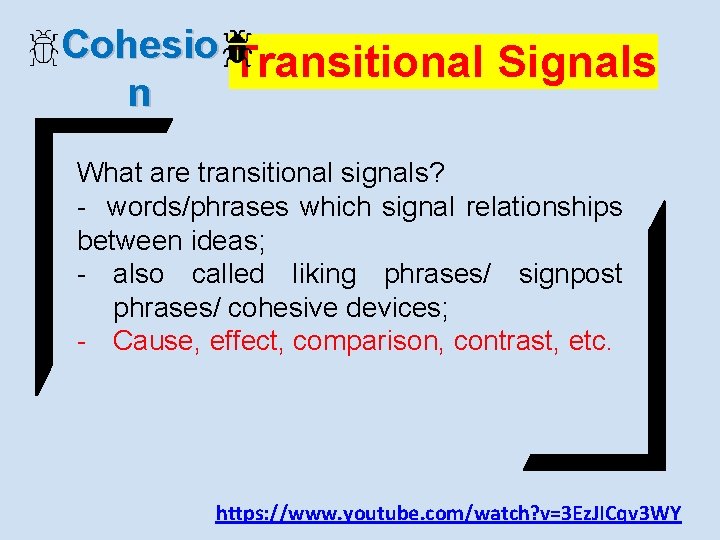
Cohesio Transitional Signals n What are transitional signals? - words/phrases which signal relationships between ideas; - also called liking phrases/ signpost phrases/ cohesive devices; - Cause, effect, comparison, contrast, etc. https: //www. youtube. com/watch? v=3 Ez. JICqv 3 WY
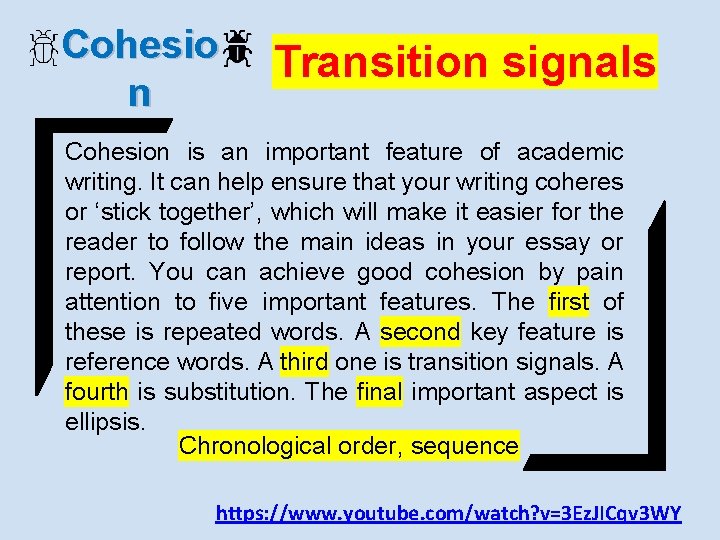
Cohesio n Transition signals Cohesion is an important feature of academic writing. It can help ensure that your writing coheres or ‘stick together’, which will make it easier for the reader to follow the main ideas in your essay or report. You can achieve good cohesion by pain attention to five important features. The first of these is repeated words. A second key feature is reference words. A third one is transition signals. A fourth is substitution. The final important aspect is ellipsis. Chronological order, sequence https: //www. youtube. com/watch? v=3 Ez. JICqv 3 WY
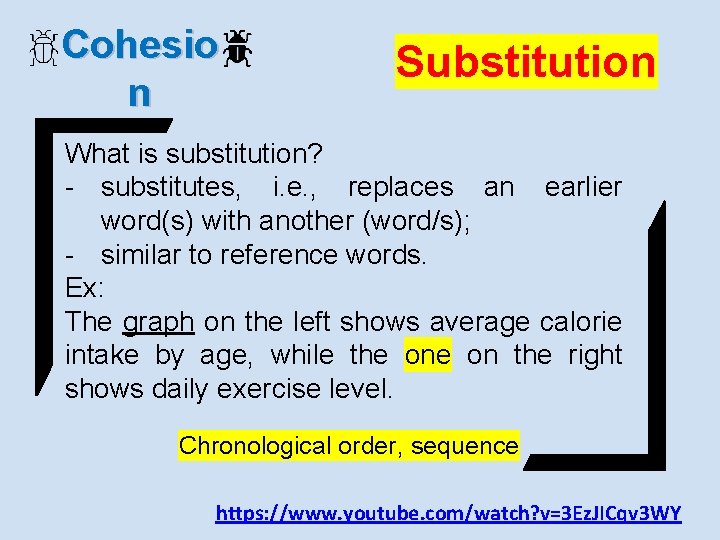
Cohesio n Substitution What is substitution? - substitutes, i. e. , replaces an earlier word(s) with another (word/s); - similar to reference words. Ex: The graph on the left shows average calorie intake by age, while the on the right shows daily exercise level. Chronological order, sequence https: //www. youtube. com/watch? v=3 Ez. JICqv 3 WY
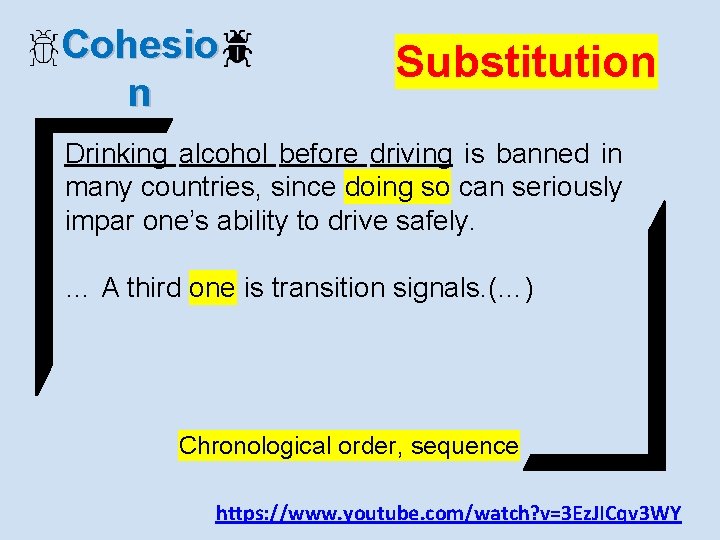
Cohesio n Substitution Drinking alcohol before driving is banned in many countries, since doing so can seriously impar one’s ability to drive safely. … A third one is transition signals. (…) Chronological order, sequence https: //www. youtube. com/watch? v=3 Ez. JICqv 3 WY
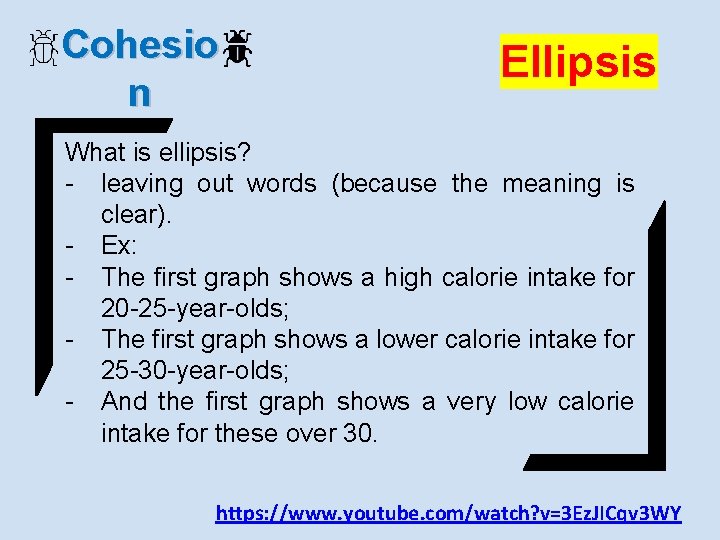
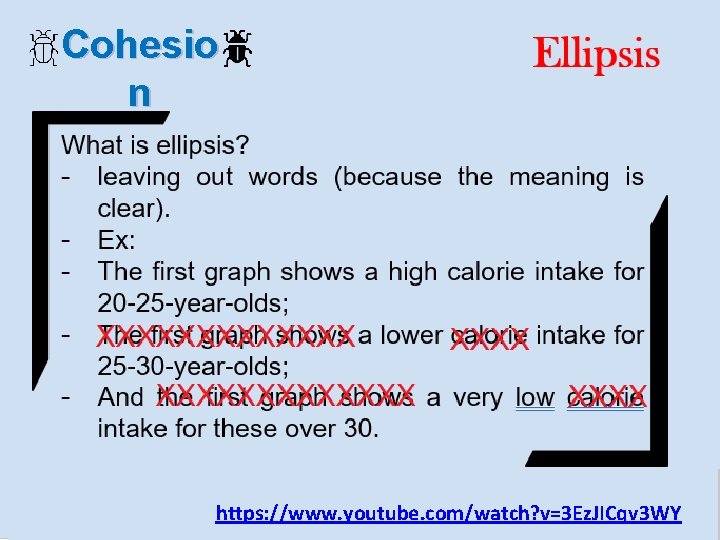
Cohesio n Ellipsis What is ellipsis? - leaving out words (because the meaning is clear). - Ex: - The first graph shows a high calorie intake for 20 -25 -year-olds; - The first graph shows a lower calorie intake for 25 -30 -year-olds; - And the first graph shows a very low calorie intake for these over 30. https: //www. youtube. com/watch? v=3 Ez. JICqv 3 WY
Cohesio n https: //www. youtube. com/watch? v=3 Ez. JICqv 3 WY
Cohesio n Ellipsis What is ellipsis? - leaving out words (because the meaning is clear). - Ex: - The first graph shows a high calorie intake for 20 -25 -year-olds; a lower intake for 25 -30 -year-olds; and a very low intake for these over 30. - … A fourth (important aspect) is substitution. https: //www. youtube. com/watch? v=3 Ez. JICqv 3 WY

Coheren ce What is coherence? - relates to organization and progression of ideas; - also about how clear and easy the ideas are to understand; https: //www. youtube. com/watch? v=3 Ez. JICqv 3 WY
Coheren ce https: //www. youtube. com/watch? v=3 Ez. JICqv 3 WY

Coheren ce How to improve coherence? - make sure ideas are well organised; - make sure ideas can be understood by the reader. https: //www. youtube. com/watch? v=3 Ez. JICqv 3 WY

Coheren How to improve coherence? ce - make sure ideas are well organised; create an outline before writing; create a ‘reverse’ outline after writing; make sure you have a clear thesis statement, topic sentences, summary, etc; check that all ideas in a paragraph relate to the topic sentence. check that all topic sentences relate to thesis statement. https: //www. youtube. com/watch? v=3 Ez. JICqv 3 WY

Coheren ce How to improve coherence? - make sure ideas can be understood by the reader. - consider the audience; - consider the purpose; - If possible, ask a peer to read it: does it make sense to them? https: //www. youtube. com/watch? v=3 Ez. JICqv 3 WY
Cohesio n Reference words What are reference words? - words that do not make sense on their own; - refer to something else in the text; - this/ that/ these/ those; - it/ they/ them/ he/ she/ which. https: //www. youtube. com/watch? v=3 Ez. JICqv 3 WY
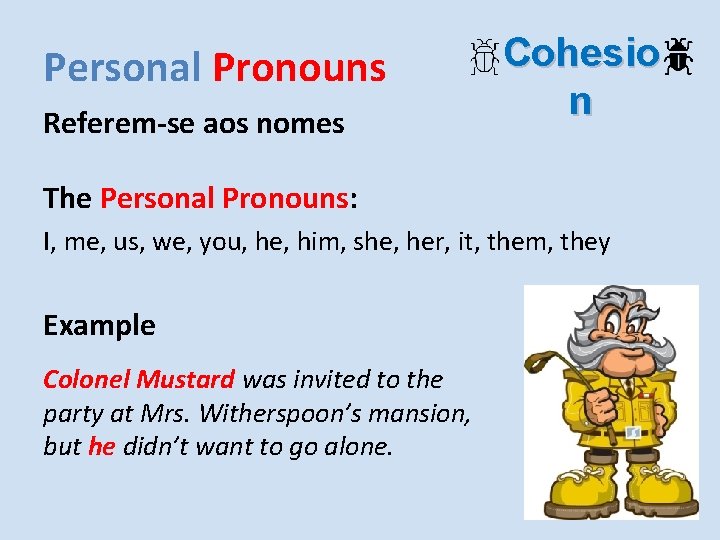
Personal Pronouns Referem-se aos nomes Cohesio n The Personal Pronouns: I, me, us, we, you, he, him, she, her, it, them, they Example Colonel Mustard was invited to the party at Mrs. Witherspoon’s mansion, but he didn’t want to go alone.
Possessive Pronouns Cohesio n Dão a ideia de posse, referem-se tanto a nomes quanto a pronomes pessoais. The Possessive Pronouns: My, mine, ours, yours, his, hers, theirs, its Example Mr. Whiskers was disappointed with his dinner.
Reflexive Pronouns Cohesio n Referm-se a nomes, sujeitos da frase. The Reflexive Pronouns: Myself, ourselves, yourself, yourselves, himself, herself, themselves, itself Example Andre just wanted to be by himself.
Relative Pronouns Cohesio n Iniciam orações relativas, explicativas, etc. Significam “que” “quem” “cujo/a, s” etc. The Relative Pronouns: That, whom, whose, which, whoever, whomever, whichever Example The pirate captain, who had never seen the inside of a schoolroom, struggled to read the ransom note.
Cohesio Demonstrative Pronouns n Demonstram localização, retomam o que foi dito. The Demonstrative Pronouns: This, that, these, those Example “This is my favorite book about unicorns, ” said Patrick.
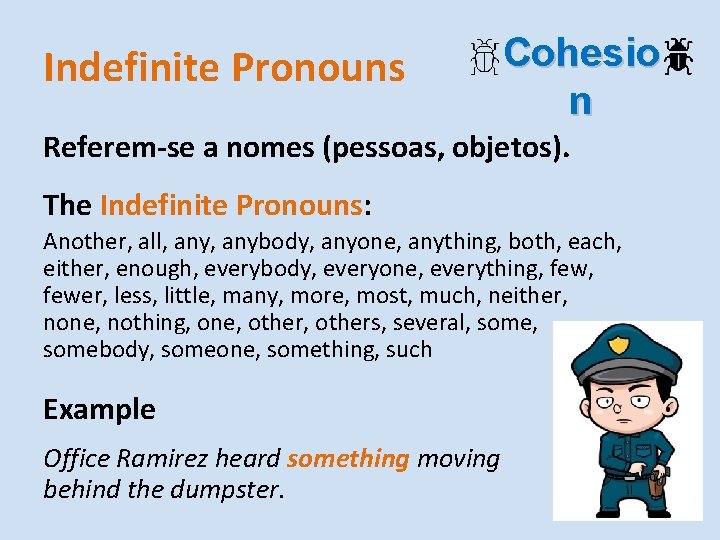
Indefinite Pronouns Cohesio n Referem-se a nomes (pessoas, objetos). The Indefinite Pronouns: Another, all, anybody, anyone, anything, both, each, either, enough, everybody, everyone, everything, fewer, less, little, many, more, most, much, neither, none, nothing, one, others, several, somebody, someone, something, such Example Office Ramirez heard something moving behind the dumpster.
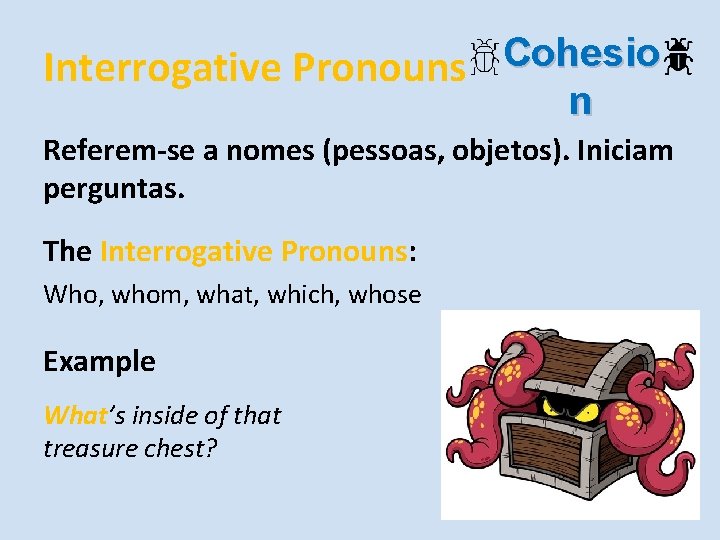
Cohesio Interrogative Pronouns n Referem-se a nomes (pessoas, objetos). Iniciam perguntas. The Interrogative Pronouns: Who, whom, what, which, whose Example What’s inside of that treasure chest?
Calma!!! Você não precisa aprender todos eles de uma vez, basta identificar no texto e tentar achar a qual palavra estes pronomes se referem.
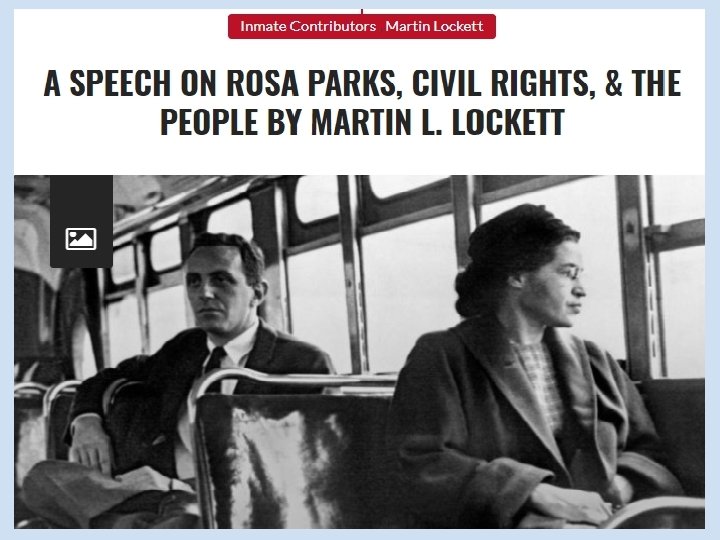
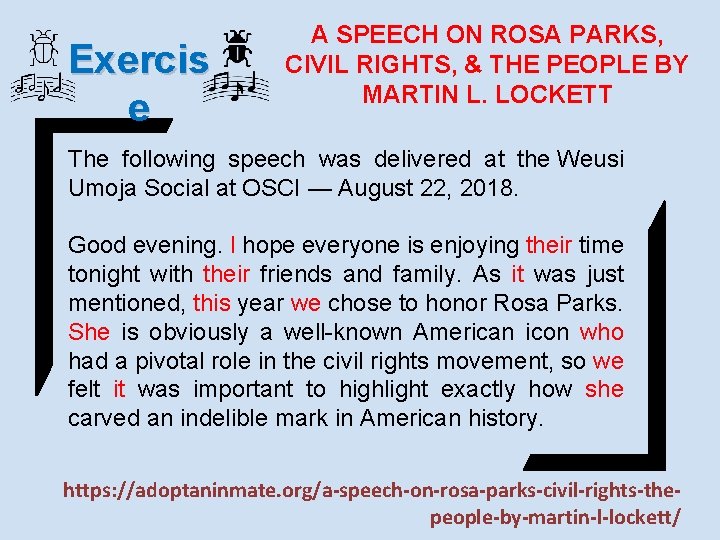
Exercis e A SPEECH ON ROSA PARKS, CIVIL RIGHTS, & THE PEOPLE BY MARTIN L. LOCKETT The following speech was delivered at the Weusi Umoja Social at OSCI — August 22, 2018. Good evening. I hope everyone is enjoying their time tonight with their friends and family. As it was just mentioned, this year we chose to honor Rosa Parks. She is obviously a well-known American icon who had a pivotal role in the civil rights movement, so we felt it was important to highlight exactly how she carved an indelible mark in American history. https: //adoptaninmate. org/a-speech-on-rosa-parks-civil-rights-thepeople-by-martin-l-lockett/
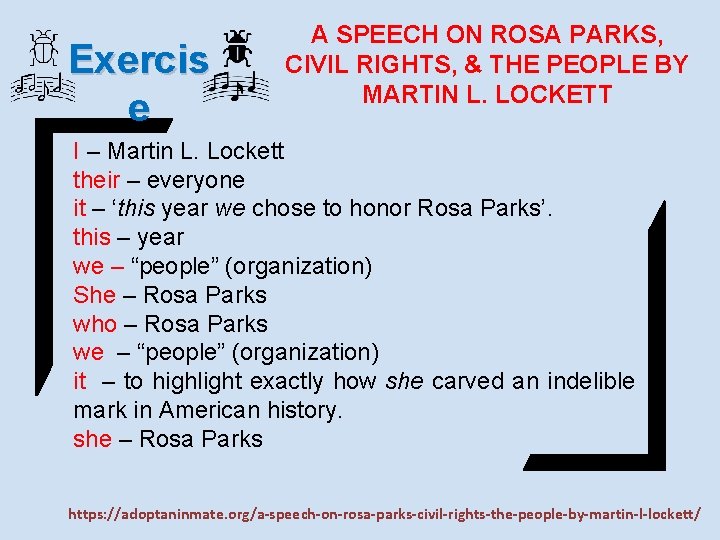
Exercis e A SPEECH ON ROSA PARKS, CIVIL RIGHTS, & THE PEOPLE BY MARTIN L. LOCKETT I – Martin L. Lockett their – everyone it – ‘this year we chose to honor Rosa Parks’. this – year we – “people” (organization) She – Rosa Parks who – Rosa Parks we – “people” (organization) it – to highlight exactly how she carved an indelible mark in American history. she – Rosa Parks https: //adoptaninmate. org/a-speech-on-rosa-parks-civil-rights-the-people-by-martin-l-lockett/
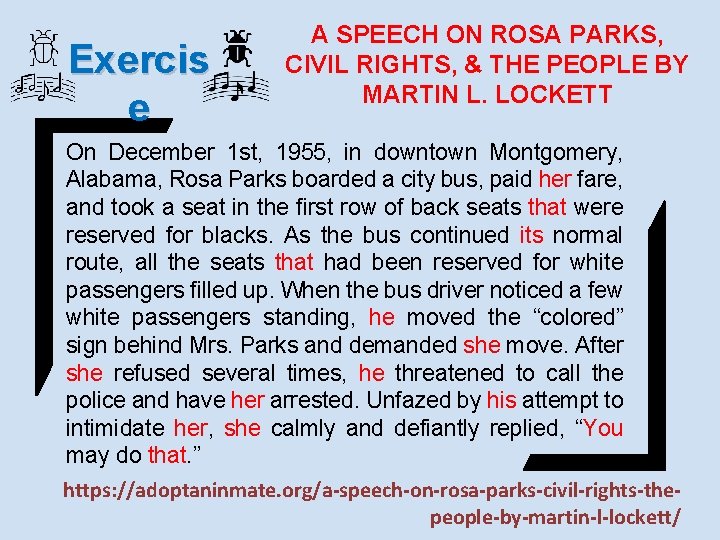
Exercis e A SPEECH ON ROSA PARKS, CIVIL RIGHTS, & THE PEOPLE BY MARTIN L. LOCKETT On December 1 st, 1955, in downtown Montgomery, Alabama, Rosa Parks boarded a city bus, paid her fare, and took a seat in the first row of back seats that were reserved for blacks. As the bus continued its normal route, all the seats that had been reserved for white passengers filled up. When the bus driver noticed a few white passengers standing, he moved the “colored” sign behind Mrs. Parks and demanded she move. After she refused several times, he threatened to call the police and have her arrested. Unfazed by his attempt to intimidate her, she calmly and defiantly replied, “You may do that. ” https: //adoptaninmate. org/a-speech-on-rosa-parks-civil-rights-thepeople-by-martin-l-lockett/
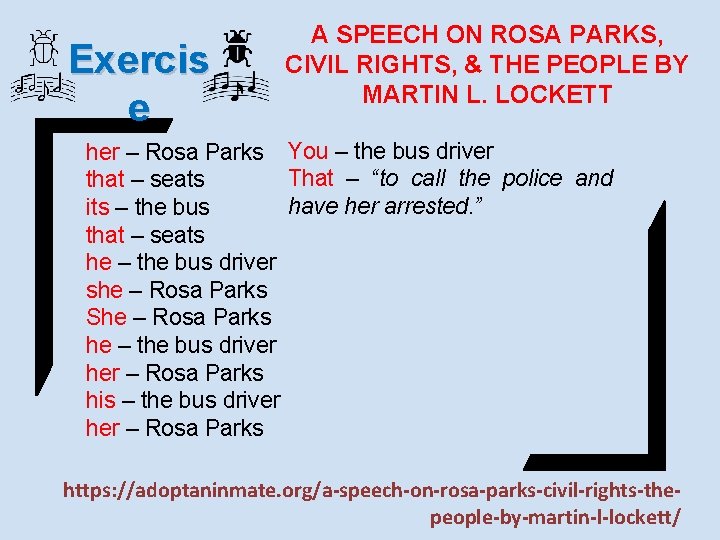
Exercis e A SPEECH ON ROSA PARKS, CIVIL RIGHTS, & THE PEOPLE BY MARTIN L. LOCKETT her – Rosa Parks You – the bus driver That – “to call the police and that – seats have her arrested. ” its – the bus that – seats he – the bus driver she – Rosa Parks She – Rosa Parks he – the bus driver her – Rosa Parks his – the bus driver her – Rosa Parks https: //adoptaninmate. org/a-speech-on-rosa-parks-civil-rights-thepeople-by-martin-l-lockett/
- Slides: 36