
Coherence and the Use of Coherent XRays John
- Slides: 37
Coherence and the Use of Coherent X-Rays John Arthur LCLS, SLAC J. Arthur: Coherence 26 June 2009 jarthur@slac. stanford. edu
Outline What is coherence? Why do we care? What are the coherence properties of an x-ray beam? Uses of coherent x-rays Diffraction Imaging Holography and speckle FEL sources J. Arthur: Coherence 26 June 2009 jarthur@slac. stanford. edu
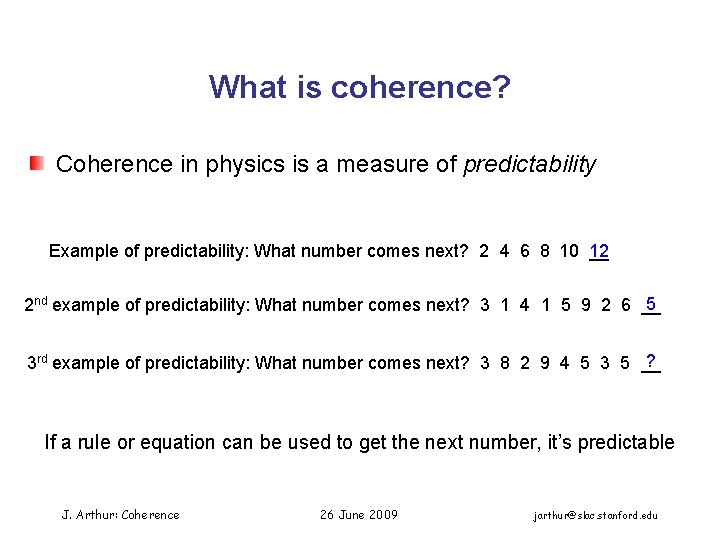
What is coherence? Coherence in physics is a measure of predictability Example of predictability: What number comes next? 2 4 6 8 10 12 __ 5 2 nd example of predictability: What number comes next? 3 1 4 1 5 9 2 6 __ ? 3 rd example of predictability: What number comes next? 3 8 2 9 4 5 3 5 __ If a rule or equation can be used to get the next number, it’s predictable J. Arthur: Coherence 26 June 2009 jarthur@slac. stanford. edu
Coherence of waves For waves, coherence refers to the predictability of the phase of the wave a = sin(kx - t + ) Phase of wave function propagating wave J. Arthur: Coherence 26 June 2009 jarthur@slac. stanford. edu
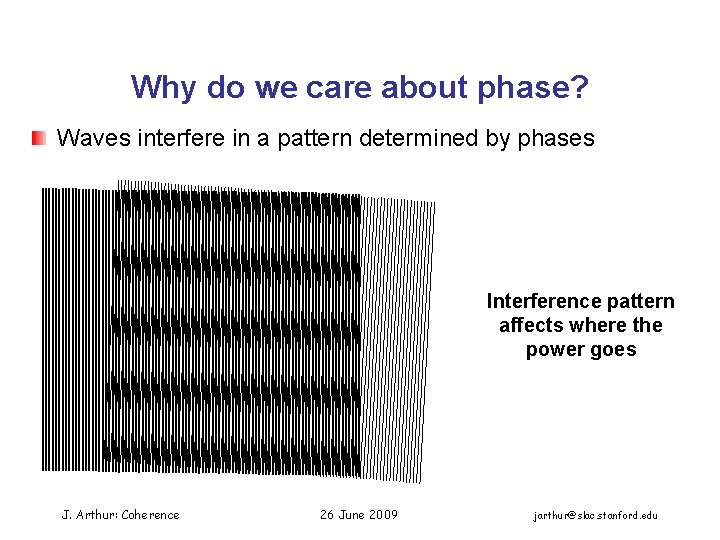
Why do we care about phase? Waves interfere in a pattern determined by phases Interference pattern affects where the power goes J. Arthur: Coherence 26 June 2009 jarthur@slac. stanford. edu
Uses of wave interference J. Arthur: Coherence 26 June 2009 jarthur@slac. stanford. edu
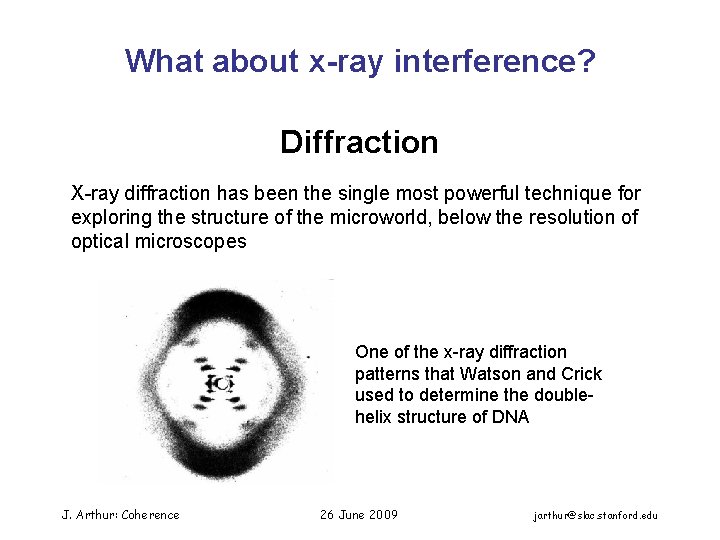
What about x-ray interference? Diffraction X-ray diffraction has been the single most powerful technique for exploring the structure of the microworld, below the resolution of optical microscopes One of the x-ray diffraction patterns that Watson and Crick used to determine the doublehelix structure of DNA J. Arthur: Coherence 26 June 2009 jarthur@slac. stanford. edu
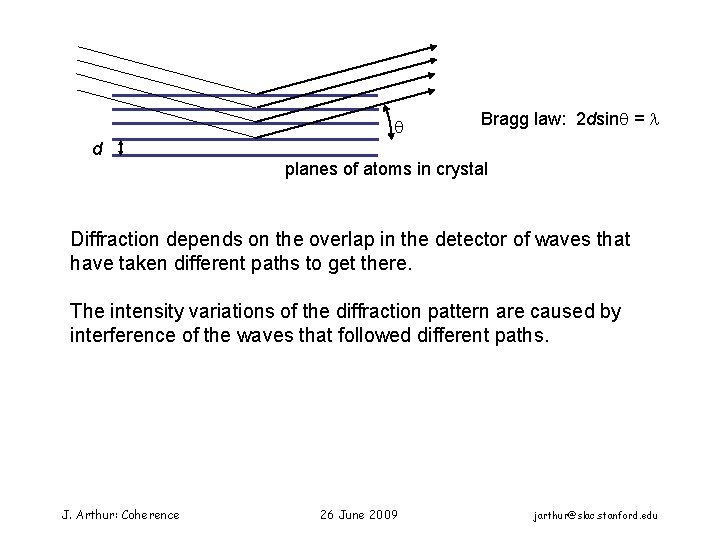
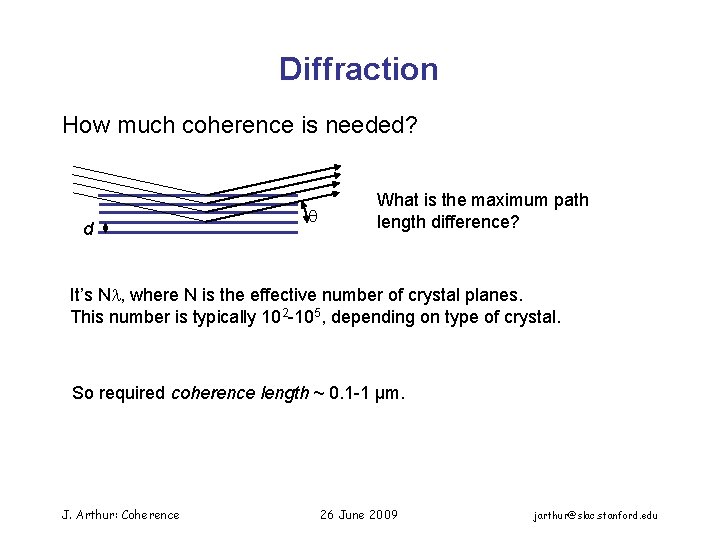
Bragg law: 2 dsin = d planes of atoms in crystal Diffraction depends on the overlap in the detector of waves that have taken different paths to get there. The intensity variations of the diffraction pattern are caused by interference of the waves that followed different paths. J. Arthur: Coherence 26 June 2009 jarthur@slac. stanford. edu
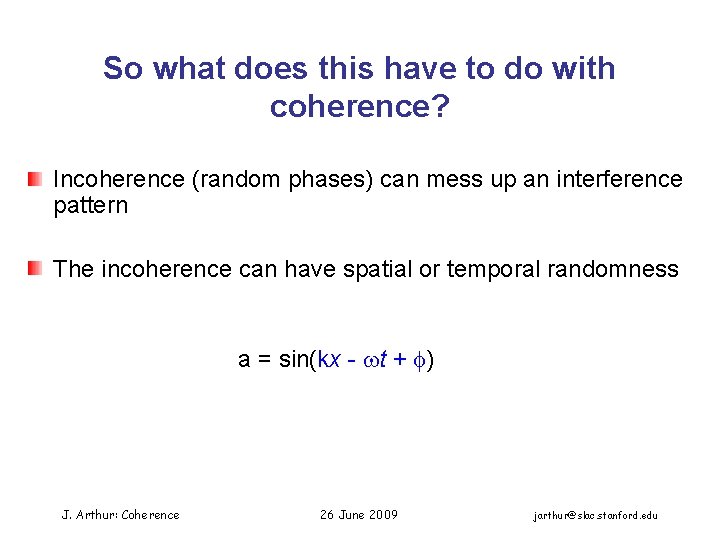
So what does this have to do with coherence? Incoherence (random phases) can mess up an interference pattern The incoherence can have spatial or temporal randomness a = sin(kx - t + ) J. Arthur: Coherence 26 June 2009 jarthur@slac. stanford. edu
How predictable is phase? If we can write a function for the wave, then we can predict its phase exactly => High coherence If we cannot predict the phase at all => Low coherence If we can predict the phase approximately, but not exactly => Partial coherence J. Arthur: Coherence 26 June 2009 jarthur@slac. stanford. edu
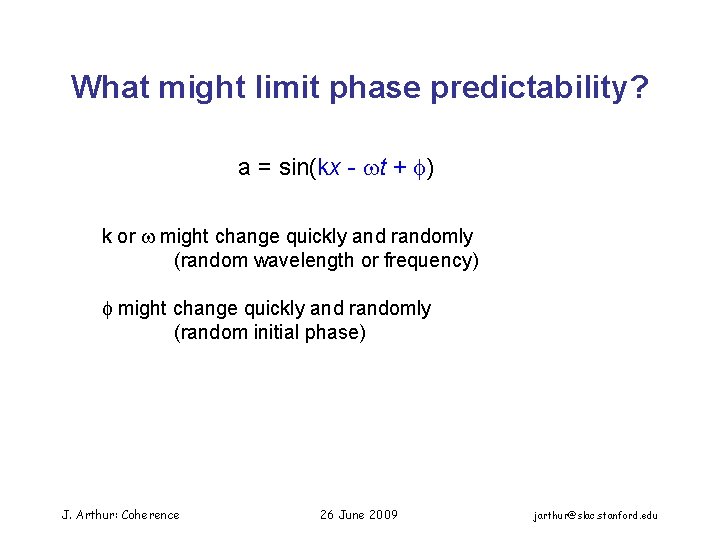
What might limit phase predictability? a = sin(kx - t + ) k or might change quickly and randomly (random wavelength or frequency) might change quickly and randomly (random initial phase) J. Arthur: Coherence 26 June 2009 jarthur@slac. stanford. edu
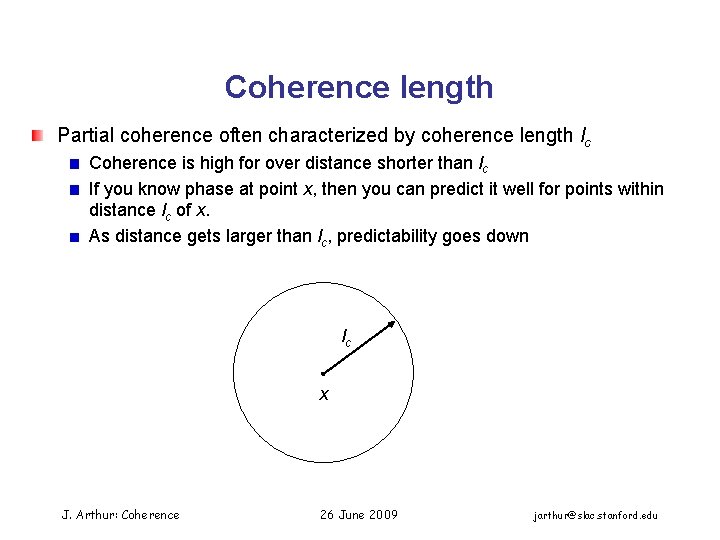
Coherence length Partial coherence often characterized by coherence length lc Coherence is high for over distance shorter than lc If you know phase at point x, then you can predict it well for points within distance lc of x. As distance gets larger than lc, predictability goes down lc x J. Arthur: Coherence 26 June 2009 jarthur@slac. stanford. edu
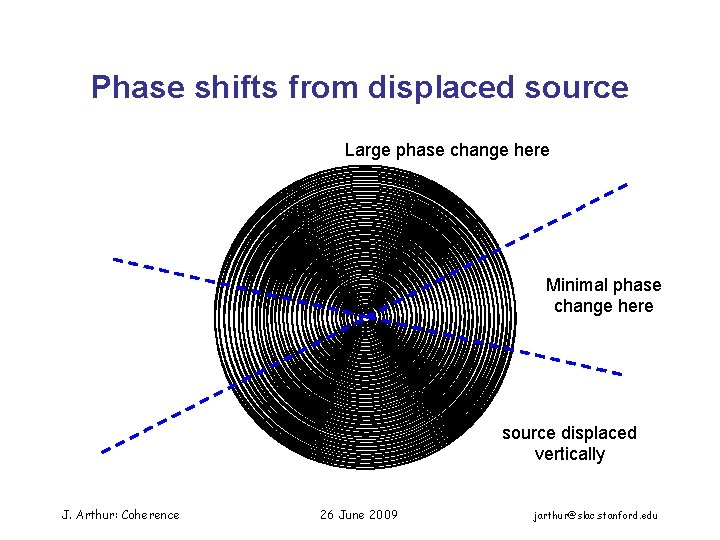
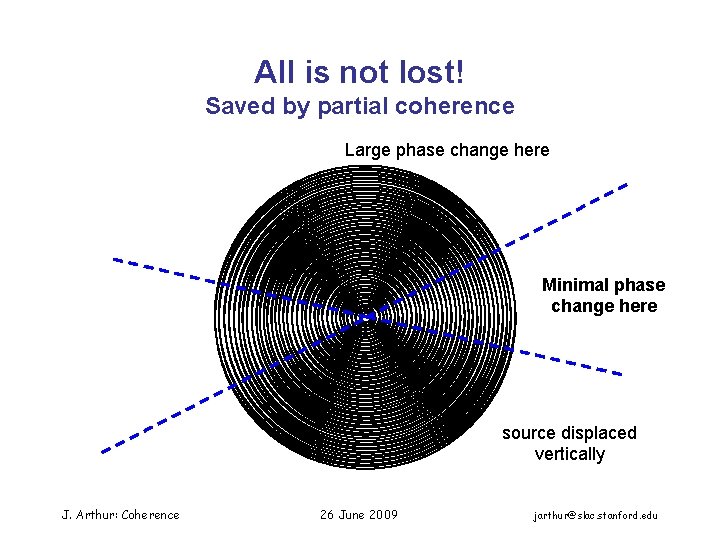
Phase shifts from displaced source Large phase change here Minimal phase change here source displaced vertically J. Arthur: Coherence 26 June 2009 jarthur@slac. stanford. edu
Coherence of x-ray sources Typical x-ray source (tube, plasma, electron bunch in synchrotron) is large compared to x-ray wavelength Distances between emitting electrons are random Emission times (initial phases) are random X-ray wavelength is not precisely defined So these sources are incoherent by nature Incoherent both spatially (transversely) and temporally (longitudinally) J. Arthur: Coherence 26 June 2009 jarthur@slac. stanford. edu
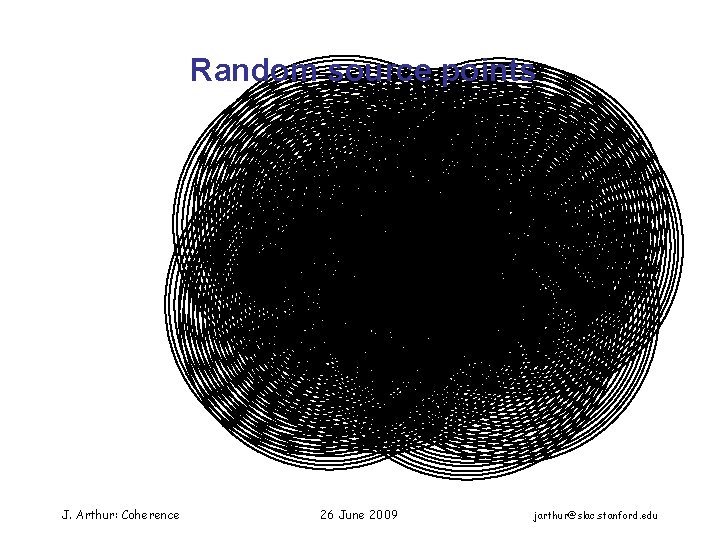
What, precisely, causes these sources to be incoherent? Each electron, radiating from a point, creates a coherent wave. There are many electrons, radiating from different places, with different wavelengths, and at different times. The detector integrates over the signal from many source electrons. J. Arthur: Coherence 26 June 2009 jarthur@slac. stanford. edu
Random source points J. Arthur: Coherence 26 June 2009 jarthur@slac. stanford. edu
All is not lost! Saved by partial coherence Large phase change here Minimal phase change here source displaced vertically J. Arthur: Coherence 26 June 2009 jarthur@slac. stanford. edu
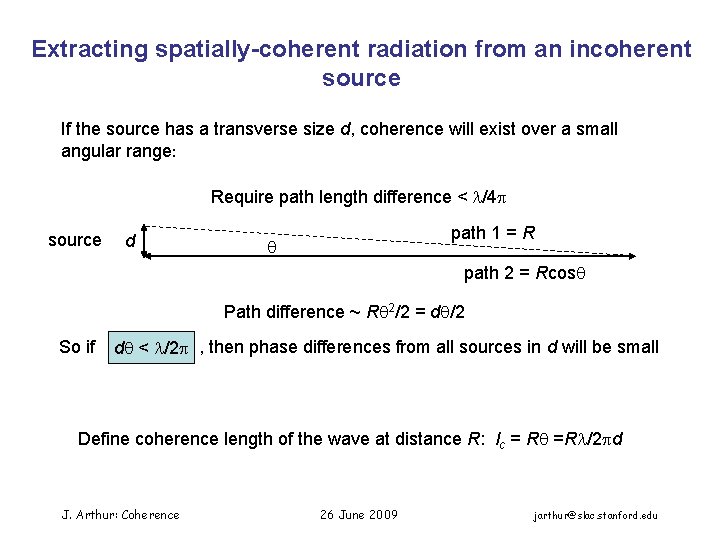
Extracting spatially-coherent radiation from an incoherent source If the source has a transverse size d, coherence will exist over a small angular range: Require path length difference < /4 source d path 1 = R path 2 = Rcos Path difference ~ R 2/2 = d /2 So if d d << /2 , /2 then phase differences from all sources in d will be small Define coherence length of the wave at distance R: lc = R =R /2 d J. Arthur: Coherence 26 June 2009 jarthur@slac. stanford. edu
Important points Incoherent x-ray sources appear spatially coherent over a small angle The sensitivity to path length differences and other sources of incoherence depends on At large distances from a source, the coherence length can be large 100µm source at 100 m, =1. 5Å: lc ~ 24µm However, the coherent fraction is small (fraction of total emitted light that lies within a spatially-coherent region) ~ 2/d 2 J. Arthur: Coherence 26 June 2009 jarthur@slac. stanford. edu
Uses of coherent x-rays Diffraction J. Arthur: Coherence Imaging 26 June 2009 Speckle jarthur@slac. stanford. edu
Diffraction How much coherence is needed? d What is the maximum path length difference? It’s N , where N is the effective number of crystal planes. This number is typically 102 -105, depending on type of crystal. So required coherence length ~ 0. 1 -1 µm. J. Arthur: Coherence 26 June 2009 jarthur@slac. stanford. edu
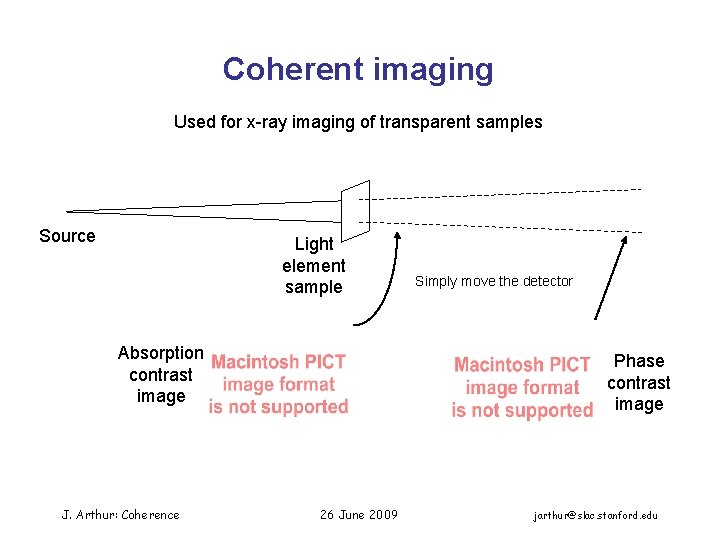
Coherent imaging Used for x-ray imaging of transparent samples Source Light element sample Absorption contrast image J. Arthur: Coherence Simply move the detector Phase contrast image 26 June 2009 jarthur@slac. stanford. edu
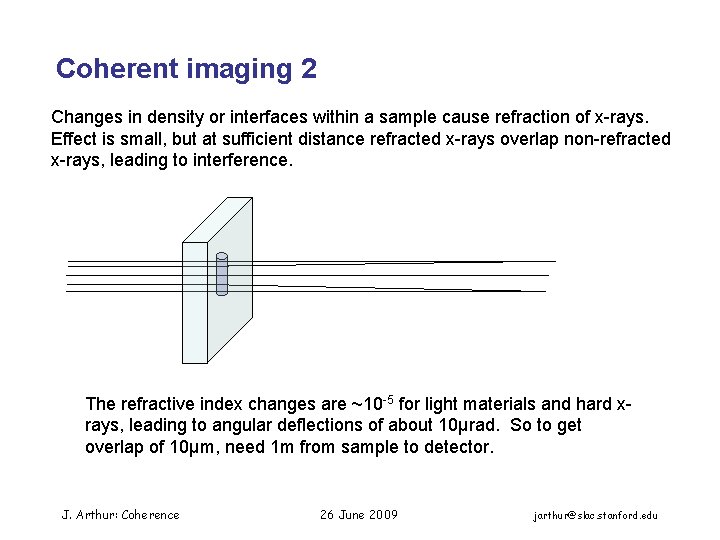
Coherent imaging 2 Changes in density or interfaces within a sample cause refraction of x-rays. Effect is small, but at sufficient distance refracted x-rays overlap non-refracted x-rays, leading to interference. The refractive index changes are ~10 -5 for light materials and hard xrays, leading to angular deflections of about 10µrad. So to get overlap of 10µm, need 1 m from sample to detector. J. Arthur: Coherence 26 June 2009 jarthur@slac. stanford. edu
Coherent X-ray images J. Arthur: Coherence 26 June 2009 jarthur@slac. stanford. edu
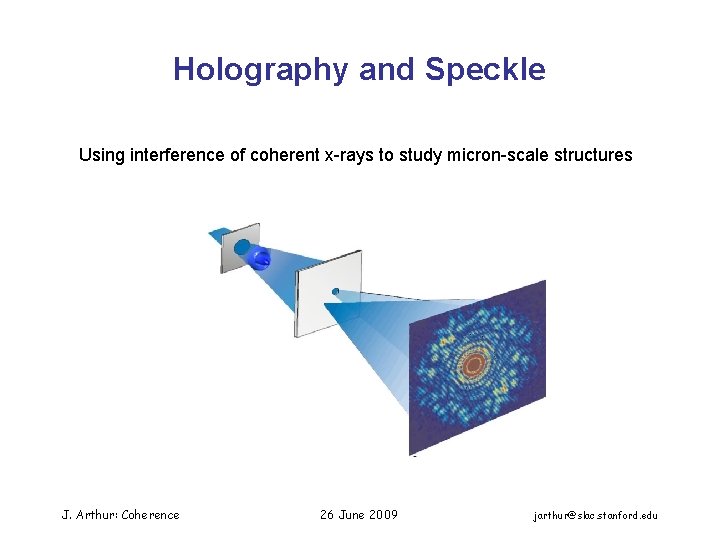
Holography and Speckle Using interference of coherent x-rays to study micron-scale structures J. Arthur: Coherence 26 June 2009 jarthur@slac. stanford. edu
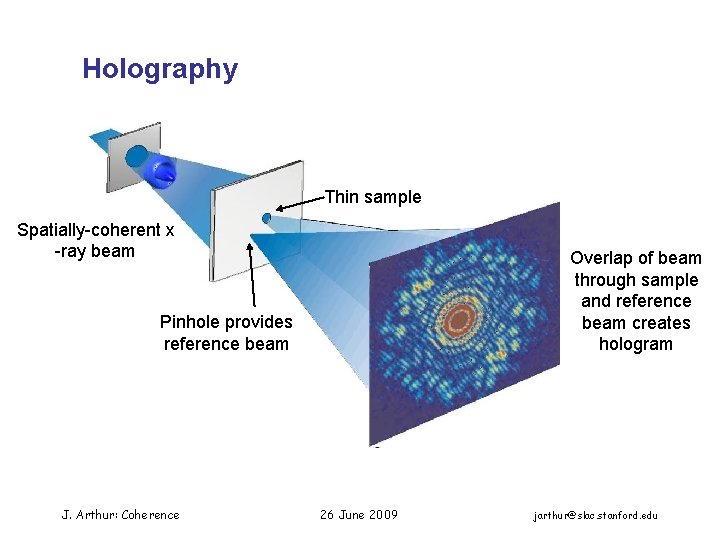
Holography Thin sample Spatially-coherent x -ray beam Overlap of beam through sample and reference beam creates hologram Pinhole provides reference beam J. Arthur: Coherence 26 June 2009 jarthur@slac. stanford. edu
Holography 2 The reference beam, through the interference pattern, provides information about the phase relationships in the wave coming through the sample, which allows the reconstruction Image reconstructed on computer Hologram recorded by CCD camera (15Å x-rays) ~1µm Ref: S. Eisebitt, et al. , Appl. Phys. Lett. 84, 3373 (2004) J. Arthur: Coherence 26 June 2009 Thin Co/Pt film with magnetic domain structure jarthur@slac. stanford. edu
Holography without reference, or coherent diffraction imaging 19 pyramids 1 pyramid diffraction pattern from this particular array of 19 pyramids J. Arthur: Coherence diffraction pattern from 1 pyramid 26 June 2009 jarthur@slac. stanford. edu
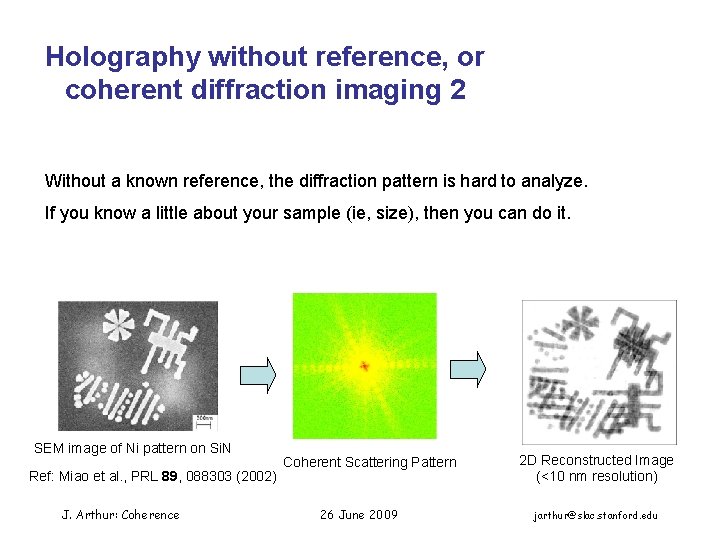
Holography without reference, or coherent diffraction imaging 2 Without a known reference, the diffraction pattern is hard to analyze. If you know a little about your sample (ie, size), then you can do it. SEM image of Ni pattern on Si. N Ref: Miao et al. , PRL 89, 088303 (2002) J. Arthur: Coherence Coherent Scattering Pattern 26 June 2009 2 D Reconstructed Image (<10 nm resolution) jarthur@slac. stanford. edu
Speckle Diffraction pattern from lots of micron-sized objects Precise interference pattern depends on precise arrangement of objects Speckle pattern from Fe-Al alloy with Fe-rich and Al-rich domains J. Arthur: Coherence 26 June 2009 jarthur@slac. stanford. edu
Speckle analysis By studying the change in the speckle pattern, we learn about change in the microstructure of the sample We don’t need to know the details, just that there has been a change Each image is a subtraction of two speckle patterns at different magnetic field J. Arthur: Coherence 26 June 2009 jarthur@slac. stanford. edu
Speckle analysis 2 Using the time-dependence of a speckle pattern to deduce sample dynamics is called X-ray Photon Correlation Spectroscopy (XPCS) Fluctuation rate vs temperature for a superstructure Bragg peak from a Co 60 Ga 40 crystal, measured using XPCS J. Arthur: Coherence 26 June 2009 jarthur@slac. stanford. edu
Coherence of an FEL source FEL process causes electrons to move into predictable, coherent positions Therefore, FEL radiation is highly coherent J. Arthur: Coherence 26 June 2009 jarthur@slac. stanford. edu
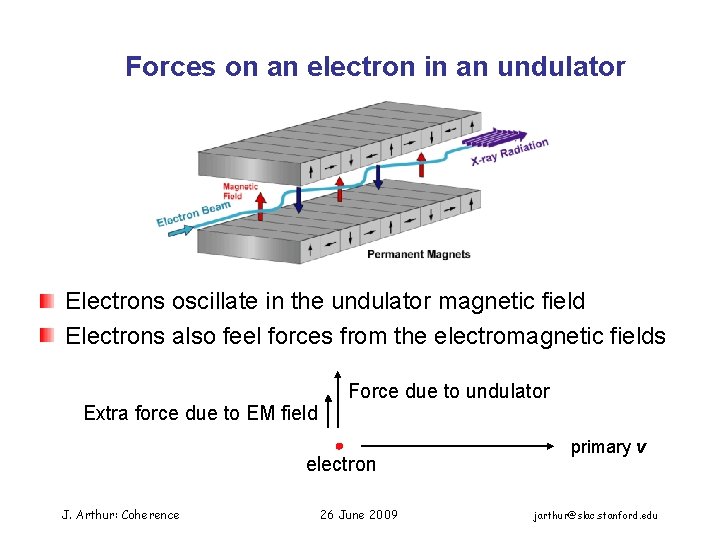
Forces on an electron in an undulator Electrons oscillate in the undulator magnetic field Electrons also feel forces from the electromagnetic fields Extra force due to EM field Force due to undulator electron J. Arthur: Coherence 26 June 2009 primary v jarthur@slac. stanford. edu
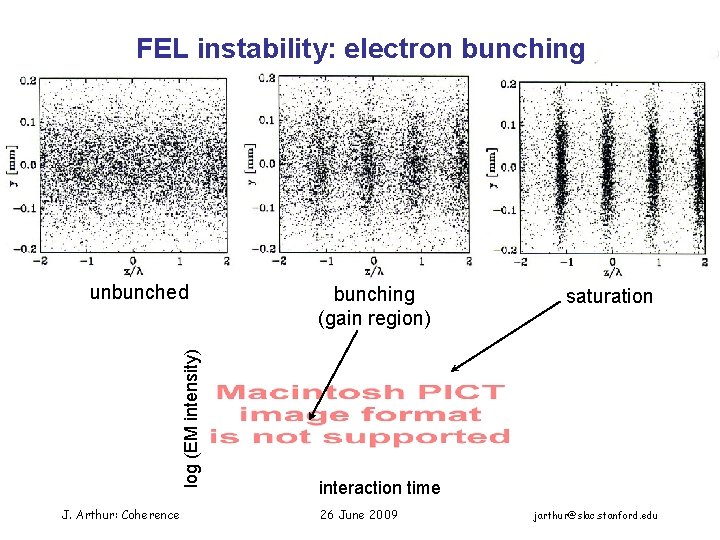
FEL instability: electron bunching log (EM intensity) unbunched J. Arthur: Coherence bunching (gain region) saturation interaction time 26 June 2009 jarthur@slac. stanford. edu
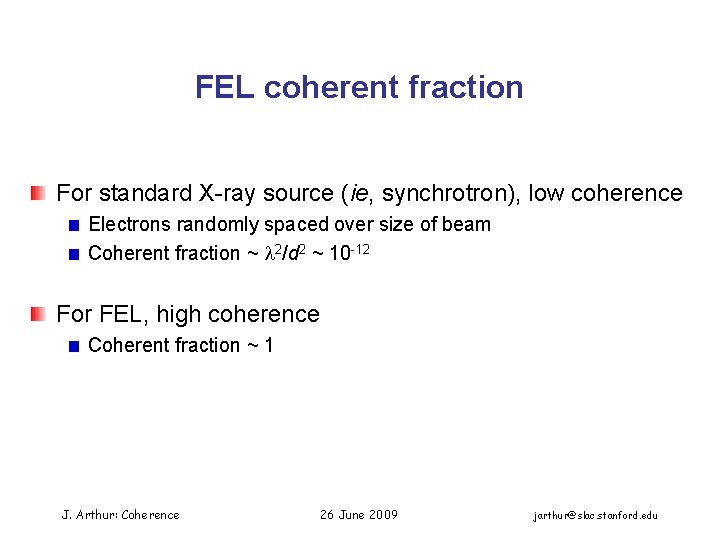
FEL coherent fraction For standard X-ray source (ie, synchrotron), low coherence Electrons randomly spaced over size of beam Coherent fraction ~ 2/d 2 ~ 10 -12 For FEL, high coherence Coherent fraction ~ 1 J. Arthur: Coherence 26 June 2009 jarthur@slac. stanford. edu
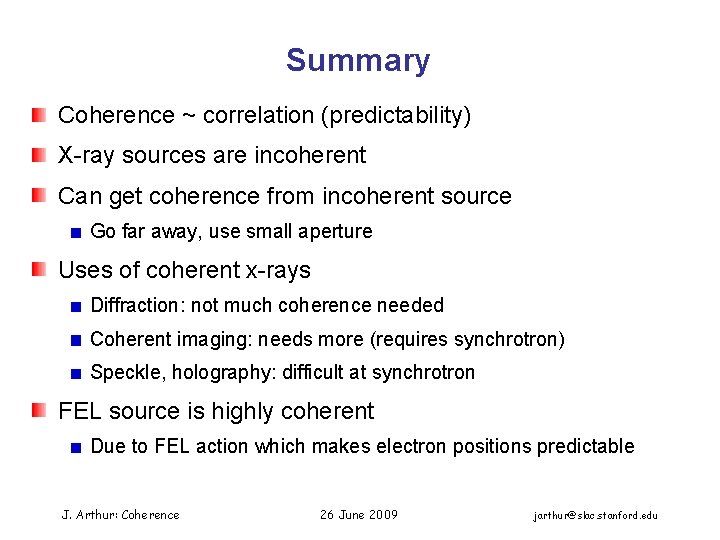
Summary Coherence ~ correlation (predictability) X-ray sources are incoherent Can get coherence from incoherent source Go far away, use small aperture Uses of coherent x-rays Diffraction: not much coherence needed Coherent imaging: needs more (requires synchrotron) Speckle, holography: difficult at synchrotron FEL source is highly coherent Due to FEL action which makes electron positions predictable J. Arthur: Coherence 26 June 2009 jarthur@slac. stanford. edu