
Cognitive test results and Finalization of the Module
![Seeing Children aged 2 -17 years 1 a) Does [name] wear glasses? Yes/No [If](https://slidetodoc.com/presentation_image_h/be067ad95b7949ff1a9750685ff8e321/image-12.jpg "Seeing Children aged 2 -17 years 1 a) Does [name] wear glasses? Yes/No [If")
![Hearing Children aged 2 -17 years 2 a) Does [name] use a hearing aid?](https://slidetodoc.com/presentation_image_h/be067ad95b7949ff1a9750685ff8e321/image-13.jpg "Hearing Children aged 2 -17 years 2 a) Does [name] use a hearing aid?")
![Walking Children aged 2 -17 years Does [name] use any equipment or receive help](https://slidetodoc.com/presentation_image_h/be067ad95b7949ff1a9750685ff8e321/image-14.jpg "Walking Children aged 2 -17 years Does [name] use any equipment or receive help")
![Walking Children aged 2 -4 years [If child uses equipment or receives help] 3](https://slidetodoc.com/presentation_image_h/be067ad95b7949ff1a9750685ff8e321/image-15.jpg "Walking Children aged 2 -4 years [If child uses equipment or receives help] 3")
![Walking Children aged 5 -17 years [If child uses equipment or receives help] 3](https://slidetodoc.com/presentation_image_h/be067ad95b7949ff1a9750685ff8e321/image-16.jpg "Walking Children aged 5 -17 years [If child uses equipment or receives help] 3")
![Walking Children aged 5 -17 years [If child uses equipment or receives help] 3](https://slidetodoc.com/presentation_image_h/be067ad95b7949ff1a9750685ff8e321/image-17.jpg "Walking Children aged 5 -17 years [If child uses equipment or receives help] 3")
![Visual Representation of Thematic Schema Compared with children of the same age, does [name]](https://slidetodoc.com/presentation_image_h/be067ad95b7949ff1a9750685ff8e321/image-20.jpg "Visual Representation of Thematic Schema Compared with children of the same age, does [name]")
![Self-care Children aged 5 - 17 years 4) ÷ Does [name] have difficulty with](https://slidetodoc.com/presentation_image_h/be067ad95b7949ff1a9750685ff8e321/image-21.jpg "Self-care Children aged 5 - 17 years 4) ÷ Does [name] have difficulty with")
![Communication/Comprehension Children aged 2 -4 years 5 a) Does [name] have difficulty understanding you?](https://slidetodoc.com/presentation_image_h/be067ad95b7949ff1a9750685ff8e321/image-23.jpg "Communication/Comprehension Children aged 2 -4 years 5 a) Does [name] have difficulty understanding you?")
![Emotions Children aged 5 -17 years 9) ÷ How much does [name] worry or](https://slidetodoc.com/presentation_image_h/be067ad95b7949ff1a9750685ff8e321/image-29.jpg "Emotions Children aged 5 -17 years 9) ÷ How much does [name] worry or")
![Attention Children aged 5 -17 11) ÷ Does [name] have difficulty focussing on an](https://slidetodoc.com/presentation_image_h/be067ad95b7949ff1a9750685ff8e321/image-32.jpg "Attention Children aged 5 -17 11) ÷ Does [name] have difficulty focussing on an")
![Coping with change Children aged 5 -17 years 12) ÷ Does [name] have difficulty](https://slidetodoc.com/presentation_image_h/be067ad95b7949ff1a9750685ff8e321/image-34.jpg "Coping with change Children aged 5 -17 years 12) ÷ Does [name] have difficulty")
![Relationships Children aged 5 -17 years 14) Does [name] have difficulty making friends? Would](https://slidetodoc.com/presentation_image_h/be067ad95b7949ff1a9750685ff8e321/image-38.jpg "Relationships Children aged 5 -17 years 14) Does [name] have difficulty making friends? Would")
- Slides: 38
Cognitive test results and Finalization of the Module on Child Functioning and Disability Mitchell Loeb (with Kristen Miller & Meredith Massey) NCHS Washington, DC / Washington Group on Disability Statistics in collaboration with UNICEF
Use of measures of child functioning and disability Describe the population at risk – to inform policy. Classify the population to monitor disparities in participation by disability status (also provides a prevalence rate). Identify a population for 2 nd stage assessment. (Improve our understanding of population data. ) To provide services to children identified.
Cognitive Training/Testing: Sites: • September 2012, Mumbai, India • January 2013, Belmopan, Belize • April 2013, Muscat, Oman • July 2013, Podgorica, Montenegro Analysis: • Individual country reports • Larger, unified analysis (N=224)
Overview of Primary Findings • Child disability questions perform differently than adult disability questions • Primarily in 2 ways: • Parental proxy • Parent’s knowledge of “what is normal” - comparing to other children the same age
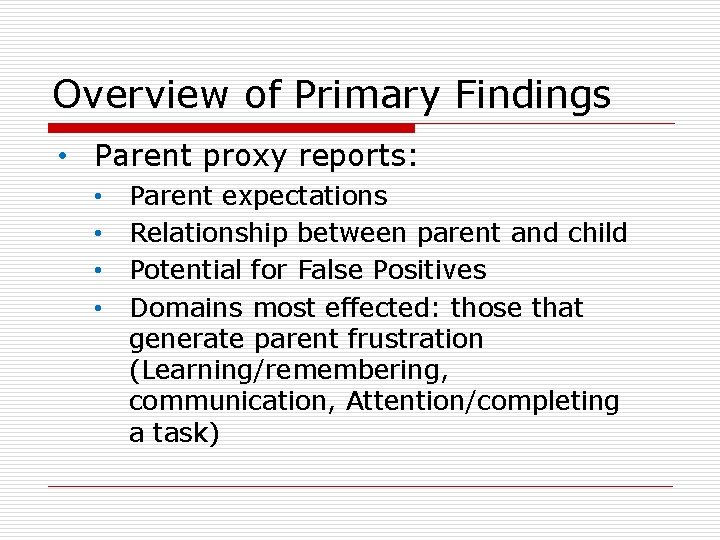
Overview of Primary Findings • Parent proxy reports: • • Parent expectations Relationship between parent and child Potential for False Positives Domains most effected: those that generate parent frustration (Learning/remembering, communication, Attention/completing a task)
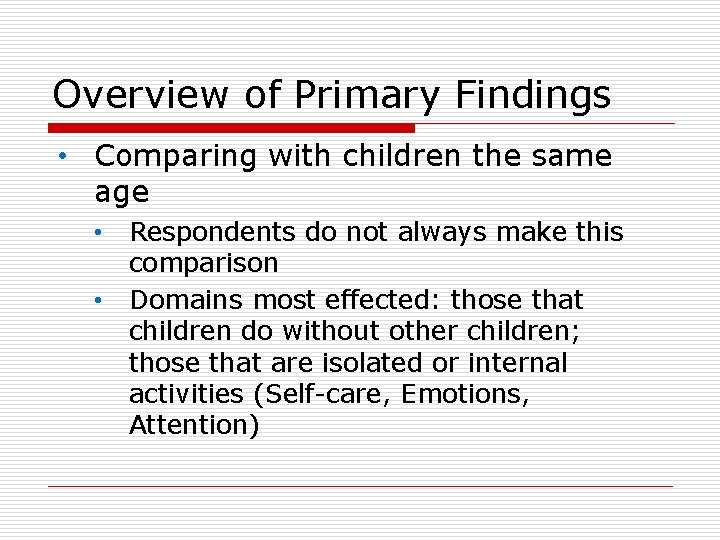
Overview of Primary Findings • Comparing with children the same age • Respondents do not always make this comparison • Domains most effected: those that children do without other children; those that are isolated or internal activities (Self-care, Emotions, Attention)
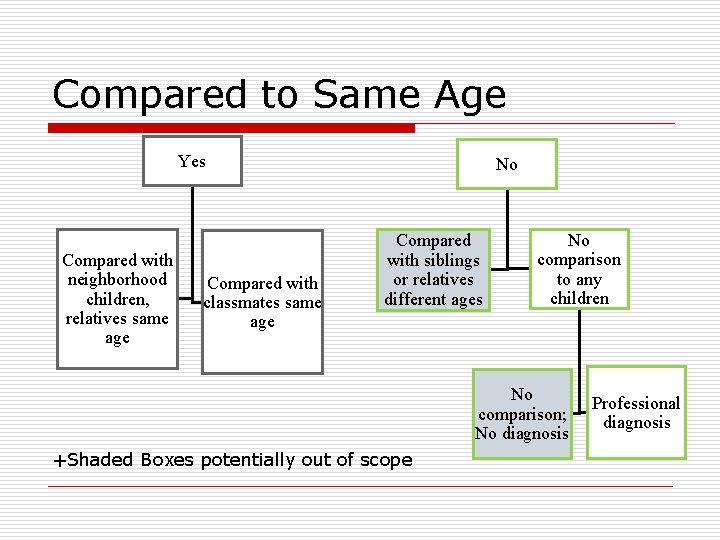
Compared to Same Age Yes Compared with neighborhood children, relatives same age Compared with classmates same age No Compared with siblings or relatives different ages No comparison to any children No comparison; No diagnosis +Shaded Boxes potentially out of scope Professional diagnosis
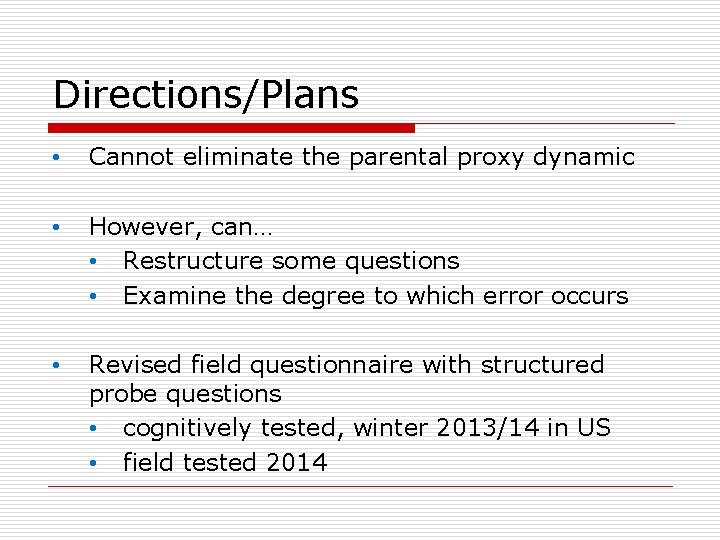
Directions/Plans • Cannot eliminate the parental proxy dynamic • However, can… • Restructure some questions • Examine the degree to which error occurs • Revised field questionnaire with structured probe questions • cognitively tested, winter 2013/14 in US • field tested 2014
Preamble The next questions ask about difficulties your child may have in doing certain activities…
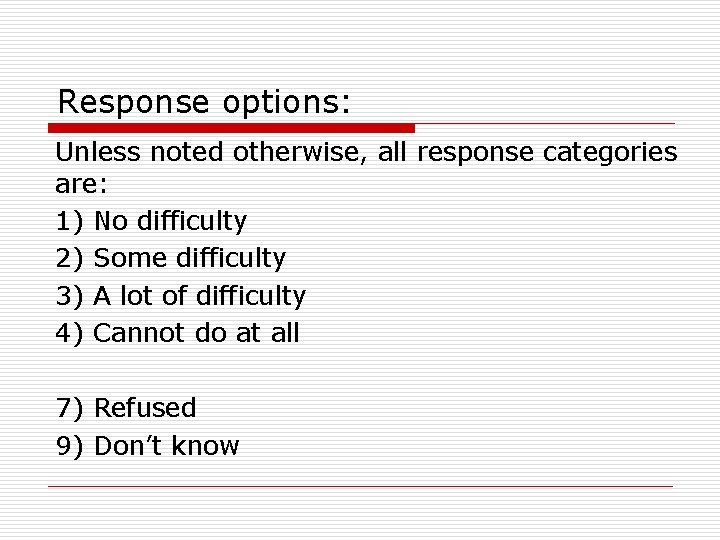
Response options: Unless noted otherwise, all response categories are: 1) No difficulty 2) Some difficulty 3) A lot of difficulty 4) Cannot do at all 7) Refused 9) Don’t know
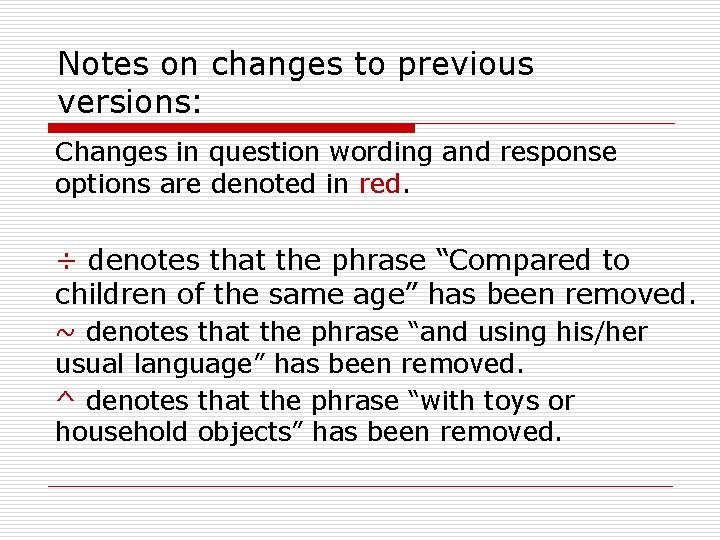
Notes on changes to previous versions: Changes in question wording and response options are denoted in red. ÷ denotes that the phrase “Compared to children of the same age” has been removed. ~ denotes that the phrase “and using his/her usual language” has been removed. ^ denotes that the phrase “with toys or household objects” has been removed.
Seeing Children aged 2 -17 years 1 a) Does [name] wear glasses? Yes/No [If child wears glasses] 1 b) When wearing [his/her] glasses, does [name] have difficulty seeing? Would you say… [Read response categories] [If child does NOT wear glasses] 1 b) Does [name] have difficulty seeing? Would you say… [Read response categories]
Hearing Children aged 2 -17 years 2 a) Does [name] use a hearing aid? Yes/No [If child uses a hearing aid] 2 b) When using [his/her] hearing aid(s), does [name] have difficulty hearing? Would you say… [Read response categories] [If child does NOT use a hearing aid] 2 b) Does [name] have difficulty hearing? Would you say… [Read response categories]
Walking Children aged 2 -17 years Does [name] use any equipment or receive help for walking? Yes/No
Walking Children aged 2 -4 years [If child uses equipment or receives help] 3 a 1) ÷ Without the use of any equipment or assistance, does [name] have difficulty walking? Would you say… [Read response categories; do not include No difficulty] [If child does NOT use equipment or receives help] 3 a 2) Compared with children of the same age, does [name] have difficulty walking? Would you say… [Read response categories]
Walking Children aged 5 -17 years [If child uses equipment or receives help] 3 b 1) ÷ Without the use of any equipment or assistance, does [name] have difficulty walking 100 yards/ meters on level ground? That would be about the length of 1 football field. [Or insert country specific example]. Would you say… [Read response categories do not include No difficulty] If Cannot do at all, skip to Self-care
Walking Children aged 5 -17 years [If child uses equipment or receives help] 3 c 1) ÷ Without the use of any equipment or assistance, does [name] have difficulty walking 500 yards/ meters on level ground? That would be about the length of 5 football fields. [Or insert country specific example]. Would you say… [Read response categories do not include No difficulty]
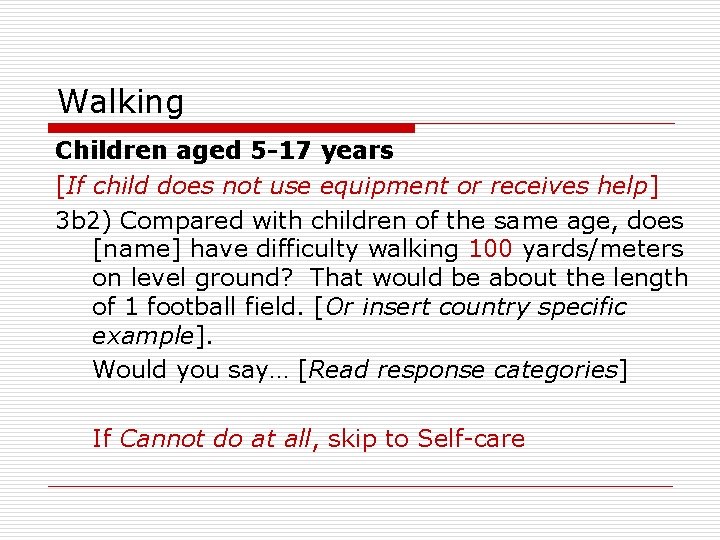
Walking Children aged 5 -17 years [If child does not use equipment or receives help] 3 b 2) Compared with children of the same age, does [name] have difficulty walking 100 yards/meters on level ground? That would be about the length of 1 football field. [Or insert country specific example]. Would you say… [Read response categories] If Cannot do at all, skip to Self-care
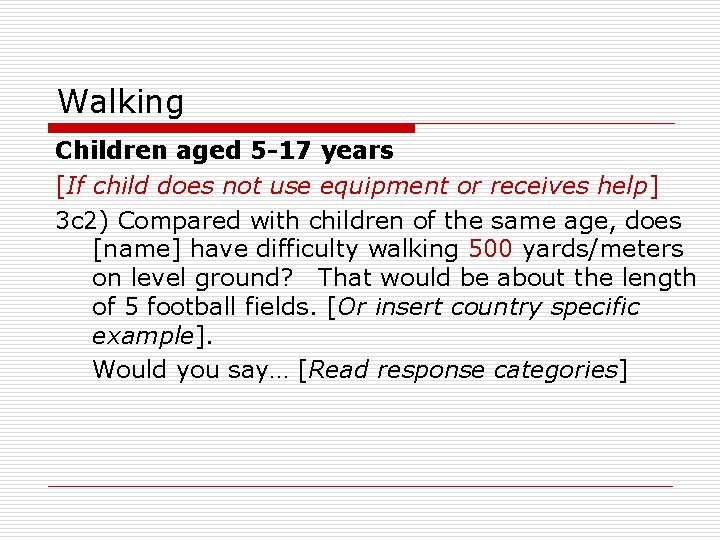
Walking Children aged 5 -17 years [If child does not use equipment or receives help] 3 c 2) Compared with children of the same age, does [name] have difficulty walking 500 yards/meters on level ground? That would be about the length of 5 football fields. [Or insert country specific example]. Would you say… [Read response categories]
Visual Representation of Thematic Schema Compared with children of the same age, does [name] have difficulty with self-care such as feeding or dressing him/herself? Activities Considered by Respondent General Conceptualization Physical capability of child to do a combination of multiple activities including feeding, dressing, bathing, combing hair, getting in and out of bed Only Feeding Physical capability of child to feed themselves Willingness of child to eat what he/she is given; whether child is a “fussy” eater Only Dressing Physical capability of child to put on clothes Willingness of child to wear appropriate clothing Both Feeding and Dressing Physical capability of child to feed and dress themselves Willingness of child to eat what he/she is given coupled with the willingness of child to wear appropriate clothing
Self-care Children aged 5 - 17 years 4) ÷ Does [name] have difficulty with self-care such as feeding or dressing [him/herself]? Would you say… [Read response categories]
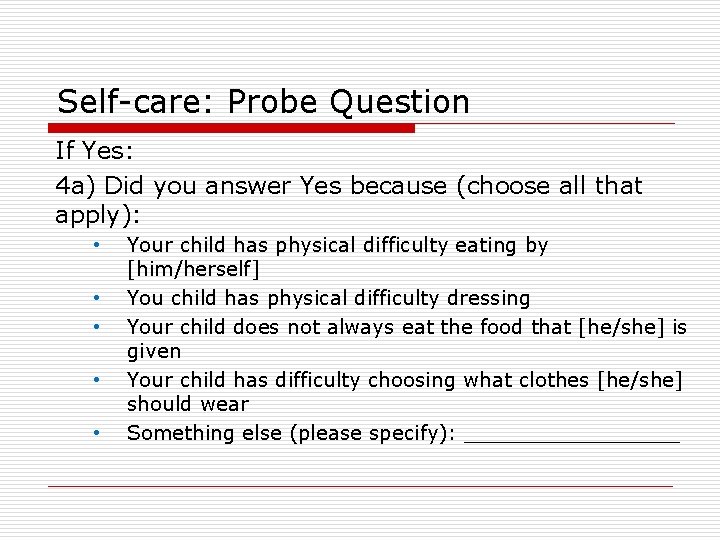
Self-care: Probe Question If Yes: 4 a) Did you answer Yes because (choose all that apply): • • • Your child has physical difficulty eating by [him/herself] You child has physical difficulty dressing Your child does not always eat the food that [he/she] is given Your child has difficulty choosing what clothes [he/she] should wear Something else (please specify): _________
Communication/Comprehension Children aged 2 -4 years 5 a) Does [name] have difficulty understanding you? Would you say… [Read response categories] 6 a) Do you have difficulty understanding your child? Would you say… [Read response categories]
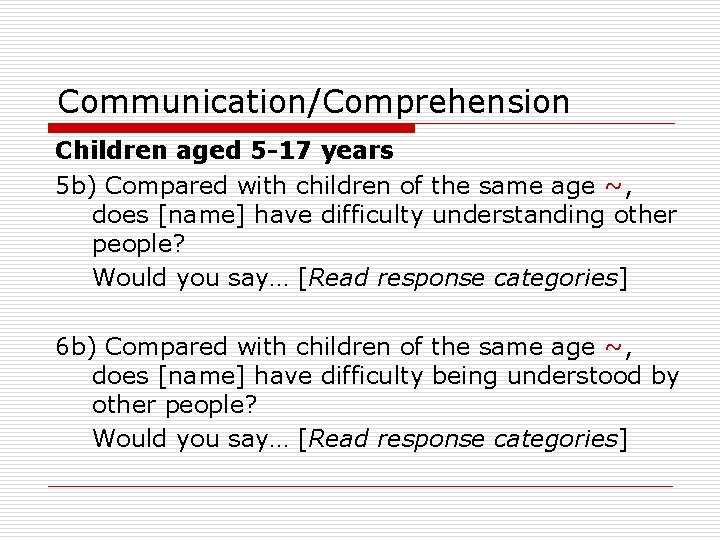
Communication/Comprehension Children aged 5 -17 years 5 b) Compared with children of the same age ~, does [name] have difficulty understanding other people? Would you say… [Read response categories] 6 b) Compared with children of the same age ~, does [name] have difficulty being understood by other people? Would you say… [Read response categories]
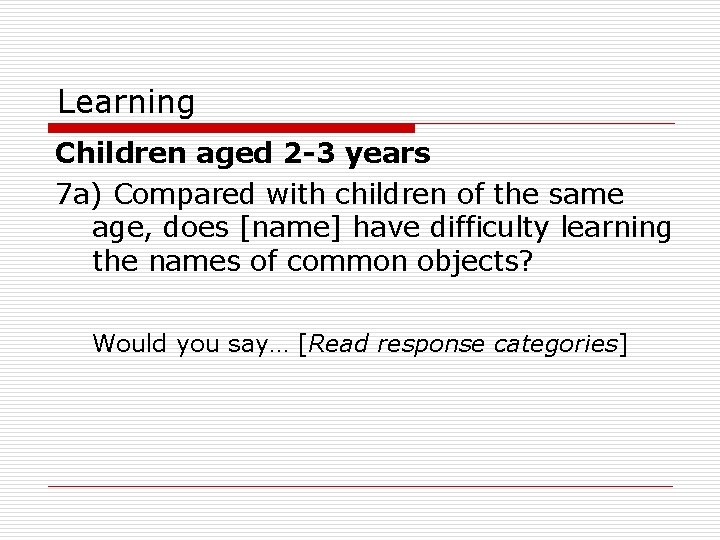
Learning Children aged 2 -3 years 7 a) Compared with children of the same age, does [name] have difficulty learning the names of common objects? Would you say… [Read response categories]
Learning Children aged 2 -17 years 7 b) Compared with children of the same age, does [name] have difficulty learning new things? Would you say… [Read response categories]
Learning Children aged 5 -17 years 8) Compared with children of the same age, does [name] have difficulty remembering things? Would you say… [Read response categories]
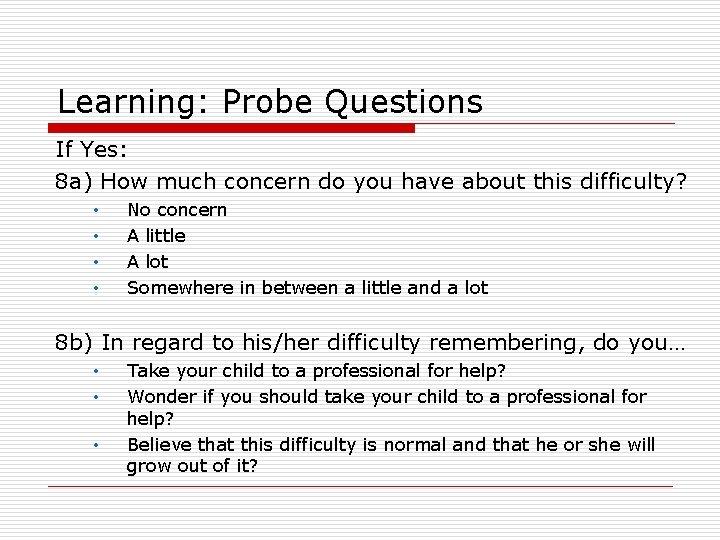
Learning: Probe Questions If Yes: 8 a) How much concern do you have about this difficulty? • • No concern A little A lot Somewhere in between a little and a lot 8 b) In regard to his/her difficulty remembering, do you… • • • Take your child to a professional for help? Wonder if you should take your child to a professional for help? Believe that this difficulty is normal and that he or she will grow out of it?
Emotions Children aged 5 -17 years 9) ÷ How much does [name] worry or feel sad? Would you say… [Read response categories] 1) Not at all 2) A little 3) A lot 4) Somewhere in between a little and a lot
Behavior Children aged 2 -4 years 10) Compared with children of the same age, how much does [name] kick, bite or hit other children or adults? Would you say… [Read response categories] 1) Not at all 2) The same or less 3) More 4) A lot more
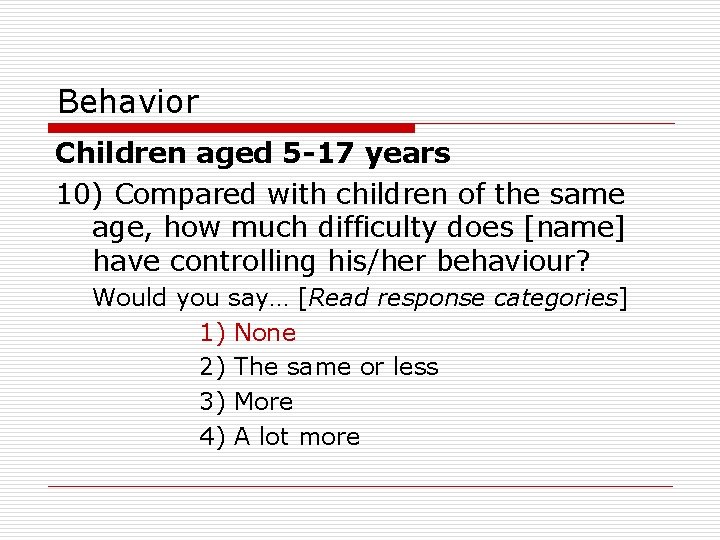
Behavior Children aged 5 -17 years 10) Compared with children of the same age, how much difficulty does [name] have controlling his/her behaviour? Would you say… [Read response categories] 1) None 2) The same or less 3) More 4) A lot more
Attention Children aged 5 -17 11) ÷ Does [name] have difficulty focussing on an activity that [he/she] enjoys doing? Would you say… [Read response categories]
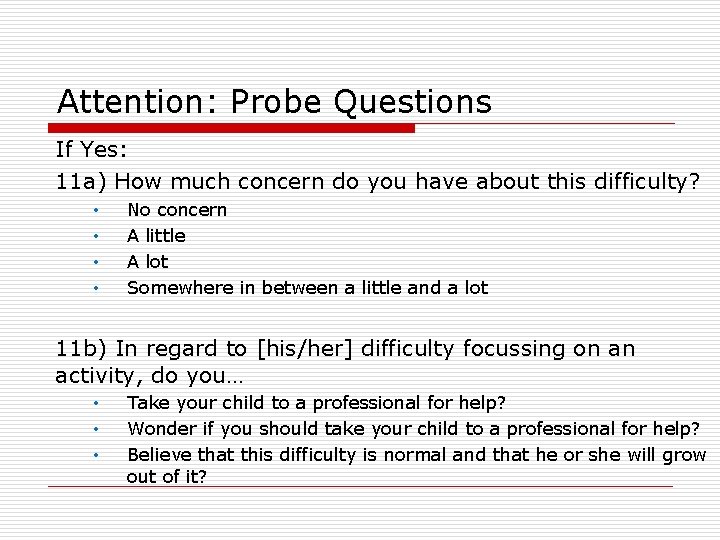
Attention: Probe Questions If Yes: 11 a) How much concern do you have about this difficulty? • • No concern A little A lot Somewhere in between a little and a lot 11 b) In regard to [his/her] difficulty focussing on an activity, do you… • • • Take your child to a professional for help? Wonder if you should take your child to a professional for help? Believe that this difficulty is normal and that he or she will grow out of it?
Coping with change Children aged 5 -17 years 12) ÷ Does [name] have difficulty accepting changes in [his/her] routine? Would you say… [Read response categories]
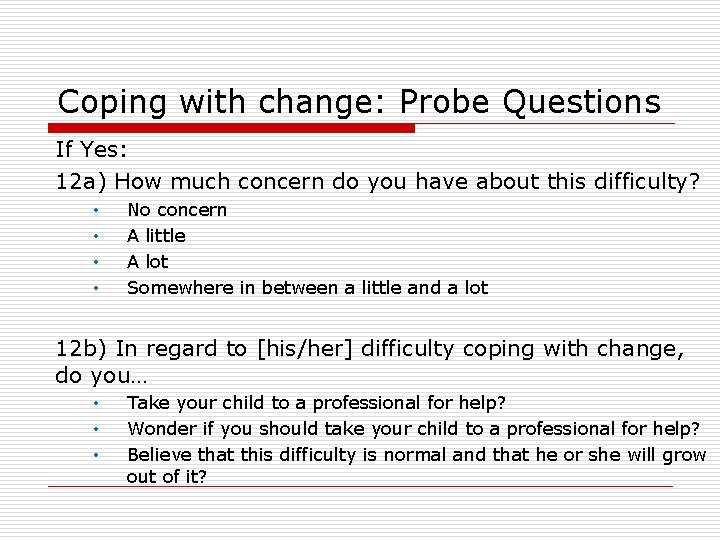
Coping with change: Probe Questions If Yes: 12 a) How much concern do you have about this difficulty? • • No concern A little A lot Somewhere in between a little and a lot 12 b) In regard to [his/her] difficulty coping with change, do you… • • • Take your child to a professional for help? Wonder if you should take your child to a professional for help? Believe that this difficulty is normal and that he or she will grow out of it?
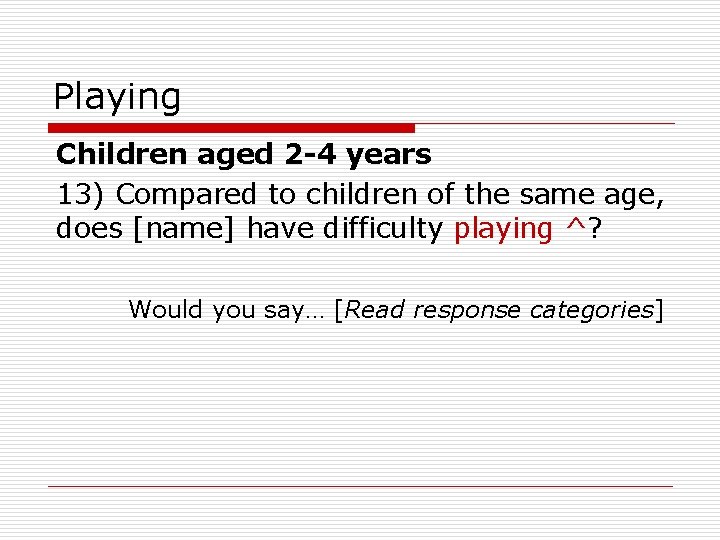
Playing Children aged 2 -4 years 13) Compared to children of the same age, does [name] have difficulty playing ^? Would you say… [Read response categories]
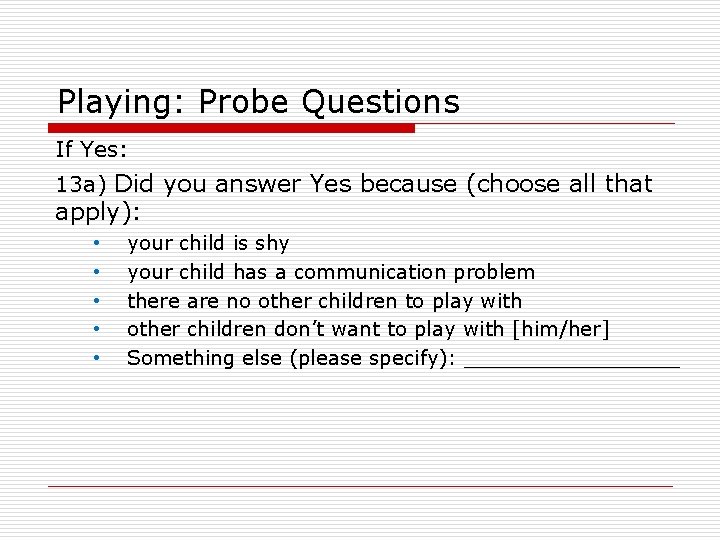
Playing: Probe Questions If Yes: 13 a) Did you answer Yes because (choose all that apply): • • • your child is shy your child has a communication problem there are no other children to play with other children don’t want to play with [him/her] Something else (please specify): _________
Relationships Children aged 5 -17 years 14) Does [name] have difficulty making friends? Would you say… [Read response categories]