
Cognitive Social Theory Main Theorists Albert Bandura Walter
Cognitive Social Theory Main Theorists Albert Bandura Walter Mischel
Also called Cognitive Social Learning Theory • Operant Conditioning – reward and punishment – these are called situational variables – PLUS • Learning by observation – PLUS • Cognitive processes within an individual – How a person thinks about the world, themselves, events – These are known as person variables
People are self-aware; people are individuals • Deliberately engage in learning • Not just at the mercy of the environment • People can modify (change) and create environments • Person variables are important in determining what behaviours will occur http: //s 159. photobucket. com/albums/t 152/sparkle 014/? action=view¤t=mil ey-cyrus-punk-08. jpg
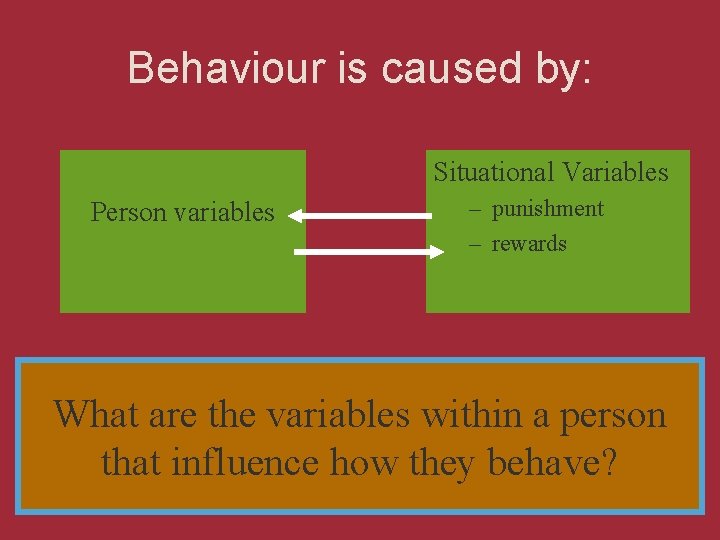
Behaviour is caused by: Situational Variables Person variables – punishment – rewards What are the variables within a person that influence how they behave?
Competencies What Can I do? • Competencies – Knowledge of rules that tell us how to behave – Skills –academic, athletic, social, job skills, and others – Ability to construct plans – Concepts of ourselves and others
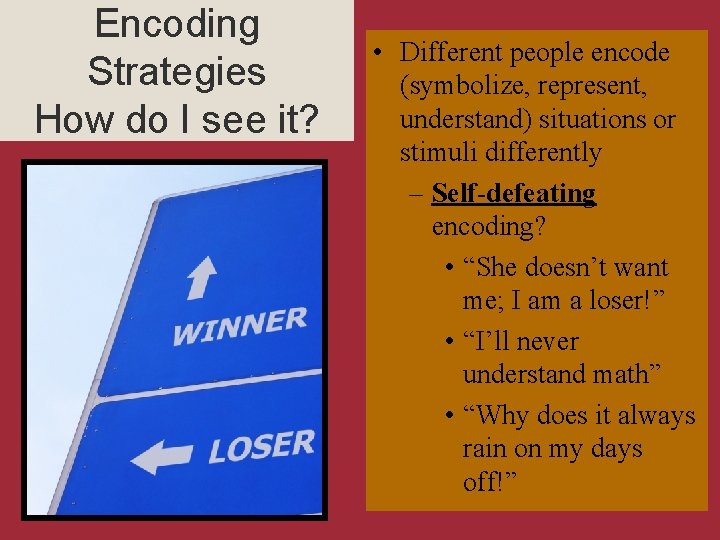
Encoding Strategies How do I see it? • Different people encode (symbolize, represent, understand) situations or stimuli differently – Self-defeating encoding? • “She doesn’t want me; I am a loser!” • “I’ll never understand math” • “Why does it always rain on my days off!”

Positive Encoding • The glass is half full – and if it isn’t, I’ll figure out where to get water – “Well, we weren’t made for each other!” – “I really need some help understanding this idea so I can pass that test” – “This will be a great day to walk in the rain!”
Expectancies What will happen? • First, what will the results of this action be? • Second, self-efficacy expectations – our belief that we can or cannot perform a certain behaviour – Positive self-efficacy • More likely to try tasks they believe they can do – Negative self-efficacy • More likely to avoid what they believe they cannot do
Subjective Values What is it worth to me? • Individuals place different values on the same outcome (terms: objective vs subjective) • Stimuli don’t control us; Stimuli have meaning – we decide the value – This is frightening; this is really interesting – This is worth working for; I can’t be bothered – I have to do this; if it doesn’t happen, it won’t bother me – I’m too scared – no way!; This is scary, but worth it
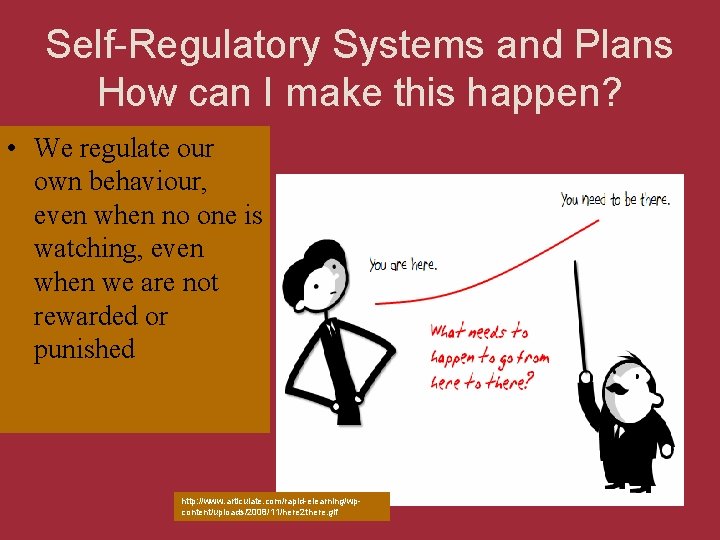
Self-Regulatory Systems and Plans How can I make this happen? • We regulate our own behaviour, even when no one is watching, even when we are not rewarded or punished http: //www. articulate. com/rapid-elearning/wpcontent/uploads/2008/11/here 2 there. gif
I’m in charge – what will I do with it? • We can’t control the environment all the time, but we can control our response to it – We set goals – Make plans – Congratulate or criticize ourselves – Give ourselves rewards – Help ourselves through the hard stuff
Assignment • Think of 10 things you would do, if you knew you wouldn’t fail • Consider the list and pick one • Complete the assignment – – Outline • • • Competencies Encoding Expectancies Subjective Value Self-Regulatory Systems and Plans
- Slides: 12