
Cognitive Robotics Lessons from the Smart Wheeler project
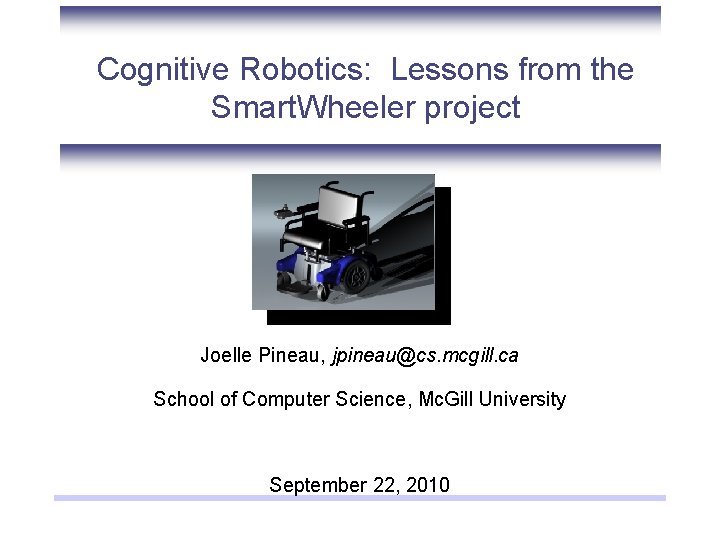
Cognitive Robotics: Lessons from the Smart. Wheeler project Joelle Pineau, jpineau@cs. mcgill. ca School of Computer Science, Mc. Gill University September 22, 2010
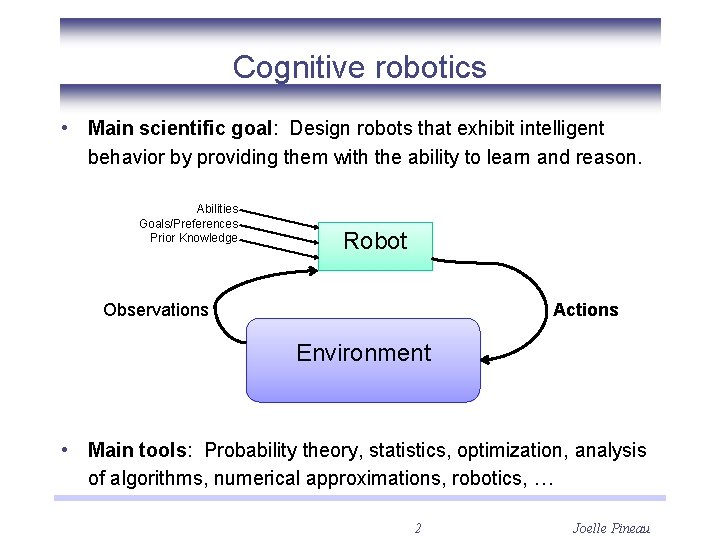
Cognitive robotics • Main scientific goal: Design robots that exhibit intelligent behavior by providing them with the ability to learn and reason. Abilities Goals/Preferences Prior Knowledge Robot Observations Actions Environment • Main tools: Probability theory, statistics, optimization, analysis of algorithms, numerical approximations, robotics, … 2 Joelle Pineau
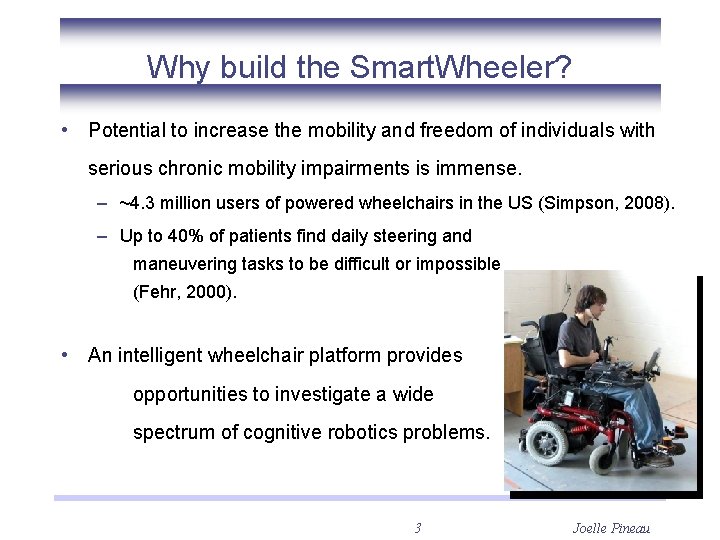
Why build the Smart. Wheeler? • Potential to increase the mobility and freedom of individuals with serious chronic mobility impairments is immense. – ~4. 3 million users of powered wheelchairs in the US (Simpson, 2008). – Up to 40% of patients find daily steering and maneuvering tasks to be difficult or impossible (Fehr, 2000). • An intelligent wheelchair platform provides opportunities to investigate a wide spectrum of cognitive robotics problems. 3 Joelle Pineau
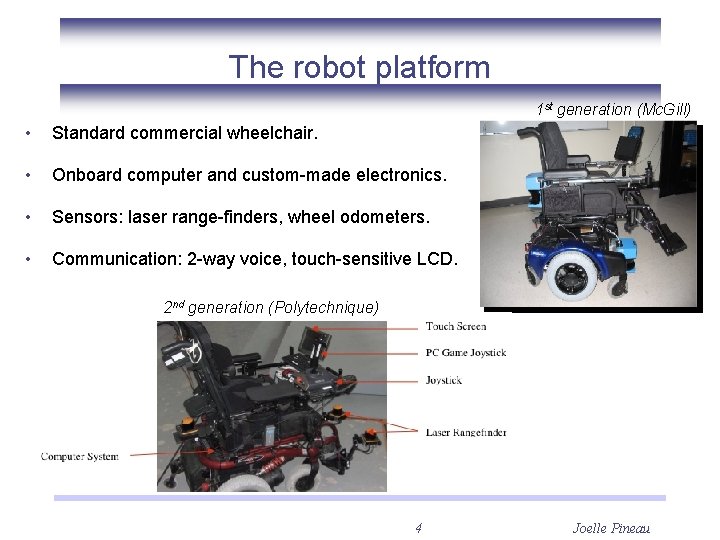
The robot platform 1 st generation (Mc. Gill) • Standard commercial wheelchair. • Onboard computer and custom-made electronics. • Sensors: laser range-finders, wheel odometers. • Communication: 2 -way voice, touch-sensitive LCD. 2 nd generation (Polytechnique) 4 Joelle Pineau
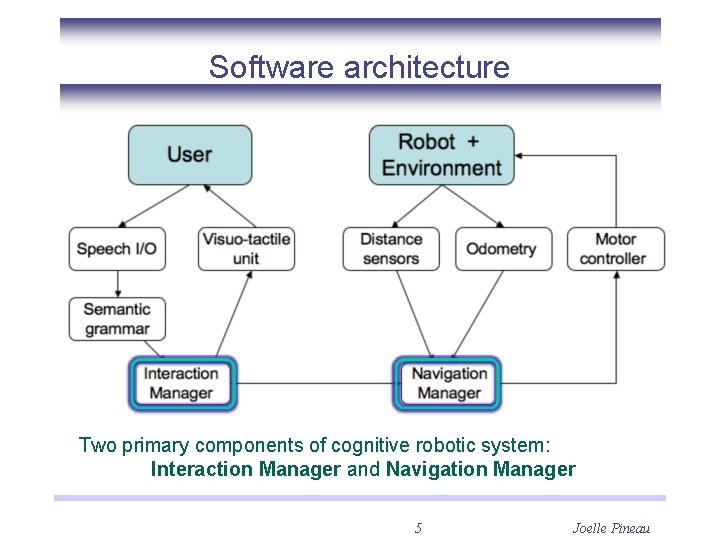
Software architecture Two primary components of cognitive robotic system: Interaction Manager and Navigation Manager 5 Joelle Pineau
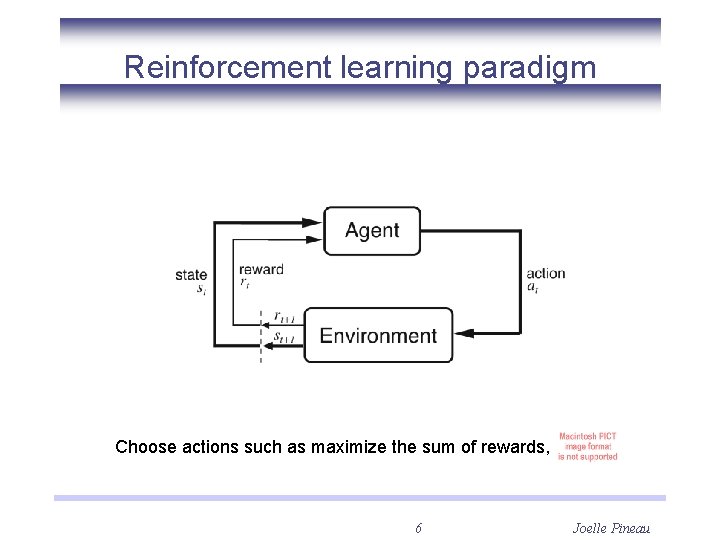
Reinforcement learning paradigm Choose actions such as maximize the sum of rewards, 6 Joelle Pineau
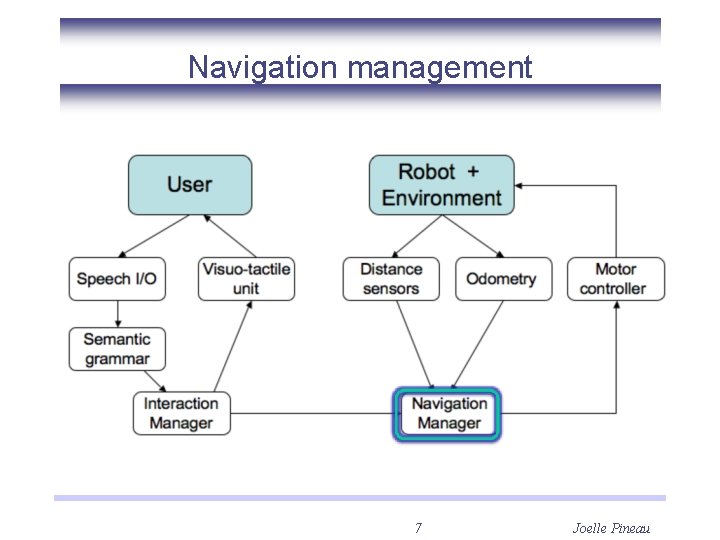
Navigation management 7 Joelle Pineau
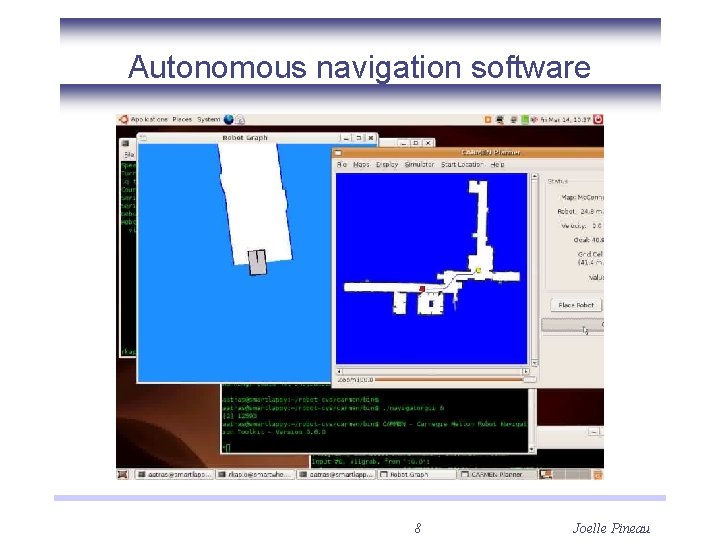
Autonomous navigation software 8 Joelle Pineau
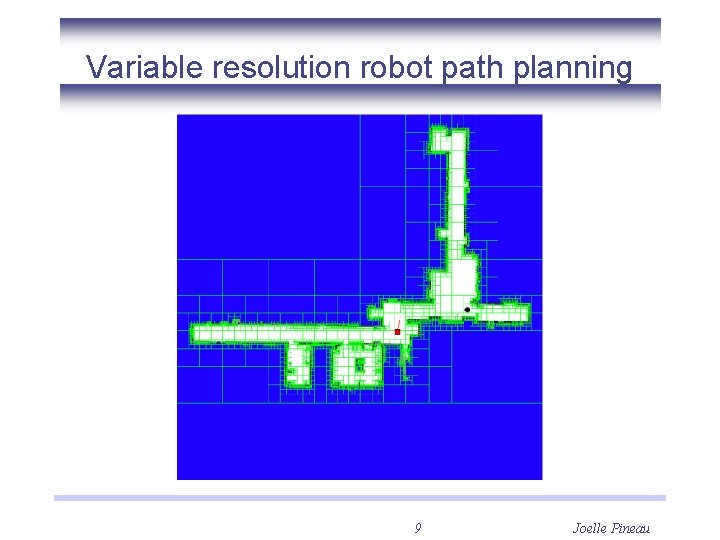
Variable resolution robot path planning 9 Joelle Pineau
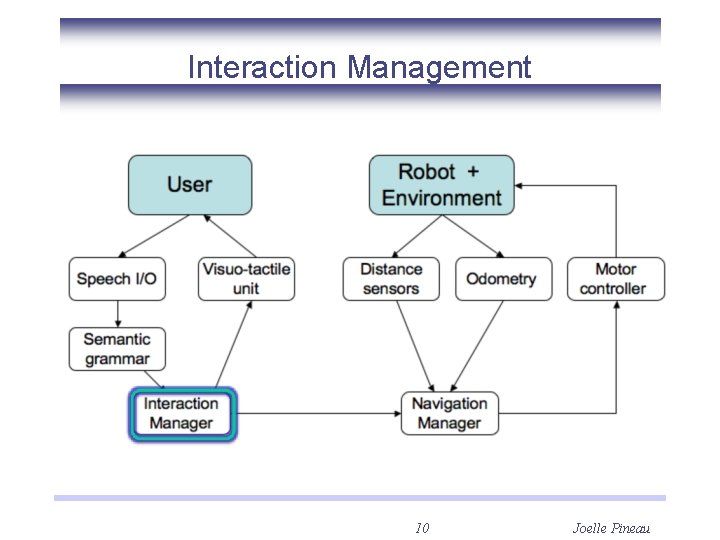
Interaction Management 10 Joelle Pineau
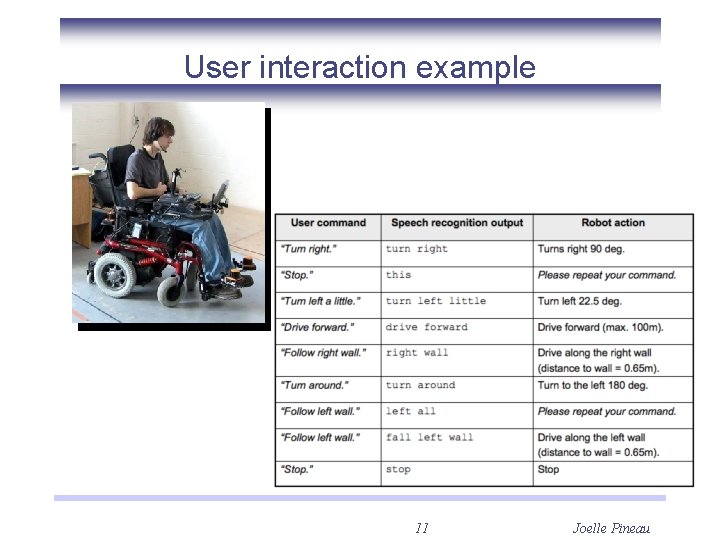
User interaction example 11 Joelle Pineau
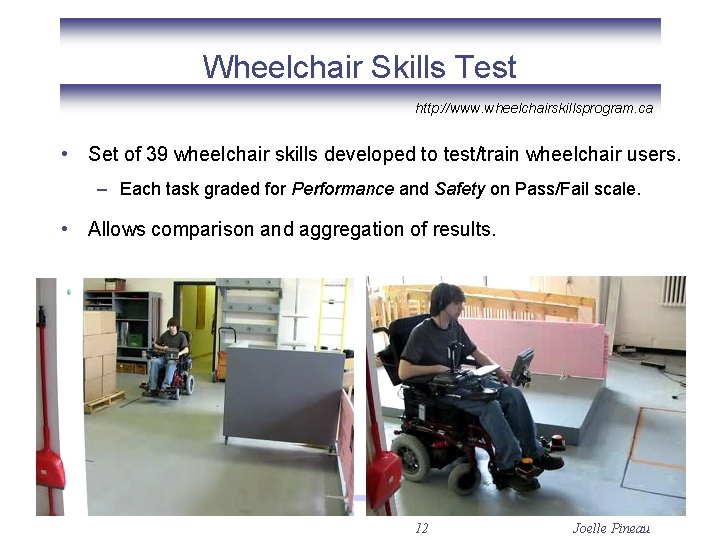
Wheelchair Skills Test http: //www. wheelchairskillsprogram. ca • Set of 39 wheelchair skills developed to test/train wheelchair users. – Each task graded for Performance and Safety on Pass/Fail scale. • Allows comparison and aggregation of results. 12 Joelle Pineau
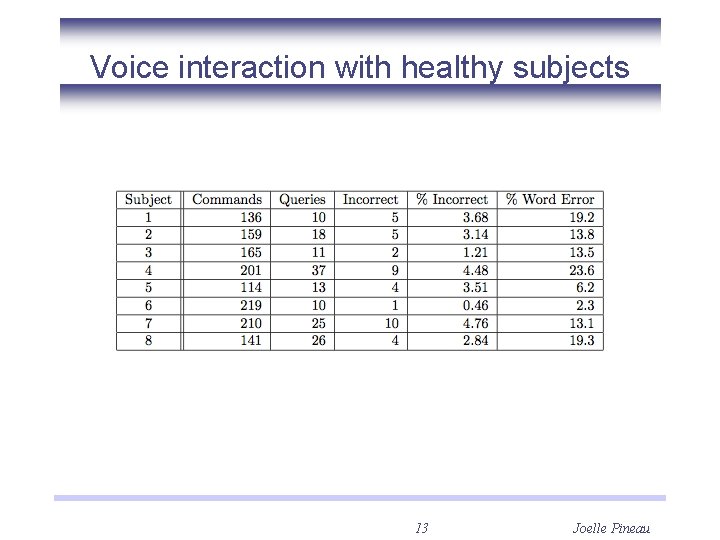
Voice interaction with healthy subjects 13 Joelle Pineau
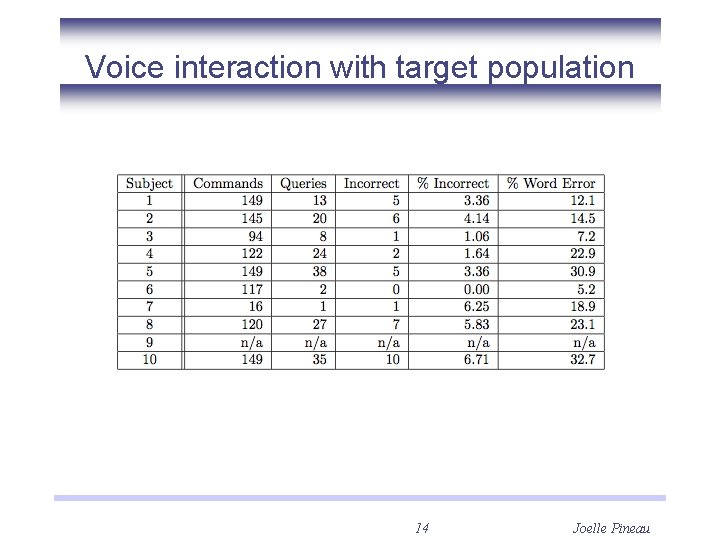
Voice interaction with target population 14 Joelle Pineau
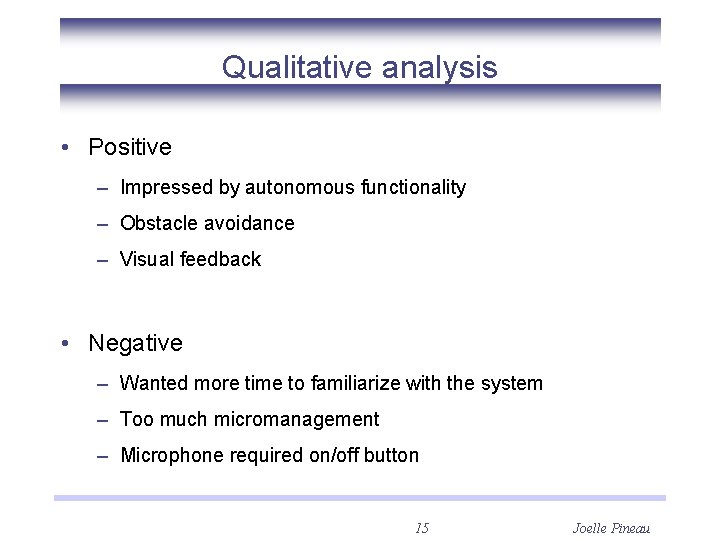
Qualitative analysis • Positive – Impressed by autonomous functionality – Obstacle avoidance – Visual feedback • Negative – Wanted more time to familiarize with the system – Too much micromanagement – Microphone required on/off button 15 Joelle Pineau
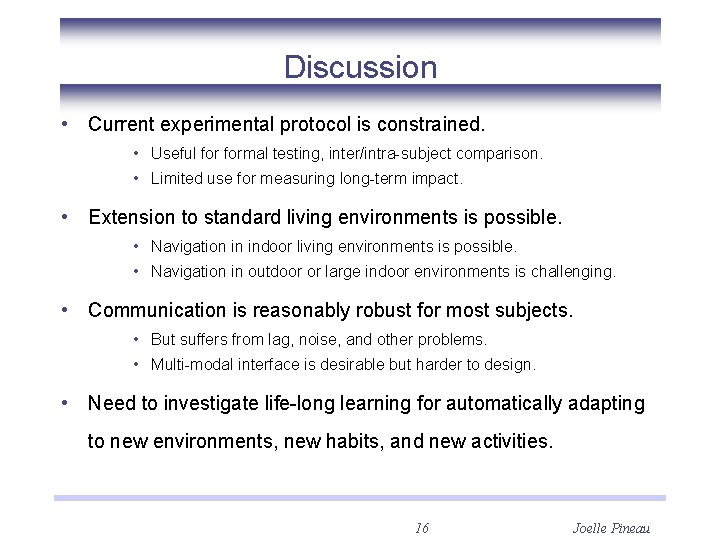
Discussion • Current experimental protocol is constrained. • Useful formal testing, inter/intra-subject comparison. • Limited use for measuring long-term impact. • Extension to standard living environments is possible. • Navigation in indoor living environments is possible. • Navigation in outdoor or large indoor environments is challenging. • Communication is reasonably robust for most subjects. • But suffers from lag, noise, and other problems. • Multi-modal interface is desirable but harder to design. • Need to investigate life-long learning for automatically adapting to new environments, new habits, and new activities. 16 Joelle Pineau
Project Team • Mc. Gill University: – Amin Atrash, Robert Kaplow, Julien Villemure, Robert West, Hiba Yamani • Ecole Polytechnique de Montréal: – Paul Cohen, Sousso Kelouwani, Hai Nguyen, Patrice Boucher • Université de Montréal – Robert Forget, Louise Demers • Centre de réadaptation Lucie-Bruneau – Wormser Honoré, Claude Dufour • Constance-Lethbridge Rehabilitation Centre – Paula Stone, Daniel Rock, Jean-Paul Dussault • Institut de réadaptation en déficience physique de Québec – François Routhier 17 Joelle Pineau
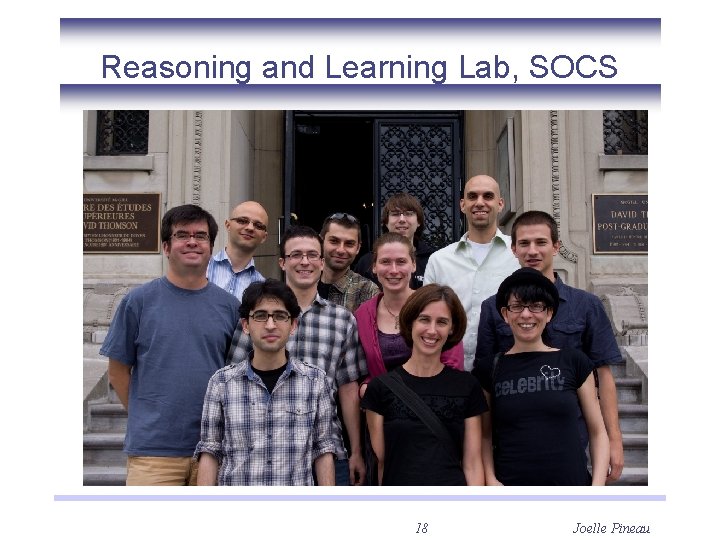
Reasoning and Learning Lab, SOCS 18 Joelle Pineau
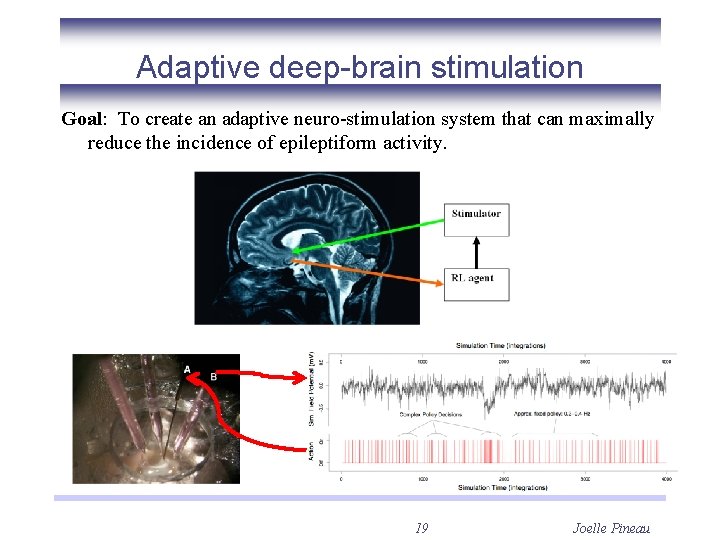
Adaptive deep-brain stimulation Goal: To create an adaptive neuro-stimulation system that can maximally reduce the incidence of epileptiform activity. 19 Joelle Pineau
- Slides: 19