
COGNITIVE PSYCHOLOGY Kenneth J Malmberg Ph D HISTORY
COGNITIVE PSYCHOLOGY Kenneth J. Malmberg, Ph. D
HISTORY OF COGNITIVE PSYCHOLOGY Kenneth J. Malmberg, Ph. D

Franciscus Donders men·tal (adj. ) Of or relating to the mind; intellectual. chro·nom·e·try (n. ) The scientific measurement of time. MENTAL CHRONOMETRY The study of the mind’s timing Franciscus Donders: Investigated Mental Chronometry

Franciscus Donders: Reaction Time Specifically, Donders sought to measure how long cognitive process take (I. e. , reaction times). A reaction time is an interval between the presentation of a stimulus and a response. Franciscus Donders

Donders: Simple Decision Task Lots of things (processes) happen during this interval and the challenge was to measure the how long each process took given only the overall reaction time. How long did it take for the subject to decide whether the stimulus appear on the right side of the screen or the left side of the screen?

Donders: Method of Subtraction How long did it take for the subject to decide whether the stimulus appeared on the right side of the screen or the left side of the screen? Franciscus Donders

Herman von Helmholtz UNCONSCIOUS INFERENCE Perceptions are the results of unconscious assumptions that we make about the environment. ? Why we would we need to make inferences about what we see? Herman von Helmholtz: Investigated Perception

Helmholtz: Unconscious Inference UNCONSCIOUS INFERENCE Perceptions are the results of unconscious assumptions that we make about the environment. Herman von Helmholtz: Investigated Perception
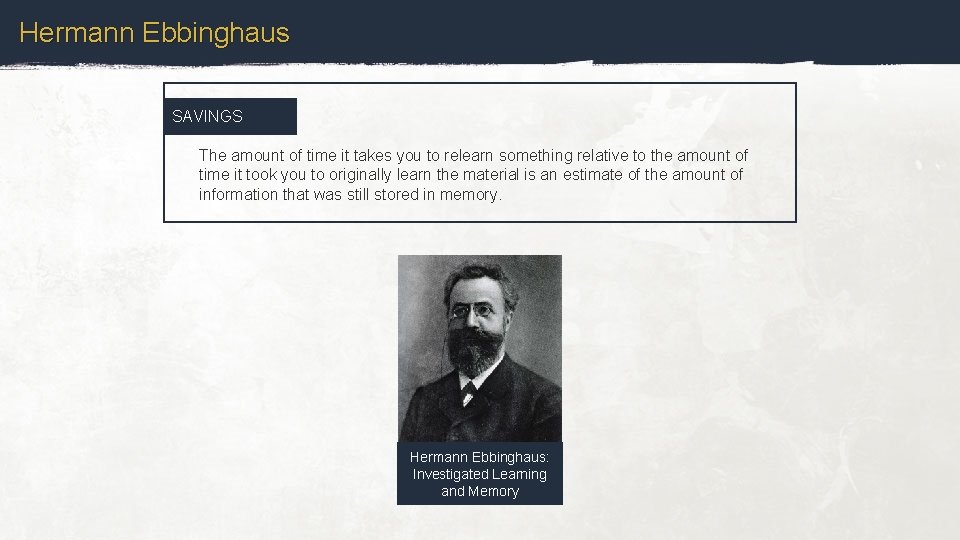
Hermann Ebbinghaus SAVINGS The amount of time it takes you to relearn something relative to the amount of time it took you to originally learn the material is an estimate of the amount of information that was still stored in memory. Hermann Ebbinghaus: Investigated Learning and Memory
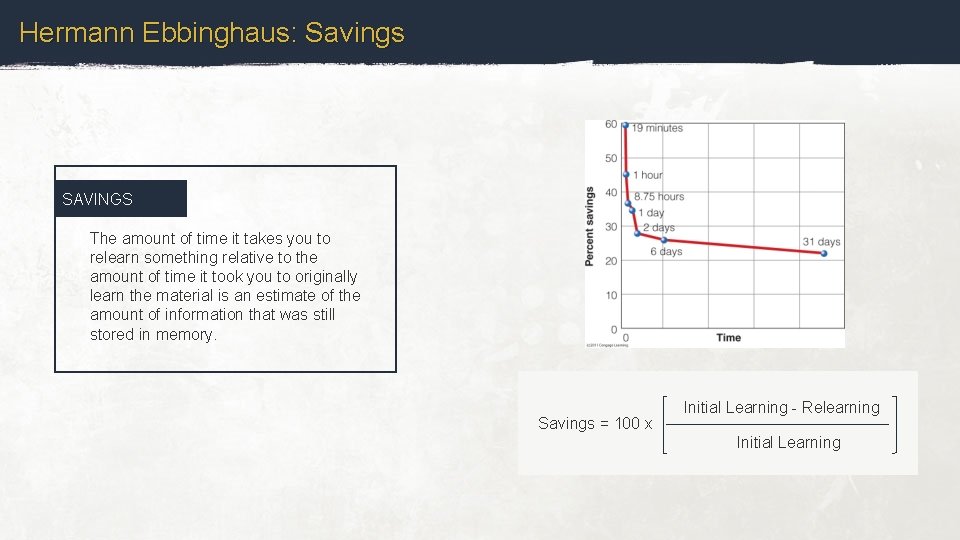
Hermann Ebbinghaus: Savings SAVINGS The amount of time it takes you to relearn something relative to the amount of time it took you to originally learn the material is an estimate of the amount of information that was still stored in memory. Savings = 100 x Initial Learning - Relearning Initial Learning
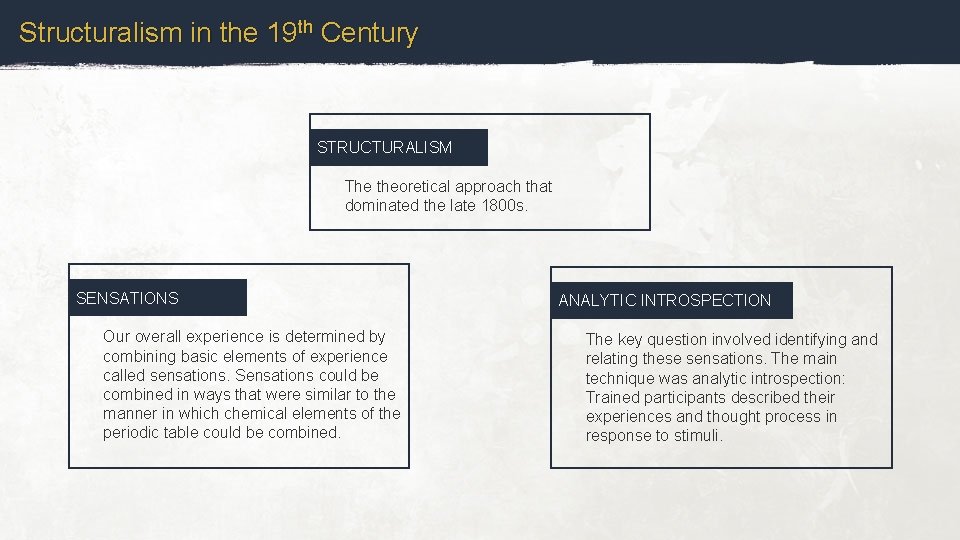
Structuralism in the 19 th Century STRUCTURALISM The theoretical approach that dominated the late 1800 s. SENSATIONS Our overall experience is determined by combining basic elements of experience called sensations. Sensations could be combined in ways that were similar to the manner in which chemical elements of the periodic table could be combined. ANALYTIC INTROSPECTION The key question involved identifying and relating these sensations. The main technique was analytic introspection: Trained participants described their experiences and thought process in response to stimuli.
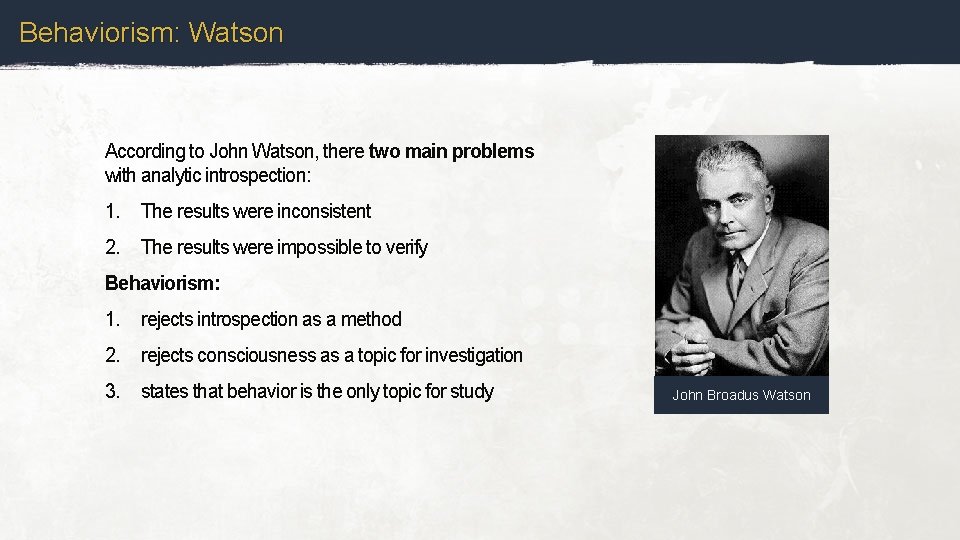
Behaviorism: Watson According to John Watson, there two main problems with analytic introspection: 1. The results were inconsistent 2. The results were impossible to verify Behaviorism: 1. rejects introspection as a method 2. rejects consciousness as a topic for investigation 3. states that behavior is the only topic for study John Broadus Watson

Behaviorism: Skinner B. F Skinner Introduced operant conditioning, which focused on how behavior is strengthen by presentations of positive reinforcers and the withdrawal of negative reinforcers. Reinforcement Schedules (e. g. , fixed interval) Cumulative Response Record: plots the number of responses as a function of time. These functions are “scalloped”.

The Cognitive Revolution Noam Chomsky criticized B. F. Skinner’s theory of language development. According to Skinner, language is learned my reinforcing the proper mimicking of adult language by infants. Chomsky noted that children produce language that they never heard before. He proposed that children are born with certain capacities that allow language to develop. This opened the way for investigating and theorizing about the nature of these capacities independently of behavior. Noam Chomsky

Quiz

Cognitive psychologists were the first to study human psychology in a scientific manner
Donder's goal for using the subtraction method was to measure the duration of simple cognitive processes.

von Hemlholtz believed that mind perceives only what is in our present environment.

The mind has a terrible time dealing with ambiguous information.

Ebbinghuas found that forgetting accelerates over time.

A key problem with the structuralist approach concerned the methods that they used.

Skinner's debate with Chomsky led to the behavioral revolution.

You have reached the end of the presentation.
- Slides: 23