
Cognitive Psychology Fifth Edition Robert J Sternberg Chapter
Cognitive Psychology, Fifth Edition, Robert J. Sternberg Chapter 4: Attention and Consciousness
Cognitive Psychology, Fifth Edition, Robert J. Sternberg Chapter 4 Attention Is… • The concentration of mental energy that must be used to process incoming information – Selective – Limited – Both conscious and preconscious
Cognitive Psychology, Fifth Edition, Robert J. Sternberg Chapter 4 Main points • Preconscious: Items that lie outside our conscious awareness • Priming, Automatic vs. control process • Conscious attention 1) Searching – Treisman’s theory 2) Selective Attention – Three theories, Resource account, Stroop 3) Divided Attention – Dual task paradigm
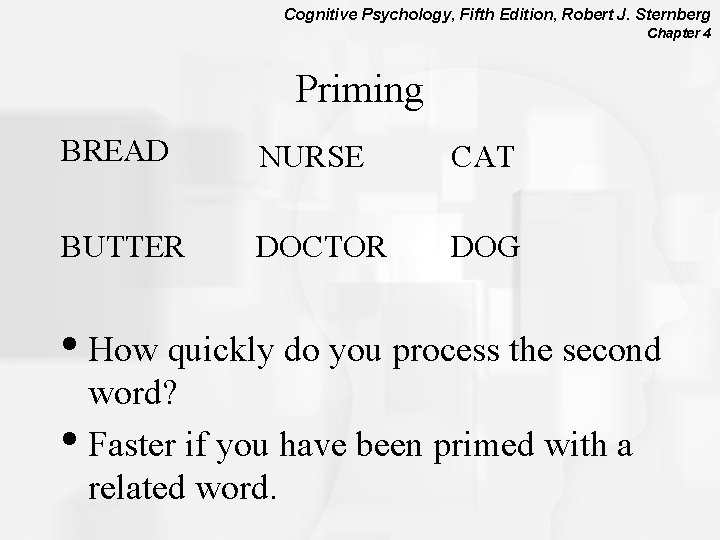
Cognitive Psychology, Fifth Edition, Robert J. Sternberg Chapter 4 Priming BREAD NURSE CAT BUTTER DOCTOR DOG • How quickly do you process the second word? • Faster if you have been primed with a related word.
Cognitive Psychology, Fifth Edition, Robert J. Sternberg Chapter 4 NURSE
Cognitive Psychology, Fifth Edition, Robert J. Sternberg Chapter 4 DOCTOR
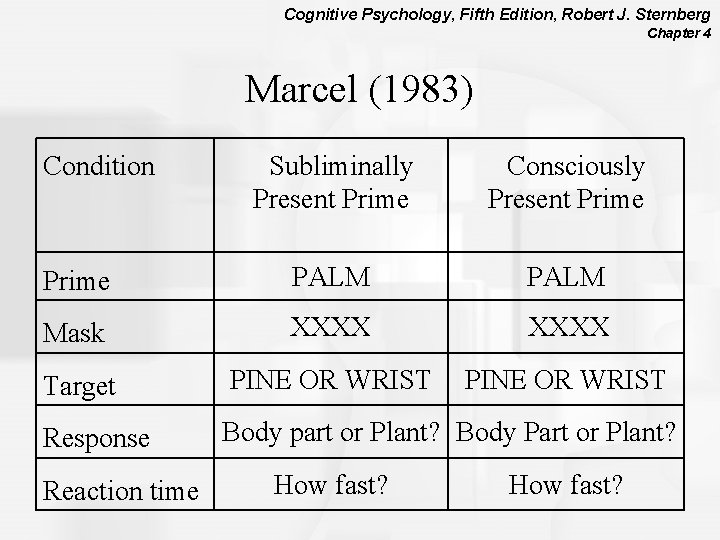
Cognitive Psychology, Fifth Edition, Robert J. Sternberg Chapter 4 Marcel (1983) Condition Subliminally Present Prime Consciously Present Prime PALM Mask XXXX Target PINE OR WRIST Response Body part or Plant? Body Part or Plant? Reaction time How fast?
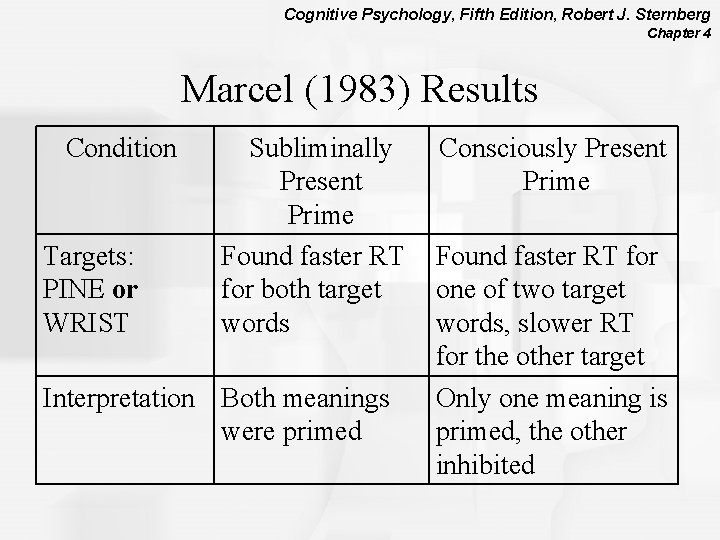
Cognitive Psychology, Fifth Edition, Robert J. Sternberg Chapter 4 Marcel (1983) Results Condition Targets: PINE or WRIST Subliminally Present Prime Found faster RT for both target words Interpretation Both meanings were primed Consciously Present Prime Found faster RT for one of two target words, slower RT for the other target Only one meaning is primed, the other inhibited
Cognitive Psychology, Fifth Edition, Robert J. Sternberg Chapter 4 Priming Can Speed or Slow Processing • Facilitative Priming – Target stimuli (e. g. , BUTTER) are processed faster if preceded by a related word (e. g. , BREAD) • Priming => Let us know what’s going on early cognitive processes. Information processing in unconscious level
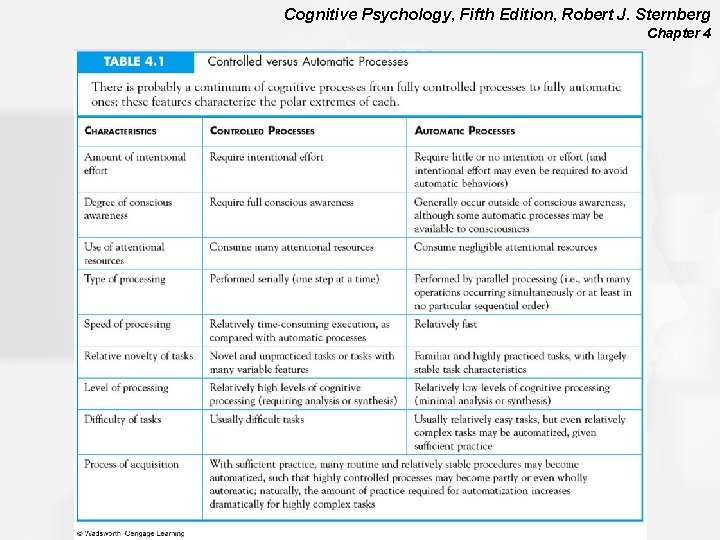
Cognitive Psychology, Fifth Edition, Robert J. Sternberg Chapter 4 Controlled vs. Automatic Processing • Automatic processing – Requires no conscious control • Controlled processing – Requires conscious control
Cognitive Psychology, Fifth Edition, Robert J. Sternberg Chapter 4 Is Typing Automatic or Controlled for You? • Do you type without thinking where your fingers are? Are you a search-and-peck typer? • If you do type without using attention, what happens when you think about the letters as you are typing them?
Cognitive Psychology, Fifth Edition, Robert J. Sternberg Chapter 4
Cognitive Psychology, Fifth Edition, Robert J. Sternberg Chapter 4 Functions of Conscious Attention • Searching • Selective Attention • Divided Attention
Cognitive Psychology, Fifth Edition, Robert J. Sternberg Chapter 4 Search • Actively searching for a target • Number of targets and distracters influence accuracy • Feature search versus conjunctive search
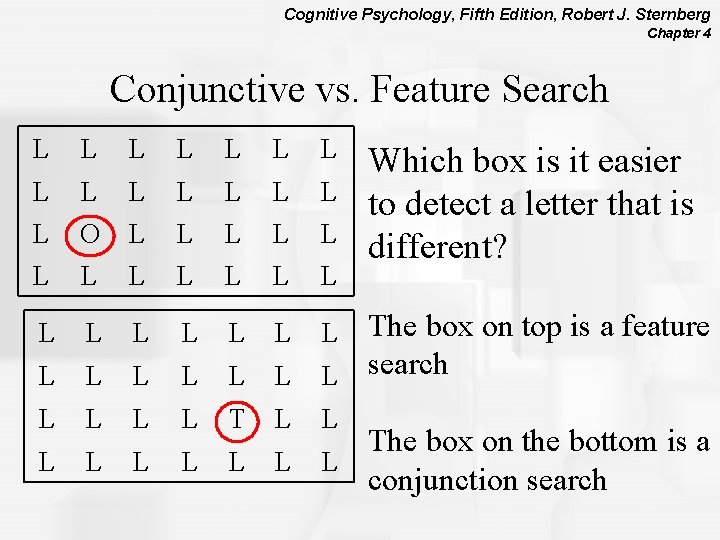
Cognitive Psychology, Fifth Edition, Robert J. Sternberg Chapter 4 Conjunctive vs. Feature Search L L L O L L L L Which box is it easier to detect a letter that is different? The box on top is a feature L L L L search L L L T L L The box on the bottom is a L L L L conjunction search
Cognitive Psychology, Fifth Edition, Robert J. Sternberg Chapter 4 Treisman’s Feature-Integration Theory • Individual Feature processing is done in parallel. • Simultaneous processing is done on the whole display and if feature is present-- we detect it. Conjunctive searching requires attention to the integration or combination of the features. Attention to particular combination of features must be done sequentially to detect presence of a certain combination.
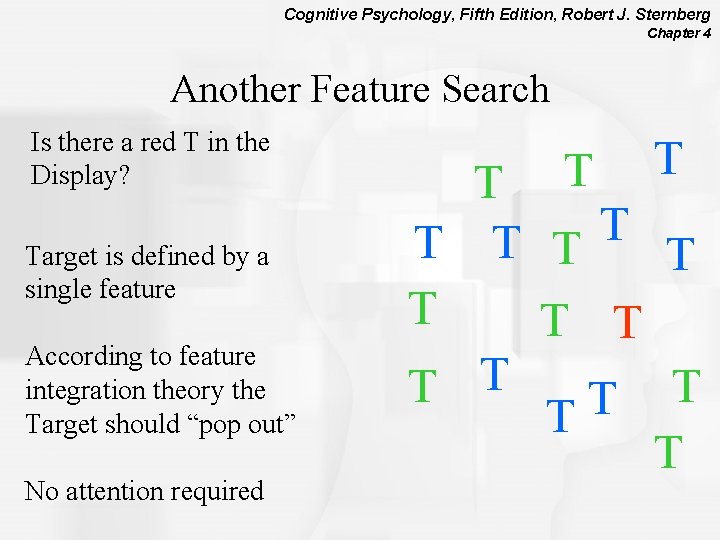
Cognitive Psychology, Fifth Edition, Robert J. Sternberg Chapter 4 Another Feature Search Is there a red T in the Display? Target is defined by a single feature According to feature integration theory the Target should “pop out” No attention required T T T T T
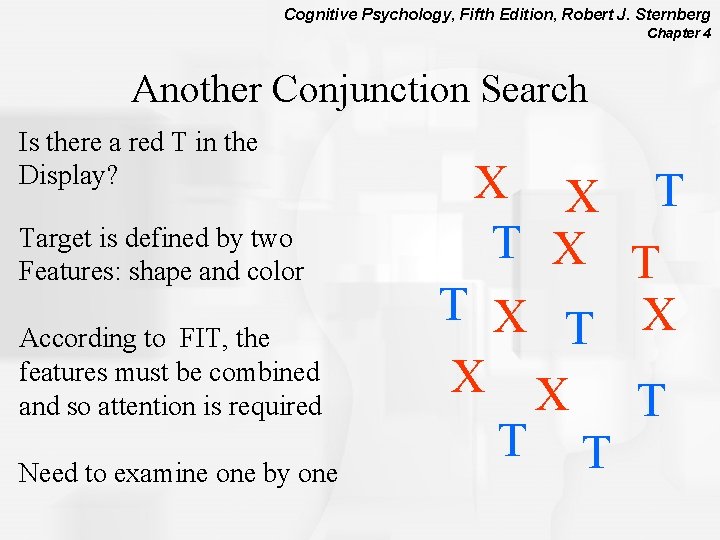
Cognitive Psychology, Fifth Edition, Robert J. Sternberg Chapter 4 Another Conjunction Search Is there a red T in the Display? Target is defined by two Features: shape and color According to FIT, the features must be combined and so attention is required Need to examine one by one X X T T X T X X X T T T
Cognitive Psychology, Fifth Edition, Robert J. Sternberg Chapter 4 Selectivity of Attention • Cocktail Party Problem – How are we able to follow one conversation in the presence of other conversations?
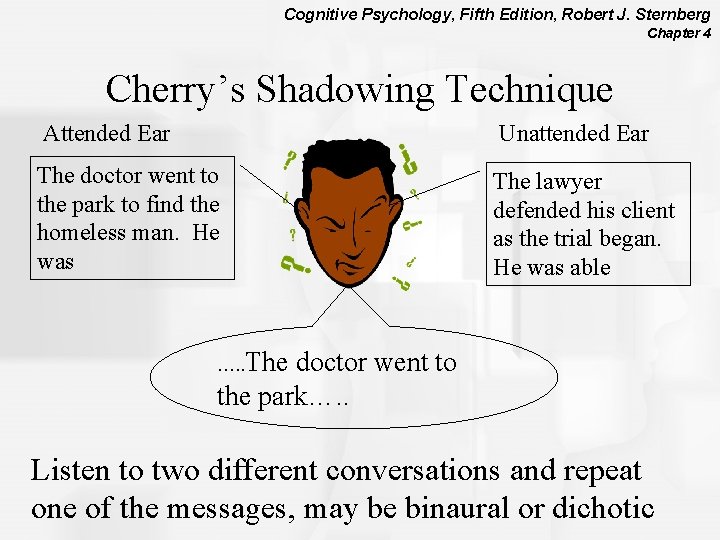
Cognitive Psychology, Fifth Edition, Robert J. Sternberg Chapter 4 Cherry’s Shadowing Technique Attended Ear Unattended Ear The doctor went to the park to find the homeless man. He was The lawyer defended his client as the trial began. He was able …. . The doctor went to the park…. . Listen to two different conversations and repeat one of the messages, may be binaural or dichotic
Cognitive Psychology, Fifth Edition, Robert J. Sternberg Chapter 4 Cherry’s Study Results • Noticed in unattended ear: – Change in gender – Familiar name including the subject’s • Did notice in unattended ear: – Changed language – Changed topic, same speaker – If speech was played backwards
Cognitive Psychology, Fifth Edition, Robert J. Sternberg Chapter 4 Models of Selective Attention • Do they have a filter? • Where does the filter occur?
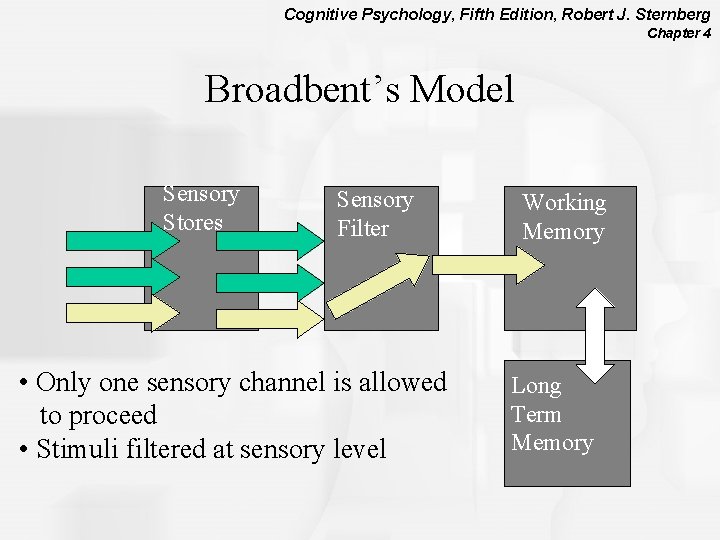
Cognitive Psychology, Fifth Edition, Robert J. Sternberg Chapter 4 Broadbent’s Model Sensory Stores Sensory Filter • Only one sensory channel is allowed to proceed • Stimuli filtered at sensory level Working Memory Long Term Memory
Cognitive Psychology, Fifth Edition, Robert J. Sternberg Chapter 4 Broadbent’s Model Could Not Explain • Participant’s name gets through • Participants can shadow meaningful messages that switches from one ear to another • Effects of practice on detecting information in unattended ear (e. g. , detect digit in unattended ear for naïve and practiced participants)
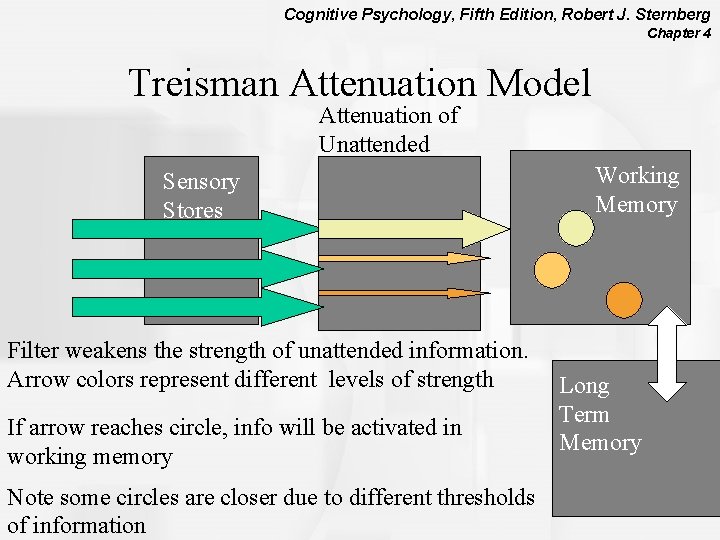
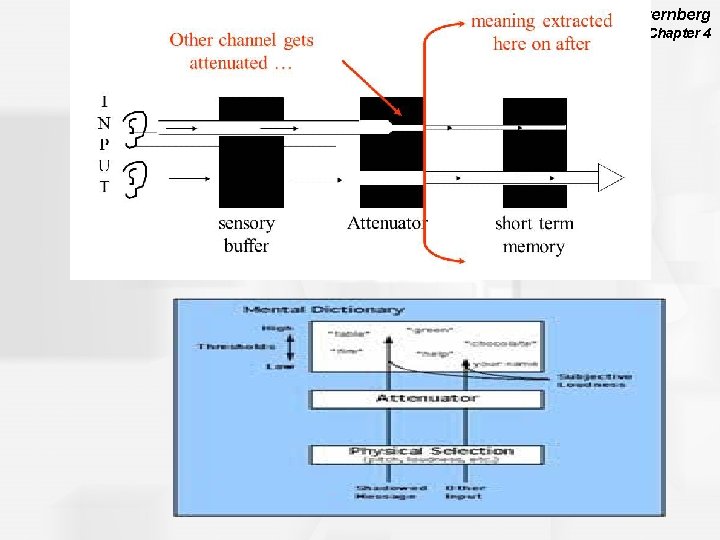
Cognitive Psychology, Fifth Edition, Robert J. Sternberg Chapter 4 Treisman Attenuation Model Attenuation of Unattended Sensory Stores Filter weakens the strength of unattended information. Arrow colors represent different levels of strength If arrow reaches circle, info will be activated in working memory Note some circles are closer due to different thresholds of information Working Memory Long Term Memory
Cognitive Psychology, Fifth Edition, Robert J. Sternberg Chapter 4
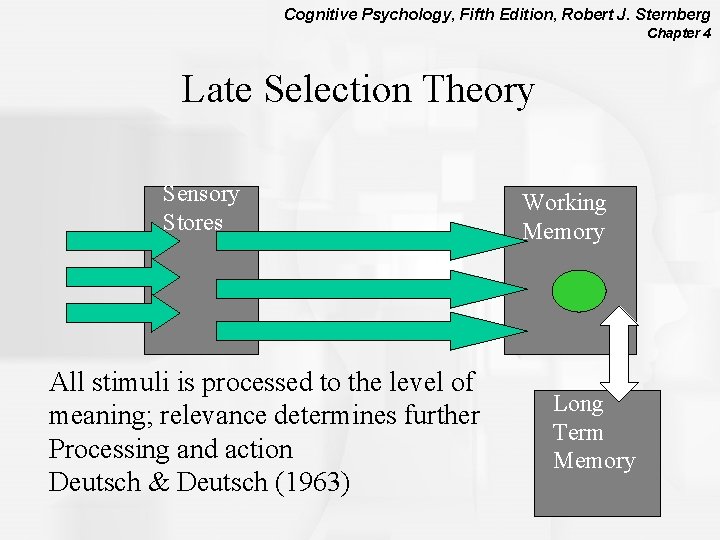
Cognitive Psychology, Fifth Edition, Robert J. Sternberg Chapter 4 Late Selection Theory Sensory Stores All stimuli is processed to the level of meaning; relevance determines further Processing and action Deutsch & Deutsch (1963) Working Memory Long Term Memory
Cognitive Psychology, Fifth Edition, Robert J. Sternberg Chapter 4 Neisser’s Synthesis • Preattentive Processes – Parallel – Note physical characteristics • Attentive Processes – Controlled processes occur serially – Occur in working memory
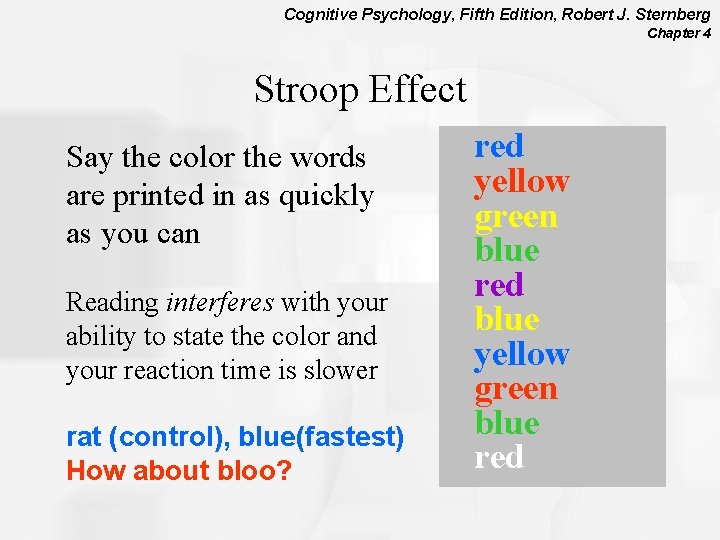
Cognitive Psychology, Fifth Edition, Robert J. Sternberg Chapter 4 Stroop Effect Say the color the words are printed in as quickly as you can Reading interferes with your ability to state the color and your reaction time is slower rat (control), blue(fastest) How about bloo? red yellow green blue red blue yellow green blue red
Cognitive Psychology, Fifth Edition, Robert J. Sternberg Chapter 4 Divided Attention • How many tasks can you do at once? – e. g. driving & talking, radio, phone. . . • Related to automatic processes
Cognitive Psychology, Fifth Edition, Robert J. Sternberg Chapter 4 Dual Task Paradigm • Task 1 may require a verbal response to an auditory stimulus • Task 2 may require a participant to push a button in response to a visual stimulus. • Results indicate that responses to the Task 1 are delayed
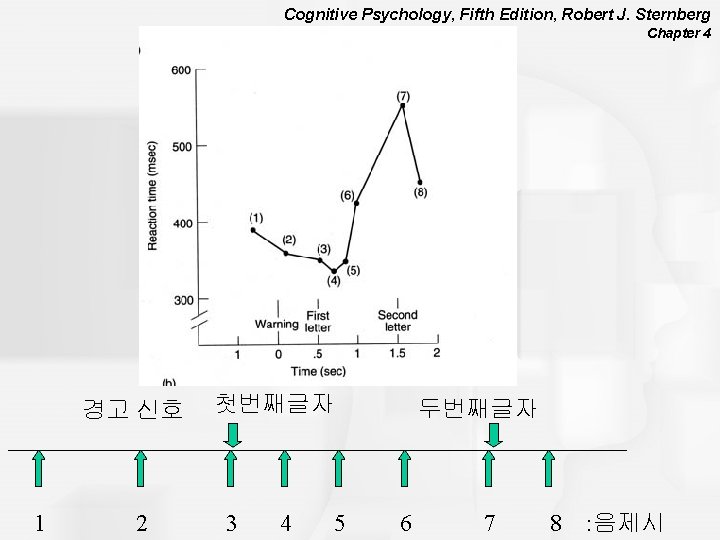
Cognitive Psychology, Fifth Edition, Robert J. Sternberg Chapter 4 경고 신호 1 2 첫번째글자 3 4 5 두번째글자 6 7 8 : 음제시
Cognitive Psychology, Fifth Edition, Robert J. Sternberg Chapter 4 Real Life Dual Task • Driving and – Cell phones – Adjusting music – Watching the scenery • Almost 80 % of crashes and 65 % of near-crashes involved some form of driver inattention within three seconds of the event
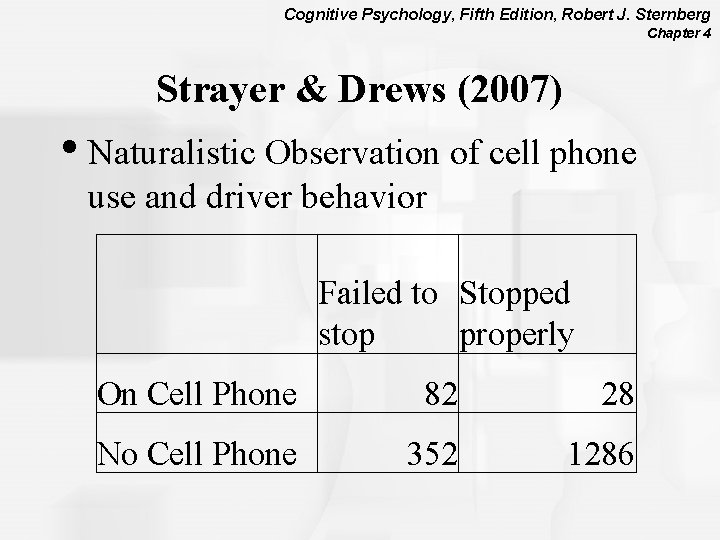
Cognitive Psychology, Fifth Edition, Robert J. Sternberg Chapter 4 Strayer & Drews (2007) • Naturalistic Observation of cell phone use and driver behavior Failed to Stopped stop properly On Cell Phone 82 28 No Cell Phone 352 1286
Cognitive Psychology, Fifth Edition, Robert J. Sternberg Chapter 4 Strayer & Drews (2007) Results • Impact of hands free cell phone conversations on simulated driving: – Cell-phone conversation led to inattentional-blindness – Even if they looked at an object, participant did not remember the object
Cognitive Psychology, Fifth Edition, Robert J. Sternberg Chapter 4 Attention Deficit Hyperactivity Disorder (ADHD) • Symptoms – Inattention – Hyperactivity – Impulsivity – Not everyone who is overly hyperactive, inattentive, or impulsive has ADHD – Behavior must be demonstrated to a degree that is inappropriate for the person's age
- Slides: 36