
Cognitive Processes PSY 334 Chapter 6 Human Memory
- Slides: 46
Cognitive Processes PSY 334 Chapter 6 – Human Memory: Encoding and Storage
Ebbinghaus o First rigorous investigation of human memory – 1885. o Taught himself nonsense syllables n DAX, BUP, LOC o Savings – the amount of time needed to relearn a list after it has already been learned and forgotten. o Forgetting function – most forgetting takes place right away.
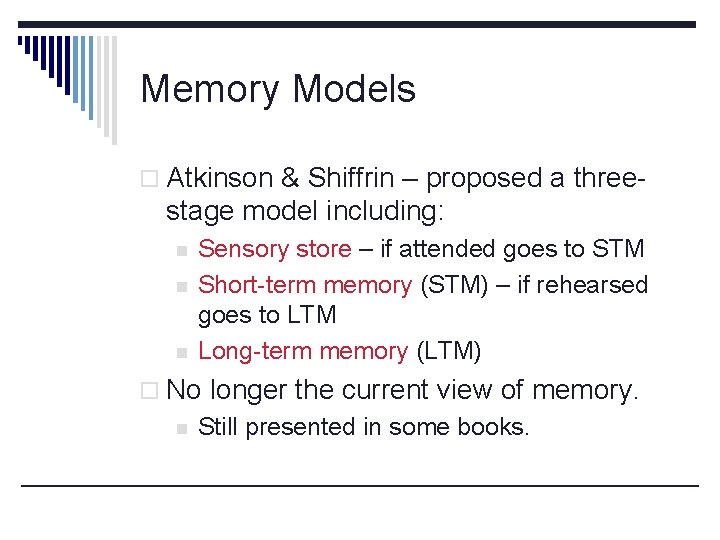
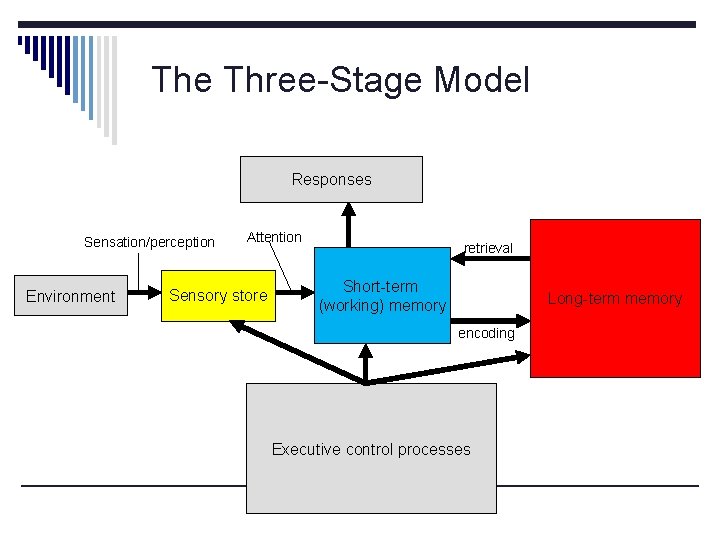
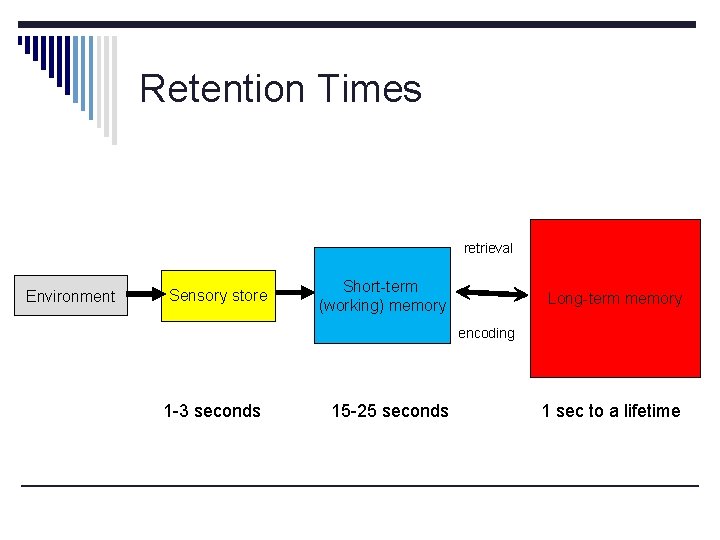
Memory Models o Atkinson & Shiffrin – proposed a three- stage model including: n n n Sensory store – if attended goes to STM Short-term memory (STM) – if rehearsed goes to LTM Long-term memory (LTM) o No longer the current view of memory. n Still presented in some books.
The Three-Stage Model Responses Sensation/perception Environment Attention Sensory store retrieval Short-term (working) memory Long-term memory encoding Executive control processes
Retention Times retrieval Environment Sensory store Short-term (working) memory Long-term memory encoding 1 -3 seconds 15 -25 seconds 1 sec to a lifetime
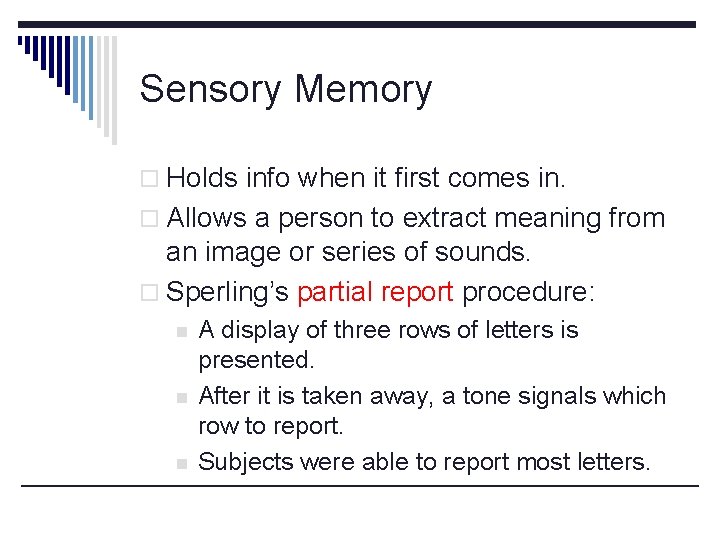
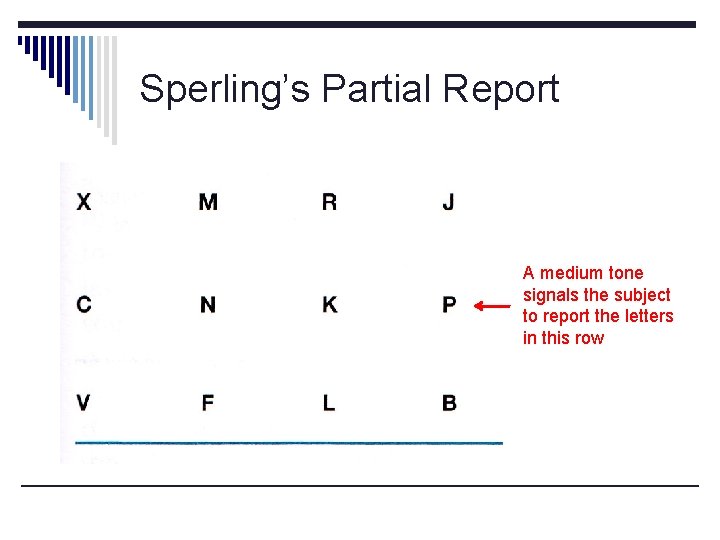
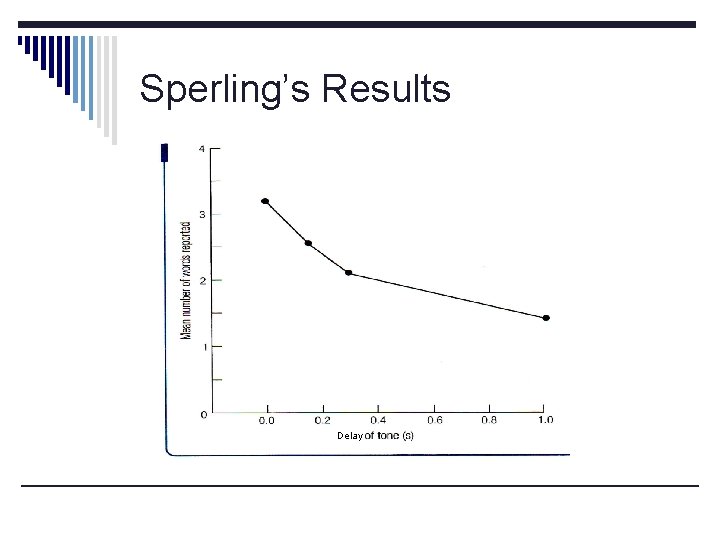
Sensory Memory o Holds info when it first comes in. o Allows a person to extract meaning from an image or series of sounds. o Sperling’s partial report procedure: n n n A display of three rows of letters is presented. After it is taken away, a tone signals which row to report. Subjects were able to report most letters.
Sperling’s Partial Report A medium tone signals the subject to report the letters in this row
Sperling’s Results Delay
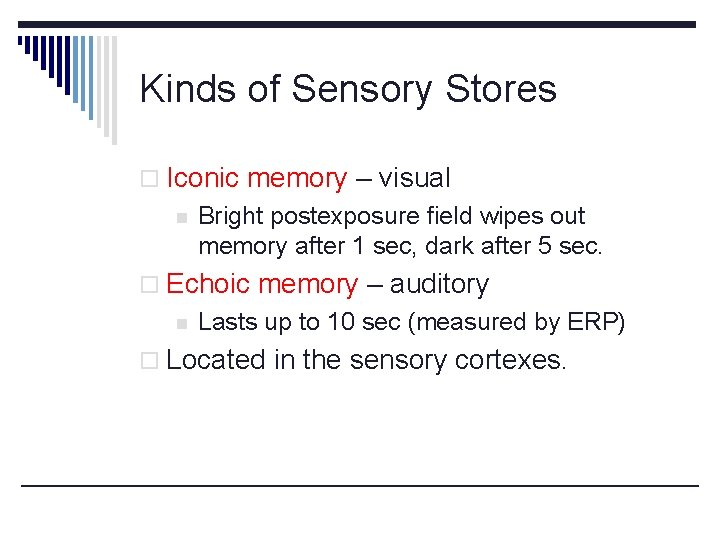
Kinds of Sensory Stores o Iconic memory – visual n Bright postexposure field wipes out memory after 1 sec, dark after 5 sec. o Echoic memory – auditory n Lasts up to 10 sec (measured by ERP) o Located in the sensory cortexes.
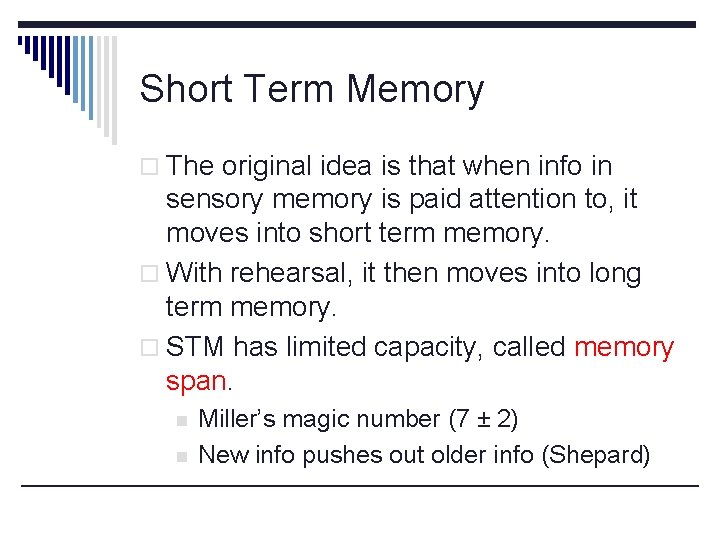
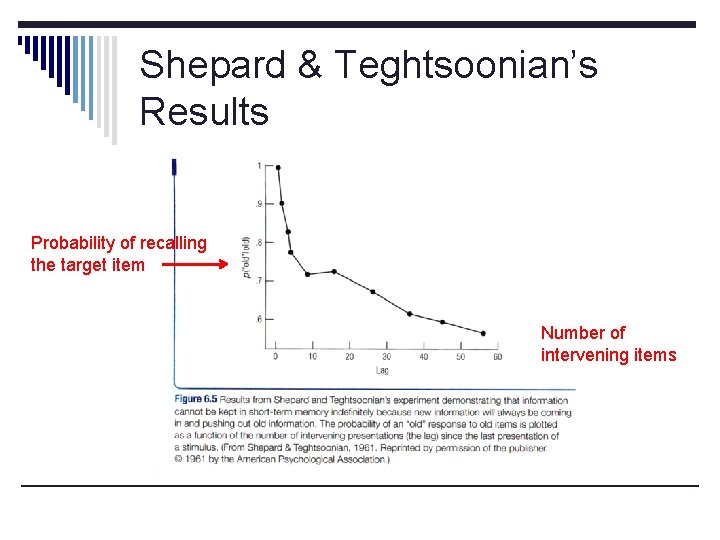
Short Term Memory o The original idea is that when info in sensory memory is paid attention to, it moves into short term memory. o With rehearsal, it then moves into long term memory. o STM has limited capacity, called memory span. n n Miller’s magic number (7 ± 2) New info pushes out older info (Shepard)
Shepard & Teghtsoonian’s Results Probability of recalling the target item Number of intervening items
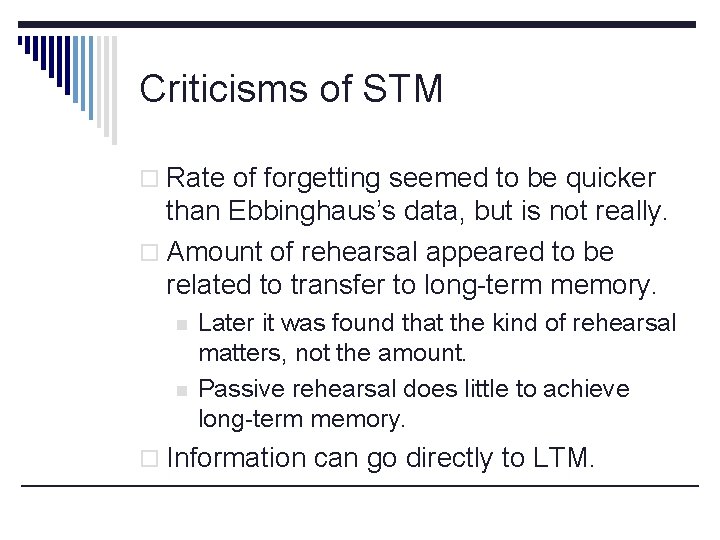
Criticisms of STM o Rate of forgetting seemed to be quicker than Ebbinghaus’s data, but is not really. o Amount of rehearsal appeared to be related to transfer to long-term memory. n n Later it was found that the kind of rehearsal matters, not the amount. Passive rehearsal does little to achieve long-term memory. o Information can go directly to LTM.
Depth of Processing o Craik & Lockhart – proposed that it is not how long material is rehearsed but the depth of processing that matters. o Levels of processing demo.
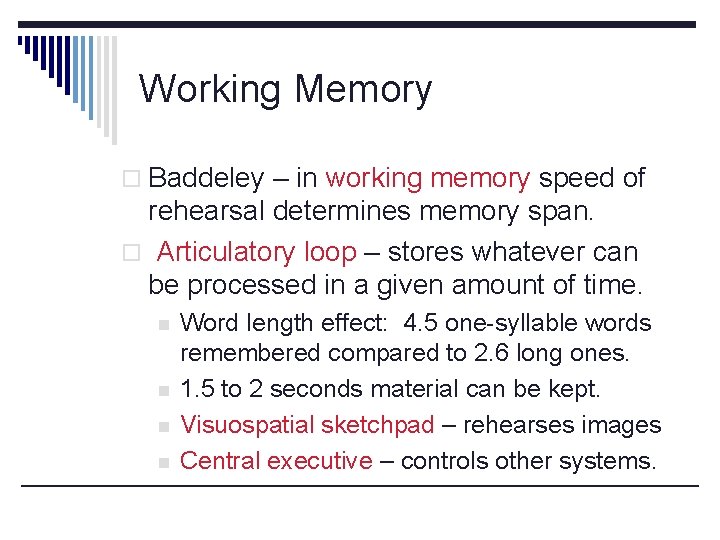
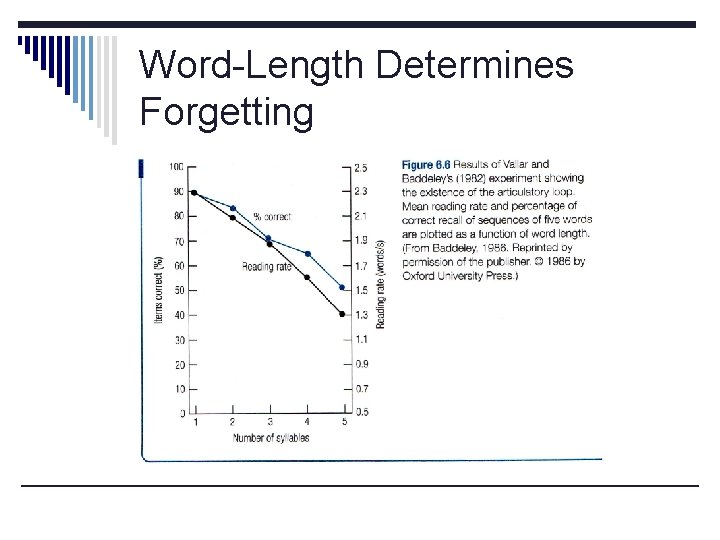
Working Memory o Baddeley – in working memory speed of rehearsal determines memory span. o Articulatory loop – stores whatever can be processed in a given amount of time. n n Word length effect: 4. 5 one-syllable words remembered compared to 2. 6 long ones. 1. 5 to 2 seconds material can be kept. Visuospatial sketchpad – rehearses images Central executive – controls other systems.
Word-Length Determines Forgetting
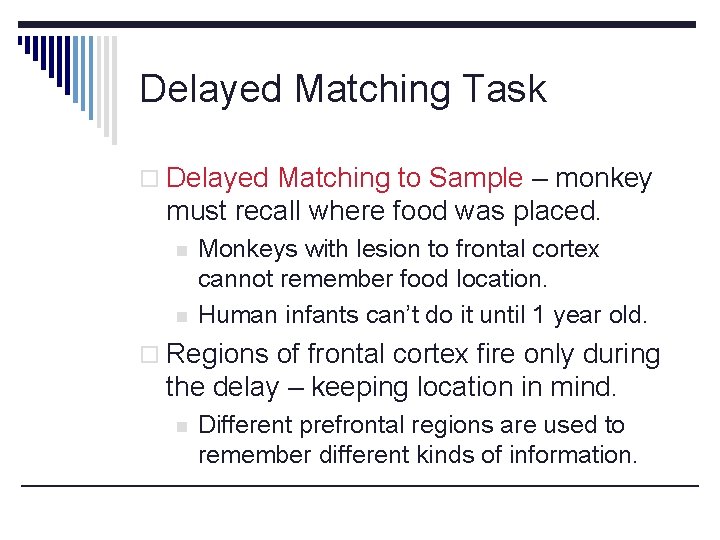
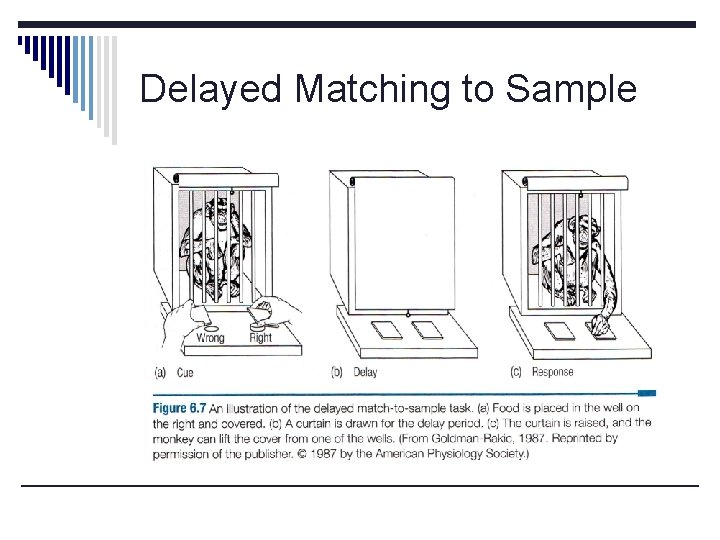
Delayed Matching Task o Delayed Matching to Sample – monkey must recall where food was placed. n n Monkeys with lesion to frontal cortex cannot remember food location. Human infants can’t do it until 1 year old. o Regions of frontal cortex fire only during the delay – keeping location in mind. n Different prefrontal regions are used to remember different kinds of information.
Delayed Matching to Sample
Activation and Long-Term Memory o Activation – how available information is to memory: Probability of access – how likely you are to remember something. n Rate of access – how fast something can be remembered. n o From moment to moment, items differ in their degree of activation in memory.
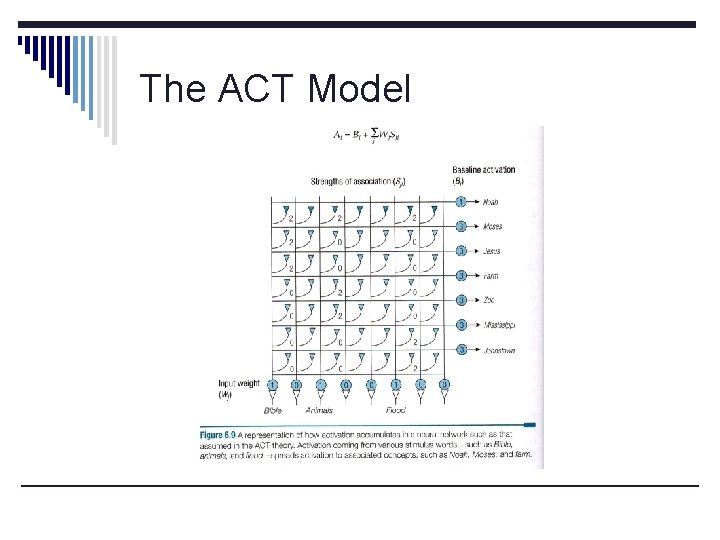
Anderson’s ACT Model o ACT – Adaptive Control of Thought o Subjects shown the word “flood” should recall Noah but do not without “Bible, ” “animal” and “flood” together. n When given the word flood they think of Mississippi or Johnstown but not Noah. o Why? Recall is based on both baseline and activation from associated concepts. n Moses and Jesus have higher baselines.
Moses Illusion o How many animals of each species did Moses bring onto the ark? n People respond 2 rather than none. o This occurs because people do not focus attention on who did it, and because Moses and Noah are both Biblical characters. o This is a semantic illusion.
The ACT Model
Spreading Activation o Activation spreads along the paths of a propositional network. n Related items are faster to recall. o Associative priming – involuntary spread of activation to associated items in memory. n Kaplan’s dissertation – cues to solving riddles hidden in the environment led to faster solutions.
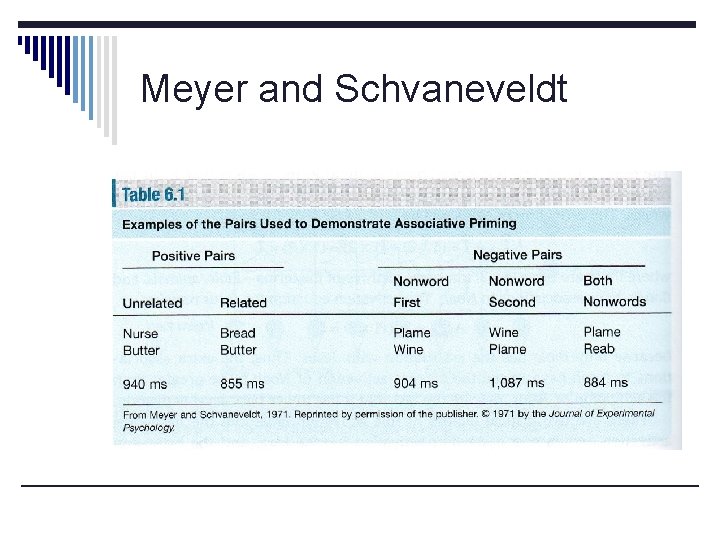
Associative Priming o Meyer & Schvaneveldt – spreading activation affects how quickly words are read. Subjects judged whether pairs of related & unrelated items were words. n Judgments about related words were faster. n
Meyer and Schvaneveldt
Practice and Strength o The amount of spreading activation depends on the strength of a memory. o Memory strength increases with practice. o Greater memory strength increases the likelihood of recall.
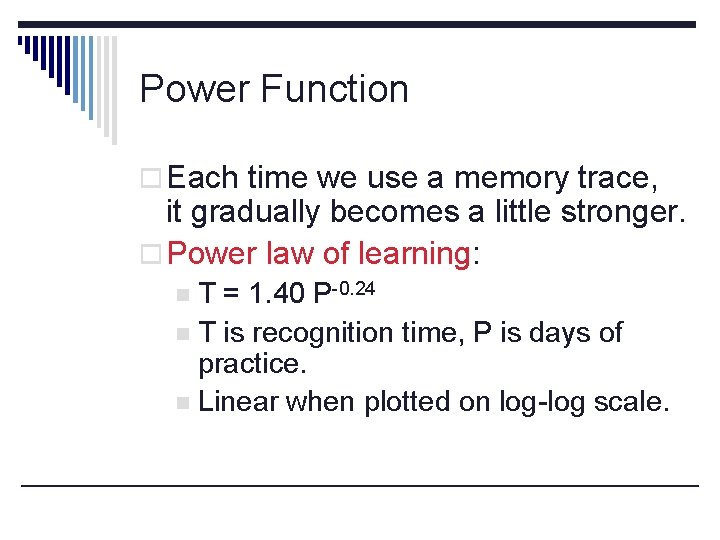
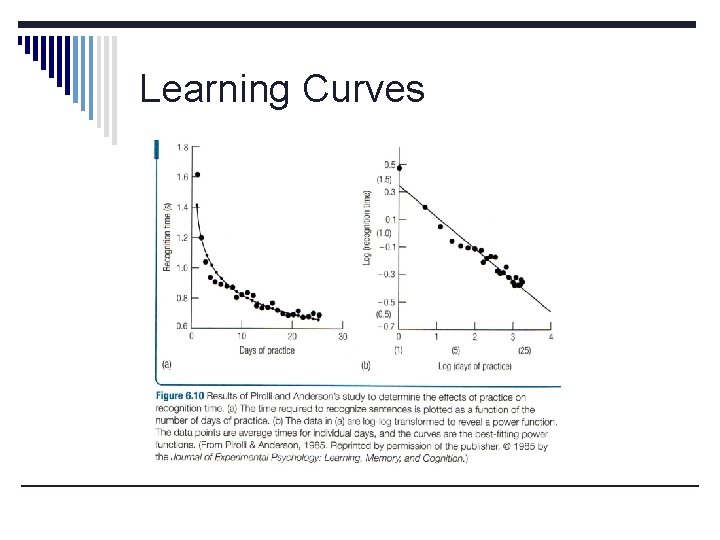
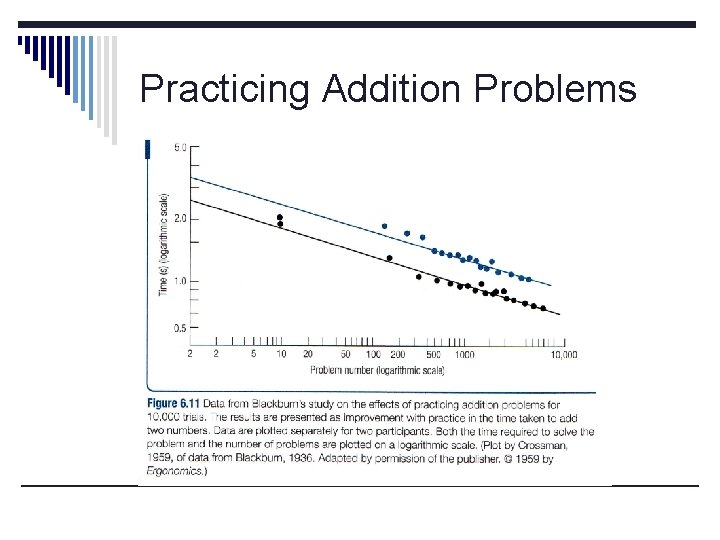
Power Function o Each time we use a memory trace, it gradually becomes a little stronger. o Power law of learning: T = 1. 40 P-0. 24 n T is recognition time, P is days of practice. n Linear when plotted on log-log scale. n
Learning Curves
Practicing Addition Problems
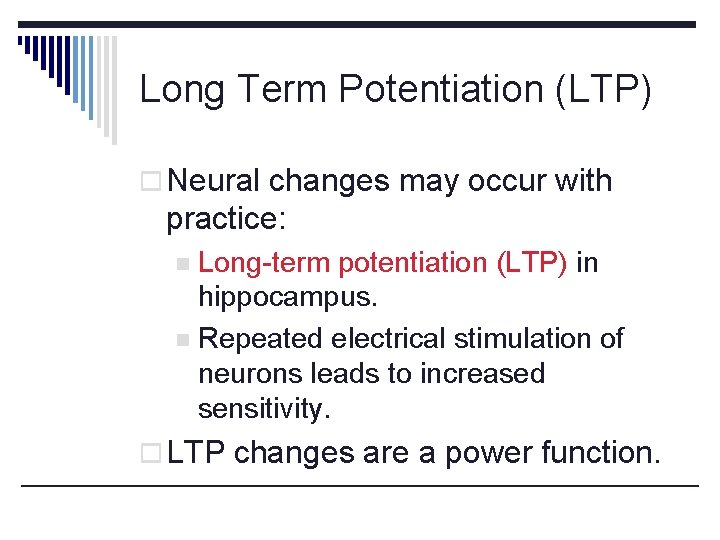
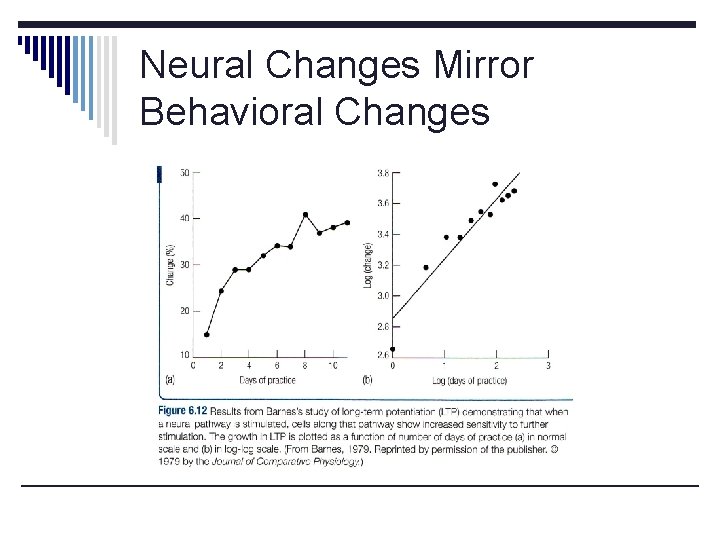
Long Term Potentiation (LTP) o Neural changes may occur with practice: Long-term potentiation (LTP) in hippocampus. n Repeated electrical stimulation of neurons leads to increased sensitivity. n o LTP changes are a power function.
Neural Changes Mirror Behavioral Changes
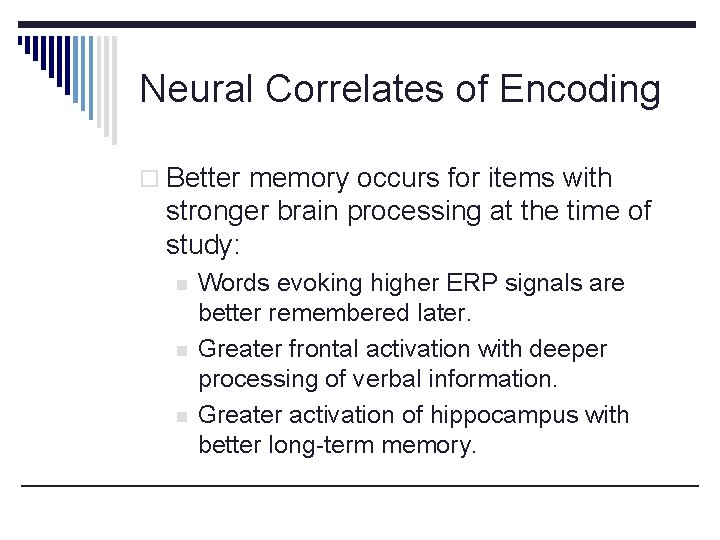
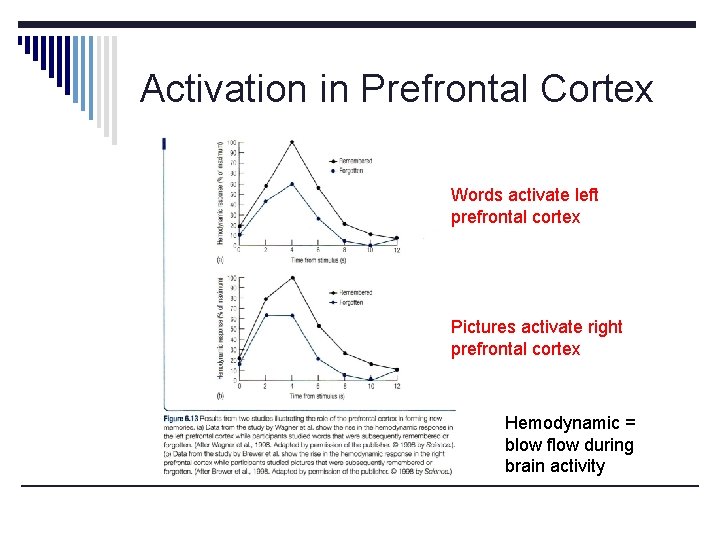
Neural Correlates of Encoding o Better memory occurs for items with stronger brain processing at the time of study: n n n Words evoking higher ERP signals are better remembered later. Greater frontal activation with deeper processing of verbal information. Greater activation of hippocampus with better long-term memory.
Activation in Prefrontal Cortex Words activate left prefrontal cortex Pictures activate right prefrontal cortex Hemodynamic = blow flow during brain activity
Factors Influencing Memory o Study alone does not improve memory – what matters is how studying is done. n n Shallow study results in little improvement. Semantic associates (tulip-flower) better remembered than rhymes (tower-flower), 81% vs 70%. o Better retention occurs for more meaningful elaboration.
Elaborative Processing o Elaboration – embellishing an item with additional information. o Anderson & Bower – subjects added details to simple sentences: n n 57% recall without elaboration 72% recall with made-up details added o Self-generated elaborations are better than experimenter-generated ones.
Self-Generated Elaborations o Stein & Bransford – subjects were given 10 sentences. Four conditions: n n Just the sentences alone – 4. 2 adjectives Subject generates an elaboration – 5. 8 Experimenter-generated imprecise elaboration – 2. 2 Experimenter-generated precise elaboration – 7. 8 o Precision of detail (constraint) matters, not who generates the elaboration.
Advance Organizers o PQ 4 R method – use questions to guide reading. n n 64% correct, compared to 57% (controls) 76% of relevant questions correct, 52% of non-relevant. o These study techniques work because they encourage elaboration. n Question making and question answering both improve memory for text (reviewing is better than seeing the questions first).
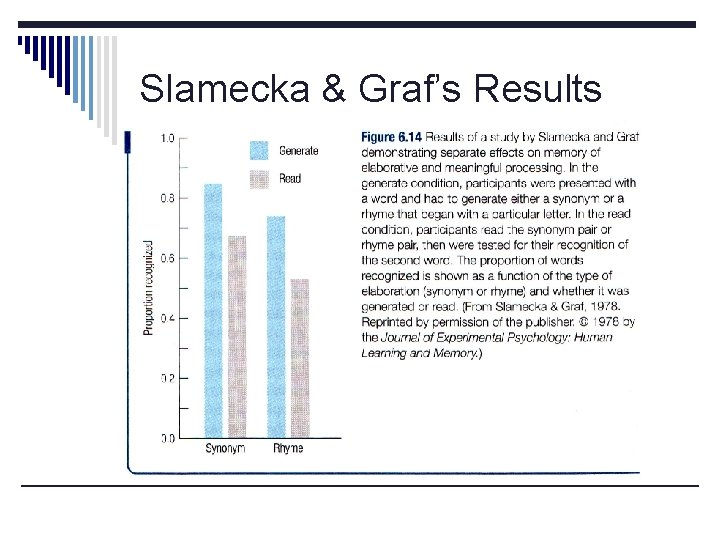
Meaningful Elaboration o Elaboration need not be meaningful – other sorts of elaboration also work. o Kolers compared memory for right-sideup sentences with upside-down. n Extra processing needed to read upside down may enhance memory. o Slamecka & Graf – compared generation of synonyms and rhymes. Both improved memory, but synonyms did more.
Slamecka & Graf’s Results
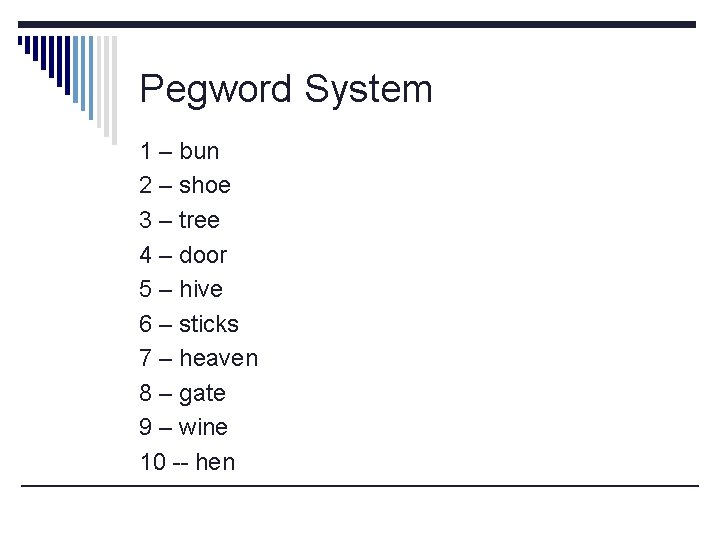
Mnemonics o Method of Loci – place items in a location, then take a mental walk. o Peg-word System – use peg words as a structure and associate a list of items with them using visualization. n Create acronyms for lists of items. o Convert nonsense syllables (DAX, GIB) into meaningful items by associating them with real words (e. g. , DAD).
“This Old Man” Song o http: //www. youtube. com/watch? v=3 c. Yf 9 vk. W_x. U o http: //www. totlol. com/watch/5 d-6 Q 5 V 79 CM/This-Old-Man/0/
Pegword System 1 – bun 2 – shoe 3 – tree 4 – door 5 – hive 6 – sticks 7 – heaven 8 – gate 9 – wine 10 -- hen
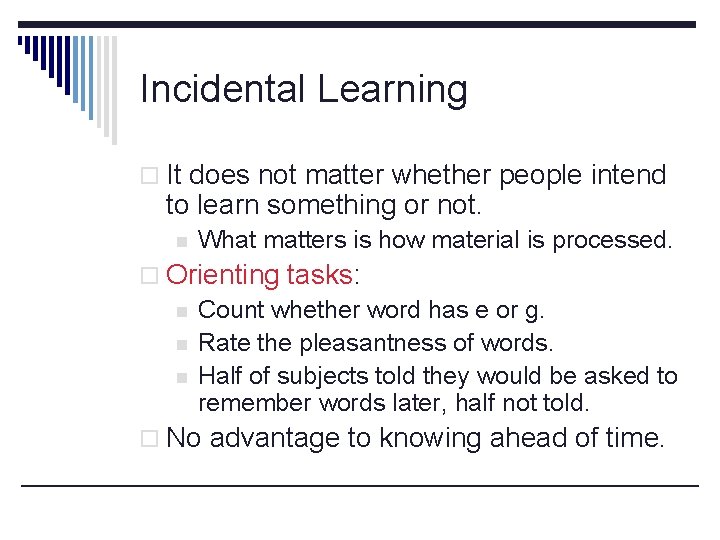
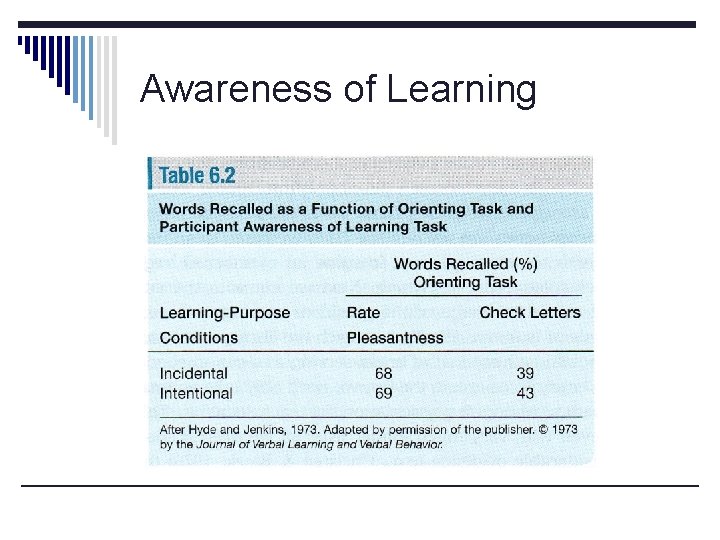
Incidental Learning o It does not matter whether people intend to learn something or not. n What matters is how material is processed. o Orienting tasks: n Count whether word has e or g. n Rate the pleasantness of words. n Half of subjects told they would be asked to remember words later, half not told. o No advantage to knowing ahead of time.
Awareness of Learning
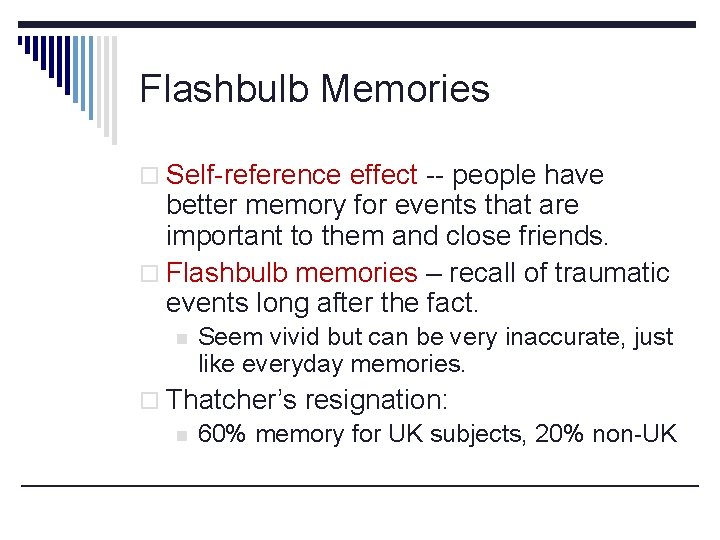
Flashbulb Memories o Self-reference effect -- people have better memory for events that are important to them and close friends. o Flashbulb memories – recall of traumatic events long after the fact. n Seem vivid but can be very inaccurate, just like everyday memories. o Thatcher’s resignation: n 60% memory for UK subjects, 20% non-UK
9/11 Memories o Talairco & Rubin (2003) found that 9/11 story-consistent details decreased and inconsistent details increased with time. n Rate and amount of both kinds of details were closely similar for flashbulb & everyday memories. o Sharot et al. (2007) reported greater activity in the amygdala for people closer to ground zero, when recalling 3 yrs later
Arousal & the Self-Reference Effect o Two explanations: n n Activation of the amygdala involves a biological mechanism reinforcing memory for events important to us. Info relevant and important to the self is rehearsed more often – resulting in better elaboration. o High arousal may enhance memory above and beyond rehearsal.