
Cognitive Processes PSY 334 Chapter 5 MeaningBased Knowledge
Cognitive Processes PSY 334 Chapter 5 – Meaning-Based Knowledge Representation July 24, 2003
Propositional Representations o Notation – a method for describing the meaning that remains once details have been abstracted away. o Propositional representation – uses concepts from logic and linguistics to describe meaning. o Proposition – the smallest unit of knowledge that can be judged as true or false.
Propositional Analysis o A complex sentence consists of smaller units of meaning (propositions). o If any of the propositions are untrue, the entire sentence cannot be true. o The meaning of primitive assertions is preserved, but not the exact wording.
Kintsch’s Notation Each proposition is a list containing a relation plus arguments: (relation, arguments) o Relation – organizes the arguments. n Verbs, adjectives, other relational terms. o Arguments – particular times, places, people, objects. n Nouns o Relations connect arguments.
Psychological Reality o Psychological reality -- do propositions really exist mentally? o Bransford & Franks: n n Presented 12 sentences with the same 2 sets of 4 propositions. Tested on 3 kinds of sentences. Old (previously viewed), new (containing same propositions), noncase (new and containing different propositions). o Able to identify noncase, but not old/new

Propositional Networks o Propositional network – another way of representing propositions (the structure of meaning). o Nodes – the propositions, including relations and arguments. o Links – labeled arrows connecting the nodes. o Spatial location of nodes is arbitrary. o Can show hierarchies of meaning.
Associations Between Ideas o Weisberg – demonstrated that ideas are associated in the ways shown in a propositional network. n n n Subjects memorized sentences. Given a word from the sentence, subjects were asked to say the first word that came to mind. Subjects cued with “slow” said “children” and almost never “bread”.
Conceptual Knowledge o Concept -- an abstraction formed from multiple experiences. n Propositions – eliminate perceptual details but keep relationships among elements. o Categories – eliminate perceptual details but keep general properties of a class of experiences. n n Used to make predictions. Two kinds: semantic networks, schemas
Semantic Networks o Quillian – information about categories stored in a network hierarchy. n n n Nodes are categories. Isa links related categories to each other. Nodes have properties associated with them. o Properties of higher level nodes are also true of lower level nodes linked to them. n Categories are used to make inferences.
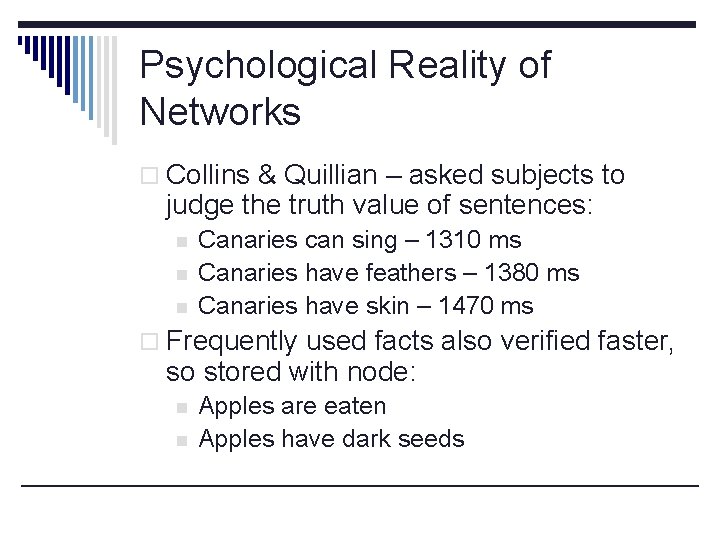
Psychological Reality of Networks o Collins & Quillian – asked subjects to judge the truth value of sentences: n n n Canaries can sing – 1310 ms Canaries have feathers – 1380 ms Canaries have skin – 1470 ms o Frequently used facts also verified faster, so stored with node: n n Apples are eaten Apples have dark seeds
Schemas o Schema – stores specific knowledge about a category, not just properties: n n Uses a slot structure mixing propositional and perceptual information. Slots specify default values for what is generally or typically true. o Isa statement makes a schema part of a generalization hierarchy. o Part hierarchy.
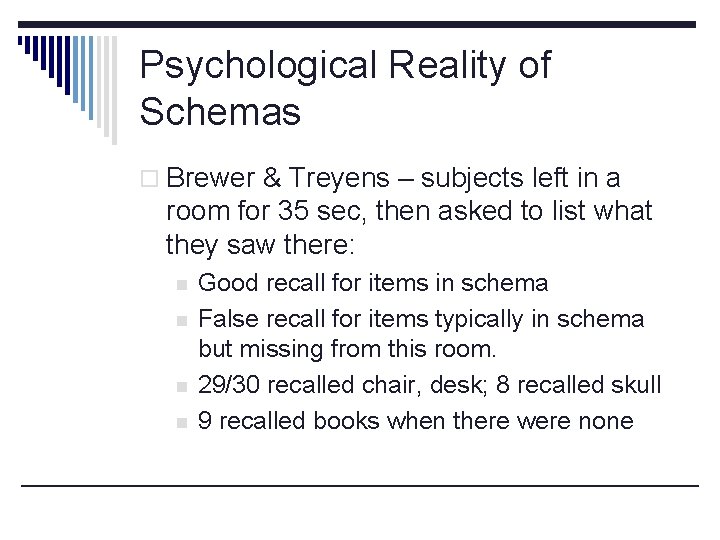
Psychological Reality of Schemas o Brewer & Treyens – subjects left in a room for 35 sec, then asked to list what they saw there: n n Good recall for items in schema False recall for items typically in schema but missing from this room. 29/30 recalled chair, desk; 8 recalled skull 9 recalled books when there were none
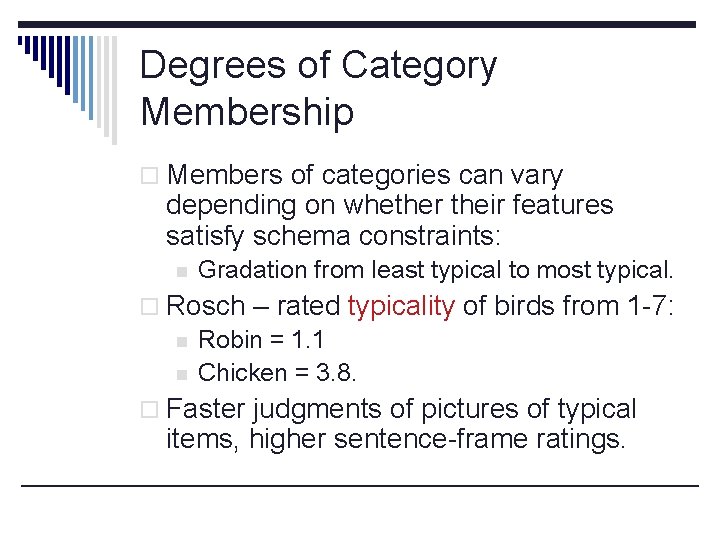
Degrees of Category Membership o Members of categories can vary depending on whether their features satisfy schema constraints: n Gradation from least typical to most typical. o Rosch – rated typicality of birds from 1 -7: n Robin = 1. 1 n Chicken = 3. 8. o Faster judgments of pictures of typical items, higher sentence-frame ratings.
Disagreements at Category Boundaries o Mc. Closkey & Glucksberg – subjects disagree about whether atypical items belong in a category: n n n 30/30 apple is a fruit, chicken is not a fruit 16/30 pumpkin is a fruit Subjects change their minds when tested later. o Labov – boundaries for cups and bowls change with context.
Event Concepts (Scripts) o Schank & Abelson – stereotypic sequences of actions called scripts. o Bower, Black & Turner – script for going to a restaurant. o Scripts affect memory for stories: n n Story elements included in script well remembered, atypical elements not recalled, false recognition of script items. Items out of order put back in typical order.
Two Theories o What happens mentally when we categorize? n Two theories are being debated. o Abstraction theory -- we abstract and store the general properties of instances. n Prototype theory. o Instance theory -- we store the multiple instances themselves and then compare average distances among them.
Neural Nets for Learning Schemas o Gluck & Bower – designed a neural net that abstracts central tendencies without storing instances. n n n Patients with four symptoms classified into two hypothetical diseases. One disease 3 times more frequent than the other. Error correction changes the strength of associations in the network (delta rule). o Model predicted subject decisions well.
Evidence From Neuroscience o People with temporal lobe deficits selectively impaired in recognizing natural categories but not artifacts (tools) o People with frontoparietal lesions unaffected for biological categories but cannot recognize artifacts (tools). o Artifacts may be organized by what we do with them whereas biological categories are identified by shape.
Bartlett’s War of the Ghosts o Demo
- Slides: 19