
Cognitive Processes PSY 334 Chapter 2 Perception July
- Slides: 25
Cognitive Processes PSY 334 Chapter 2 – Perception July 3, 2003
Law of Pragnanz o Of all the possible interpretations, we will select the one that yields the simplest or most stable form. o Simple, symmetrical forms are seen more easily. o In compound letters, the larger figure dominates the smaller ones.
Visual Illusions o Depend on experience. n Influenced by culture. o Illustrate normal perceptual processes. n These are not errors but rather failures of perception in unusual situations.
Visual Pattern Recognition o Bottom-up approaches: n n n Template-matching Feature analysis Recognition by components
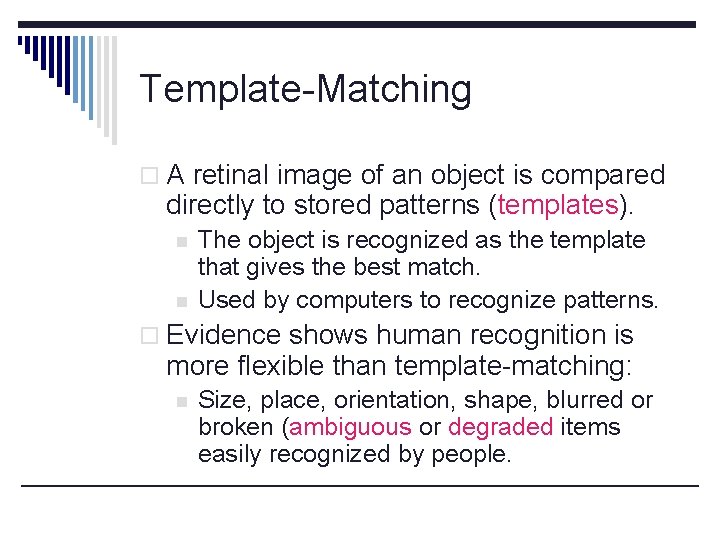
Template-Matching o A retinal image of an object is compared directly to stored patterns (templates). n n The object is recognized as the template that gives the best match. Used by computers to recognize patterns. o Evidence shows human recognition is more flexible than template-matching: n Size, place, orientation, shape, blurred or broken (ambiguous or degraded items easily recognized by people.
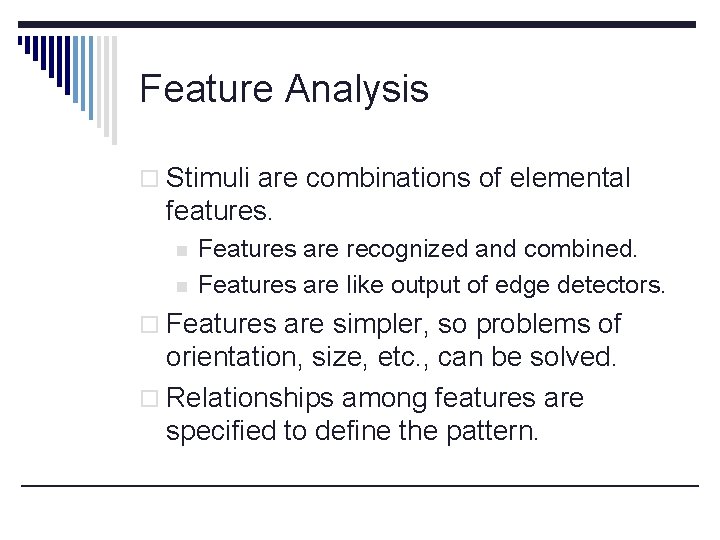
Feature Analysis o Stimuli are combinations of elemental features. n n Features are recognized and combined. Features are like output of edge detectors. o Features are simpler, so problems of orientation, size, etc. , can be solved. o Relationships among features are specified to define the pattern.
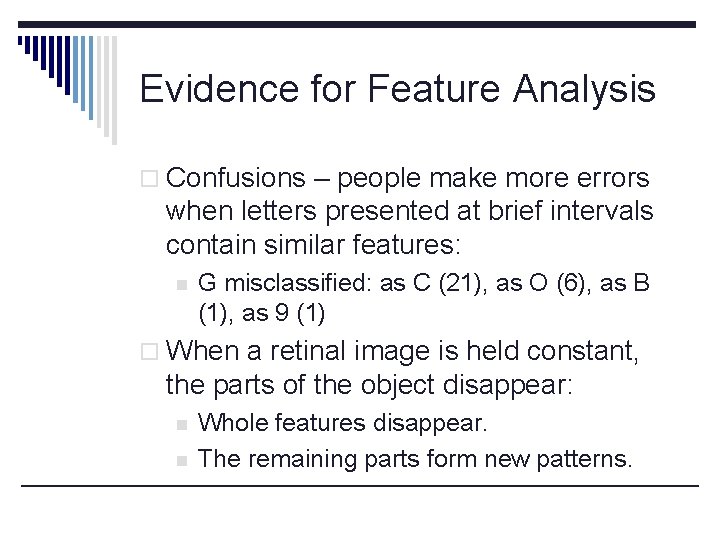
Evidence for Feature Analysis o Confusions – people make more errors when letters presented at brief intervals contain similar features: n G misclassified: as C (21), as O (6), as B (1), as 9 (1) o When a retinal image is held constant, the parts of the object disappear: n n Whole features disappear. The remaining parts form new patterns.
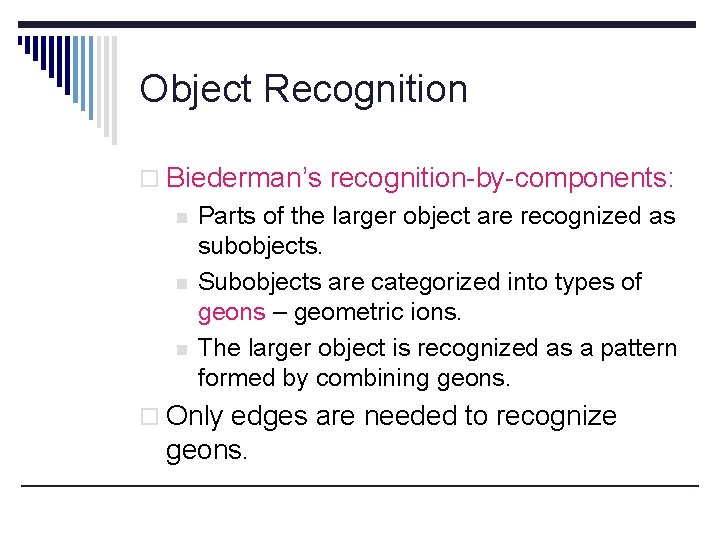
Object Recognition o Biederman’s recognition-by-components: n n n Parts of the larger object are recognized as subobjects. Subobjects are categorized into types of geons – geometric ions. The larger object is recognized as a pattern formed by combining geons. o Only edges are needed to recognize geons.
Tests of Biederman’s Theory o Object recognition should be mediated by recognition of object components. o Two types of degraded figures presented for brief intervals: n n Components (geons) missing Line segments missing o At fast intervals (65 -100 ms) subjects could not recognize components when segments were missing.
Speech Recognition o The physical speech signal is not broken up into parts that correspond to recognizable units of speech. n n n Undiminished sound energy at word boundaries – gaps are illusory. Cessation of speech energy in the middle of words. Word boundaries cannot be heard in an unfamiliar language.
Phoneme Perception o No one-to-one letter-to-sound correspondence. o Speech is continuous – phonemes are not discrete (separate) but run together. o Speakers vary in how they produce the same phoneme. o Coarticulation – phonemes overlap. n The sound produced depends on the sound immediately preceding it.
Feature Analysis of Speech o Features of phonemes appear to be: n n n Consonantal feature (consonant vs vowel). Voicing – do vocal cords vibrate or not. Place of articulation – where the vocal track is constricted (where is tongue placed). o The phoneme heard by listeners changes as you vary these features. n Sounds with similar features are confused.
Categorical Perception o For speech, perception does not change continuously but abruptly at a category boundary. o Categorical perception – failure to perceive gradations among stimuli within a category. n Pairs of [b]’s or [p]’s sound alike despite differing in voice-onset times.
Two Views of Categorical Perception o Weak view – stimuli are grouped into recognizable categories. o Strong view – we cannot discriminate among items within such a category. o Massaro – people can discriminate within category but have a bias to same items are the same despite differences. o Category boundaries can be shifted by fatiguing the feature detectors.
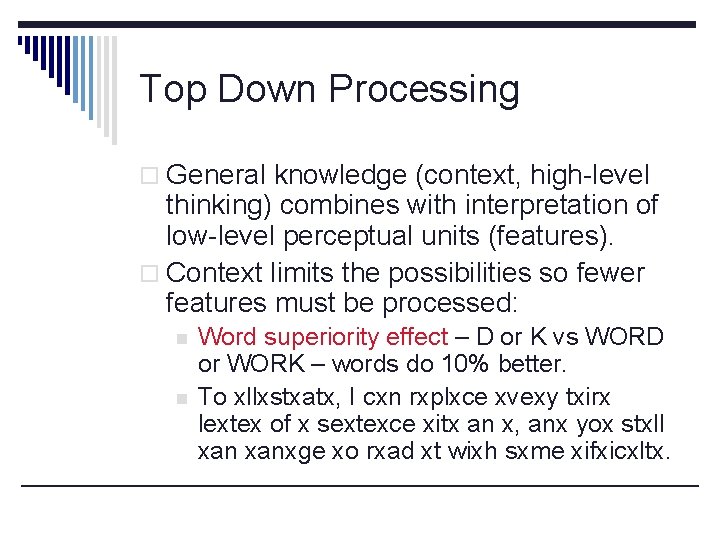
Top Down Processing o General knowledge (context, high-level thinking) combines with interpretation of low-level perceptual units (features). o Context limits the possibilities so fewer features must be processed: n n Word superiority effect – D or K vs WORD or WORK – words do 10% better. To xllxstxatx, I cxn rxplxce xvexy txirx lextex of x sextexce xitx an x, anx yox stxll xanxge xo rxad xt wixh sxme xifxicxltx.
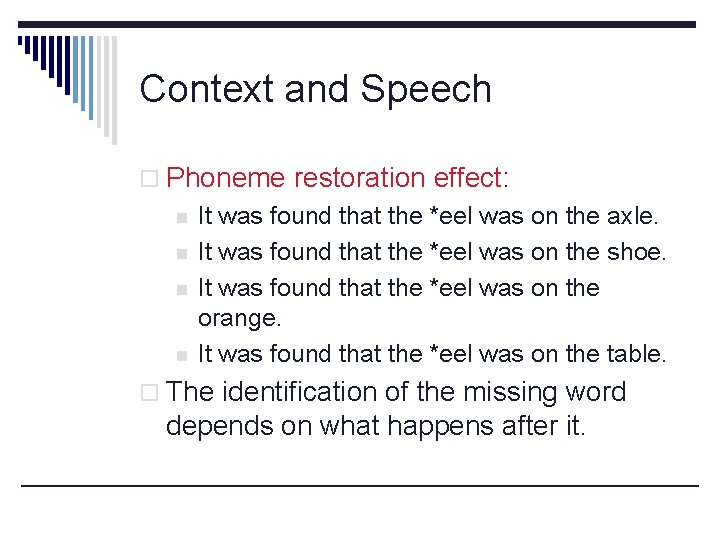
Context and Speech o Phoneme restoration effect: n n It was found that the *eel was on the axle. It was found that the *eel was on the shoe. It was found that the *eel was on the orange. It was found that the *eel was on the table. o The identification of the missing word depends on what happens after it.
Faces and Scenes o When parts are presented in isolation, more feature information is needed to recognize them. n n Face parts are recognized with less detail when in the context of a face. Subjects are better able to identify objects when they are part of coherent novel scenes rather than jumbled scenes.
Models of Object Perception o Two competing models explain how context and feature information are combined: n n Massaro’s FLMP (fuzzy logic model of perception) -- Context and detail are two independent sources of information. Mc. Clelland & Rumelhart’s PDP model – connectionist model in which both sources of information interact.
Testing the FLMP Model o Four kinds of stimuli: n n Only an e can make a real word. Only a c can make a real word. Both letters can make a word. Neither letter can make a word. o Within each group, stimuli go from e to c. o Subjects saw each stimulus word briefly and had to identify the letter, e or c.
FLMP Results o Observed frequencies for naming a letter e increase as it has more e features, but also as the context demands an e. o Baye’s theorem gives a formula for combining the independent contributions of two sources of information. o Massaro’s results conform to predictions of Baye’s theorem, suggesting that the information sources must be independent of each other.
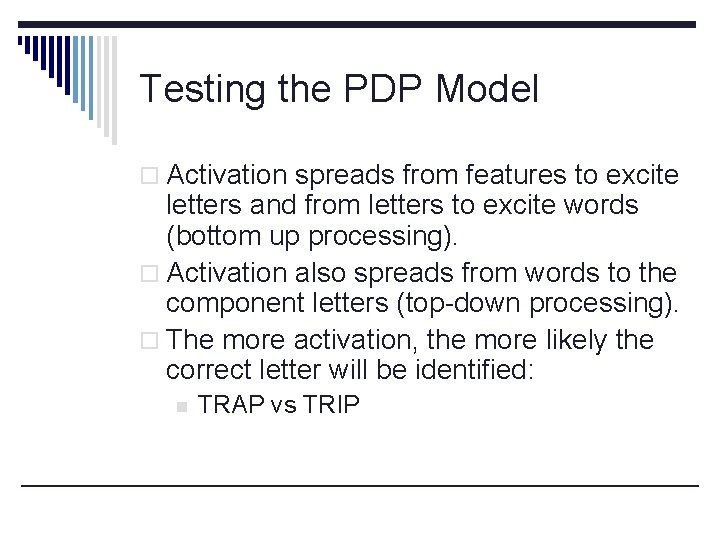
Testing the PDP Model o Activation spreads from features to excite letters and from letters to excite words (bottom up processing). o Activation also spreads from words to the component letters (top-down processing). o The more activation, the more likely the correct letter will be identified: n TRAP vs TRIP
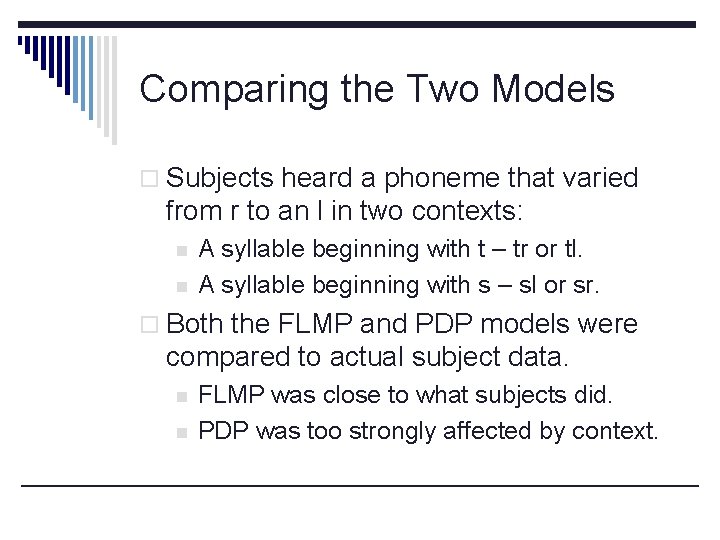
Comparing the Two Models o Subjects heard a phoneme that varied from r to an l in two contexts: n n A syllable beginning with t – tr or tl. A syllable beginning with s – sl or sr. o Both the FLMP and PDP models were compared to actual subject data. n n FLMP was close to what subjects did. PDP was too strongly affected by context.
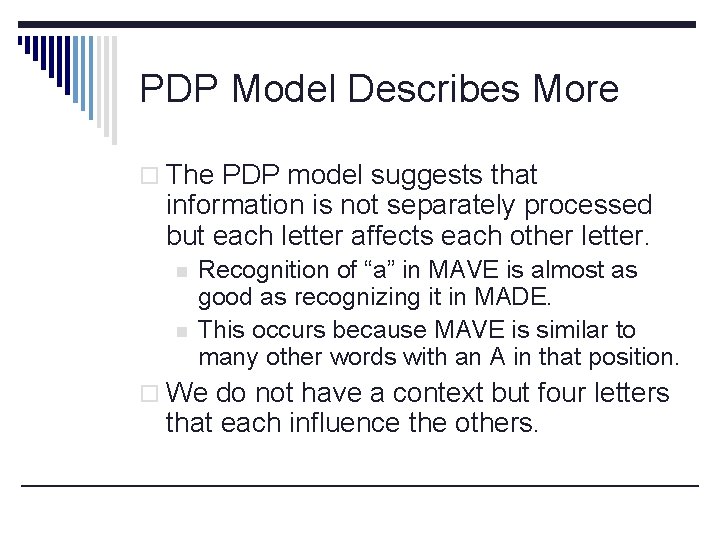
PDP Model Describes More o The PDP model suggests that information is not separately processed but each letter affects each other letter. n n Recognition of “a” in MAVE is almost as good as recognizing it in MADE. This occurs because MAVE is similar to many other words with an A in that position. o We do not have a context but four letters that each influence the others.
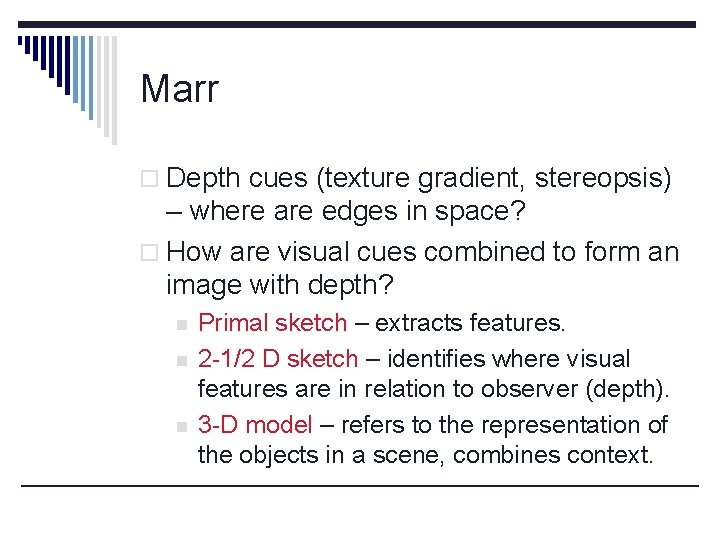
Marr o Depth cues (texture gradient, stereopsis) – where are edges in space? o How are visual cues combined to form an image with depth? n n n Primal sketch – extracts features. 2 -1/2 D sketch – identifies where visual features are in relation to observer (depth). 3 -D model – refers to the representation of the objects in a scene, combines context.
Putting it All Together o The output of these stages (see Fig 2. 31) is a representation of an object and its location. o This output is used as input to higherlevel cognitive processes. o Conscious awareness (a higher-level process) involves the recognition stage, but lots of processing occurs first.