
Cognitive neuroscience Study of the brain activity linked
Cognitive neuroscience • Study of the brain activity linked with our mental processes. • A woman with no outward signs of conscious awareness was asked to imagine playing tennis. • An f. MRI showed activity in the areas of the brain responsible for arm and leg movements. • Dual processing- we are unconsciously or automatically aware of events “low road” • Or we are deliberately aware of what is happening “high road” • Our brain waves show that we are aware of things that we do not consciously perceive.
Behavior Genetics: Predicting Individual Differences The topics in the text: 1. genes 2. twin and adoption studies 3. temperament and heredity 4. molecular genetics 5. heritability 6. gene/environment interaction Behavior geneticists study how heredity and environment contribute to human differences. Let’s start by looking at GENES.
• Ways to study the effects of genes on our behaviors… • Twin studies (identical vs fraternal) • Separated twins • Biological vs. adopted relatives
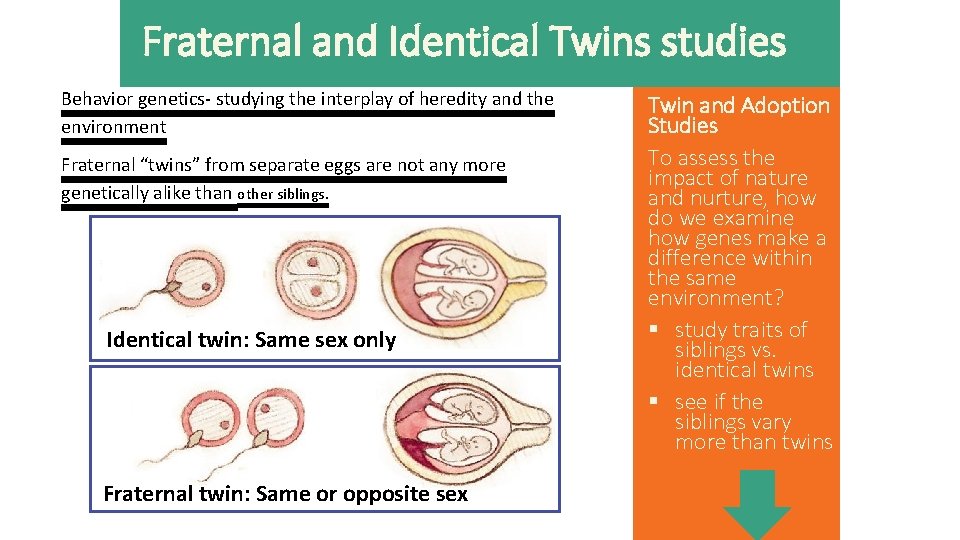
Fraternal and Identical Twins studies Behavior genetics- studying the interplay of heredity and the environment Fraternal “twins” from separate eggs are not any more genetically alike than other siblings. Identical twin: Same sex only Fraternal twin: Same or opposite sex Twin and Adoption Studies To assess the impact of nature and nurture, how do we examine how genes make a difference within the same environment? § study traits of siblings vs. identical twins § see if the siblings vary more than twins

Identical vs. Fraternal Twins Studies of twins in adulthood show that identical twins are more alike than fraternal twins in: § personality traits such as extraversion (sociability) and neuroticism (emotional instability). § behaviors/outcomes such as the rate of divorce. § abilities such as overall Intelligence test scores. § Studies of identical twins raised in different homes show the same results Twin and Adoption Studies How do we find out how the same genes express themselves in different environments? We can study the traits of identical twins as they grow up, or if they were raised separately (e. g. , the Minnesota Twin Family Study).

Adoption Studies • Discuss where your parents or your environment has had the most impact on you. • Genetic relatives and environmental relatives are created. • People who grow up together, related or not, do not really resemble each other in personality. • In traits like extraversion and agreeableness, adoptees are more like their genetic parents. • The environment shared by a family’s children has virtually no discernable impact on their personalities. • Two adopted kids in the same home can be just as similar or different than a kid raised down the block.
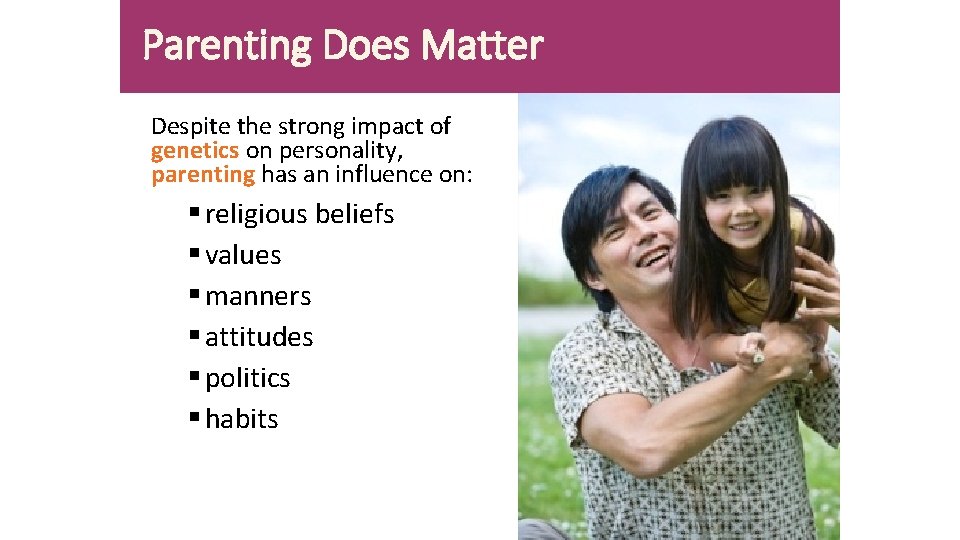
Parenting Does Matter Despite the strong impact of genetics on personality, parenting has an influence on: § religious beliefs § values § manners § attitudes § politics § habits
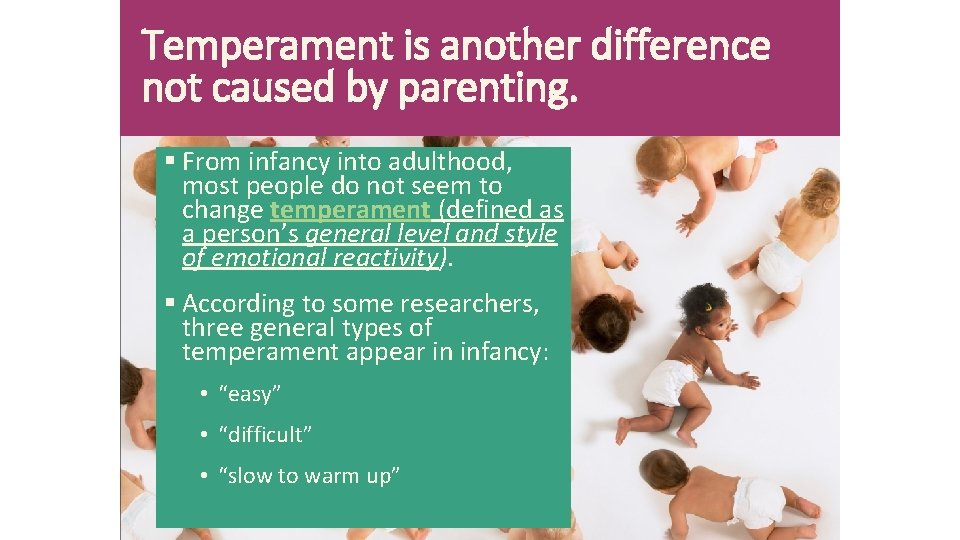
Temperament is another difference not caused by parenting. § From infancy into adulthood, most people do not seem to change temperament (defined as a person’s general level and style of emotional reactivity). § According to some researchers, three general types of temperament appear in infancy: • “easy” • “difficult” • “slow to warm up”
• Anxious infants have high and variable heart rates and a reactive nervous system. They become more physiologically aroused. • Biology leads to temperament • In experiments with monkeys, even uptight monkeys were still uptight even though they were raised to easy going mothers. • Genetic temperament outweighs child rearing.
Heritability • How much of the difference in individuals is actually genetic? • If we raised boys in a barrel until they were 12, any variation in their intelligence would be due to genes. • That’s the heritability • It would be 100% • They would have lower than normal IQ but the difference would be completely genetic. • This does not apply to ethnic or gender differences. Difference in environment are more responsible for group differences.
• Genetic traits influence the social environment, which in turn affects behavior. • One child may be predisposed to be attractive, sociable, and easygoing. • This child attracts more affection and develops into a warmer, more outgoing person. The outgoing child more often seeks activities that encourage social confidence. • They work together. • the other child may be aggressive and impulsive and therefore is yelled at more. As a result, they become more aggressive. • This is why parents raise children differently
epigenetics • Studying the molecular mechanisms by which environments trigger genetic expression. • Drugs, stress and diet can effect the epigenetic molecule that turns a gene on or off. • Rats deprived of their mother’s licking had more molecules that blocked access to the “on” switch for developing brain’s stress hormone receptors. • As a result, they had more stress hormones floating around in their brain • Child abuse may have a similar effect • Moceanu
What would you do? • You are on a boat that overturns. It contains your 5 yr old and your 1 year old children. (same sex) The boat sinks and you can save only one. Which one do you save? • The same boat, you aren’t very smart, contains your 40 year old and 20 year old children. (same sex) neither can swim. Whom do you save?
• You and your spouse are the proud parents of a new child. The grandparents are ecstatic. Who do you think will be kinder to the child? • Mother of the mother • Mother of the father
• Who will mourn more at the death of a child? • Father or mother • Parents of the father or parents of the mother • Younger parents or older parents • Which will elicit more grief? • Death of a son or death of a daughter • Death of an unhealthy child or death of a healthy child
Evolutionary Psychology: Understanding Human Nature Some topics: § Natural selection and adaptation § Evolutionary success may help explain similarities § An evolutionary explanation of human sexuality Evolutionary psychology is the study of how evolutionary principles help explain the origin and function of the human mind, traits, and behaviors. We have been talking so far about human differences; we may now seek insight in the ways in which humans are alike. 16
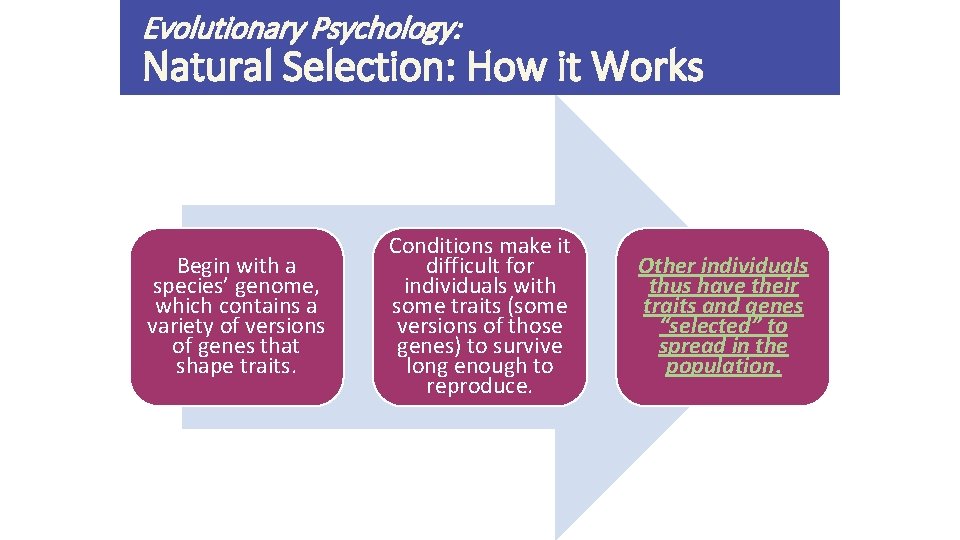
Evolutionary Psychology: Natural Selection: How it Works Begin with a species’ genome, which contains a variety of versions of genes that shape traits. Conditions make it difficult for individuals with some traits (some versions of those genes) to survive long enough to reproduce. Other individuals thus have their traits and genes “selected” to spread in the population.
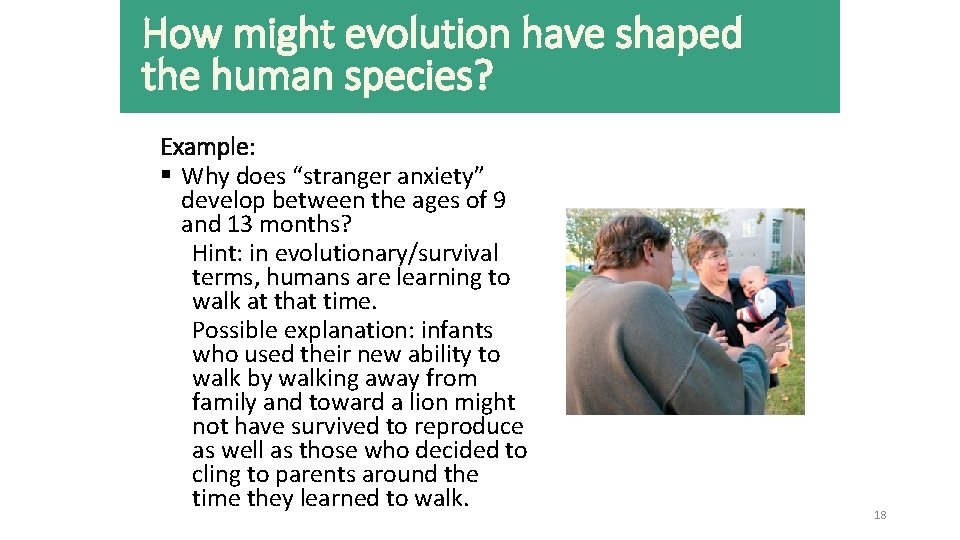
How might evolution have shaped the human species? Example: § Why does “stranger anxiety” develop between the ages of 9 and 13 months? Hint: in evolutionary/survival terms, humans are learning to walk at that time. Possible explanation: infants who used their new ability to walk by walking away from family and toward a lion might not have survived to reproduce as well as those who decided to cling to parents around the time they learned to walk. 18
The Biology of Gender What biologically makes us male or female? § It begins with whether our 23 rd pair of chromosomes looks like XX (female) or Xy (male). § Testes develop, and at seven weeks, the testes produce a flood of testosterone. § Hormones then guide the development of external sex organs. Brain Differences § During the fourth and fifth month of pregnancy, sex hormones bathe fetal brain. § In adulthood, women have thicker areas in a part of the frontal lobes that help with verbal fluency. § There also differences in the amygdala, hippocampus, and ratio of cell bodies to axons.
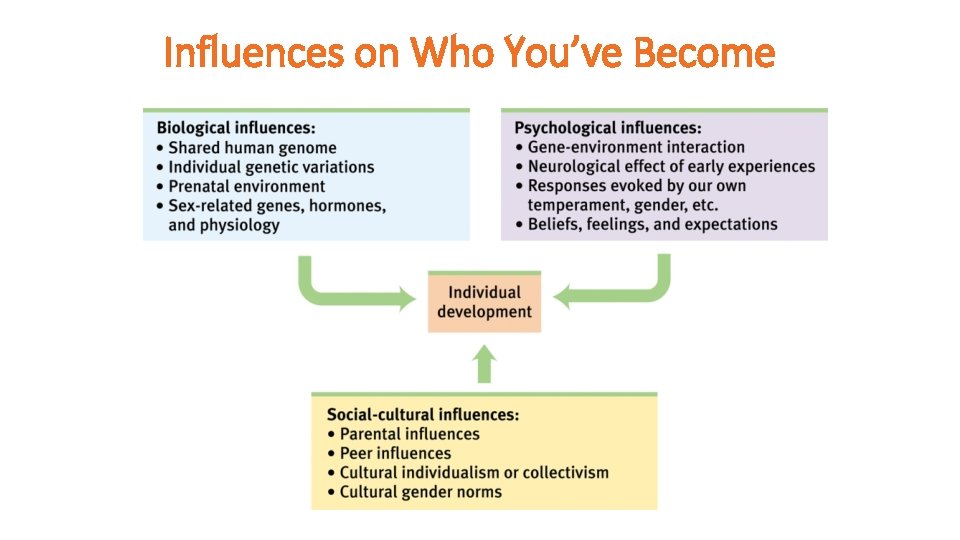
Influences on Who You’ve Become
Beyond Biopsychosocial Influences: CHOICE § Is our behavior and identity rigidly determined by our combination of nature/genes and nurture/experience? Even if free will is an illusion, it would seem that we can make choices that override our genetic influences, that differ from cultural norms, and that do not fit our environment. We can even choose to directly alter culture, environment, and even genes.
Epilogue: Evolution § Evolution is a scientific theory (NOT a guess, and not a hypothesis, but something more): a coherent set of principles that fits very well with the accumulated evidence. § Parts of the evolutionary story may conflict with other stories of origins and change over time. § Is there room for overlap and agreement? Possible areas of consensus, with or without evolution: § The human mind and body seems almost “designed, ” by evolution or other forces, to have certain traits and abilities. § Nurture may shape us, but we seem to start out with some sort of human nature.
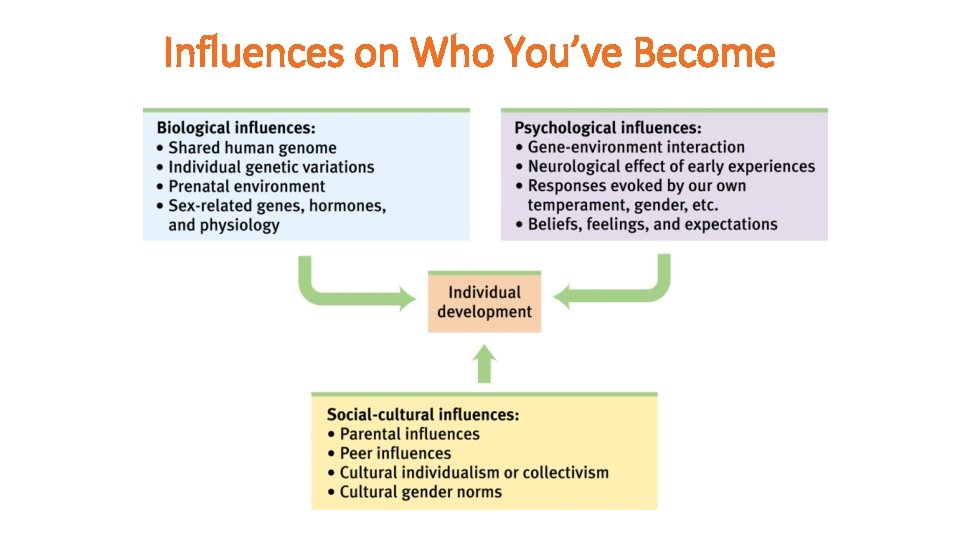
Influences on Who You’ve Become
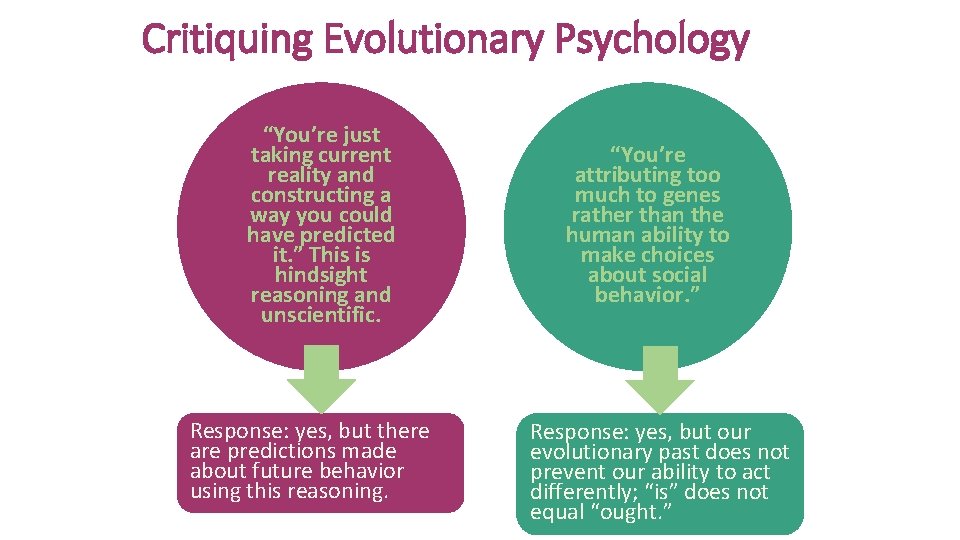
Critiquing Evolutionary Psychology “You’re just taking current reality and constructing a way you could have predicted it. ” This is hindsight reasoning and unscientific. Response: yes, but there are predictions made about future behavior using this reasoning. “You’re attributing too much to genes rather than the human ability to make choices about social behavior. ” Response: yes, but our evolutionary past does not prevent our ability to act differently; “is” does not equal “ought. ”
- Slides: 24