
Cognitive Motivation Competence and Control Chapter 11 Carl


- Slides: 62
Cognitive Motivation: Competence and Control Chapter 11
Carl Rogers The Humanistic Approach
Biography • Carl grew up on a farm in Illinois, developing an interest in biology & agriculture. • Expressing emotions was not allowed in the Rogers household & it took its toll on Carl who developed an ulcer at 15. • Rogers went to the University of Wisconsin to study agriculture in 1919. • He changed careers becoming interested in religious studies. He finished his degree and left for Union Theological Seminary in NY to become a minister.
Basic Premise • Humans are motivated through an innate potential to actualize, maintain and enhance the self • Sees people as basically good
Emergence of Self-Concept • Self-concept: How I see myself • Actualizing Tendency: Becoming Fully Functioning • Unconditional Positive Self Regard vs Unconditional Positive regard: Acceptance, love and approval from self and others no matter what – As infants grow, they develop the need for positive regard • Child does not receive positive regard: fails to develop actualizing tendency fully
Characteristics of Fully Functioning Persons (Self-Actualizing) 1. Openness to experience: Awareness of all experiences 2. Existential Living: Live fully in the moment 3. Trust own behavior and experience 4. Sense of freedom in decision making 5. Creativity: Flexible to change 6. Recognition difficulties will inevitably arise (control over ones life)
Criticisms of Carl Rogers Approach 1. Operational Definition 2. Unclear about environmental conditions 3. “Me first” little about responsibility towards others. 4. Ignores end product of “striving” towards goals 5. Empirically weak theory
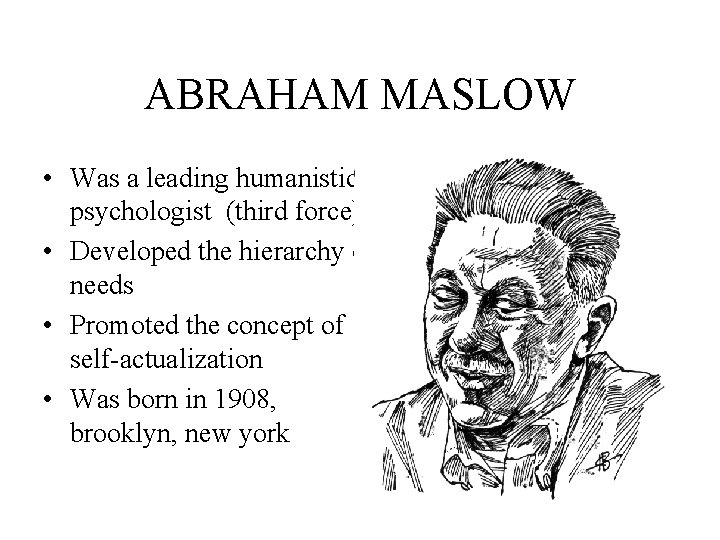
ABRAHAM MASLOW • Was a leading humanistic psychologist (third force) • Developed the hierarchy of needs • Promoted the concept of self-actualization • Was born in 1908, brooklyn, new york
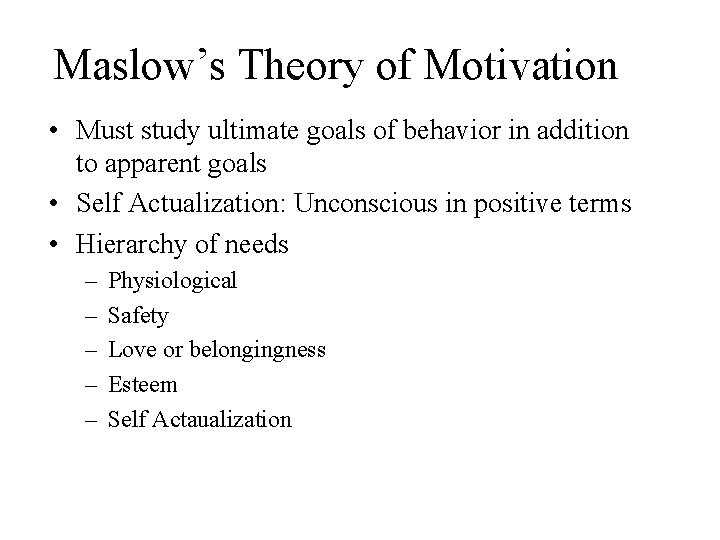
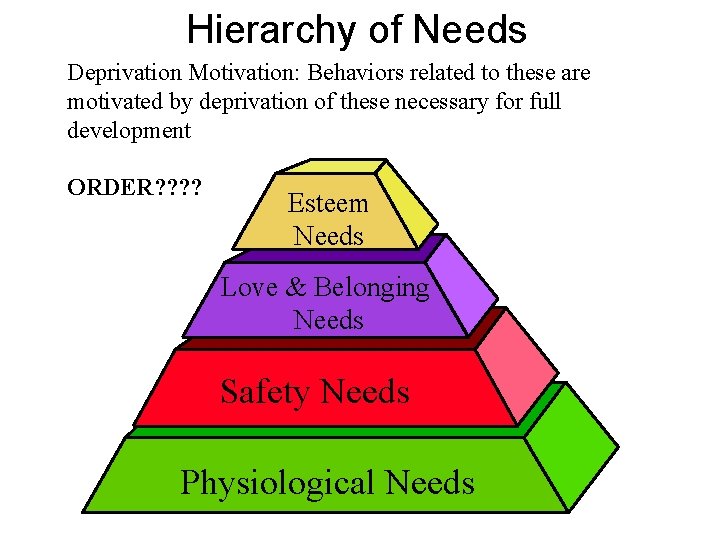
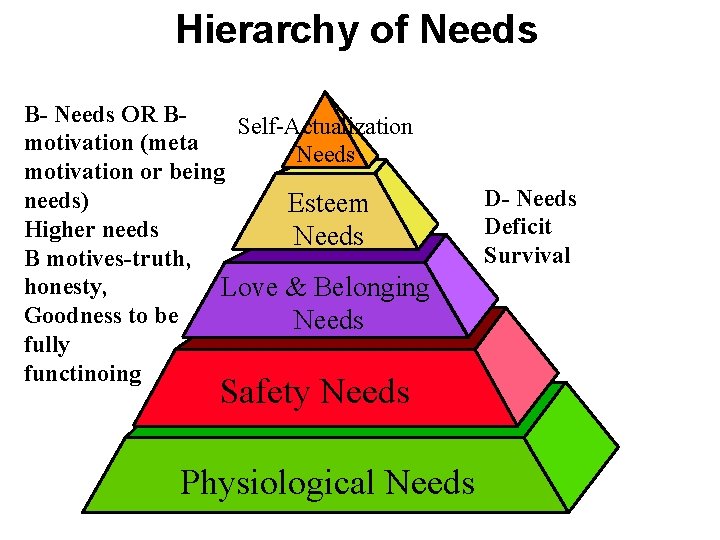
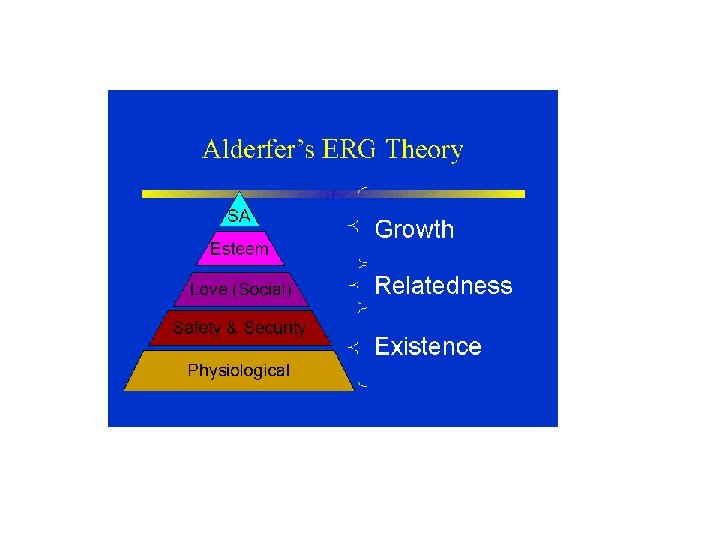
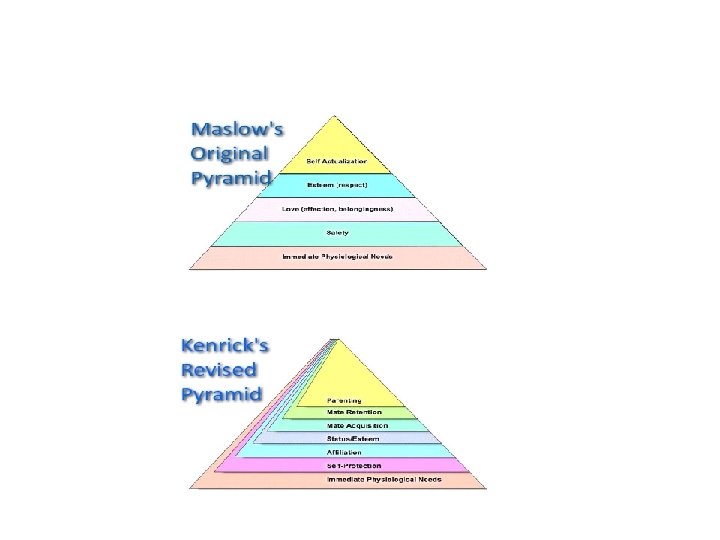
Maslow’s Theory of Motivation • Must study ultimate goals of behavior in addition to apparent goals • Self Actualization: Unconscious in positive terms • Hierarchy of needs – – – Physiological Safety Love or belongingness Esteem Self Actaualization
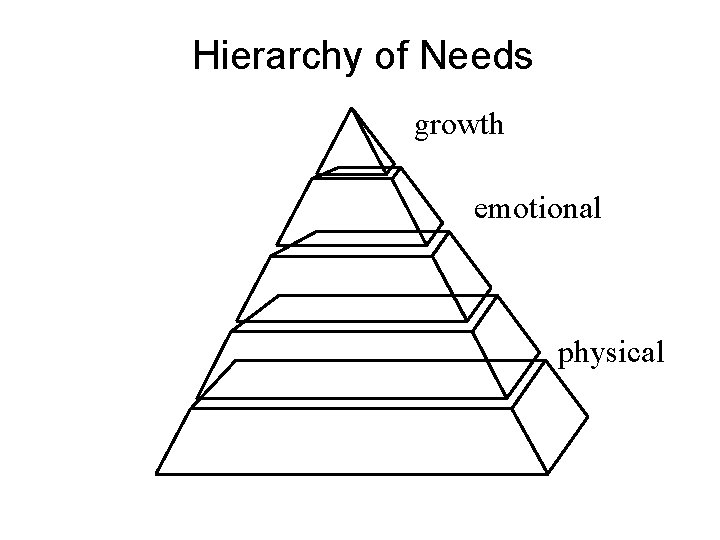
Hierarchy of Needs growth emotional physical
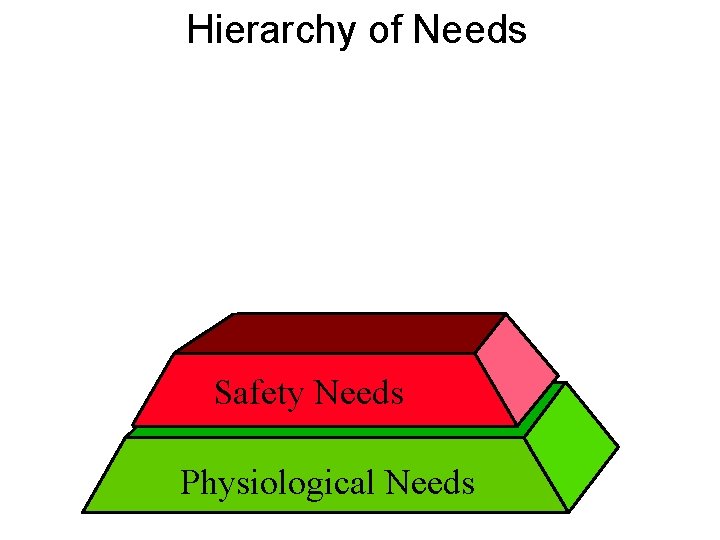
Hierarchy of Needs Physiological Needs
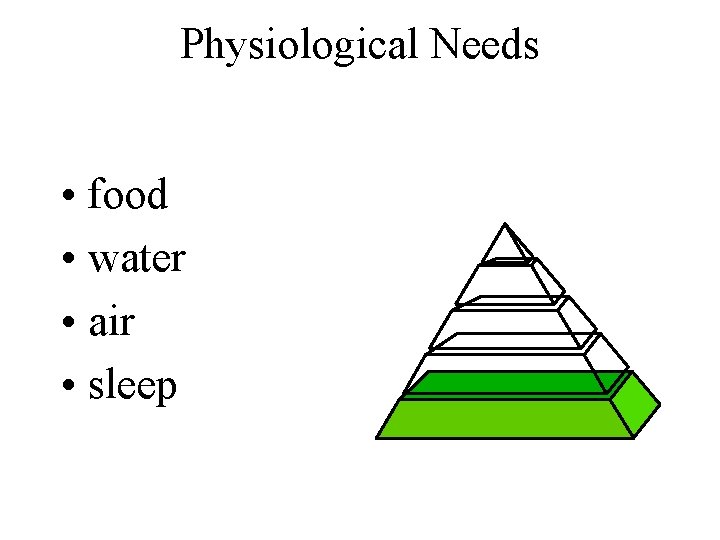
Physiological Needs • food • water • air • sleep
Food: A Most Powerful Need • South American Rugby team crashed in 1970 • Food was the most pressing problem. • They ate human flesh for survival. • Even the strongest taboo was broken to fill the basic need for food.
Food: A Most Powerful Need • Ik tribe in Uganda forced to give up hunting and live on unfertile land • long standing social mores dissolve - people became psychopathic • “ngag”, word for food, also becomes word for good • parents steal food from children, children from other children
Hierarchy of Needs Safety Needs Physiological Needs
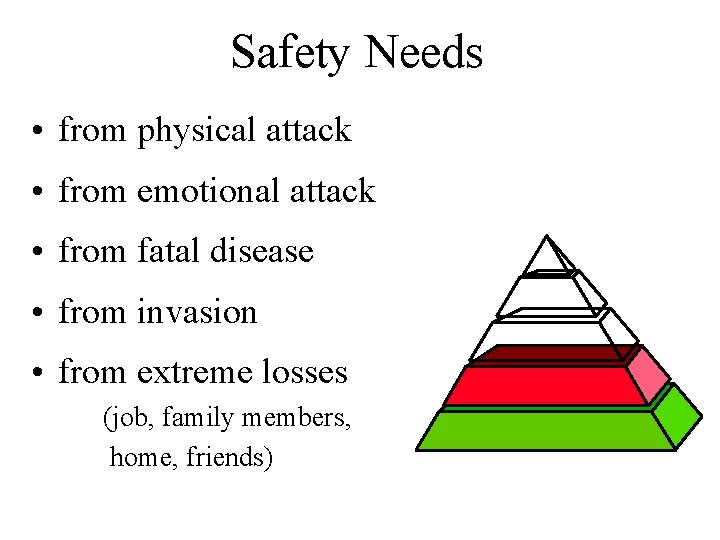
Safety Needs • from physical attack • from emotional attack • from fatal disease • from invasion • from extreme losses (job, family members, home, friends)
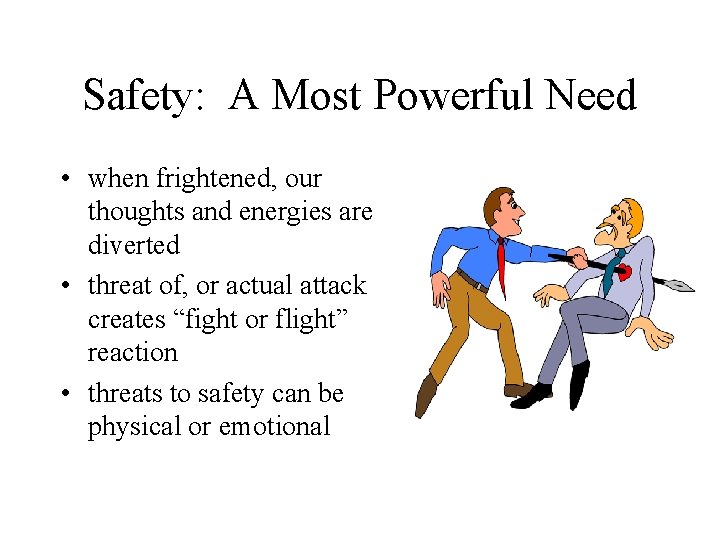
Safety: A Most Powerful Need • when frightened, our thoughts and energies are diverted • threat of, or actual attack creates “fight or flight” reaction • threats to safety can be physical or emotional
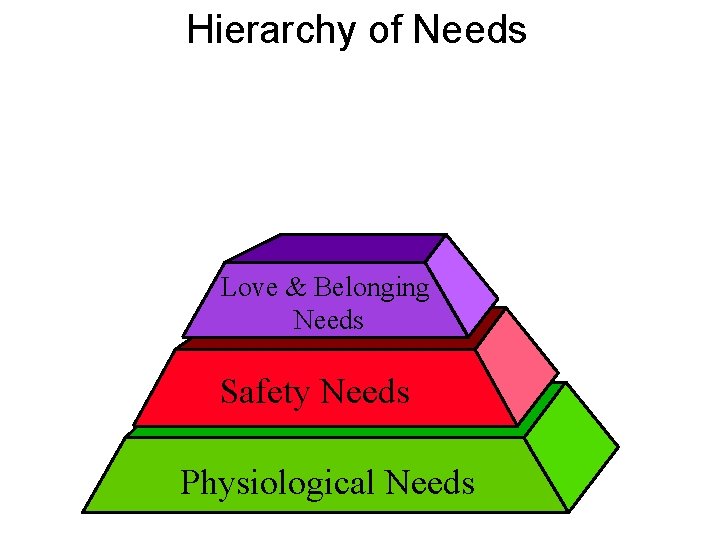
Hierarchy of Needs Love & Belonging Needs Safety Needs Physiological Needs
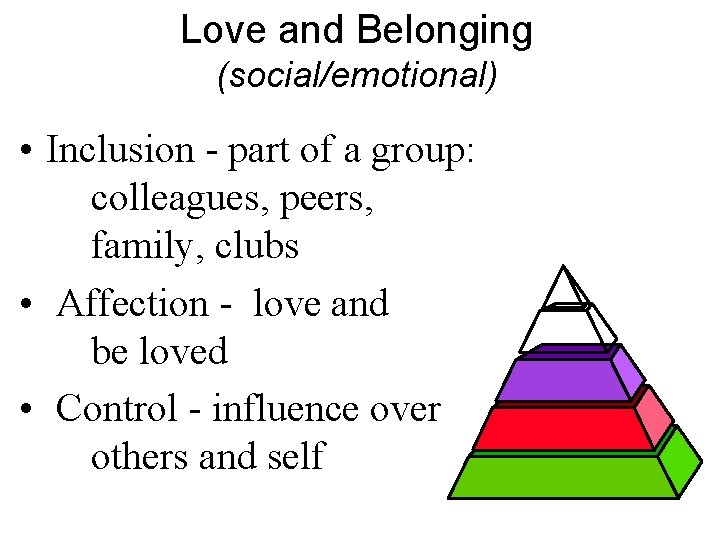
Love and Belonging (social/emotional) • Inclusion - part of a group: colleagues, peers, family, clubs • Affection - love and be loved • Control - influence over others and self
Love and Belonging: A Most Powerful Need
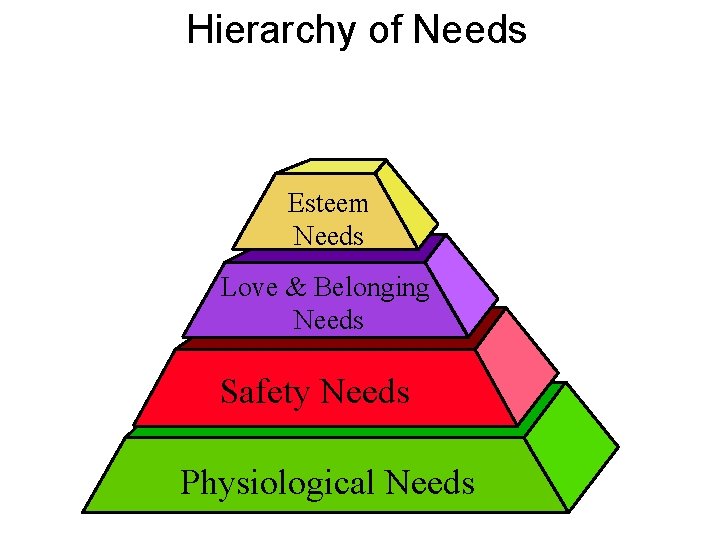
Hierarchy of Needs Esteem Needs Love & Belonging Needs Safety Needs Physiological Needs
Esteem Needs emotional (ego) • respect from others through: awards honors status • respect for self through: mastery achievement competence
Esteem from Self and Others: A Most Powerful Need Congratulations
Hierarchy of Needs Deprivation Motivation: Behaviors related to these are motivated by deprivation of these necessary for full development ORDER? ? Esteem Needs Love & Belonging Needs Safety Needs Physiological Needs
Hierarchy of Needs B- Needs OR BSelf-Actualization motivation (meta Needs motivation or being needs) Esteem Higher needs Needs B motives-truth, honesty, Love & Belonging Goodness to be Needs fully functinoing Safety Needs Physiological Needs D- Needs Deficit Survival
Some Self-Actualizing People from History • • • Abraham Lincoln Thomas Jefferson Mahatma Gandhi Albert Einstein Eleanor Roosevelt William James
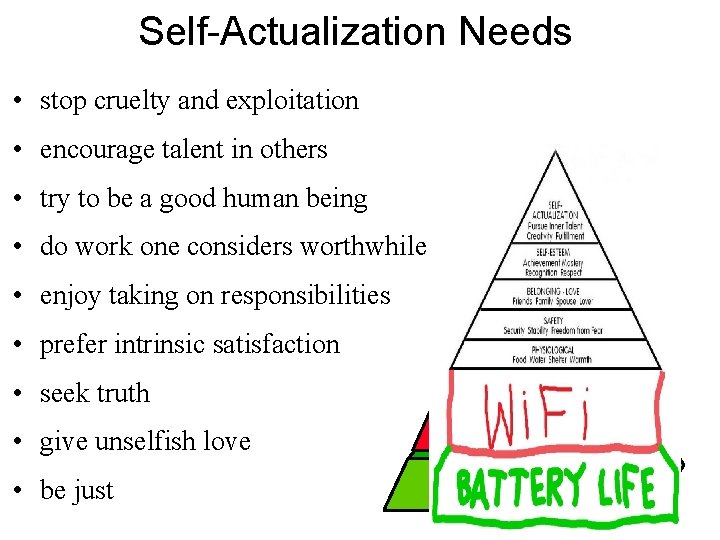
Self-Actualization Needs • stop cruelty and exploitation • encourage talent in others • try to be a good human being • do work one considers worthwhile • enjoy taking on responsibilities • prefer intrinsic satisfaction • seek truth • give unselfish love • be just
B-Needs of the Self-Actualized • • Truth Goodness Beauty Unity Aliveness Uniqueness Perfection and Necessity • • Completion Justice and order Simplicity Richness Effortlessness Playfulness Self-sufficiency Meaningfulness
Qualities of the Self-Actualized • • An non-hostile sense of humor Intimate personal relationships Acceptance of self and others Spontaneity and simplicity Freshness of appreciation More peak experiences Democratic values Independence
Peak Experiences Moments of Pure Bliss Superior functioning, enjoyable experiences without effort, it is passive and is enjoyable.
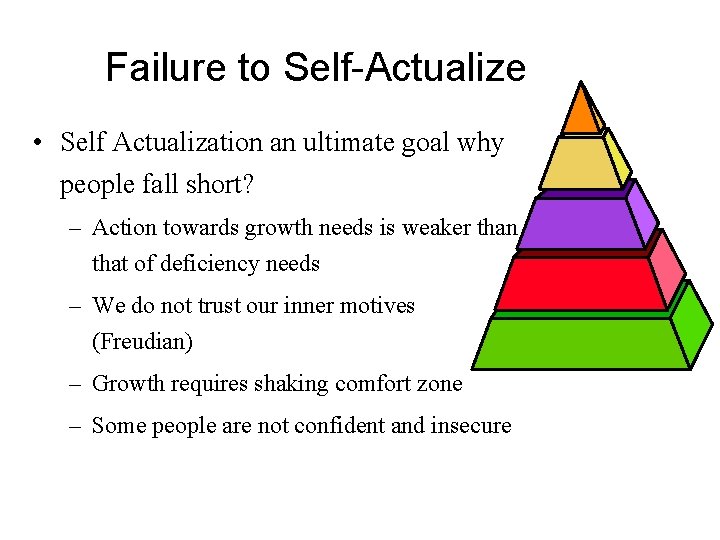
Failure to Self-Actualize • Self Actualization an ultimate goal why people fall short? – Action towards growth needs is weaker than that of deficiency needs – We do not trust our inner motives (Freudian) – Growth requires shaking comfort zone – Some people are not confident and insecure
Revision of Hierarchy of Needs Kendrick et al 2010 • Evolutionary significance • Developmental trajectory • The specific environmental stimuli that trigger each need at a given moment
Competence • Robert White (1959) • Capacity to interact effectively with the environment • Effectance Motivation: Gain control and attempt to master – Is global (directed at all aspects of the environment) • Achieving goals leads to feeling of Selffulfillment
Personal Causation Decharms (1968) • Personal causation-person as causal agent in the environment • Origin: behavior is controlled by personal choices • Pawn: Controlled by external environmental forces
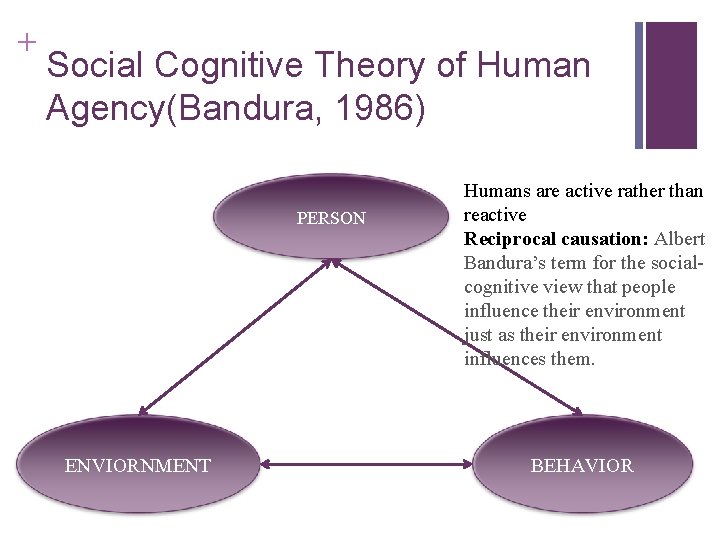
+ Social Cognitive Theory of Human Agency(Bandura, 1986) PERSON ENVIORNMENT Humans are active rather than reactive Reciprocal causation: Albert Bandura’s term for the socialcognitive view that people influence their environment just as their environment influences them. BEHAVIOR
+ Core Features of Human Agency 1. Intentionality: Making a proactive Commitment 2. Forethought: Planning and anticipation of future events. 3. Self Reactiveness: Self Regulation 4. Self Reflectiveness: Ability to evaluate how effective we are • Personal Agency: Relying on self • Proxy Agency: Relying on others • Collective Agency: Relying on groups • Application in the Health Industry
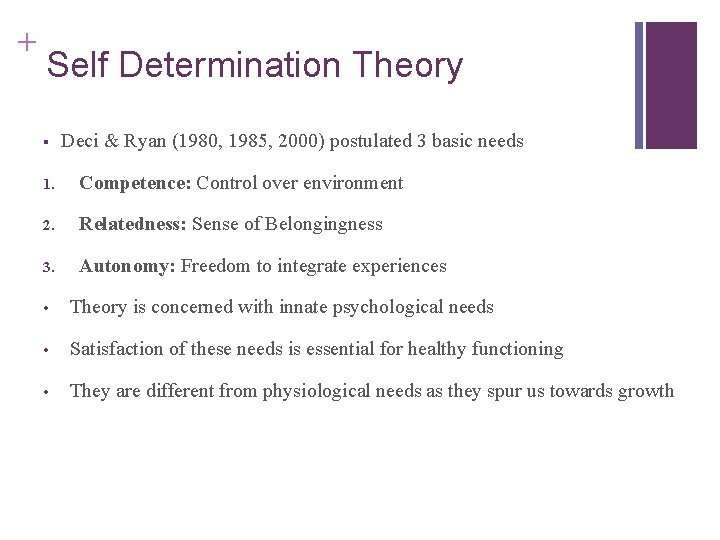
+ Self Determination Theory § Deci & Ryan (1980, 1985, 2000) postulated 3 basic needs 1. Competence: Control over environment 2. Relatedness: Sense of Belongingness 3. Autonomy: Freedom to integrate experiences • Theory is concerned with innate psychological needs • Satisfaction of these needs is essential for healthy functioning • They are different from physiological needs as they spur us towards growth
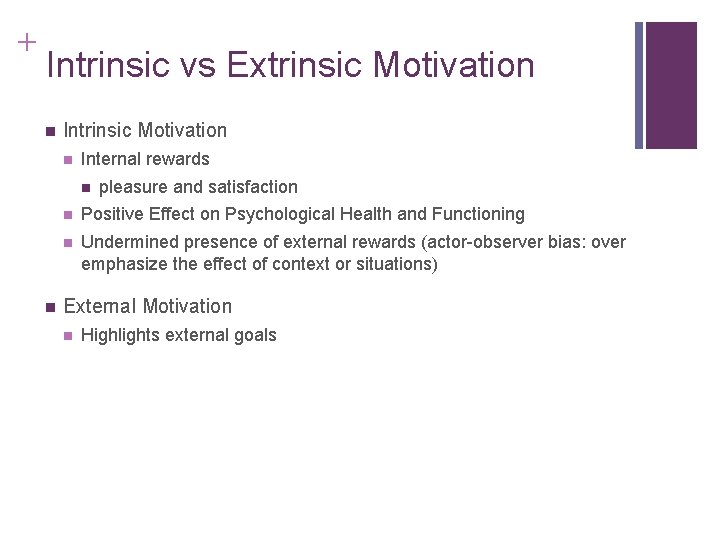
+ Intrinsic vs Extrinsic Motivation n Internal rewards n n pleasure and satisfaction n Positive Effect on Psychological Health and Functioning n Undermined presence of external rewards (actor-observer bias: over emphasize the effect of context or situations) External Motivation n Highlights external goals
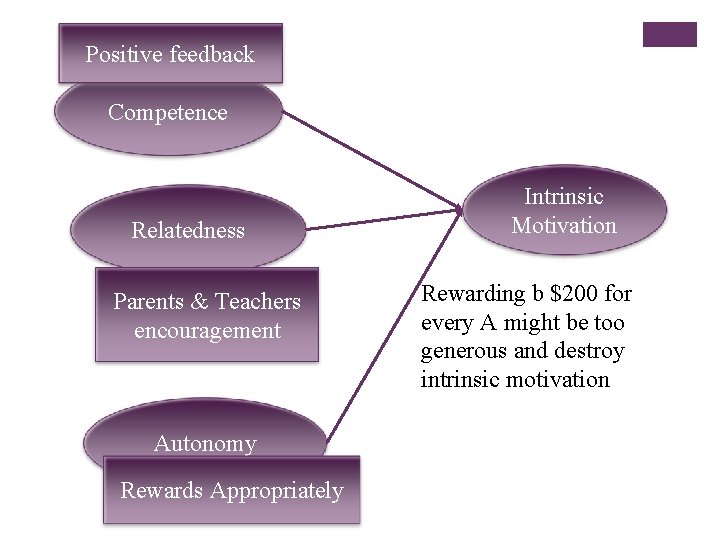
Positive feedback Competence Relatedness Parents & Teachers encouragement Autonomy Rewards Appropriately Intrinsic Motivation Rewarding b $200 for every A might be too generous and destroy intrinsic motivation
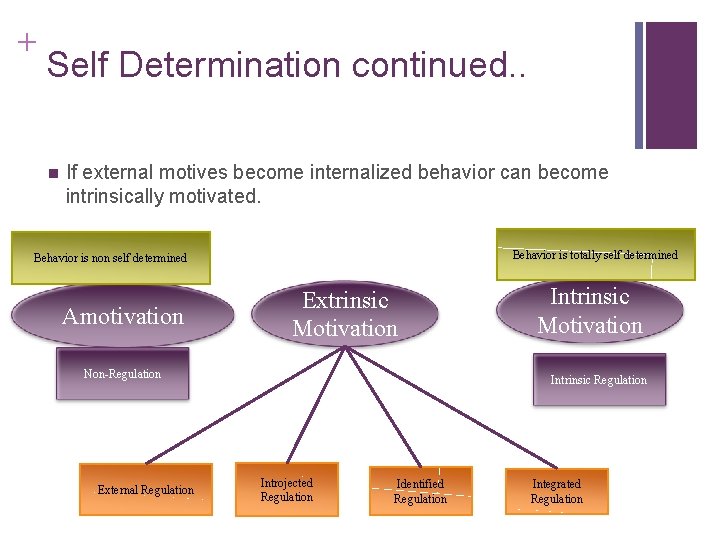
+ Self Determination continued. . n If external motives become internalized behavior can become intrinsically motivated. Behavior is totally self determined Behavior is non self determined Amotivation Extrinsic Motivation Non-Regulation External Regulation Intrinsic Motivation Intrinsic Regulation Introjected Regulation Identified Regulation Integrated Regulation
+ Rise of Positive Psychology n Seligman & Csikszentmihalyi (2000) 1. To improve productivity and functioning of people 2. To determine how to best foster the development of individuals with exceptional abilities
+ A Brief History of Positive Psychology n Study of the “good life” goes back to ancient times n Ancient Greeks used logic and reason to find the formula for the good life n Positive psychology is a fairly recent field, but has roots going back over 100 years n Martin P. Seligman is credited with formally creating the field
+ Positive Emotions n Up until 1980’s, mostly only negative emotions were investigated n Eliminating negative emotions does not automatically lead to feeling positive ones n Positive affect and negative affect comprise the basic dimensions of emotional experience n Positive affect: approach-oriented, leads person to experiences that yield pleasure n Negative affect: withdrawal-oriented
+ Fredrickson’s Broaden-and-Build Model n Negative emotions tend to limit our options, positive emotions tend to broaden them n Negative emotions can make a person act quickly (i. e. , fight or flight) n Positive emotions broaden our thought-action repertoires n We think of things that bring us pleasure, then pursue one
+ Fredrickson’s Broaden-and-Build Model (cont’d. ) n Undoing hypothesis: positive emotions help us overcome detrimental effects of negative emotions n We look to other people and resources for social support and resource sharing n Experiencing negative emotions restricts actions one feels like doing n Positive emotions facilitate the undoing of physiological effects from negative emotions
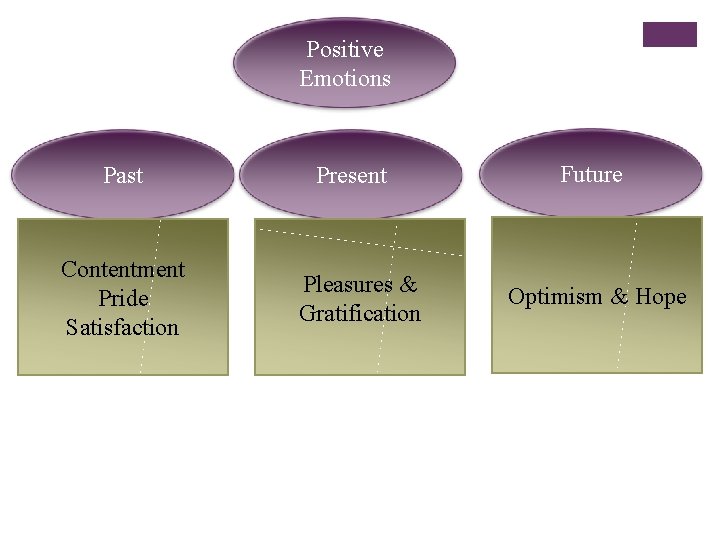
Positive Emotions Past Contentment Pride Satisfaction Present Pleasures & Gratification Future Optimism & Hope
+ Happiness Set Point and Hedonic Adaptation n Happiness set point: when we are too happy or unhappy, our internal biological regulators try to bring happiness levels back to a genetically determined set point n There is a large heritability influence on happiness n Well-being generally stays constant across one’s lifespan n Personality is greater than circumstances
+ Happiness Set Point and Hedonic Adaptation (cont’d. ) n Hedonic adaptation: novelty of a new stimulus (i. e. , buying a new car) wears off and happiness levels return to baseline
+ Happiness Set Point and Hedonic Adaptation (cont’d. ) n Resilience: people not only cope with a negative event, they are transformed by the experience n Some people show positive response patterns and thrive n Resilience trajectory seems to be the most common way people respond to adversity
+ Life Circumstances n Bottom-up theories of happiness: life’s circumstances influence happiness n Top-down theories of happiness: happiness levels begin in ourselves and they effect how we view life’s circumstances n Interactions of the two theories may occur n Usually, the more unhealthy you are, the less happy you are
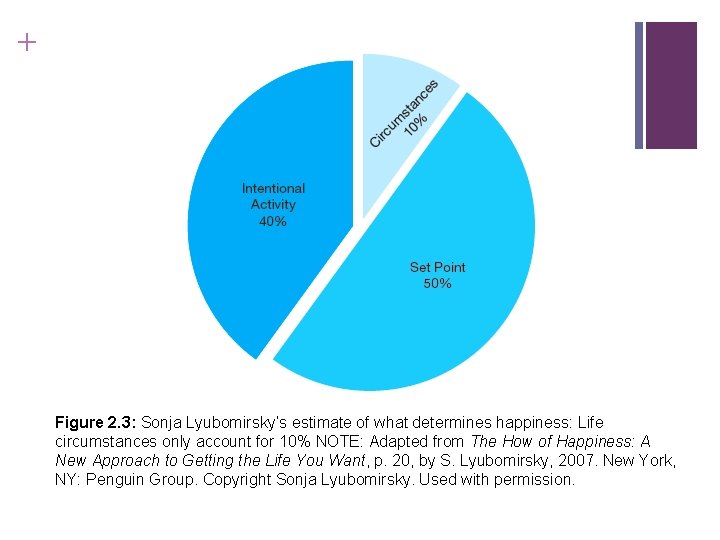
+ Figure 2. 3: Sonja Lyubomirsky’s estimate of what determines happiness: Life circumstances only account for 10% NOTE: Adapted from The How of Happiness: A New Approach to Getting the Life You Want, p. 20, by S. Lyubomirsky, 2007. New York, NY: Penguin Group. Copyright Sonja Lyubomirsky. Used with permission.
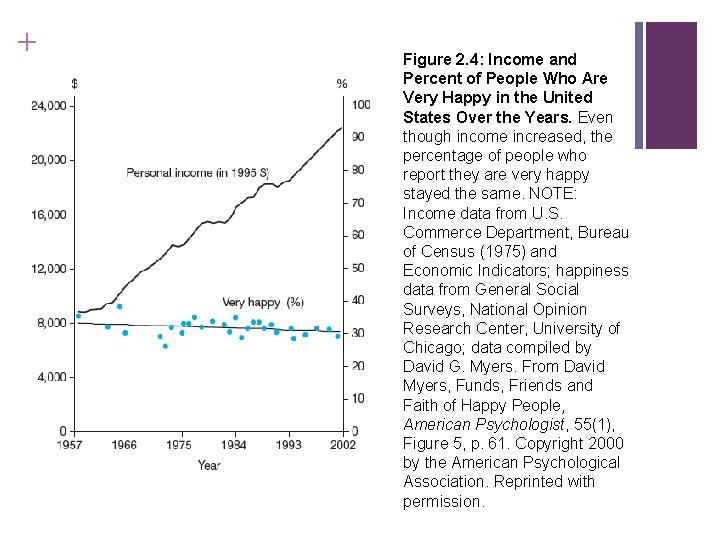
+ Life Circumstances (cont’d. ) n As one’s income rises above the level of meeting basic needs, hedonic adaptation begins n If the nation itself is wealthy, very little difference in happiness among its rich and poor n Happy people are more likely to get married than unhappy people n Marriage itself does not cause happiness
+ Figure 2. 4: Income and Percent of People Who Are Very Happy in the United States Over the Years. Even though income increased, the percentage of people who report they are very happy stayed the same. NOTE: Income data from U. S. Commerce Department, Bureau of Census (1975) and Economic Indicators; happiness data from General Social Surveys, National Opinion Research Center, University of Chicago; data compiled by David G. Myers. From David Myers, Funds, Friends and Faith of Happy People, American Psychologist, 55(1), Figure 5, p. 61. Copyright 2000 by the American Psychological Association. Reprinted with permission.
+ Life Circumstances (cont’d. ) n Aging may cause decrease in health but increase in life satisfaction n Gender, intelligence, and education do not appear to be related to happiness
+ Positive Individual Traits & Virtues n Texts from Greek Philosophy, Islam, Judaism, Christianity, Hinduism & Buddhism espouse 6 core virtues for a HAPPY LIFE 1. Wisdom 2. Courage 3. Humanity 4. Justice 5. Temperance 6. Transcendence
+ Traits of Happy People n Extraversion gives people a slightly higher advantage toward feeling happy n Extraversion pre-disposes a person to experiencing positive affect n Agreeableness can also boost happiness n Conscientious people tend to have high life satisfaction n Happy people have high self-esteem
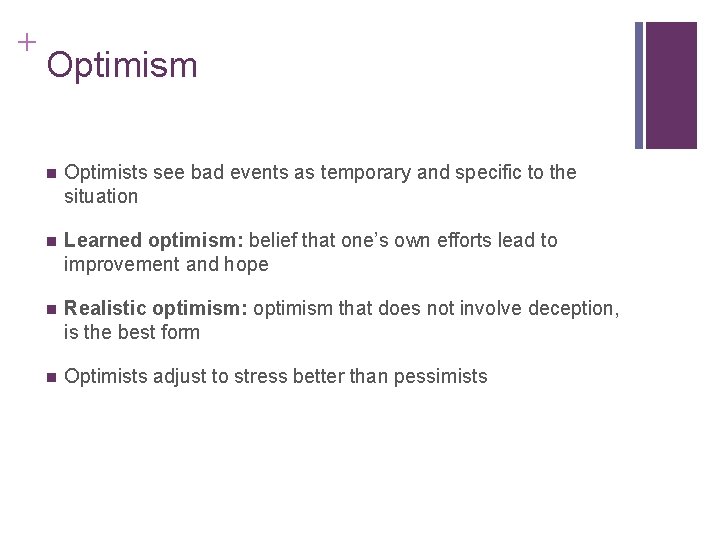
+ Optimism n Optimists see bad events as temporary and specific to the situation n Learned optimism: belief that one’s own efforts lead to improvement and hope n Realistic optimism: optimism that does not involve deception, is the best form n Optimists adjust to stress better than pessimists
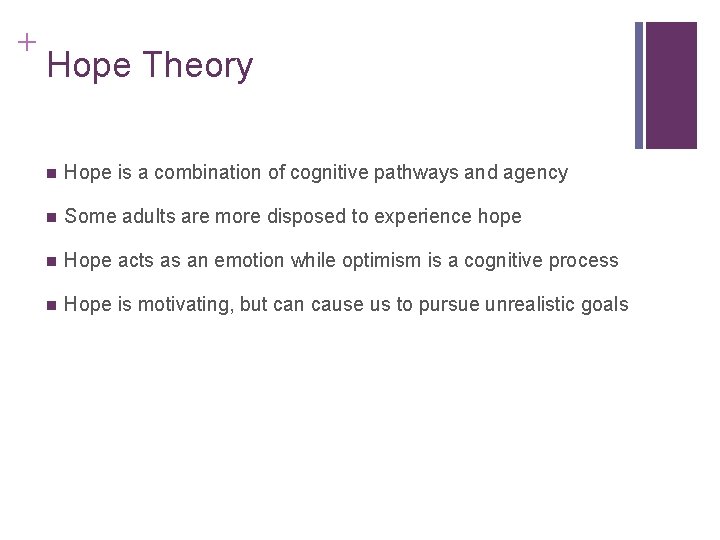
+ Hope Theory n Hope is a combination of cognitive pathways and agency n Some adults are more disposed to experience hope n Hope acts as an emotion while optimism is a cognitive process n Hope is motivating, but can cause us to pursue unrealistic goals
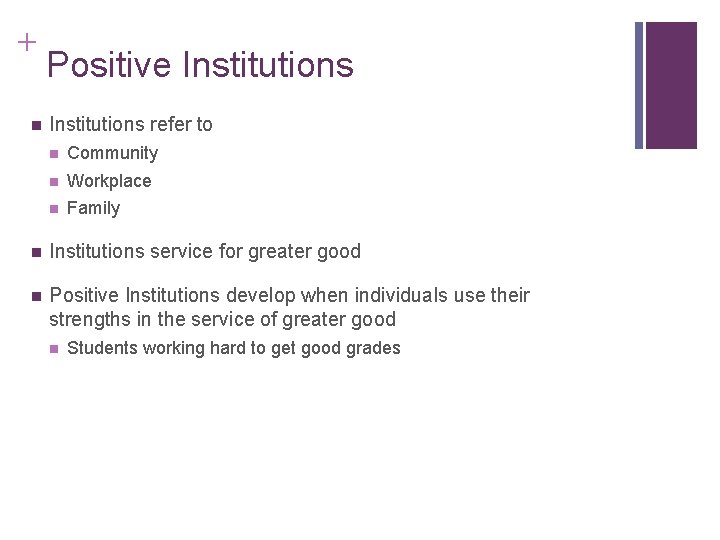
+ n Positive Institutions refer to n Community n Workplace n Family n Institutions service for greater good n Positive Institutions develop when individuals use their strengths in the service of greater good n Students working hard to get good grades
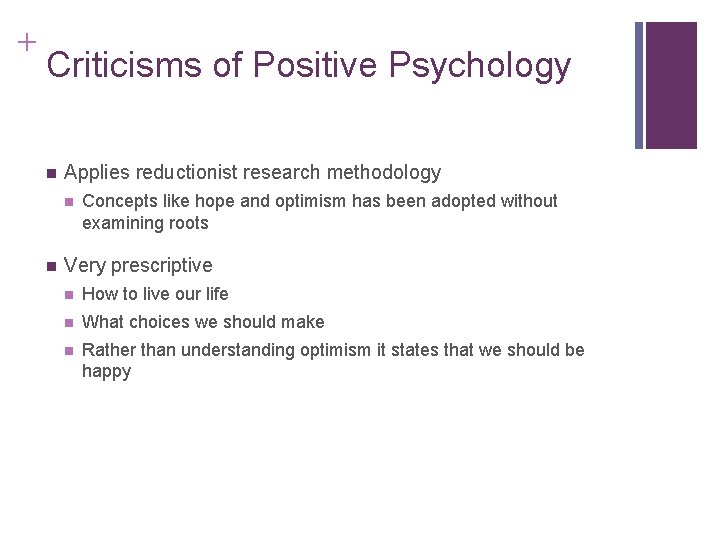
+ Criticisms of Positive Psychology n Applies reductionist research methodology n n Concepts like hope and optimism has been adopted without examining roots Very prescriptive n How to live our life n What choices we should make n Rather than understanding optimism it states that we should be happy