
Cognitive Modelling for Psychology Students An investigation of
- Slides: 9
Cognitive Modelling for Psychology Students: An investigation of a visual approach to computer programming for non-programmers Trevor Collins and Pat Fung Institute of Educational Technology The Open University Milton Keynes, UK Email: t. d. collins/p. fung@open. ac. uk WWW: http: //iet. open. ac. uk/pp/t. d. collins/research/current/hank/ June 24 th, 1999 CAL RG 20 th Anniversary 1 of 9
Problem • Programming by non-programmers – Psychology students build computer-based models of cognitive psychology theories (typically in Prolog or Lisp) Cognitive Theory Psychologists propose Real-World Cognition Model illustrates Model mimics Psychologists build Cognitive Model 2 of 9
Proposed Solution • HANK - A visual programming language designed for psychologists based on principles taken from: – End-user programming – Software visualization – Psychology of programming (Mulholland Watt, 1998) http: //kmi. open. ac. uk/projects/hank/ 3 of 9
HANK Language • Fact cards represent factual knowledge • Questions query knowledge • Instruction cards represent procedural knowledge 4 of 9
HANK Environment Program window Control panel Workspace view 5 of 9
Research Questions • Does cognitive modelling improve peoples understanding of cognitive psychology? • Does HANK facilitate non-programmers to build cognitive models? • Derive a set of guiding principles to support the design of programming tools for nonprogrammers 6 of 9
Approach • Programming and Educational Walkthroughs – HANK and educational supporting materials (Bell et al. , 1991) (Lewis et al. , 1998) • Cognitive Dimensions – HANK (Green and Petre, 1996) • Empirical Studies – Students’ understanding of a cognitive theory, attitudes toward modelling and confidence in their understanding 7 of 9
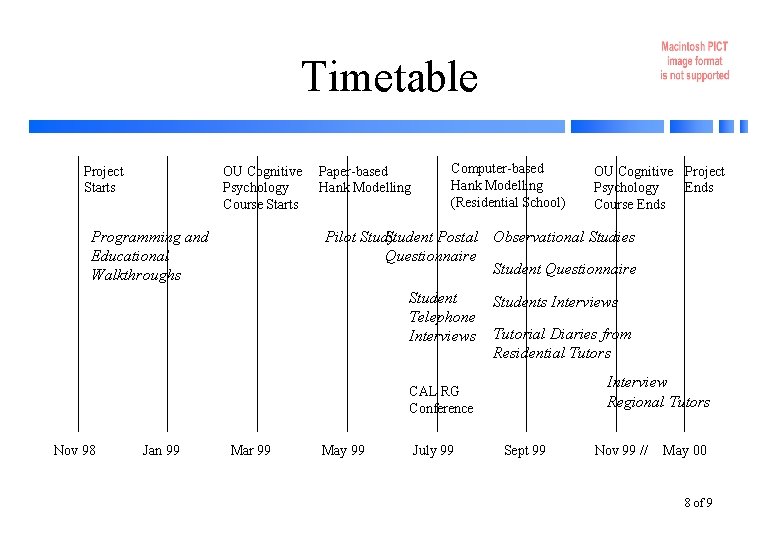
Timetable Project Starts OU Cognitive Psychology Course Starts Programming and Educational Walkthroughs Paper-based Hank Modelling Computer-based Hank Modelling (Residential School) Pilot Study Student Postal Observational Studies Questionnaire Student Telephone Interviews Students Interviews Tutorial Diaries from Residential Tutors Interview Regional Tutors CAL RG Conference Nov 98 Jan 99 OU Cognitive Project Psychology Ends Course Ends Mar 99 May 99 July 99 Sept 99 Nov 99 // May 00 8 of 9
Outcomes • Programming and Educational Walkthroughs – Evaluation findings feedback into revised • Introductory teaching material on cognitive modelling • Recommended cognitive modelling projects • Empirical Findings – Pilot study & Student questionnaires – Validate theoretical evaluation and revisions • CAL RG Technical Report No. 183 9 of 9