
Cognitive Maps Edward C Tolman 1948 Who is
- Slides: 21
Cognitive Maps Edward C. Tolman (1948)
Who is Tolman? • First of all he is, or at least considers himself a behaviorist. • In the article he mentions two schools of thought regarding behaviorism that are worth mentioning. – First the school of animal psychologists that believe behavior is stimulus and response. – Second, the field theorists who believe a map is formed.
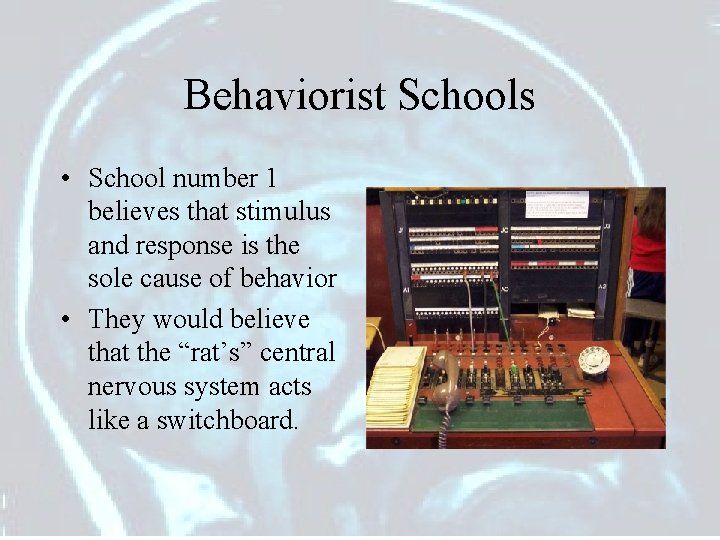
Behaviorist Schools • School number 1 believes that stimulus and response is the sole cause of behavior • They would believe that the “rat’s” central nervous system acts like a switchboard.
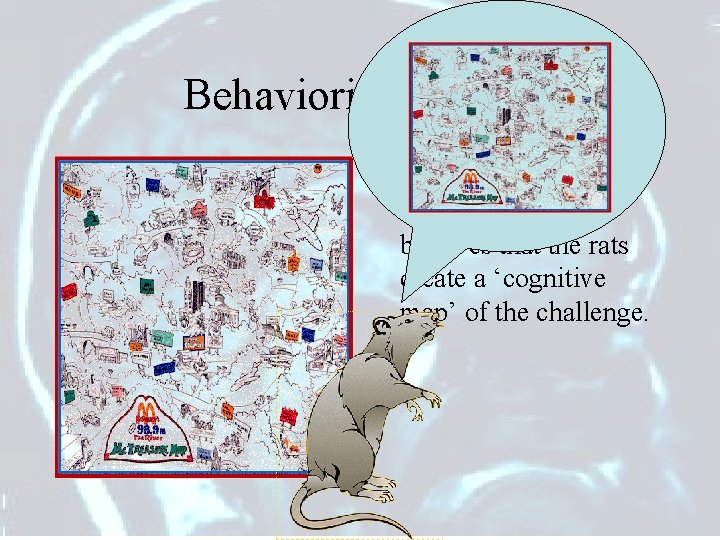
Behaviorist Schools • School number 2, Tolman’s position believes that the rats create a ‘cognitive map’ of the challenge.
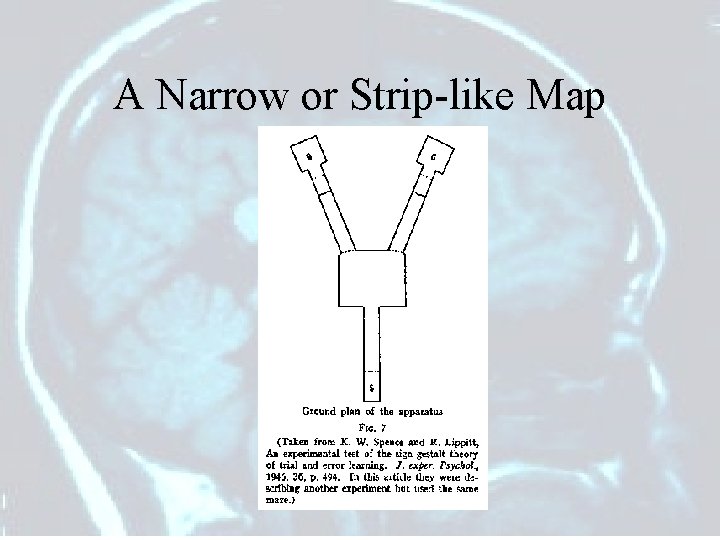
A Narrow or Strip-like Map
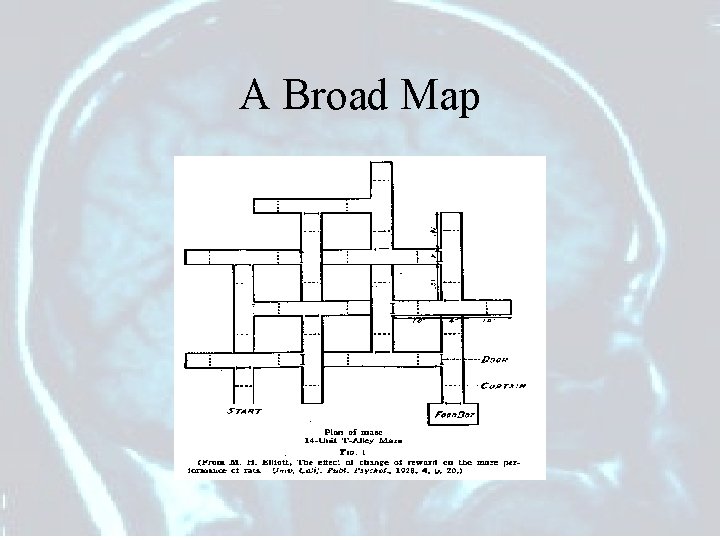
A Broad Map
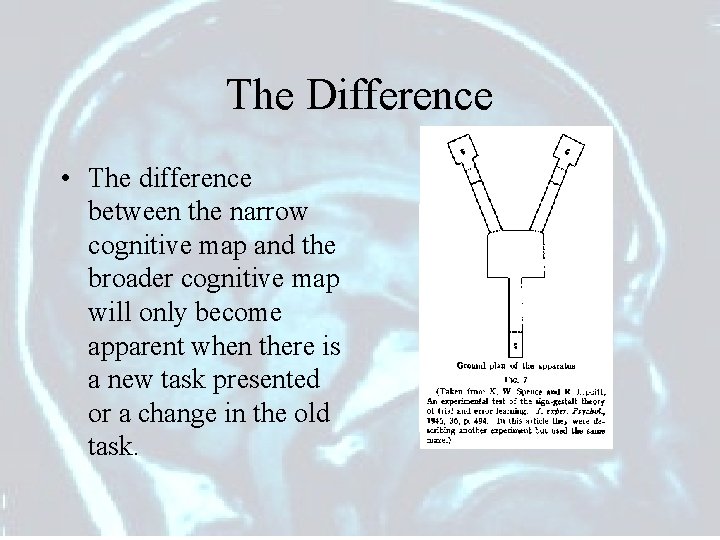
The Difference • The difference between the narrow cognitive map and the broader cognitive map will only become apparent when there is a new task presented or a change in the old task.
Review 1. Tolman always considered himself to be part of the ____ school. 2. The radical behaviorist believes that behavior is altered through ____. 3. Tolman refers to two basic schools of behaviorism. He places himself in the ____ group. 1. Behaviorist 2. Stimulus / Response 3. Field theorists.
Types of Experiments 1. 2. 3. 4. 5. ‘latent learning’ ‘vicarious trial and error’ - VTE ‘searching for the stimulus’ ‘hypothesis’ ‘spatial orientation’
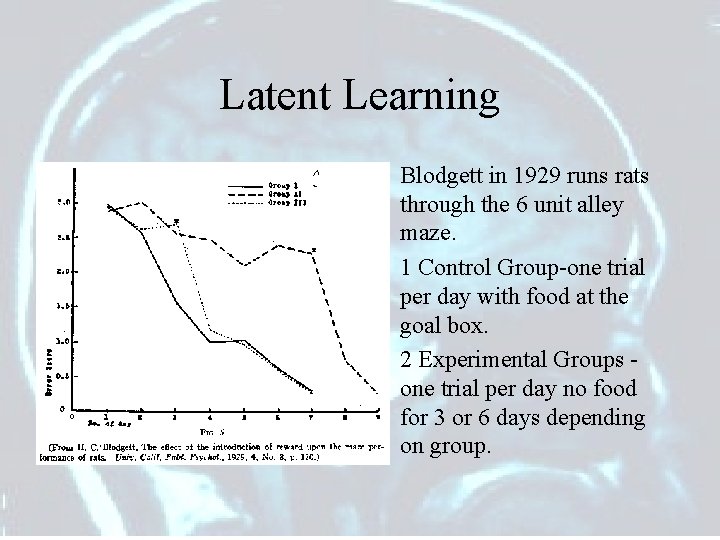
Latent Learning • Blodgett in 1929 runs rats through the 6 unit alley maze. • 1 Control Group-one trial per day with food at the goal box. • 2 Experimental Groups one trial per day no food for 3 or 6 days depending on group.
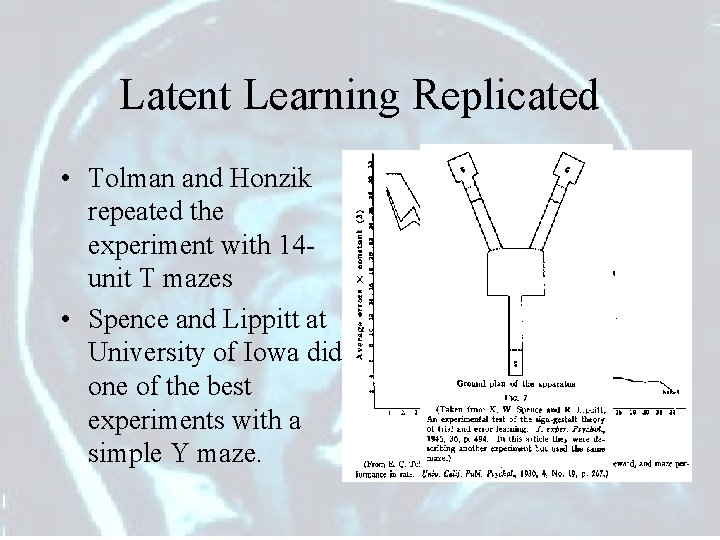
Latent Learning Replicated • Tolman and Honzik repeated the experiment with 14 unit T mazes • Spence and Lippitt at University of Iowa did one of the best experiments with a simple Y maze.
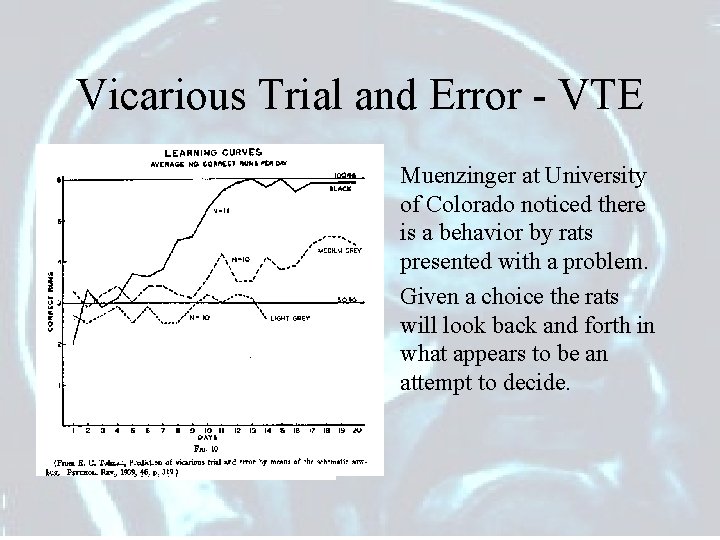
Vicarious Trial and Error - VTE • Muenzinger at University of Colorado noticed there is a behavior by rats presented with a problem. • Given a choice the rats will look back and forth in what appears to be an attempt to decide.
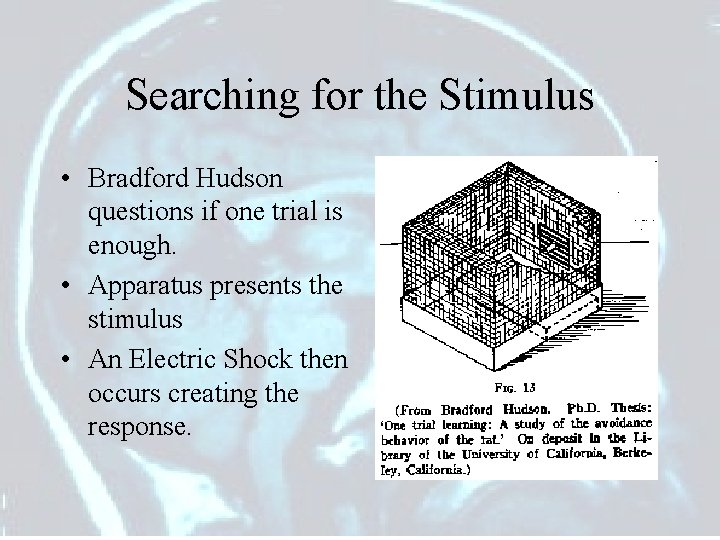
Searching for the Stimulus • Bradford Hudson questions if one trial is enough. • Apparatus presents the stimulus • An Electric Shock then occurs creating the response.
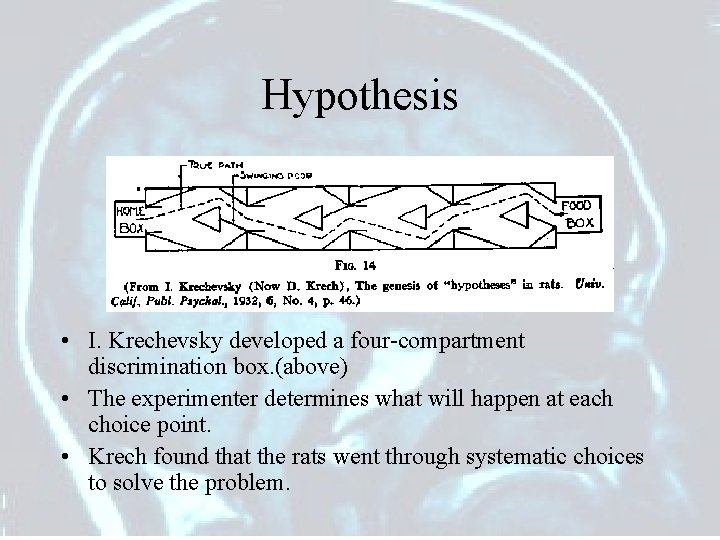
Hypothesis • I. Krechevsky developed a four-compartment discrimination box. (above) • The experimenter determines what will happen at each choice point. • Krech found that the rats went through systematic choices to solve the problem.
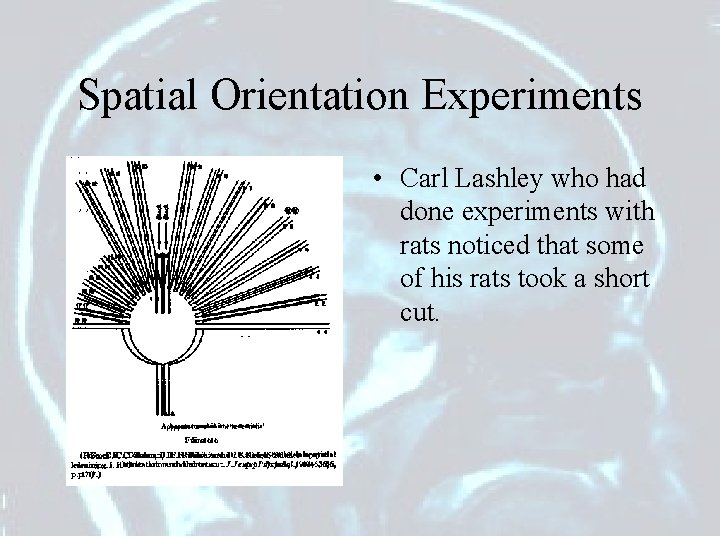
Spatial Orientation Experiments • Carl Lashley who had done experiments with rats noticed that some of his rats took a short cut.
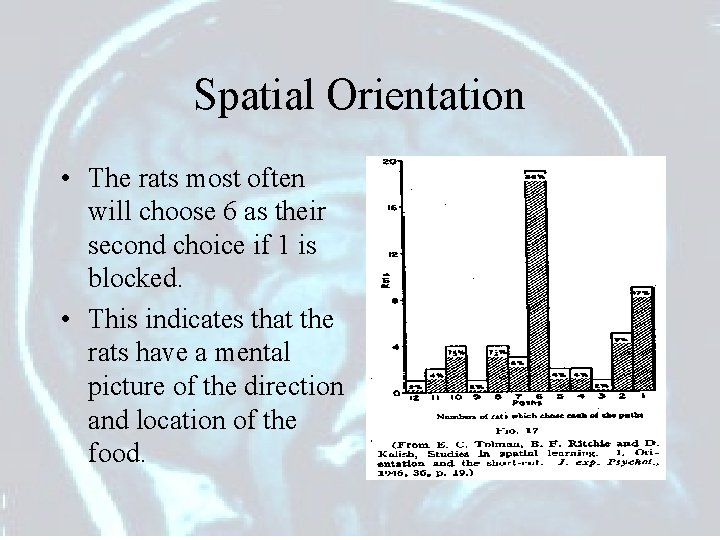
Spatial Orientation • The rats most often will choose 6 as their second choice if 1 is blocked. • This indicates that the rats have a mental picture of the direction and location of the food.
Review 1. The difference between strip maps (narrow) and comprehensive maps most often only presents itself _____. 2. “latent learning” brings into question the behaviorist concepts of ______. 1. when a new task or a change in task is presented. 2. contiguity
Review part deux 1. Explain what VTE means. 2. Now that you have defined VTE explain how you would identify it. 3. Once learning is strengthened what happens to VTE? 1. Vicarious trial and error. 2. The subject (rats) are see looking back and forth 3. VTE diminishes
And on it goes…Searching for the Stimulus • Hudson, in his Ph. D. Dissertation raised the question of could a single trial cause an avoidance reaction. 1. How did he test this question? 2. What did he find? 1. He tested the question by setting up an apparatus where the subject (rats) were shocked upon the presentation. 2. It could occur in one presentation.
Can rats develop a “hypothesis”? • Krech tested rats in a 1. In Krech’s four compartment experiments the rats discrimination box. would try systematic choices to solve the 1. What evidence, problem. anthropomorphically speaking, did he • Is this algorithmically observe that indicated or heuristically rats form a formed? hypothesis?
Tolman’s Leap • Tolman is suggesting that there are three ‘dynamism’ that influence behavior. – Regression - a term used for cases in which an individual in the face of a difficult problem will behave in a “childish fashion” – Fixation - undue persistence in light of earlier maps. – “displacement of aggression onto out groups” - the tendency to stay in a particular social group and the rejection of outside groups.