
Cognitive Level of Analysis Session 8 Flashbulb Memories
Cognitive Level of Analysis Session 8: Flashbulb Memories
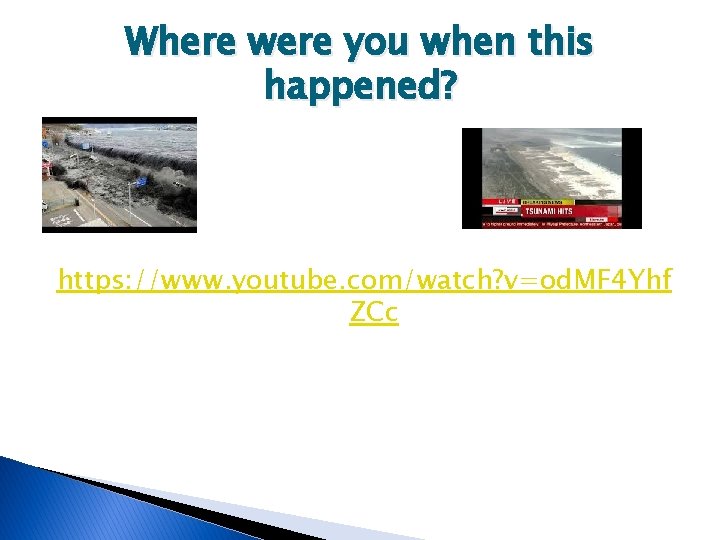
Where were you when this happened? https: //www. youtube. com/watch? v=od. MF 4 Yhf ZCc
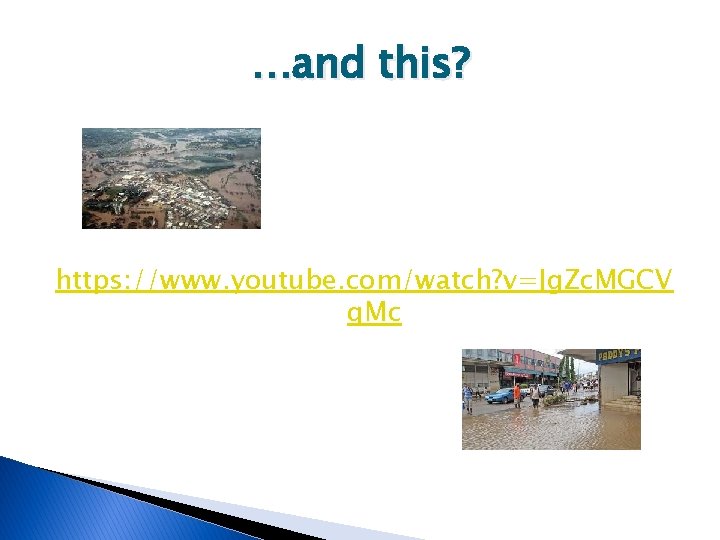
…and this? https: //www. youtube. com/watch? v=Jg. Zc. MGCV q. Mc
Task 1. Do you have other very vivid memories about events that were personally important to you, though might not have had local, state, national or international importance? If so, please list those events.
Today’s learning outcomes Evaluate one theory of how emotion may affect one cognitive process
Theory of Flashbulb Memory Brown and Kulik (1977) � Flashbulb memories are a type of episodic memory � It is assumed that they are highly resistant to forgetting � This means that the details of the memory will remain intact and accurate because of the emotional arousal at the moment of encoding. This is a very controversial theory!
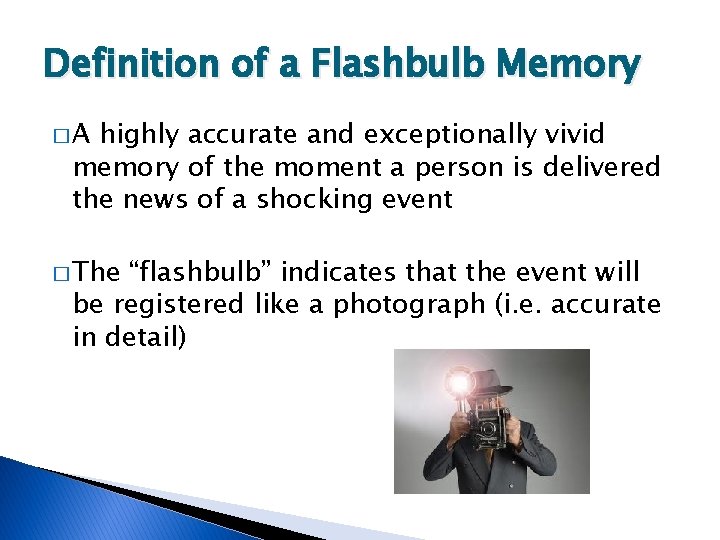
Definition of a Flashbulb Memory �A highly accurate and exceptionally vivid memory of the moment a person is delivered the news of a shocking event � The “flashbulb” indicates that the event will be registered like a photograph (i. e. accurate in detail)
Why do you think we might remember emotional events more accurately?
What theory says… � According to Brown and Kulik (1977) we remember because of two things: 1. The emotional arousal at moment of encoding 2. Memory often rehearsed as it is important or emotionally salient to individual. This makes the memory more accessible and vividly remembered over time
What theory says… � Brown and Kulik suggest that there are six important features of FM that people remember in detail: 1. 2. 3. 4. 5. 6. Place (where they were when they found out) Ongoing activity (what they were doing) Informant (how they learned about the incident) Own affect (how they felt) Others’ affect (how others felt) Aftermath (importance of the event & consequences)
Research on Flashbulb Memories
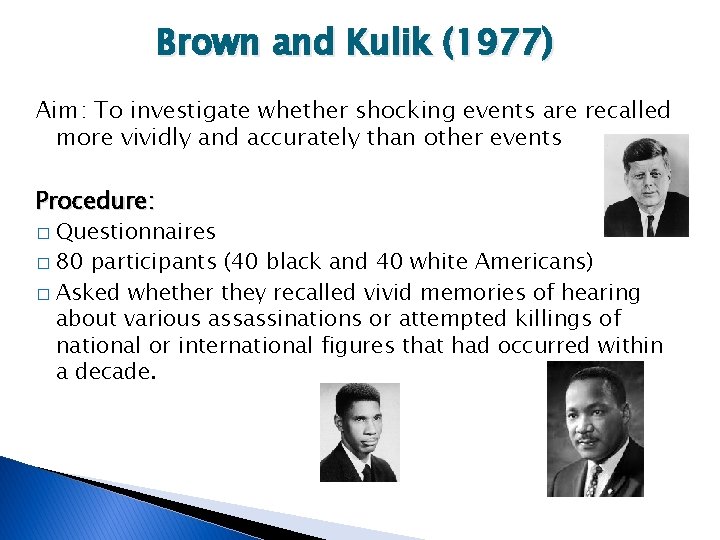
Brown and Kulik (1977) Aim: To investigate whether shocking events are recalled more vividly and accurately than other events Procedure: � Questionnaires � 80 participants (40 black and 40 white Americans) � Asked whether they recalled vivid memories of hearing about various assassinations or attempted killings of national or international figures that had occurred within a decade.
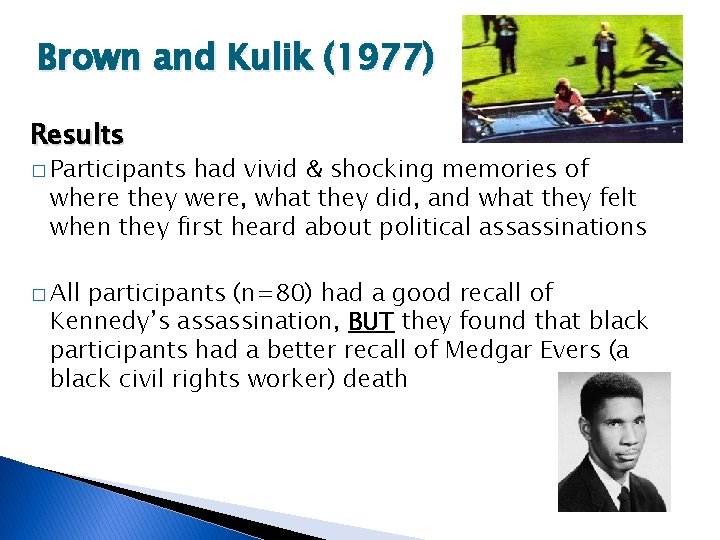
Brown and Kulik (1977) Results � Participants had vivid & shocking memories of where they were, what they did, and what they felt when they first heard about political assassinations � All participants (n=80) had a good recall of Kennedy’s assassination, BUT they found that black participants had a better recall of Medgar Evers (a black civil rights worker) death
Brown and Kulik (1977) Conclusions Suggested that FM is caused by a neural mechanism which triggers an emotional arousal because the event is unexpected or extremely important
Evaluation of Brown and Kulik (1977) � The reliance on retrospective data questions the reliability of this study. People tend to interpret an event from their current perspective. � Other research indicates that although FM is emotionally vivid it is not necessarily accurate in regards to details � The photographic model of FM has been challenged by many other researchers
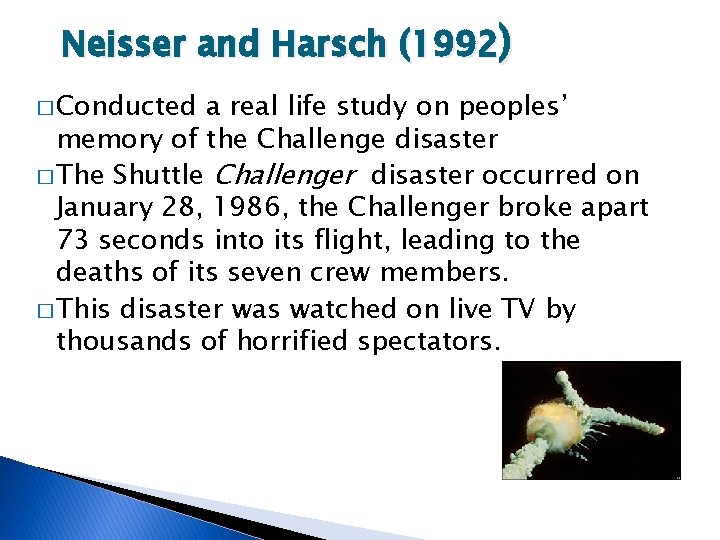
Neisser and Harsch (1992) � Conducted a real life study on peoples’ memory of the Challenge disaster � The Shuttle Challenger disaster occurred on January 28, 1986, the Challenger broke apart 73 seconds into its flight, leading to the deaths of its seven crew members. � This disaster was watched on live TV by thousands of horrified spectators.
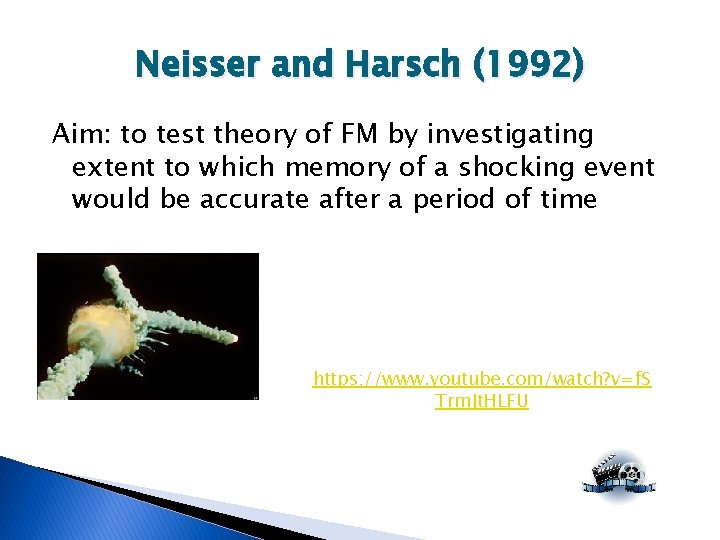
Neisser and Harsch (1992) Aim: to test theory of FM by investigating extent to which memory of a shocking event would be accurate after a period of time https: //www. youtube. com/watch? v=f. S Trm. Jt. HLFU
Neisser and Harsch (1992) Procedure: � 106 students in an introductory psychology class given a questionnaire and asked to write a description of how they heard the news. � Also answered 7 questions related to where they were, what they were doing etc. � Participants answered questionnaires less than 24 hours after disaster � 2 ½ years later, 44 of the original participants answered the questionnaire again � They were also asked to rate on a scale of 1 -5 how confident they were about the accuracy of their memories and were asked whether they had completed the questionnaire before
Neisser and Harsch (1992) Initial account: “I was in my religion class and some people walked in and started talking about it…the schoolteacher’s students had been watching and I thought it was so sad…I went to my room and watched the TV…I got all the details from that. ” Follow up account: “When I first heard…I was sitting in [my] dorm with a roommate watching TV. It came on a newsflash and we were both totally shocked. I was really upset and went upstairs to talk to a friend of mine and then I called my parents. ”
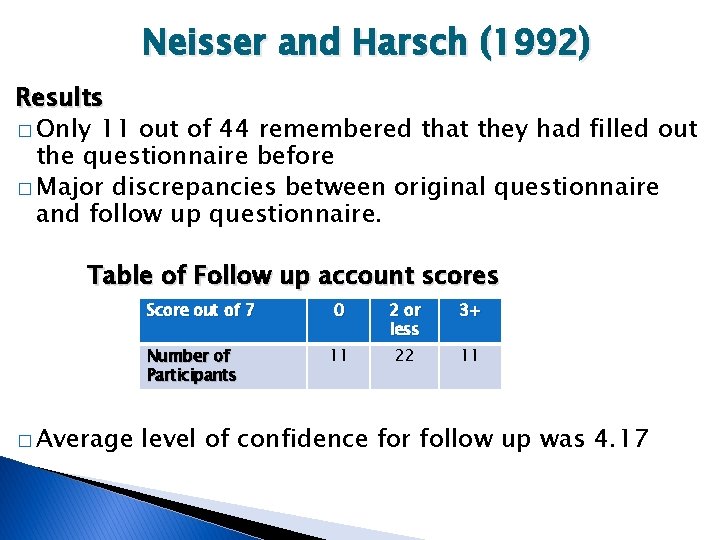
Neisser and Harsch (1992) Results � Only 11 out of 44 remembered that they had filled out the questionnaire before � Major discrepancies between original questionnaire and follow up questionnaire. Table of Follow up account scores Score out of 7 Number of Participants � Average 0 2 or less 3+ 11 22 11 level of confidence for follow up was 4. 17
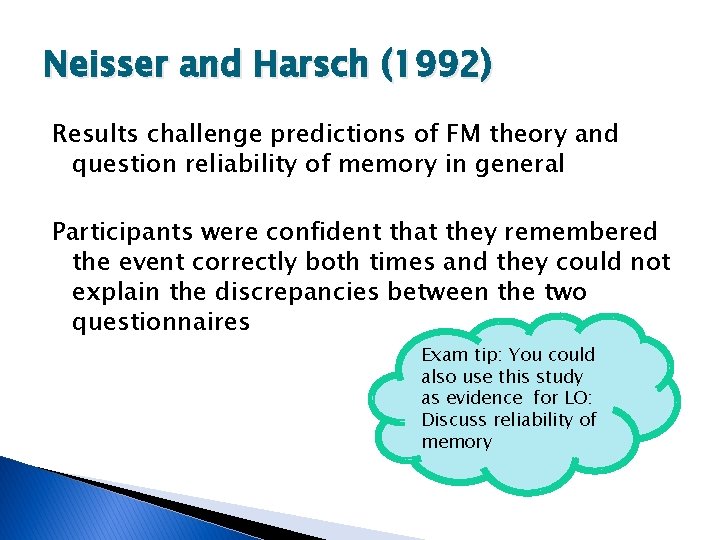
Neisser and Harsch (1992) Results challenge predictions of FM theory and question reliability of memory in general Participants were confident that they remembered the event correctly both times and they could not explain the discrepancies between the two questionnaires Exam tip: You could also use this study as evidence for LO: Discuss reliability of memory
Neisser and Harsch (1992) Evaluation � Study was conducted in a natural environment and has a higher ecological validity that laboratory experiments on memory � Participants were psychology students who participated in exchange for course credits and may not be representative � The degree of emotional arousal when witnessing a shocking public event may be different from experiencing a shocking event in your personal life. This could influence how well people remember a certain event.
Sheingold & Terry (1982) � Found that participants had very good memories for highly personal events such as the birth of a brother or sister. � These accounts remained consistent over time. � Therefore, it may be that flashbulb memories have to have emotional importance for the person, something which the Challenger disaster may have lacked. � This provides evidence for flashbulb memories as they should be memories which are consistent and unchanging. However, although the memories were consistent over time, there is no way to tell how accurate they were to begin with.
Flashbulb memories of 9/11
Memories of 9/11 survivors? How accurate do you think these memories are? Why? https: //www. youtube. com/watch? v=Vzkk 0 J 8 Q Ob. A
Activity: research into 9/11 � Read through the article of research of 9/11 memories � Key Studies: �Talarico & Rubin (2003) �Phelps et al (2007)
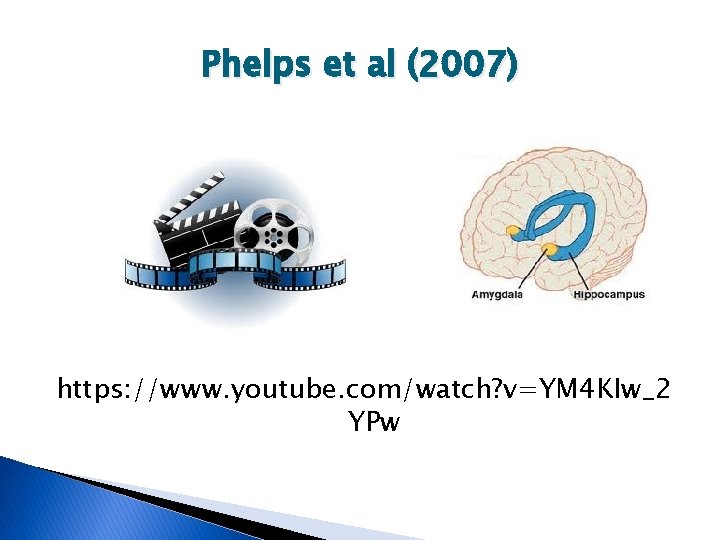
Phelps et al (2007) https: //www. youtube. com/watch? v=YM 4 KIw_2 YPw
Drawing conclusions? � Is theory accurate?
Evaluation of FM theory � Evidence for FM is mixed. Although some research suggests that memories of emotional events are more accurate whereas others suggest that is our confidence in flashbulb memories characterises our perceived accuracy and vividness of the events and flashbulb memories are subject to the same inaccuracies as everyday memories. � Despite controversy theory led to further research and has been modified over time. Some researchers now suggest FM memory does exist but event needs to be of personal significance
Evaluation of FM theory � We are more likely to discuss important emotional events overtime therefore better memory may merely be due to more rehearsal rather than the emotion itself

Make your own word cloud! www. wordle. com http: //www. abcya. com/word_clouds. htm
- Slides: 34