
Cognitive Level of Analysis IB Psychology Principles that
Cognitive Level of Analysis IB Psychology

Principles that Define the Cognitive Level of Analysis 1. Cognitive psychologists assume that there is an important biological basis for all human cognitive processing and its resultant behavior but focus research on how the brain translates into mind.
Principles that Define the Cognitive Level of Analysis 2. Mental processing in the mind can be studied scientifically. Theories of cognitive processing are studied through various methods.
Principles that Define the Cognitive Level of Analysis 3. Behavior change is explained as a result of cognitive processing that goes on in the mind. The steps to cognitive processing are as follows: a) b) c) d) Information is acquired from the world. The information is stored. Stored information is represented in the mind. Internal representations direct behavior.
Principles that Define the Cognitive Level of Analysis 4. Cognitive Processes are influenced by social and cultural factors.
The Basics of Cognitive Psychology n Cognitive Processes Sensation and Perception n Schema Theory n Memory n Language n
Sensation Vision n Hearing n Touch n Taste n Smell n
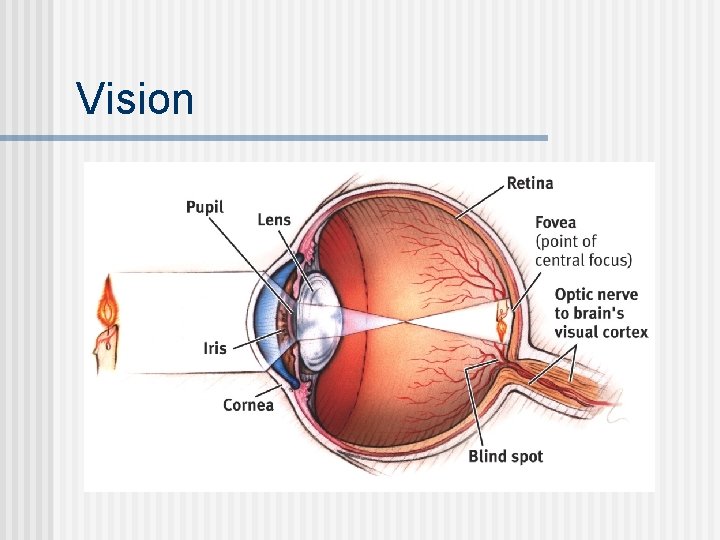
Vision
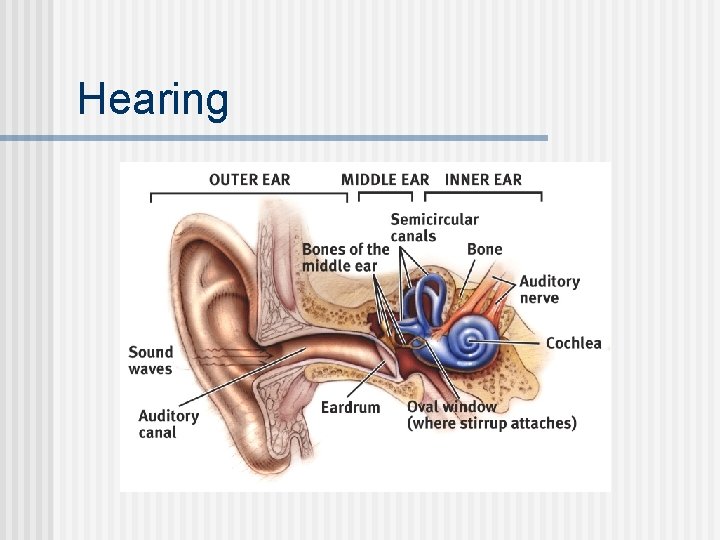
Hearing
Smell

Taste
Touch
Perception The cognitive process that interprets and organizes information from the senses to produce some meaningful experience of the world. n Video- Discovering Psychology n

Schema A mental representation of knowledge. n Mental representations can refer to: n Objects n Ideas n People n n Mental representations are organized into categories and are stored in our memories.

Schema Theory A cognitive theory about information processing. n A cognitive schema can be defined as networks of knowledge, beliefs, and expectations about particular aspects of the world. n
Cognitive Schemas Can be related to form systems n Are active recognition devices (pattern recognition) n Help predict the future events based on what happened before n Represent general knowledge rather than definitions n
Cognitive Schema We actively process information in our world. n If information is missing, the brain fills in the blanks. n This can result in mistakes--distortions. n
Evaluation of Schema Theory Lots of research supports schema theory. n It is useful in understanding how people categorize information, interpret stories, and make inferences. n Limitations include: n Not exactly sure how schemas are acquired. n Not sure exactly how they actually influence cognitive processes. n
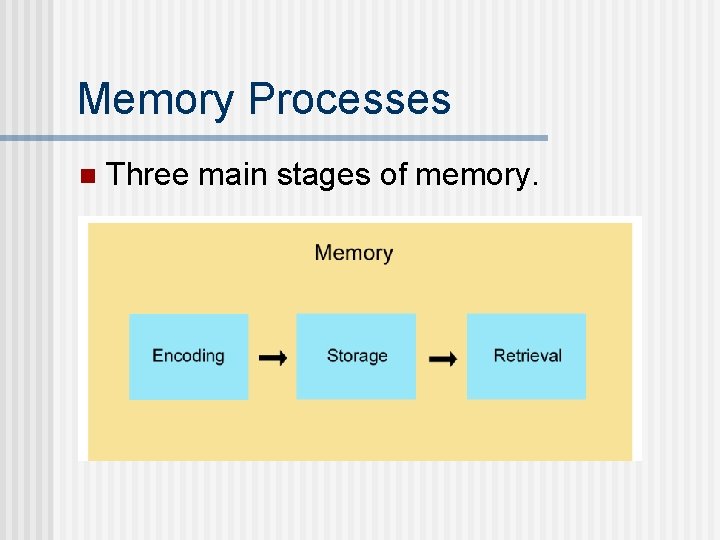
Memory Processes n Three main stages of memory.

Multi-Store Memory Model
Working Memory Model: Short Term Memory
Working Memory Model n Central Executive CEO of Working Memory. n Most important job is attention control: n • Automatic level: Based on Habits • Supervisory Level: Deals with new info and emergencies.

Working Memory Model n Episodic Buffer n n n Phonological Loop n n n Acts as a temporary and passive display store until the information is needed. Like a television screen. Inner voice which holds information in verbal form. Holds information you hear. Visuospatial Sketchpad n Inner eye. Deals with visual and spatial information.
Evaluation of the Working Memory Model Provides a much more satisfactory explanation of storage and processing than the STM component of the multistore model. n Assumes an active rather than passive process which makes more sense. n Has been supported through research. n
Long Term Memory
Long Term Memory n Explicit/Declarative Memories: Factbased information that can be consciously retrieved. n Semantic Memory: Memory for General Knowledge (Facts). n Episodic Memory: Memory for personal experiences and events.
Long-Term Memory n Implicit/ Non-Declarative Memories: Contains memories that we’re not consciously aware of. Procedural Memories: non-conscious memory for skills, habits, and actions. (HOW to do things) n Emotional Memories: memories formed via the limbic system (HOW emotional states work). n
Memory and The Brain n Hippocampus Forms explicit memories. n When it is damaged, you can still form implicit memories. n n Amygdala n Has a role in the storage of emotional memories.
Theories of Cognitive Development Piaget (biologically driven model) n Vygotsky (social driven model) n
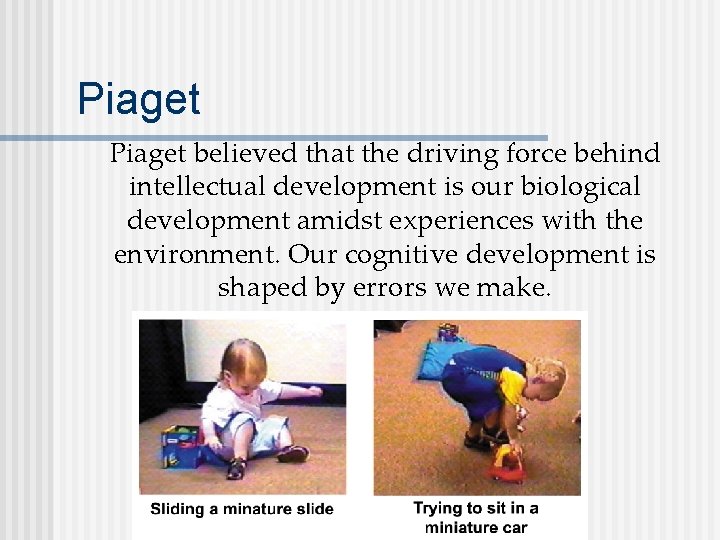
Piaget believed that the driving force behind intellectual development is our biological development amidst experiences with the environment. Our cognitive development is shaped by errors we make.
Cognitive Schemas n Schema is a term used by Piaget to describe the models, or mental structures, that we create to represent , organize, and interpret our experiences.
Piaget’s Cognitive Processes n Organization is the process by which children combine existing schemes into new and more complex intellectual structures. n Adaptation is an inborn tendency to adjust to the demands of the environment. n The goal of adaptation is to adjust to the environment; this occurs through assimilation and accommodation. n Assimilation is the process of interpreting new experiences by incorporating them into existing schemes. n Accommodation is the process of modifying existing schemes in order to incorporate or adapt to new experiences.

Example of Piaget’s Process Piagetian Concept Equilibrium Assimilation Start Accommodation Organization Finish Example Toddler who has never seen anything fly but birds thinks that all flying objects are birds Seeing an airplane flying prompts the child to call it a birdie Child experiences conflict upon realizing that the new birdie has no feathers. Concludes it is not a bird and asks for the proper term or invents a name. Equilibrium restored Forms hierarchal scheme consisting of a superordinate class (flying objects) and two subordinate classes (birdies and airplanes).
Piaget’s Theory of Cognitive Development n According to Piaget, a child’s development progresses through 4 qualitative stages and an invariant developmental sequence-universal pattern of development, which are: The Sensorimotor Stage (Birth to 2 Years) n The Preoperational Stage (2 to 7 Years) n The Concrete-Operational Stage (7 to 11 Years) n The Formal-Operational Stage (11 -12 Years and Beyond) n
Sensorimotor Stage (Birth to 2 years) Experiencing the world through senses and actions. n Object Permanence n Stranger Anxiety n
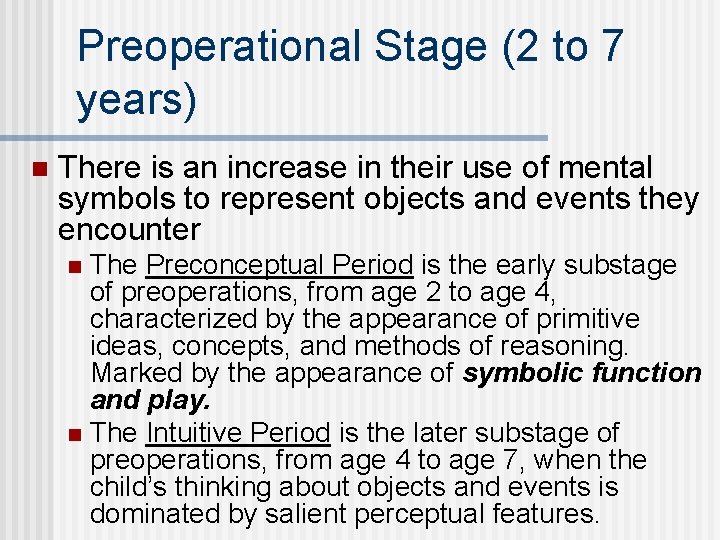
Preoperational Stage (2 to 7 years) n There is an increase in their use of mental symbols to represent objects and events they encounter The Preconceptual Period is the early substage of preoperations, from age 2 to age 4, characterized by the appearance of primitive ideas, concepts, and methods of reasoning. Marked by the appearance of symbolic function and play. n The Intuitive Period is the later substage of preoperations, from age 4 to age 7, when the child’s thinking about objects and events is dominated by salient perceptual features. n
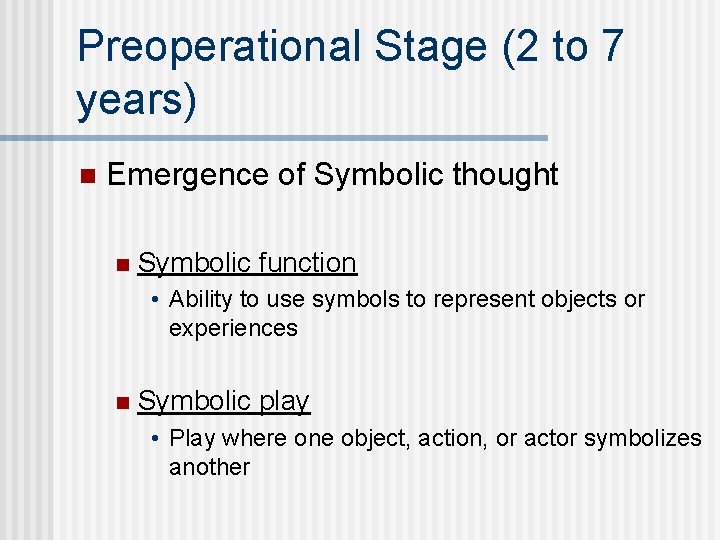
Preoperational Stage (2 to 7 years) n Emergence of Symbolic thought n Symbolic function • Ability to use symbols to represent objects or experiences n Symbolic play • Play where one object, action, or actor symbolizes another
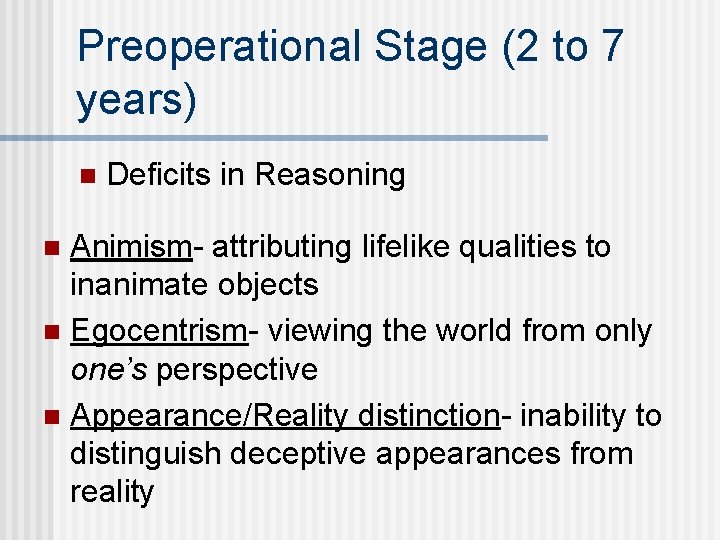
Preoperational Stage (2 to 7 years) n Deficits in Reasoning Animism- attributing lifelike qualities to inanimate objects n Egocentrism- viewing the world from only one’s perspective n Appearance/Reality distinction- inability to distinguish deceptive appearances from reality n
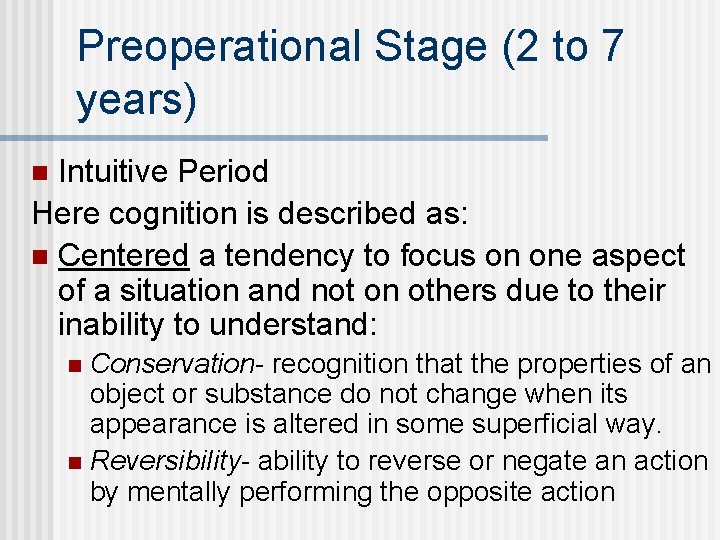
Preoperational Stage (2 to 7 years) Intuitive Period Here cognition is described as: n Centered a tendency to focus on one aspect of a situation and not on others due to their inability to understand: n Conservation- recognition that the properties of an object or substance do not change when its appearance is altered in some superficial way. n Reversibility- ability to reverse or negate an action by mentally performing the opposite action n
Concrete Operational Period (7 to 11 years) n Here children are said to think more logically about real objects and experiences n Some examples of operational thought • Conservation • Reversibility • Logic • Classification • ability to create relationships between things. • Relational Logic • Mental seriation • Transitivity n The sequencing of concrete operations • Horizontal decalage- different levels of understanding conservation tasks that seem to require the same mental operations

Formal Operational Stage (11 -12 years) Ability to reason logically about hypothetical process and events that may have no basis in reality n n Hypothetico-Deductive Reasoning • n Thinking Like a Scientist • n a formal operational ability to think hypothetically. Inductive reasoning- type of thinking where hypotheses are generated and then systematically tested in experiments. Personal and Social Implications • The formal operation stage paves the way for: • • • Identity formation Richer understanding of other peoples psychological perspectives The ability to way options in decision making
An Evaluation of Piaget’s Theory Piaget’s Contributions n n n n Founded the discipline we know today as cognitive development. Convinced us that children are curious, active explorers who play an important role in their own development. His theory was one of the first to explain, and not just describe, the process of development. His description of broad sequences of intellectual development provides a reasonably accurate overview of how children of different ages think. Piaget’s ideas have had a major influence on thinking about social and emotional development as well as many practical implications for educators. Piaget asked important questions and drew literally thousands of researchers to the study of cognitive development.
Challenges to Piaget’s cognitive developmental theory: n n n Underestimated developing minds Failed to distinguish competence from performance It is believed by some that Cognitive development does not evolve in a qualitative and stage like manner- it tends to develop gradually Provides a vague explanation on cognitive maturation Devoted little attention to social and cultural influences
Vygotsky’s Sociocultural Perspective of Cognitive Development Sociocultural theory states that: n – – Cognitive development occurs in a sociocultural context that influences the form it takes Most of a child’s cognitive skills evolve from social interactions with parents, teachers, and other more competent associates
The role of culture in intellectual development: n Vygotsky proposed that we should evaluate human development from four interrelated perspectives: n n Microgenetic-changes that occur over brief periods of time-minutes and seconds Ontogenetic-development over a lifetime Phylogenetic-development over evolutionary time Sociohistorical- changes that have occurred in one's culture and the values, norms and technologies such a history has generated
Cognitive Development n Vygotsky (1930 -1935/1978) proposed that infants are born with a few elementary mental functions – attention, sensation, perception and memory – that are eventually transformed by the culture into new and more sophisticated mental processes he called higher mental functions.
Vygotsky’s Theory n Cultures create mental tools which transform our mental work just like physical tools transform our physical work. n As we internalize these tools we become smarter (i. e. , we develop higher psychological processes). n Language is the mother of all mental tools. n We internalize these tools as we work in our Zone of Proximal Development (ZPD).
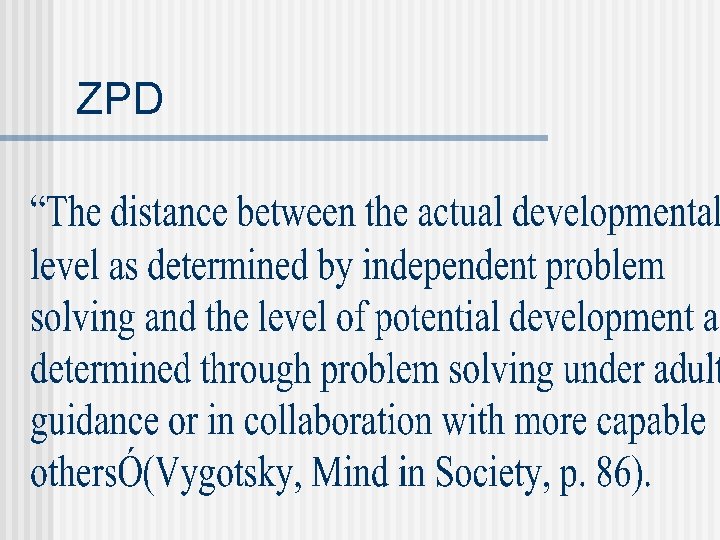
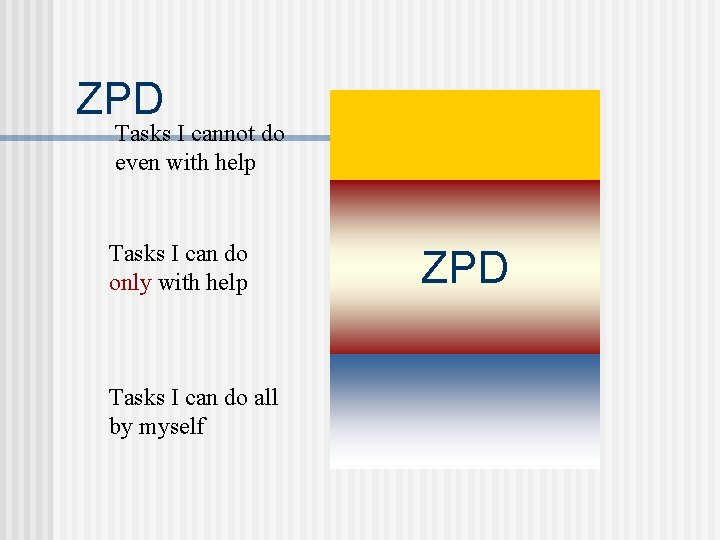
Zone of Proximal Development (ZPD) n Zone of Proximal Development range of tasks that are too complex to be mastered alone but can be accomplished with guidance and encouragement from a more skillful partner
ZPD
ZPD Tasks I cannot do even with help Tasks I can do only with help Tasks I can do all by myself ZPD
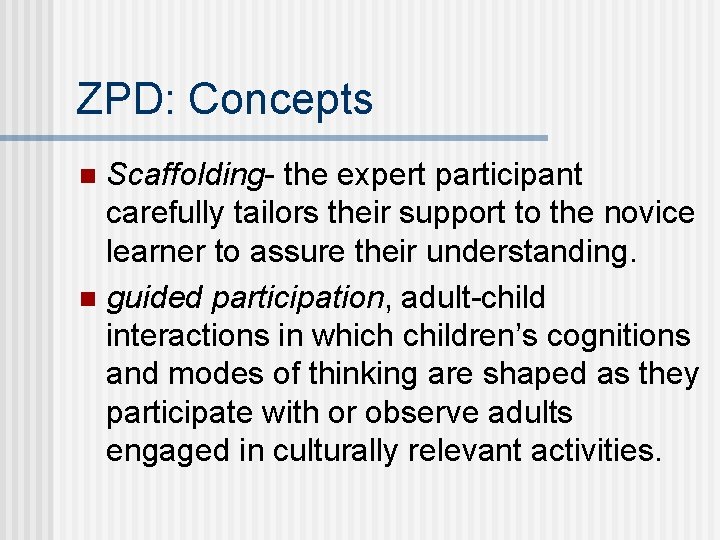
ZPD: Concepts Scaffolding- the expert participant carefully tailors their support to the novice learner to assure their understanding. n guided participation, adult-child interactions in which children’s cognitions and modes of thinking are shaped as they participate with or observe adults engaged in culturally relevant activities. n
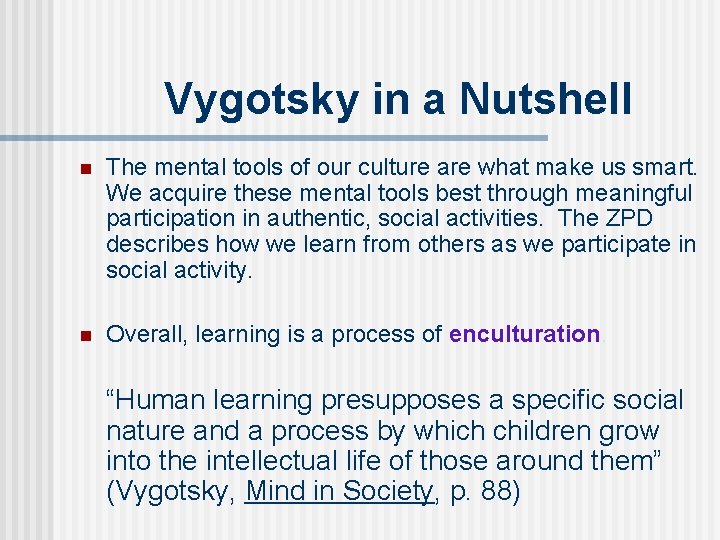
Vygotsky in a Nutshell n The mental tools of our culture are what make us smart. We acquire these mental tools best through meaningful participation in authentic, social activities. The ZPD describes how we learn from others as we participate in social activity. n Overall, learning is a process of enculturation. “Human learning presupposes a specific social nature and a process by which children grow into the intellectual life of those around them” (Vygotsky, Mind in Society, p. 88)
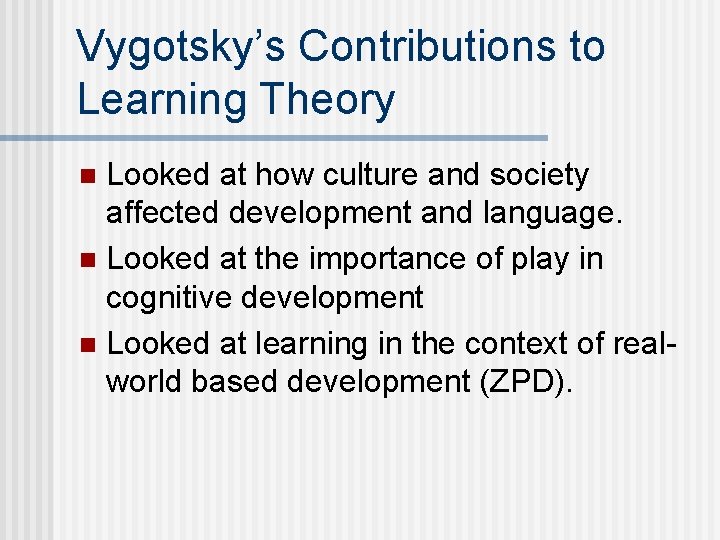
Vygotsky’s Contributions to Learning Theory Looked at how culture and society affected development and language. n Looked at the importance of play in cognitive development n Looked at learning in the context of realworld based development (ZPD). n
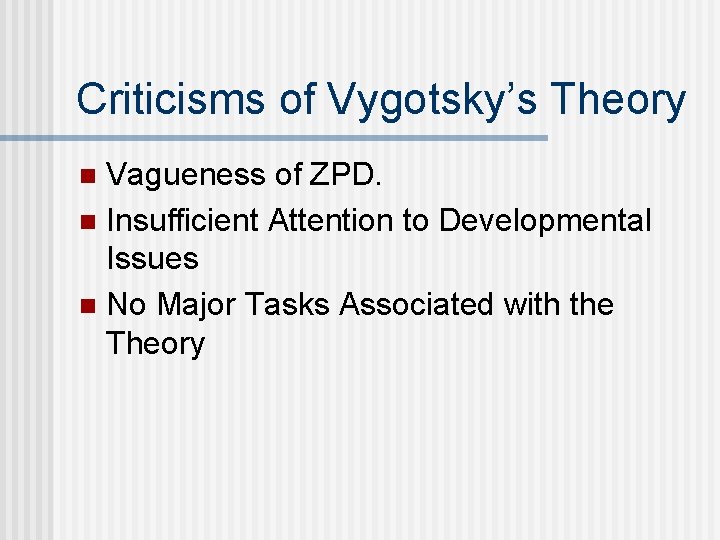
Criticisms of Vygotsky’s Theory Vagueness of ZPD. n Insufficient Attention to Developmental Issues n No Major Tasks Associated with the Theory n
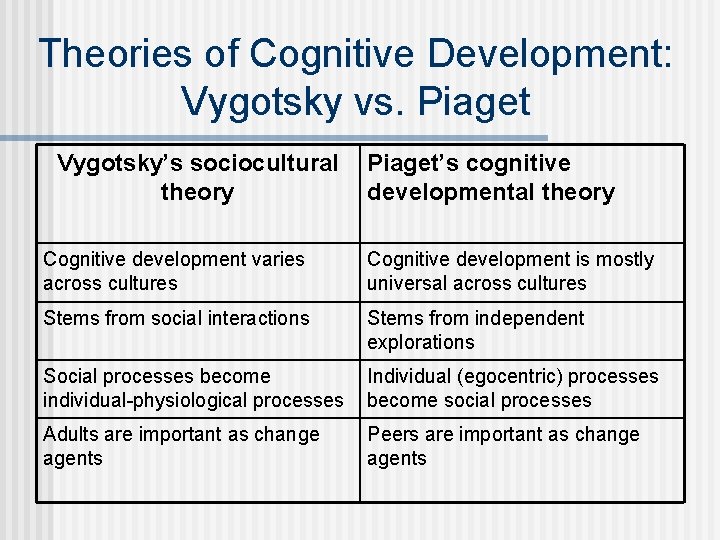
Theories of Cognitive Development: Vygotsky vs. Piaget Vygotsky’s sociocultural theory Piaget’s cognitive developmental theory Cognitive development varies across cultures Cognitive development is mostly universal across cultures Stems from social interactions Stems from independent explorations Social processes become individual-physiological processes Individual (egocentric) processes become social processes Adults are important as change agents Peers are important as change agents
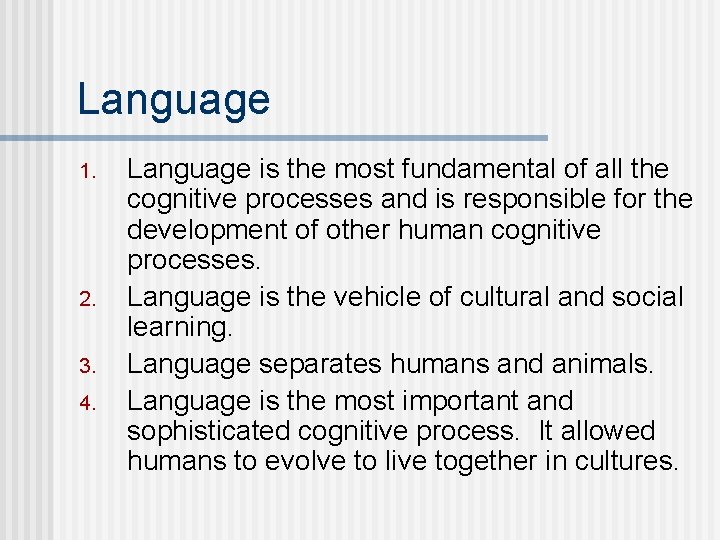
Language 1. 2. 3. 4. Language is the most fundamental of all the cognitive processes and is responsible for the development of other human cognitive processes. Language is the vehicle of cultural and social learning. Language separates humans and animals. Language is the most important and sophisticated cognitive process. It allowed humans to evolve to live together in cultures.

Basics of Language
- Slides: 57