
Cognitive Level of Analysis CLOA Donders Experiment Students




- Slides: 29
Cognitive Level of Analysis (CLOA)
Donder’s Experiment Students will do the three part experiment. After all of the data is collected, students will figure out how to do the mathematical work and create a bar chart.
Bellwork: After reading the Mc. Gaugh and Cahill study, what did we learn about the amygdala? This one has a cause and effect relationship which is unusual. Explain the cause and effect in Mc. Gaugh. Describe the study. How is it similar and/or different from Sharot et al?
I. Cognitive Approach – The study of mental processes such as attention, language use, memory, perception, problem-solving, creativity, decisionmaking, and thinking. A. Deals with structures and functions of the mind. B. Cognitive psychologists – want to find out how the human mind comes to know the things about the world and how it uses this knowledge. 1. Cognition - the mental action or process of acquiring knowledge and understanding through thought, experience, and the senses. 2. They believe mental processes can be studied scientifically to some extent. 3. Our experiences develop different mental representations – conceptual understandings of how the world works. It influences the way we think. C. History 1. Developed around the 1950’s. 2. Psychologists dissatisfied with Behaviorism. a) Behaviorism founder B. F. Skinner (Skinner box)
D. Assumptions of the Cognitive Approach 1. People are information processors. a) We actively organize and manipulate information we receive. 1) Hardware – Our brain 2) Software – Mental representations 3) Input – Sensory information that comes to us through our interaction with the environment. b) Bottom-up Processing – Perception starts at the sensory input (the stimulus). Goes in one direction and is data driven. 1) See a Flower (stimulus) -> retina -> visual cortex in the brain c) Top-down Processing – development of pattern recognition through the use of contextual information. 1) Difficult handwriting -> read whole paragraph rather than individual words to get the gist of the message by the author. 2. Cognitive processes can be studied scientifically by scientific research
b) Ulric Neisser argued cognitive psych was too artificial – now study in daily context, too. 3. Mental representations guide behavior. a) The way we process & organize our info determines how we behave. b) We process new info through the filter or past experiences & understanding. c) This determines how we attend to, perceive, & remember new info. 1) Student procrastinates writing a paper. In the past received feedback that he is a poor writer, so he avoids the task in order to avoid further failure. d) Fiske and Taylor (1991) – Argue that we are cognitive misers: we often make the choice NOT to actively process information in order to save time and effort. 1) We make mental short cuts to make decisions based on knowledge,
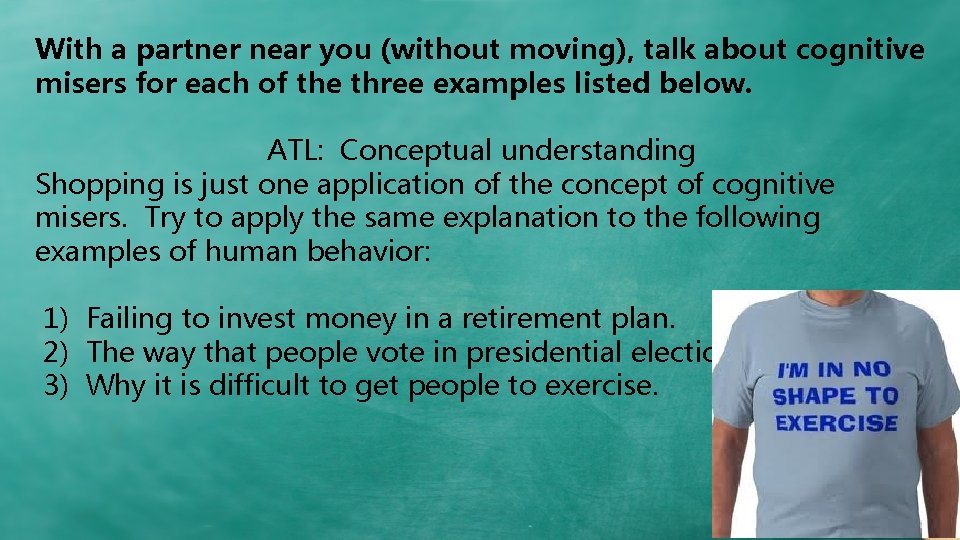
With a partner near you (without moving), talk about cognitive misers for each of the three examples listed below. ATL: Conceptual understanding Shopping is just one application of the concept of cognitive misers. Try to apply the same explanation to the following examples of human behavior: 1) Failing to invest money in a retirement plan. 2) The way that people vote in presidential elections. 3) Why it is difficult to get people to exercise.
ATL: Thinking critically Will it ever be possible to develop robots that can think like humans? In what ways are the human mind and computers the same? Start off by making a list of what the human mind can do and what the computer can do. What do you think are the most significant differences between the human mind and computers? Computers that think like humans Based on what you have seen in the video, do you think it will ever be possible to construct a robot that could process information like we do? Do you think that this would be a good thing - or a bad thing? Be able to justify your response.
Quiz time! Which of the following is NOT a cognitive process? A. Attention B. Trust C. Memory D. Perception
When a big, barking dog comes running at me, I notice that it is actually my neighbor's dog, so I am able to relax. The process of recognizing that the dog is my neighbor's dog and determining that there is nothing to worry about is an example of A. Bottom-up processing B. Denial C. Top-down processing D. Rationalization
According to Fiske and Taylor (1991), what factor influences our decision making behavior? A. We often don’t have enough past experience or knowledge to make a well-informed decision. B. We often are not motivated to change past behaviors. C. Decision making takes too much cognitive energy, so we take the easiest choices. D. All of the above.
II. Schema Theory A. Schemas – mental representations that are derived from prior experience and knowledge. 1. People use a top-down process to determine the most relevant schemas in order to decide appropriate behavior. 2. Help us to predict what to expect based on prior experience. 3. Also organize our knowledge, assist in recall, guide our behavior, & make sense of current experience. 4. Assimilation – when we add or change information to fit existing schema. a) Ex. Need to call 911 on someone else’s phone. It may not be the type of phone I’ve used before, but I can assimilate and figure out how to make it work. 5. Script – patterns of behavior that are learned through our interaction with the environment. a) Developed within a cultural context – NOT universal. 1) Shopping – Here-> pay price on tag; other countries -> Bargain 6. Schema Theory – How humans process incoming information, relate it to existing knowledge, and use it.
a) Based on humans being active information processors. b) Not always aware that we are actively processing. c) If information is missing, our brain fills in the blanks with existing schema. 1) The filling in of the blanks can result in mistakes: memory distortion & errors in decision-making. With a partner…Practice aloud some scripts for one of the following scenarios: 1 – You have a new sub you have never seen before in Mrs. Fry’s room. 2 – You are playing soccer, and you are attempting to make a penalty kick. 3 – You are doing a Power Point presentation in front of the class when the power goes out. Share some scripts with the class…there should be multiple per scenario.
B. Schema Theory and Memory 1. Frederic Bartlett – pioneer in developing schema theory. a) First to suggest that cognitive schemas can be seen as specific knowledge organized and stored in memory that can be accessed and used when it is needed. TOK Ways of Knowing In cognitive psychology, schema are one of building blocks of many theories. However, it is not possible to see schema, even with modern brain imaging technology. Does this matter? The early Freudians argued that we could study what was in the unconscious mind. Behaviorists reacted against this and argued that we should only study that which can be observed. Cognitive theorists found a middle ground; they argued that we should study what we cannot directly observe, but we must use scientific approaches. With a partner, consider the following questions: 1. What are some things that we believe to be true, even though we cannot directly see them? 2. How important is it to be able to see something to know that it is true? 3. What type of evidence would you want for something that is not seeable?
2. In the Cognitive Approach it is assumed that cognitive processes are influenced by social & cultural factors. 3. Bartlett showed cultural schema influenced remembering. 4. Memory is not like a photo or recording, but people remember in terms of what makes the most sense to them. 5. Bartlett’s experiment a) Serial Reproduction – where one participant reads a story & reproduces it for a 2 nd participant who then reproduces it for a 3 rd, & so on until many reproductions have been created. b) Repeated Production – a participant learns material & then recalls it repeatedly over multiple occasions. Same participant each time. 6. Positives and Negatives of Bartlett Experiment a) Naturalistic Setting / Real life (Pos) b) Did not document his procedures in detail – hard to replicate (Neg) c) Didn’t standardize interval times for reproducing the story (Neg) d) Suggested that schemas are complex unconscious knowledge structure (Pos)
7. Bergman & Roedeger (1999) – Replication of Bartlett with a twist. a) IV – amount of delay in retelling the story. 1) 15 minute delay in 1 st retelling of story = higher distortion rate 2) Immediate retelling was highly accurate with less distortion over time. 8. Schema theory – used to explain how memory works. a) Memory process are divided into 3 main stages: 1) Encoding – transforming sensory information into memory. 2) Storage – creating a biological trace of the encoded info in memory, which is either consolidated or lost. 3) Retrieval – using the stored info in thinking, problem solving, & decision making. b) Schema processing can affect memory at all stages. (See Brewer & Treyens 1981)
ATL Activity Telephone Game X 2 Mrs. Fry will read a short story to the first person who will whisper it to the second person, and it will continue around the room until the last person shares it with us. We will do this twice. With a partner…reflect: What did schema have to do with this activity? What kinds of changes were made to the story? Why? Share out on the reflections.
C. Evaluation of Schema Theory 1. Useful in understanding how we categorize, interpret, & make inferences. 2. Helps in understanding memory distortions & false memories. 3. Limitations a) Not clear how schema are acquired. b) Not clear the exact way they influence cognitive processes. 4. Robust theory that has generated much research.
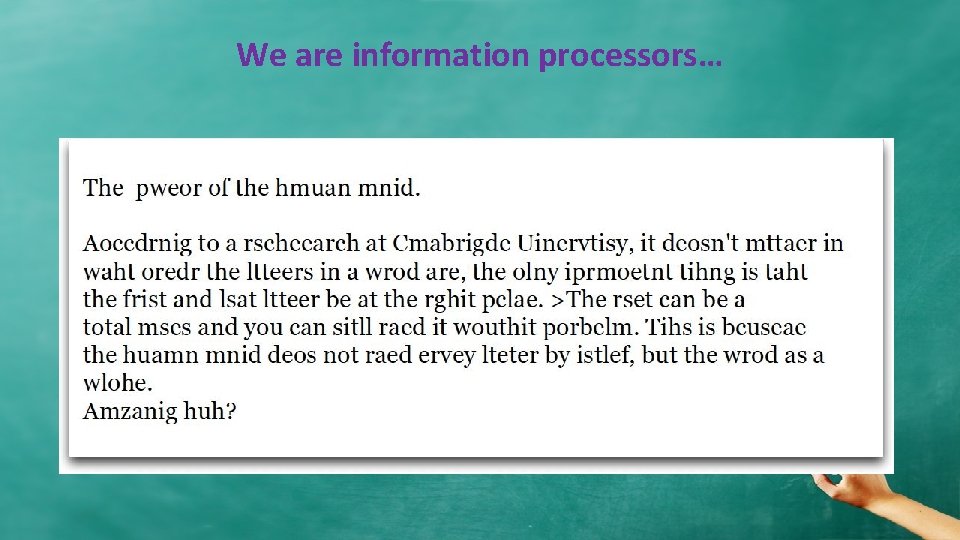
We are information processors…
We continue to be information processors… • • Activity 2 Keep the paper I hand you upside down until I tell you to flip it. When it is time, flip it over. I am only going to give you 75 seconds to count the number of “e’s” in the page. When you are finished or when I call time, write the number of “e’s” that you believe are on the page on the BACKSIDE of the sheet. What were the numbers?
Did you know? • • • I handed out two different sheets of paper? One is nonsensical and one is a paragraph. Let’s look at the data for the paragraph people… Now, let’s look at the data for the nonsensical writing… Which had the closer number of correct “e’s”? Why? What does this tell you about our automatic processing?
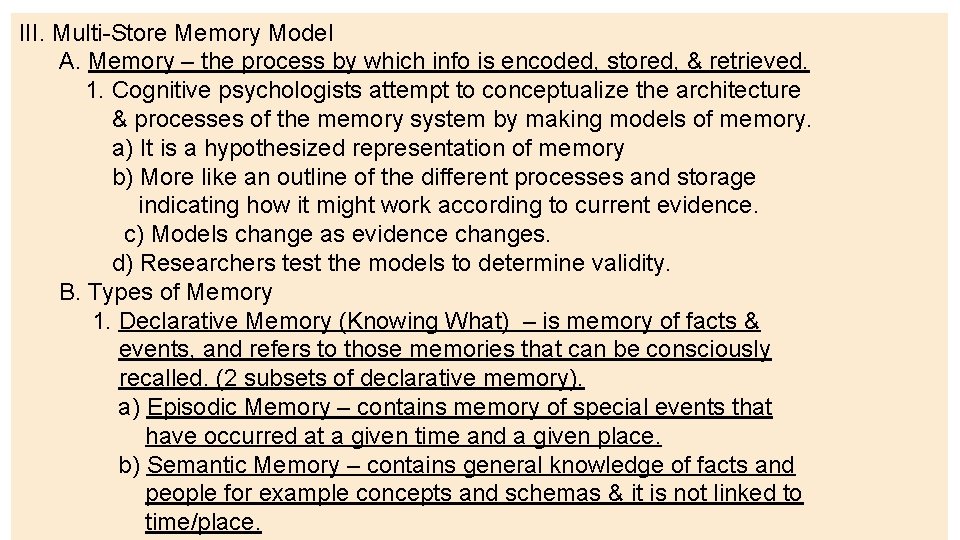
III. Multi-Store Memory Model A. Memory – the process by which info is encoded, stored, & retrieved. 1. Cognitive psychologists attempt to conceptualize the architecture & processes of the memory system by making models of memory. a) It is a hypothesized representation of memory b) More like an outline of the different processes and storage indicating how it might work according to current evidence. c) Models change as evidence changes. d) Researchers test the models to determine validity. B. Types of Memory 1. Declarative Memory (Knowing What) – is memory of facts & events, and refers to those memories that can be consciously recalled. (2 subsets of declarative memory). a) Episodic Memory – contains memory of special events that have occurred at a given time and a given place. b) Semantic Memory – contains general knowledge of facts and people for example concepts and schemas & it is not linked to time/place.
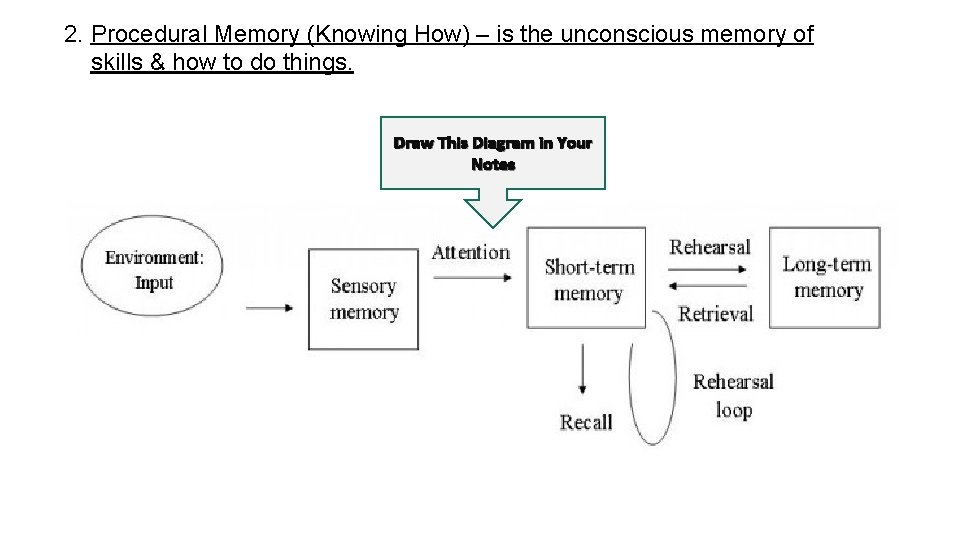
2. Procedural Memory (Knowing How) – is the unconscious memory of skills & how to do things. Draw This Diagram in Your Notes
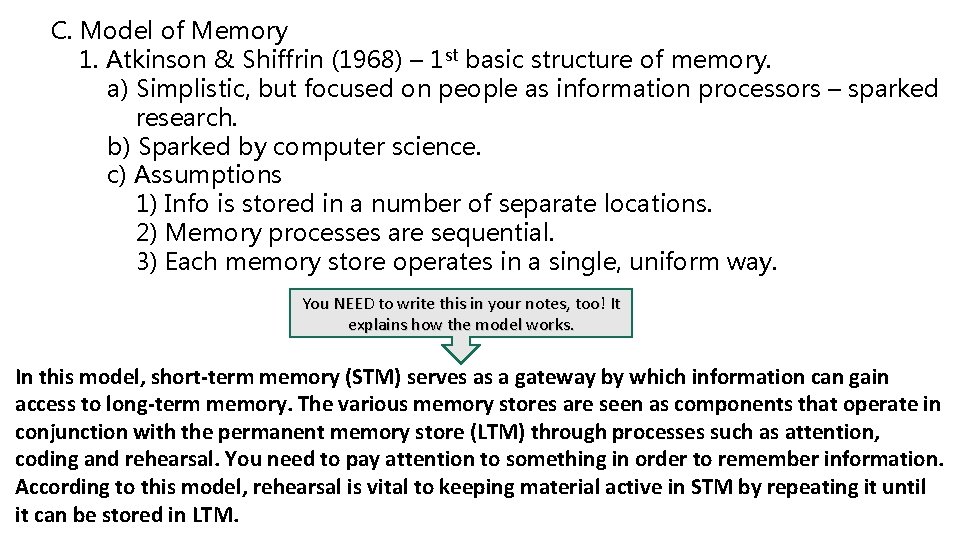
C. Model of Memory 1. Atkinson & Shiffrin (1968) – 1 st basic structure of memory. a) Simplistic, but focused on people as information processors – sparked research. b) Sparked by computer science. c) Assumptions 1) Info is stored in a number of separate locations. 2) Memory processes are sequential. 3) Each memory store operates in a single, uniform way. You NEED to write this in your notes, too! It explains how the model works. In this model, short-term memory (STM) serves as a gateway by which information can gain access to long-term memory. The various memory stores are seen as components that operate in conjunction with the permanent memory store (LTM) through processes such as attention, coding and rehearsal. You need to pay attention to something in order to remember information. According to this model, rehearsal is vital to keeping material active in STM by repeating it until it can be stored in LTM.
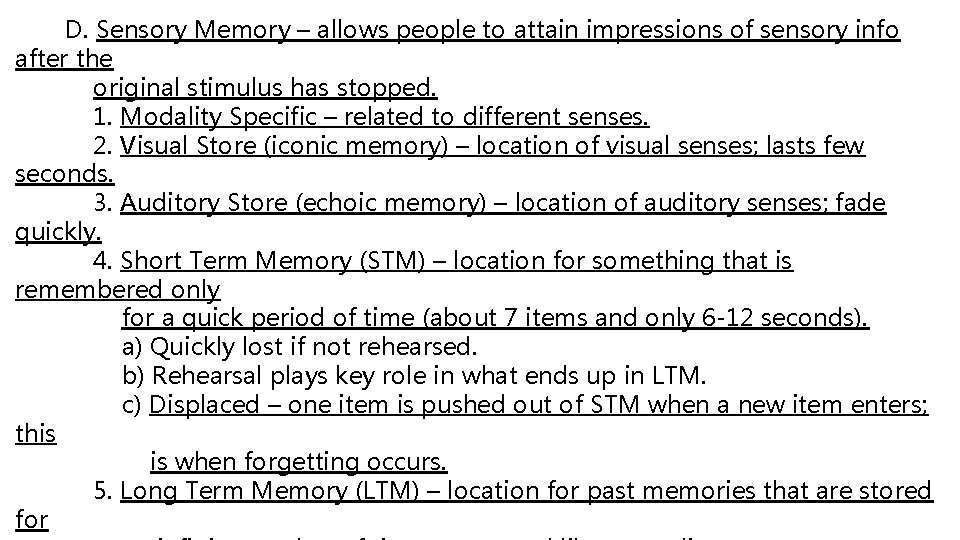
D. Sensory Memory – allows people to attain impressions of sensory info after the original stimulus has stopped. 1. Modality Specific – related to different senses. 2. Visual Store (iconic memory) – location of visual senses; lasts few seconds. 3. Auditory Store (echoic memory) – location of auditory senses; fade quickly. 4. Short Term Memory (STM) – location for something that is remembered only for a quick period of time (about 7 items and only 6 -12 seconds). a) Quickly lost if not rehearsed. b) Rehearsal plays key role in what ends up in LTM. c) Displaced – one item is pushed out of STM when a new item enters; this is when forgetting occurs. 5. Long Term Memory (LTM) – location for past memories that are stored for
Research in psychology: Miller's Magic Number 7 (1956)