
Cognitive Learning Theories v Information Processing Theory v
- Slides: 19
Cognitive Learning Theories v Information Processing Theory v Schema Theory Dept of Educational Technology, SNDTU
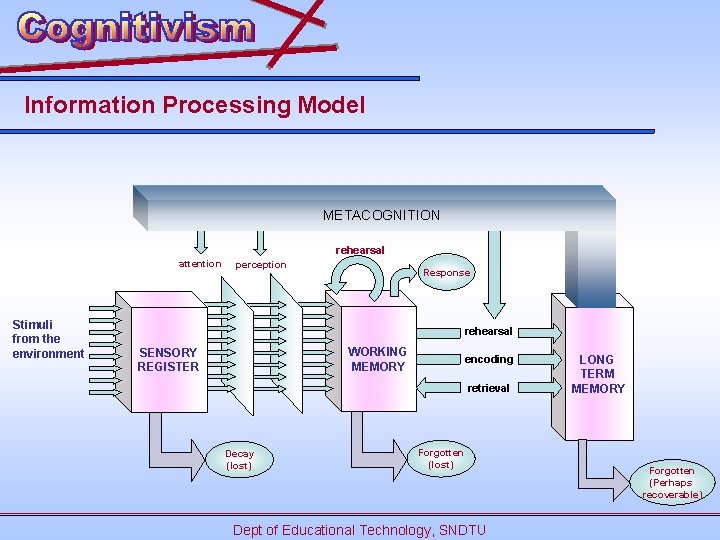
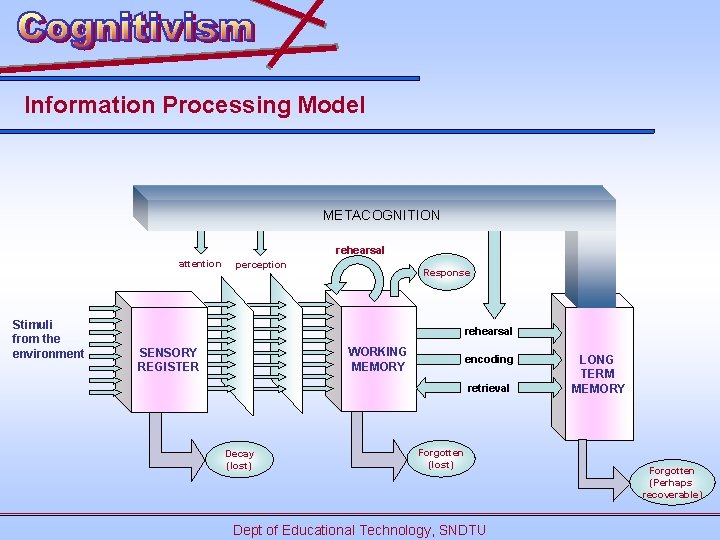
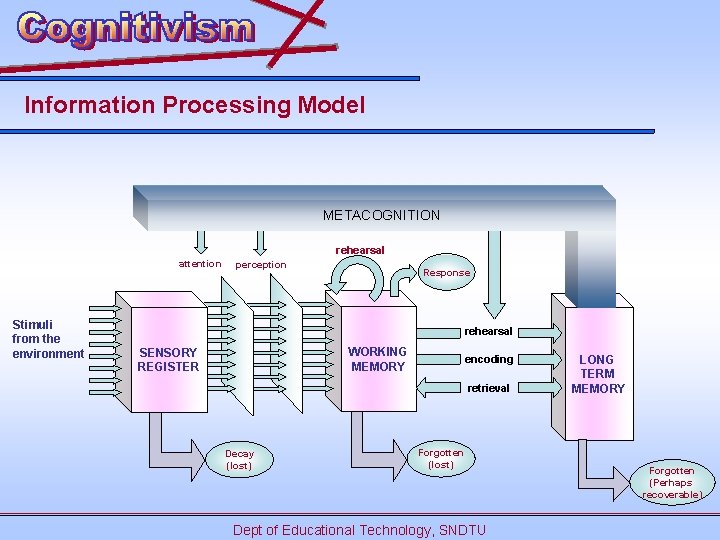
Cognitive Learning Theories Information Processing Looks at learning as a process in which information is registered, perceived, and possibly placed into short-term memory (into our consciousness) where it can be encoded and manipulated (as symbols). Finally, some information will be stored in long-term memory where it stays until recalled back into working short-term memory. Dept of Educational Technology, SNDTU
Cognitive Learning Theories Symbol Manipulation Asserts that we think by mentally assigning and manipulating symbols that represent the things we perceive in the real world. Symbols are our mind's thinking tools. Dept of Educational Technology, SNDTU
Cognitive Learning Theories Knowledge Construction We each reconstruct knowledge based on our existing schema as well as a variety of other factors. It is not likely that there will be an absolute, objective correlation between what we receive and what we encode into long-term memory. Dept of Educational Technology, SNDTU
Information Processing Model METACOGNITION rehearsal attention Stimuli from the environment perception Response rehearsal WORKING MEMORY SENSORY REGISTER encoding retrieval Decay (lost) Forgotten (lost) Dept of Educational Technology, SNDTU LONG TERM MEMORY Forgotten (Perhaps recoverable)
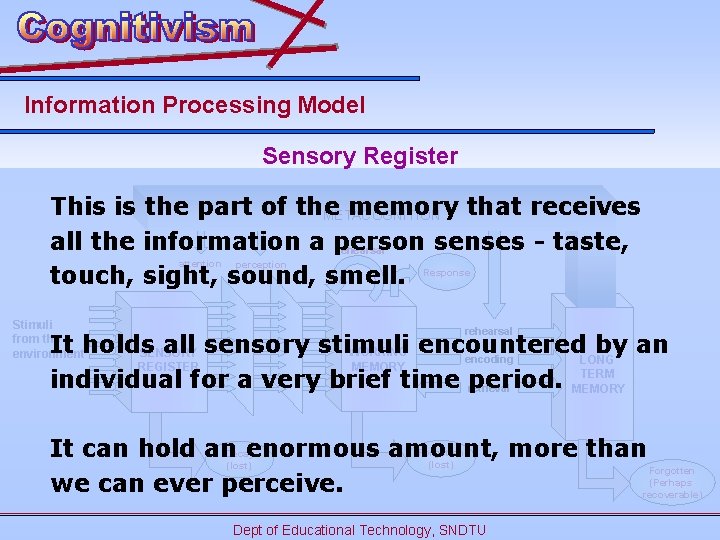
Information Processing Model Sensory Register This is the part of the memory that receives METACOGNITION all the information a person senses - taste, rehearsal attention perception touch, sight, sound, smell. Response Stimuli from the environment rehearsal It holds all sensory stimuli WORKING encountered by an SENSORY encoding LONG MEMORY REGISTER TERM individual for a very brief time retrieval period. MEMORY Forgotten It can hold an enormous amount, more than Decay (lost) Forgotten (Perhaps we can ever perceive. recoverable) Dept of Educational Technology, SNDTU
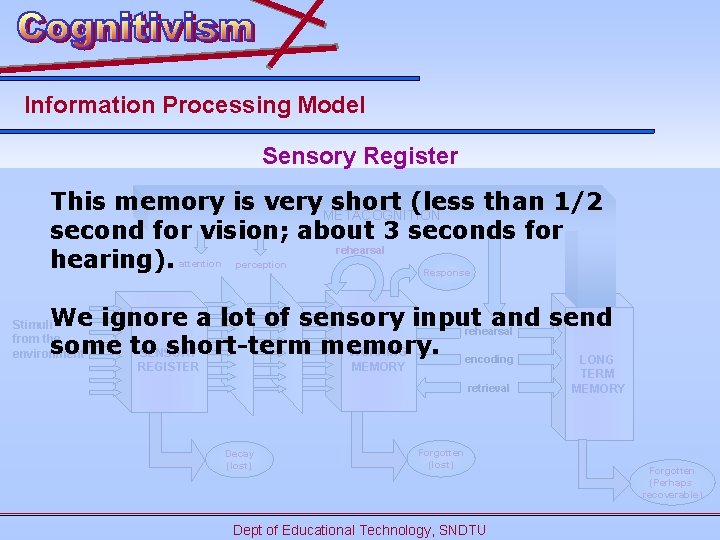
Information Processing Model Sensory Register This memory is very. METACOGNITION short (less than 1/2 second for vision; about 3 seconds for rehearsal hearing). attention perception Response We ignore a lot of sensory input and send rehearsal some to short-term memory. WORKING SENSORY encoding LONG Stimuli from the environment MEMORY REGISTER retrieval Decay (lost) Forgotten (lost) Dept of Educational Technology, SNDTU TERM MEMORY Forgotten (Perhaps recoverable)
Information Processing Model METACOGNITION rehearsal attention Stimuli from the environment perception Response rehearsal WORKING MEMORY SENSORY REGISTER encoding retrieval Decay (lost) Forgotten (lost) Dept of Educational Technology, SNDTU LONG TERM MEMORY Forgotten (Perhaps recoverable)
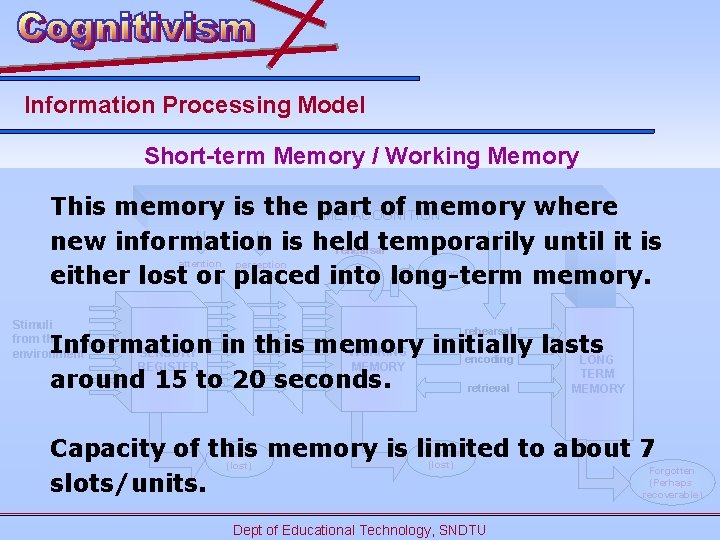
Information Processing Model Short-term Memory / Working Memory This memory is the part of memory where METACOGNITION new information is held temporarily until it is rehearsal attention perception Response either lost or placed into long-term memory. Stimuli from the environment rehearsal Information in this memory initially lasts WORKING SENSORY encoding LONG MEMORY REGISTER TERM around 15 to 20 seconds. retrieval MEMORY Forgotten Capacity of this to about 7 Decay memory is limited (lost) Forgotten (Perhaps slots/units. recoverable) Dept of Educational Technology, SNDTU
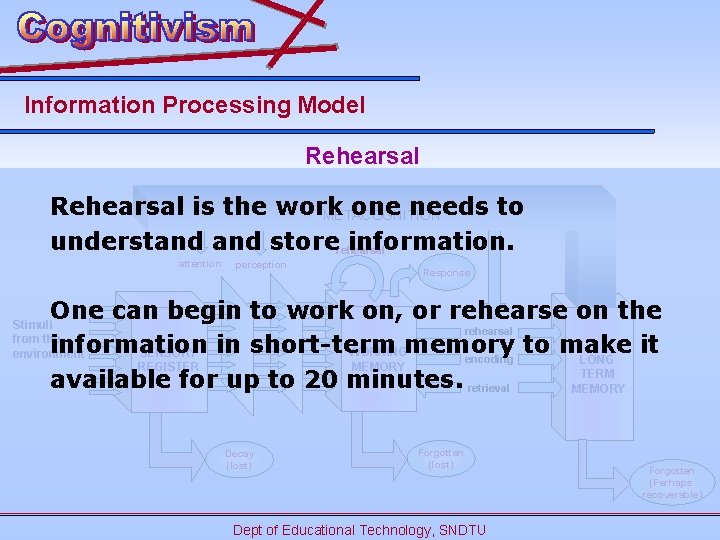
Information Processing Model Rehearsal is the work one needs to METACOGNITION understand storerehearsal information. attention perception Response One can begin to work on, or rehearse on the rehearsal information WORKINGmemory to make it SENSORY in short-term encoding LONG MEMORY REGISTER TERM available for up to 20 minutes. retrieval MEMORY Stimuli from the environment Decay (lost) Forgotten (lost) Dept of Educational Technology, SNDTU Forgotten (Perhaps recoverable)
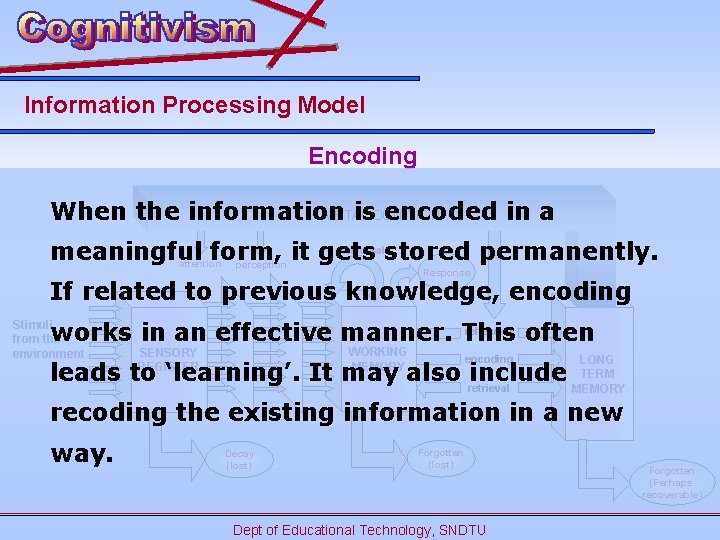
Information Processing Model Encoding When the information is encoded in a METACOGNITION rehearsal meaningful form, it gets stored permanently. attention perception Response If related to previous knowledge, encoding rehearsal often works in an effective manner. This Stimuli from the environment WORKING MEMORY SENSORY REGISTER encoding leads to ‘learning’. It may also retrieval include LONG TERM MEMORY recoding the existing information in a new way. Decay (lost) Forgotten (lost) Dept of Educational Technology, SNDTU Forgotten (Perhaps recoverable)
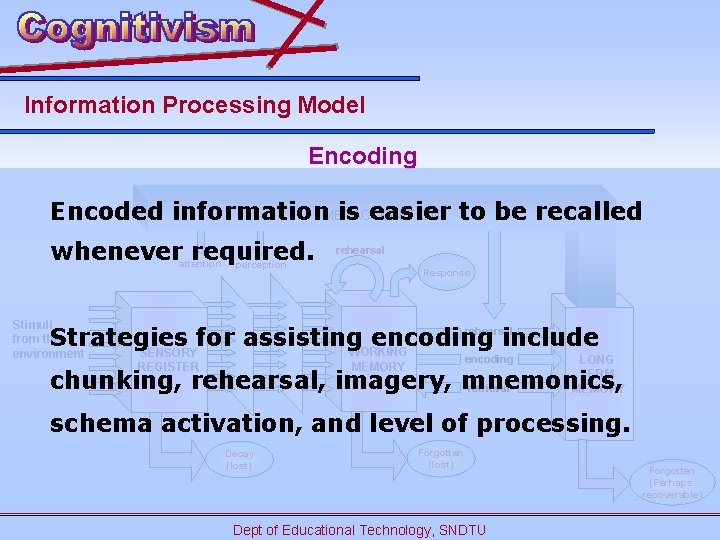
Information Processing Model Encoding Encoded information. METACOGNITION is easier to be recalled wheneverattention required. perception Stimuli from the environment rehearsal Response rehearsal Strategies for assisting encoding include WORKING SENSORY encoding MEMORY REGISTER LONG TERM MEMORY chunking, rehearsal, imagery, mnemonics, retrieval schema activation, and level of processing. Decay (lost) Forgotten (lost) Dept of Educational Technology, SNDTU Forgotten (Perhaps recoverable)
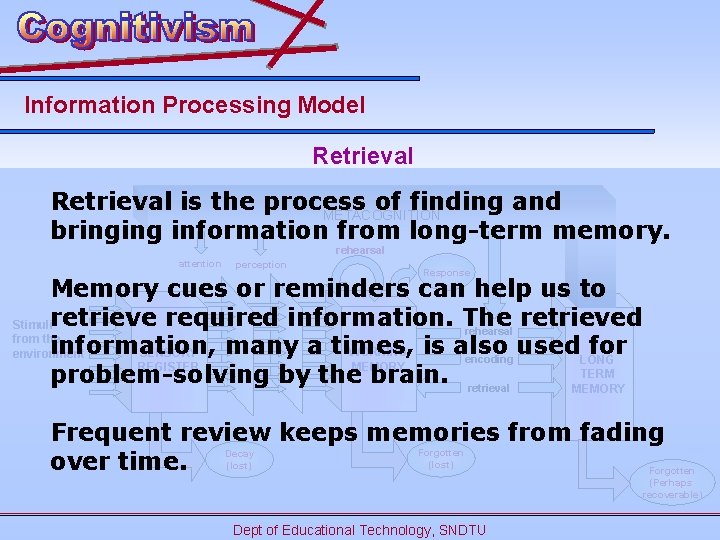
Information Processing Model Retrieval is the process of finding and METACOGNITION bringing information from long-term memory. rehearsal attention perception Response Memory cues or reminders can help us to Stimuliretrieve required information. The retrieved rehearsal from the information, many a times, WORKING is also used for SENSORY environment encoding LONG MEMORY REGISTER TERM problem-solving by the brain. retrieval MEMORY Frequent review keeps memories from fading Forgotten Decay (lost) over time. Forgotten (Perhaps recoverable) Dept of Educational Technology, SNDTU
Information Processing Model METACOGNITION rehearsal attention Stimuli from the environment perception Response rehearsal WORKING MEMORY SENSORY REGISTER encoding retrieval Decay (lost) Forgotten (lost) Dept of Educational Technology, SNDTU LONG TERM MEMORY Forgotten (Perhaps recoverable)
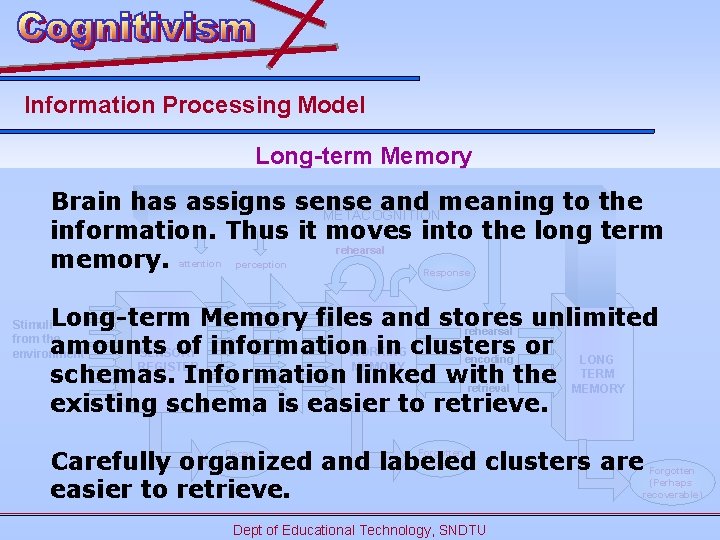
Information Processing Model Long-term Memory Brain has assigns sense and meaning to the METACOGNITION information. Thus it moves into the long term rehearsal memory. attention perception Response Long-term Memory files and stores unlimited rehearsal amounts of information in clusters or LONG WORKING SENSORY encoding MEMORY REGISTER TERM schemas. Information linked with the retrieval MEMORY existing schema is easier to retrieve. Stimuli from the environment (lost) Carefully organized and labeled clusters are Forgotten (Perhaps recoverable) easier to retrieve. Decay Forgotten Dept of Educational Technology, SNDTU
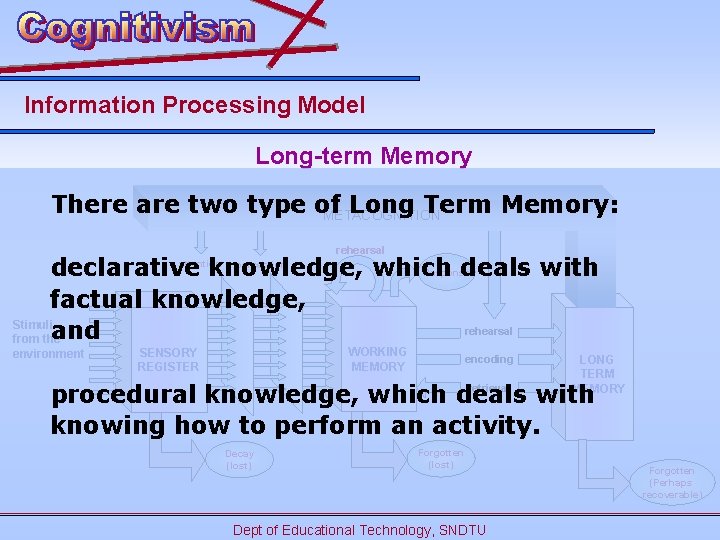
Information Processing Model Long-term Memory There are two type of Long Term Memory: METACOGNITION rehearsal perception Response declarative knowledge, which deals with factual knowledge, Stimuli rehearsal and from the attention environment WORKING MEMORY SENSORY REGISTER encoding LONG TERM MEMORY retrieval procedural knowledge, which deals with knowing how to perform an activity. Decay (lost) Forgotten (lost) Dept of Educational Technology, SNDTU Forgotten (Perhaps recoverable)
Information Processing Model METACOGNITION rehearsal attention Stimuli from the environment perception Response rehearsal WORKING MEMORY SENSORY REGISTER encoding retrieval Decay (lost) Forgotten (lost) Dept of Educational Technology, SNDTU LONG TERM MEMORY Forgotten (Perhaps recoverable)
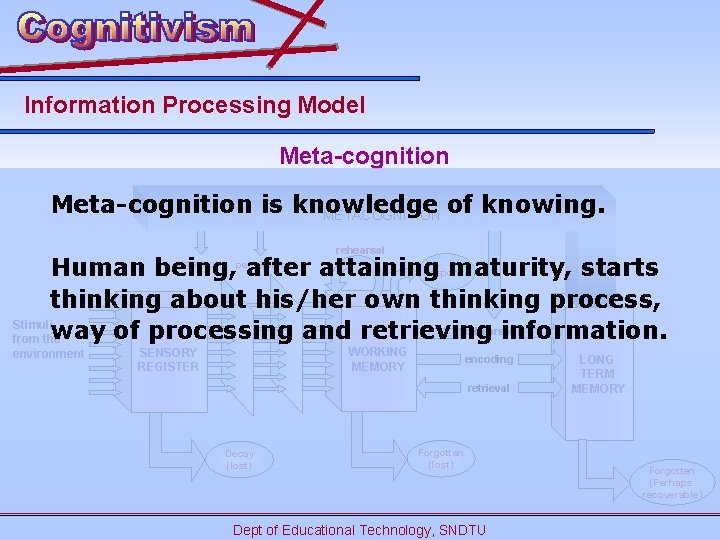
Information Processing Model Meta-cognition is knowledge of knowing. METACOGNITION rehearsal Response Human being, perception after attaining maturity, starts thinking about his/her own thinking process, Stimuli rehearsal way of processing and retrieving information. from the attention environment WORKING MEMORY SENSORY REGISTER encoding retrieval Decay (lost) Forgotten (lost) Dept of Educational Technology, SNDTU LONG TERM MEMORY Forgotten (Perhaps recoverable)
Information Processing Model More readings… http: //studytips. aac. ohiou. edu/? Function=memory&Type=info. Process http: //www. usq. edu. au/studentservices/counselling/issues/memory/proc ess. htm http: //hsc. csu. edu. au/pro_dev/teaching_online/how_we_learn/informatio n. html Dept of Educational Technology, SNDTU