
Cognitive Interpersonal Therapy The Basics Core Beliefs Relationship
Cognitive Interpersonal Therapy The Basics
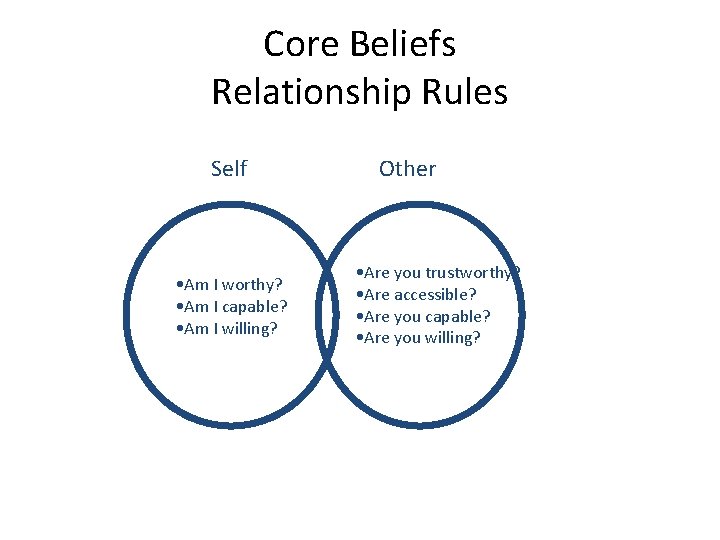
Core Beliefs Relationship Rules Self • Am I worthy? • Am I capable? • Am I willing? Other • Are you trustworthy? • Are accessible? • Are you capable? • Are you willing?
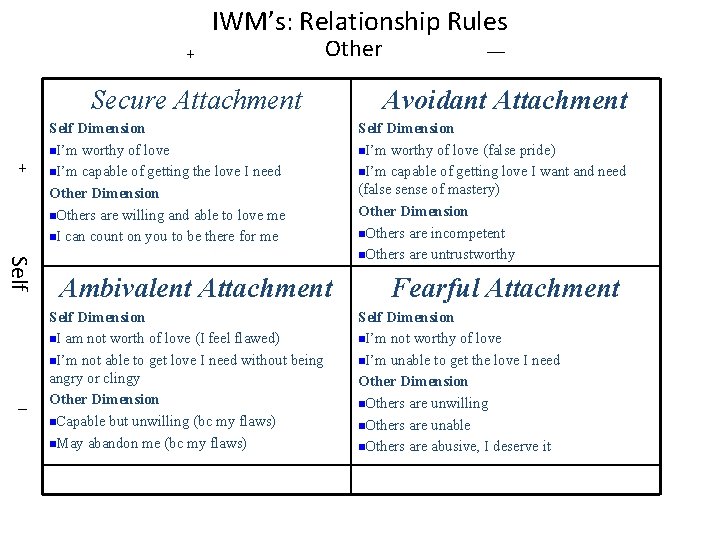
IWM’s: Relationship Rules + Other Secure Attachment + Self _ Self Dimension n. I’m worthy of love n. I’m capable of getting the love I need Other Dimension n. Others are willing and able to love me n. I can count on you to be there for me Ambivalent Attachment Self Dimension n. I am not worth of love (I feel flawed) n. I’m not able to get love I need without being angry or clingy Other Dimension n. Capable but unwilling (bc my flaws) n. May abandon me (bc my flaws) __ Avoidant Attachment Self Dimension n. I’m worthy of love (false pride) n. I’m capable of getting love I want and need (false sense of mastery) Other Dimension n. Others are incompetent n. Others are untrustworthy Fearful Attachment Self Dimension n. I’m not worthy of love n. I’m unable to get the love I need Other Dimension n. Others are unwilling n. Others are unable n. Others are abusive, I deserve it
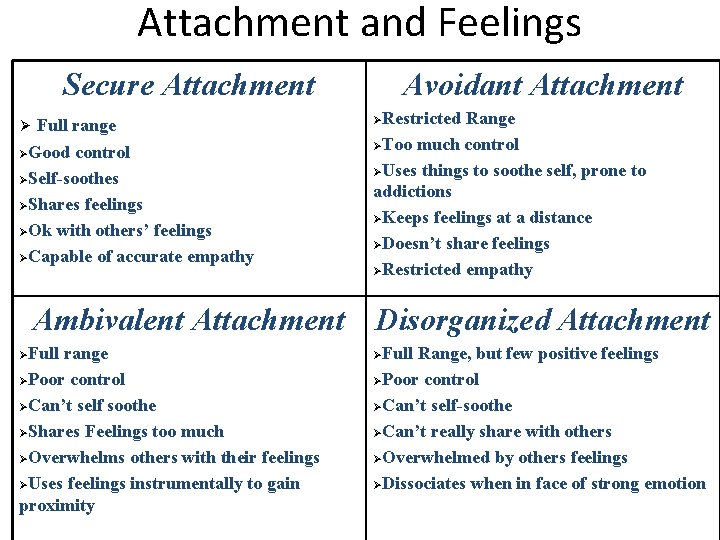
Attachment and Feelings Secure Attachment Ø Full range ØGood control ØSelf-soothes ØShares feelings ØOk with others’ feelings ØCapable of accurate empathy Avoidant Attachment ØRestricted Range ØToo much control ØUses things to soothe self, prone to addictions ØKeeps feelings at a distance ØDoesn’t share feelings ØRestricted empathy Ambivalent Attachment Disorganized Attachment ØFull range ØPoor control ØCan’t self soothe ØShares Feelings too much ØOverwhelms others with their feelings ØUses feelings instrumentally to gain proximity ØFull Range, but few positive feelings ØPoor control ØCan’t self-soothe ØCan’t really share with others ØOverwhelmed by others feelings ØDissociates when in face of strong emotion
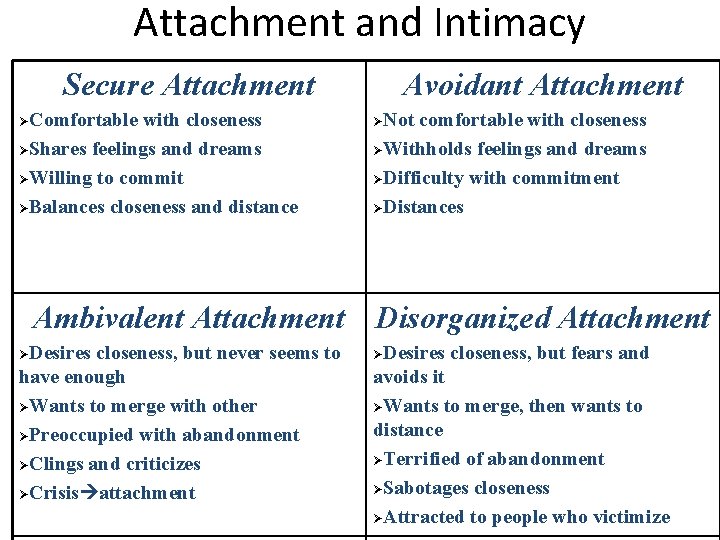
Attachment and Intimacy Secure Attachment Comfortable with closeness ØShares feelings and dreams ØWilling to commit ØBalances closeness and distance Ø Avoidant Attachment Not comfortable with closeness ØWithholds feelings and dreams ØDifficulty with commitment ØDistances Ø Ambivalent Attachment Disorganized Attachment Desires closeness, but never seems to have enough ØWants to merge with other ØPreoccupied with abandonment ØClings and criticizes ØCrisis attachment Ø Desires closeness, but fears and avoids it ØWants to merge, then wants to distance ØTerrified of abandonment ØSabotages closeness ØAttracted to people who victimize Ø
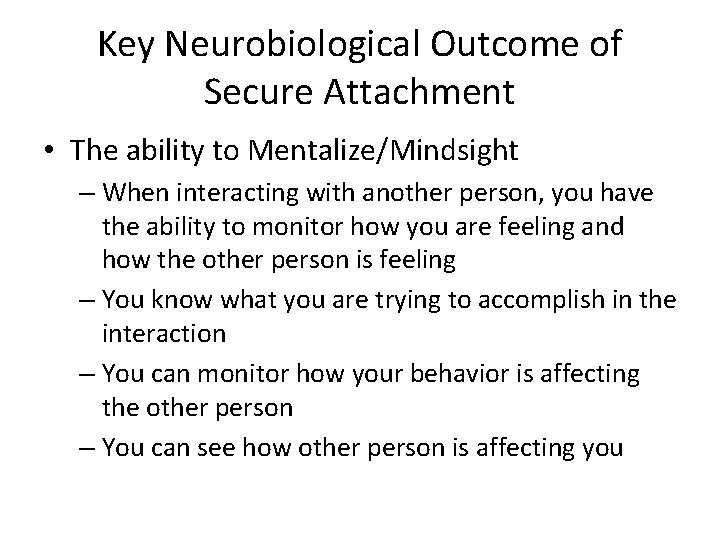
Key Neurobiological Outcome of Secure Attachment • The ability to Mentalize/Mindsight – When interacting with another person, you have the ability to monitor how you are feeling and how the other person is feeling – You know what you are trying to accomplish in the interaction – You can monitor how your behavior is affecting the other person – You can see how other person is affecting you

Secure vs Insecure Person 1 Person 2 Insecure Models are to new information. Security recognizes the transactional Nature of relationships
Attachment and Marriage • We rely on secure base relationships in marriage • Two roles in attachment relationship: – Secure-base use—(attachment) – Secure base provision—(caregiving)
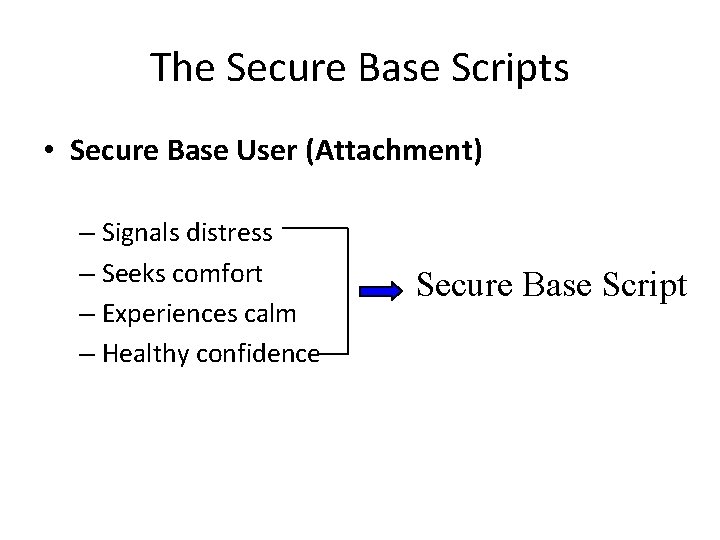
The Secure Base Scripts • Secure Base User (Attachment) – Signals distress – Seeks comfort – Experiences calm – Healthy confidence Secure Base Script
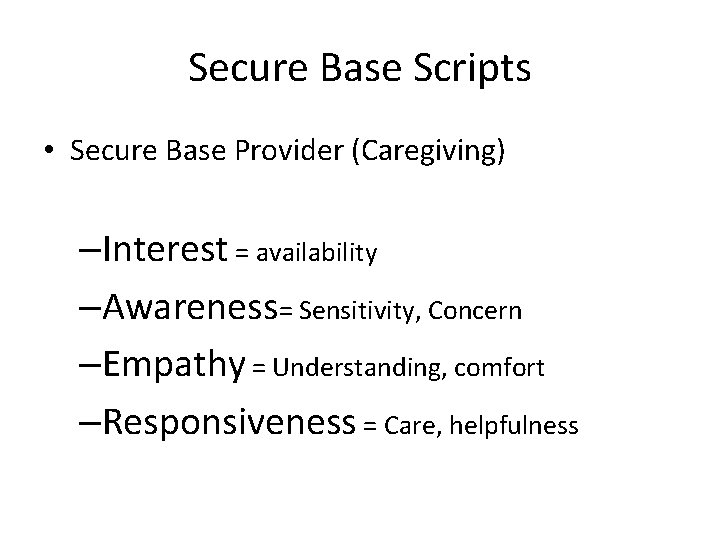
Secure Base Scripts • Secure Base Provider (Caregiving) –Interest = availability –Awareness= Sensitivity, Concern –Empathy = Understanding, comfort –Responsiveness = Care, helpfulness
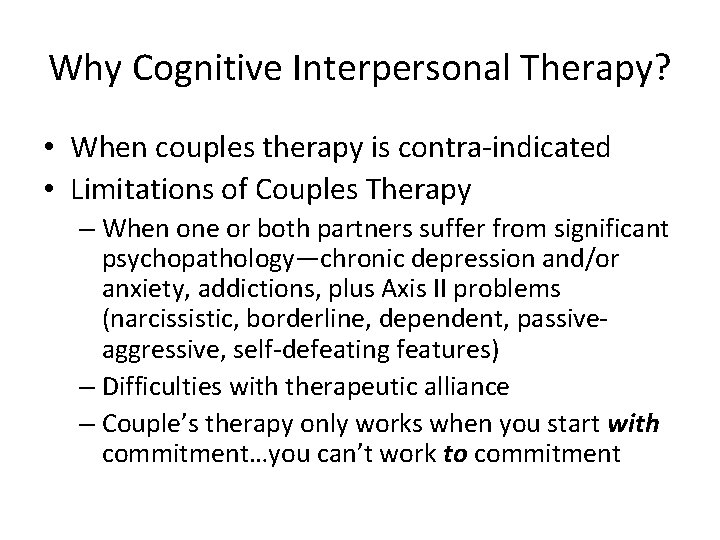
Why Cognitive Interpersonal Therapy? • When couples therapy is contra-indicated • Limitations of Couples Therapy – When one or both partners suffer from significant psychopathology—chronic depression and/or anxiety, addictions, plus Axis II problems (narcissistic, borderline, dependent, passiveaggressive, self-defeating features) – Difficulties with therapeutic alliance – Couple’s therapy only works when you start with commitment…you can’t work to commitment
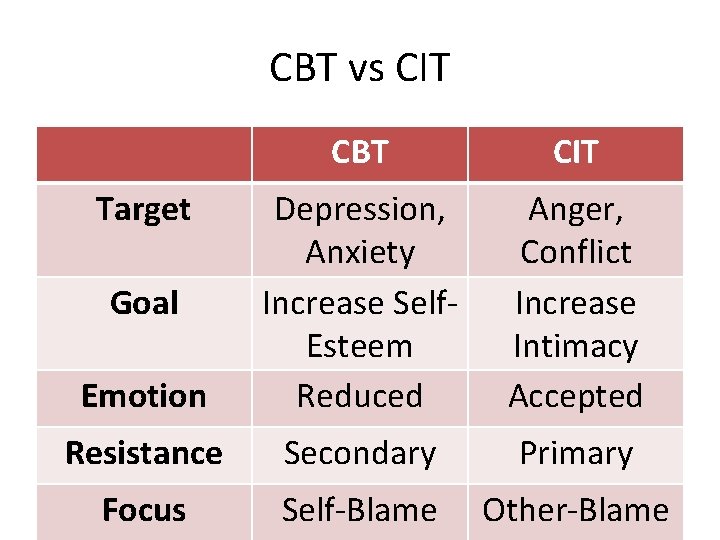
CBT vs CIT CBT CIT Emotion Depression, Anxiety Increase Self. Esteem Reduced Anger, Conflict Increase Intimacy Accepted Resistance Secondary Primary Focus Self-Blame Other-Blame Target Goal
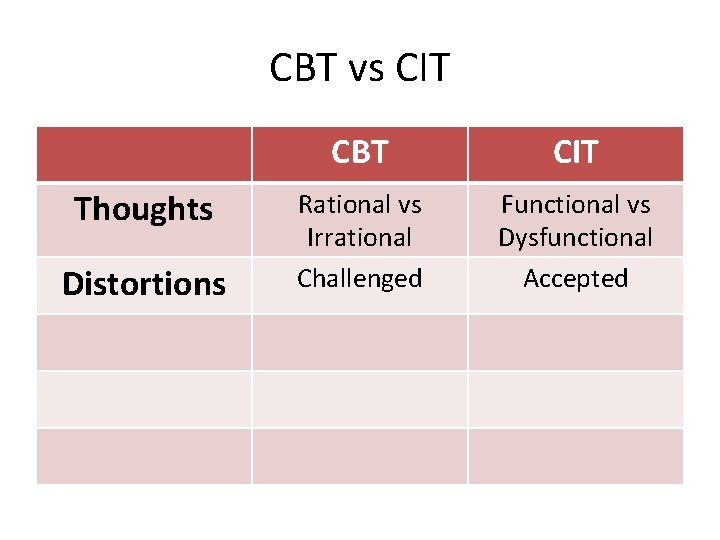
CBT vs CIT Thoughts Distortions CBT CIT Rational vs Irrational Challenged Functional vs Dysfunctional Accepted
Basic Process and Flow of Therapy • Identify relationship dispute in a close relationship (e. g. , spouse, parent, close friend) and link it to negative emotions (e. g. , anger, anxiety, depression) • Invitation— – ”Do you want me to help you with this relationship? ”
Four Basic Phases • Identification and Invitation • Enhance Motivation and Commitment (Will Set) • Skill Acquisition Phase (Skill Set) • Skill Application and Follow-Through
Phase I Identification and Invitation • Identification—linking emotional distress--e. g. , anxiety, depression, addiction—to Interpersonal Conflict • Help client see connection between relationship conflict and ongoing symptoms • Invitation— – “Would you like me to help you with this relationship? ”
Phase II Enhance Motivation and Commitment • These are all volitional commitments – The Price of Intimacy – Choosing from three options – Giving—up intimacy-incompatible attitudes and behaviors
The Price of Intimacy • Burn’s definition of Intimacy – You willingness to endure the negative feelings you will get when you get close to another person
Three Options • One: – Status Quo—continue trying to change the other person • Two: – Leave the relationship • Three: – Stay, but take 100% responsibility to change the way you deal with conflict
Giving-up Intimacy Incompatible Attitudes and Behaviors • Giving-up Blame – Your right to punish another person when they hurt you • Giving-up being Right – Your right to be viewed by the other person as being right
Dealing With Resistance • Essential component of CIT • Two Kinds of Resistance – Process – Outcome • Key Principles: – don’t resistance – Go with it • Using Paradoxical Cost-Benefit Analysis
Remember • Do not progress to the next phase unless person is able to make all three commitments • “I’d love to help you with this relationship, but unfortunately I don’t have any way to help without your commitment”
Phase Three Skill Acquistion • Three Sets of Skills – Core Communication Skills – Getting a Situational Description – Completing Relationship Event Questionnaire
Core Communication Skills Quick Peek • Empathy—Acknowledging and accepting how another person feels and why they feel that way • Assertiveness—expressing your feelings, wants, needs • Respect—being kind and valuing your relationship with other person
Empathy • Inquiry • Feeling empathy—what the other person is feeling • Thought empathy—Why the other is feeling that way • Disarming—seeing grain of truth in other person’s criticism
Two Laws • The law of reciprocity—The Golden Rule • The law of opposites
Assertiveness • Expressing you feelings— – When you_______, I feel_____. – Expressing what you need/want – Expressing your own negative feelings about your own behavior—humility • I’m really angry with myself for doing x. • This is really painful to hear, but there is a lot of truth in what you are saying
Respect • DO’s – Being Kind – Overtly valuing the relationship – Giving person benefit of doubt • Don’t – Blame – Judge – Use sarcasm
Getting Situational Description • Moving beyond global, transitional description • Anchoring relationship events into an actual place and an actual time frame • Identifying a slice of time: with a beginning, a middle, and an end. • Block commentary/interpretations • Identify hotspot in the conversation • Move to Relationship Event Worksheet
Sample Narrative • My husband doesn’t appreciate me. Nothing I do interests him. He cares more about his video games than me. He’s always had sort of an addictive personality…he gets totally absorbed in things…he doesn’t care about anyone but himself…I guess it’s just me. If I try to say something to him about how I feel he just goes off and starts putting me down. It’s useless for me to say anything to him about my feelings. They don’t matter to him.
Sample Narrative • The other evening I decided to tell my husband my feelings about him spending so much time playing the video game. I told him that I felt he was addicted to the game and even told him there is research on how these games work like addictions. I also told him it was like he had a mistress and I couldn’t stand it anymore. He told me I was overreacting and that I blow everything out of proportion. I told him I was just trying to tell him my feelings. He told me I needed to get a life and walked off.
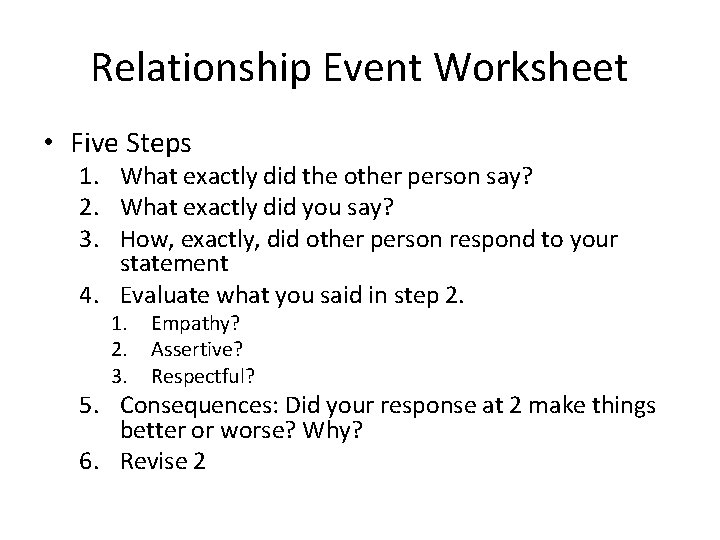
Relationship Event Worksheet • Five Steps 1. What exactly did the other person say? 2. What exactly did you say? 3. How, exactly, did other person respond to your statement 4. Evaluate what you said in step 2. 1. 2. 3. Empathy? Assertive? Respectful? 5. Consequences: Did your response at 2 make things better or worse? Why? 6. Revise 2
Working Through • Deal with Resistance • Use various forms of role, especially reverse role play – Very strong neurobiological challenge to the prefrontal cortex – Increases mentalization— • The ability to think about how you and other states of mind interact
Teaching Repair Process • Healthy couples engage in repair process • Instead of avoiding emotionally charged situations, approach them skillfully • Use empathy proactively, especially disarming skills
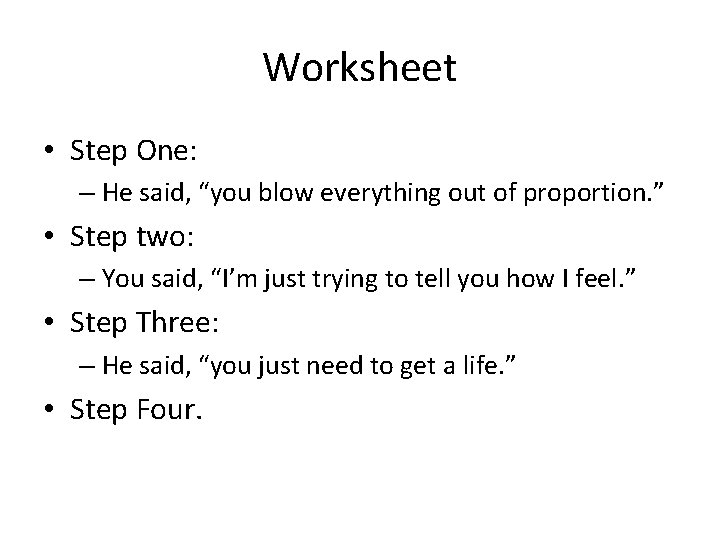
Worksheet • Step One: – He said, “you blow everything out of proportion. ” • Step two: – You said, “I’m just trying to tell you how I feel. ” • Step Three: – He said, “you just need to get a life. ” • Step Four.
- Slides: 35