
Cognitive Information Processing Theory CIP in Action Debra
Cognitive Information Processing Theory (CIP) in Action Debra Osborn, Ph. D. Florida State University May 2017 Ohio Career Development Association National Career Development Association
Today’s Goals: • Review theoretical foundation of CIP • Present practical CIP tools and strategies • Share research findings on CIP service delivery model
Why CIP? • The CIP differentiated service delivery approach has been used at the Florida State University Career Center for the past 42 years • Application to other higher education career centers and school career guidance programs in the US and worldwide
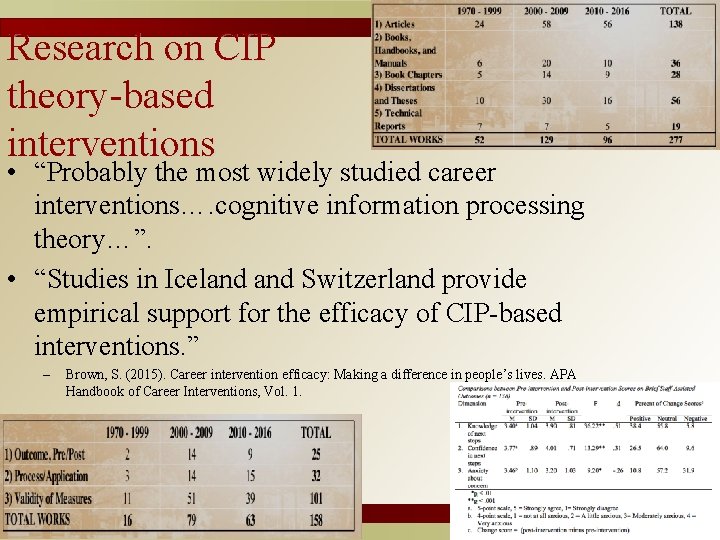
Research on CIP theory-based interventions • “Probably the most widely studied career interventions…. cognitive information processing theory…”. • “Studies in Iceland Switzerland provide empirical support for the efficacy of CIP-based interventions. ” – Brown, S. (2015). Career intervention efficacy: Making a difference in people’s lives. APA Handbook of Career Interventions, Vol. 1.
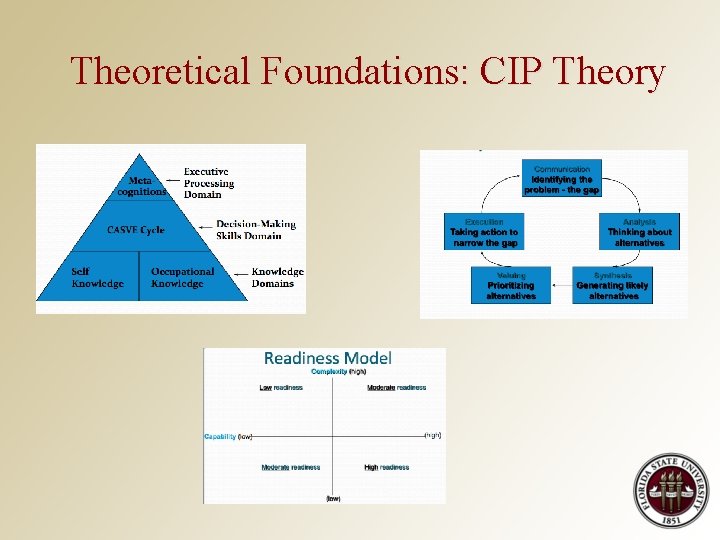
Theoretical Foundations: CIP Theory
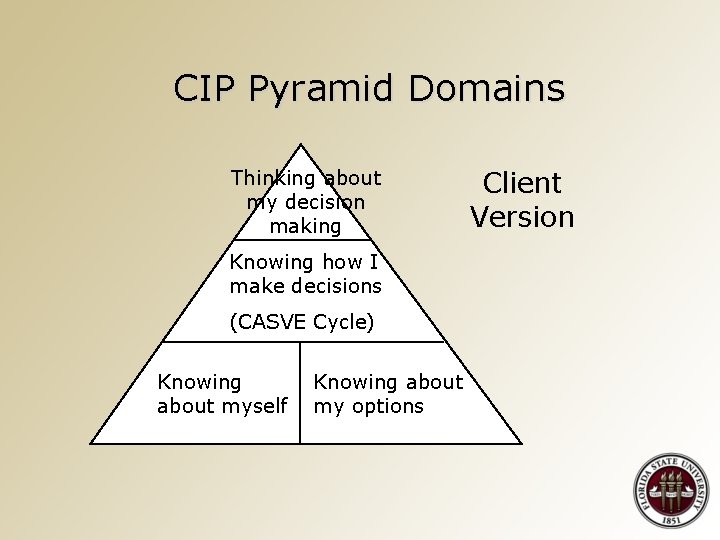
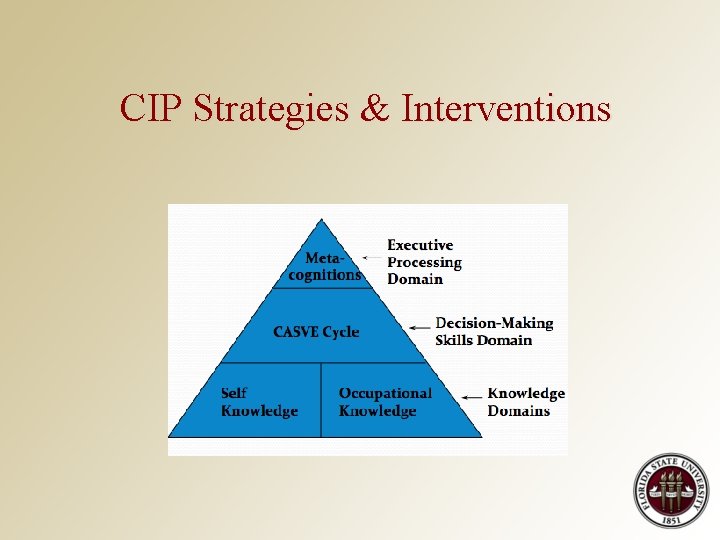
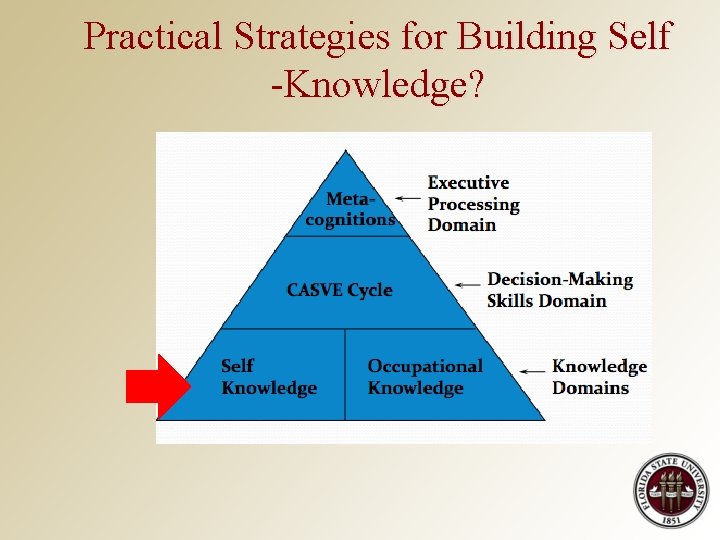
CIP Pyramid Domains Thinking about my decision making Knowing how I make decisions (CASVE Cycle) Knowing about myself Knowing about my options Client Version
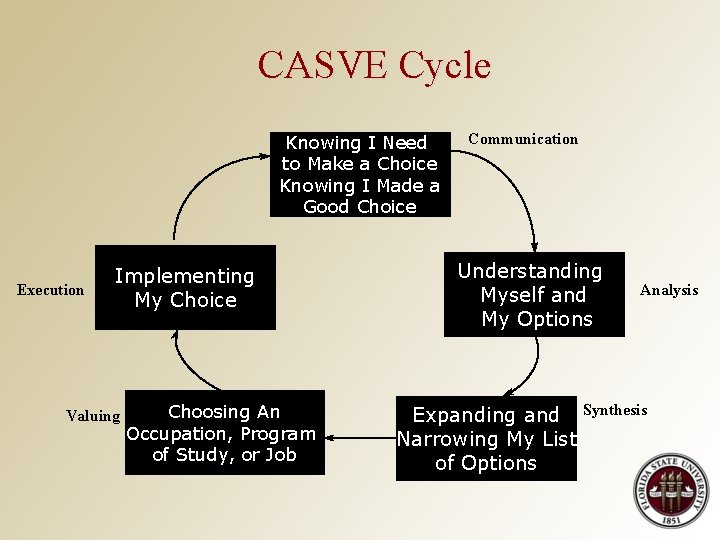
CASVE Cycle Knowing I Need to Make a Choice Knowing I Made a Good Choice Execution Implementing My Choice Valuing Choosing An Occupation, Program of Study, or Job Communication Understanding Myself and My Options Expanding and Narrowing My List of Options Analysis Synthesis
Readiness The capability of an individual to make appropriate career choices taking into account the complexity of family, social, economic, and organizational factors that influence career development Readiness also includes possessing adequate language skills and literacy skills for communication and learning Source: Sampson, J. P. , Jr. , Reardon, R. C. , Peterson, G. W. , & Lenz, J. G. (2004). Career counseling and services: A cognitive information processing approach. Pacific Grove, CA: Brooks/Cole.
Accurate Assessment of Individual Needs • Capability concerns internal factors that make it more, or less, difficult to decide about occupational, educational, training, or employment options • Complexity concerns external factors that make it more, or less, difficult to decide, such as the family, society, the economy, or organizations 10
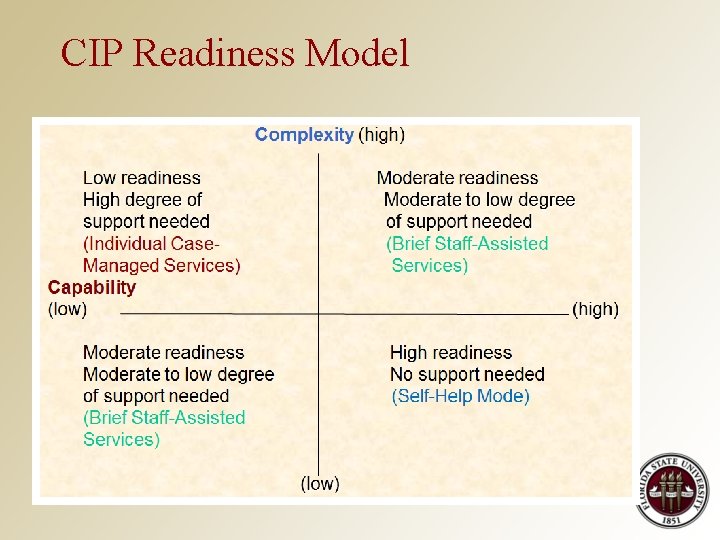
CIP Readiness Model
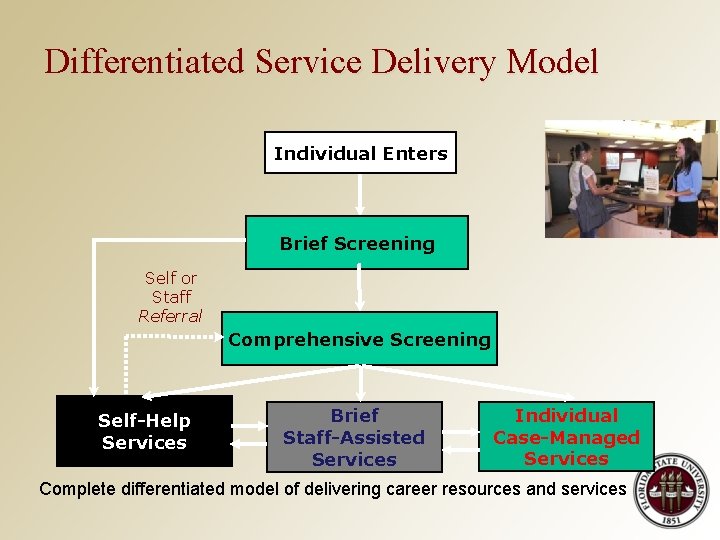
Differentiated Service Delivery Model Individual Enters Brief Screening Self or Staff Referral Comprehensive Screening Self-Help Services Brief Staff-Assisted Services Individual Case-Managed Services Complete differentiated model of delivering career resources and services
CIP in Practice - Roleplay • Have your two diagrams in hand • Our primary goal: – Identify the gap
Once we know the gap… • We need to learn what’s impacting her decision. • We have a tool for that!
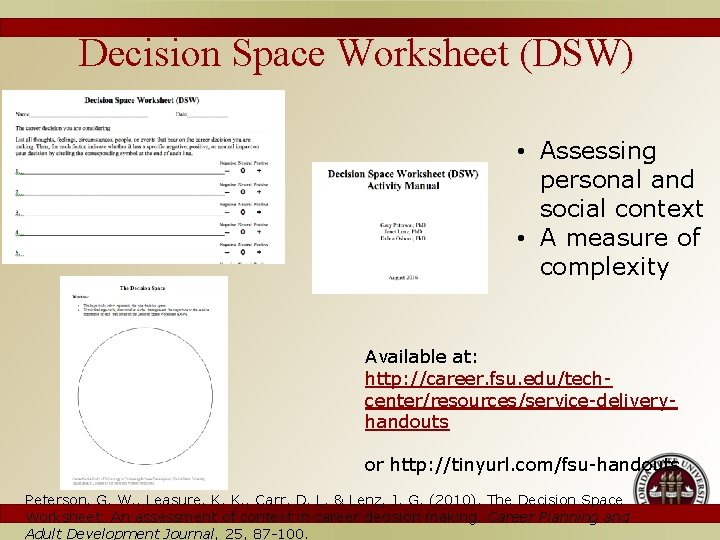
Decision Space Worksheet (DSW) • Assessing personal and social context • A measure of complexity Available at: http: //career. fsu. edu/techcenter/resources/service-deliveryhandouts or http: //tinyurl. com/fsu-handouts Peterson, G. W. , Leasure, K. K. , Carr, D. L. & Lenz, J. G. (2010). The Decision Space Worksheet: An assessment of context in career decision making. Career Planning and Adult Development Journal, 25, 87 -100.
Purpose of the Decision Space Worksheet (DSW) • Cognitive mapping task • Helps clients reveal thoughts, feelings, persons, circumstances associated with career decision • Helps clients prioritize importance of contextual influences • Can be used with middle school through college level students and adults
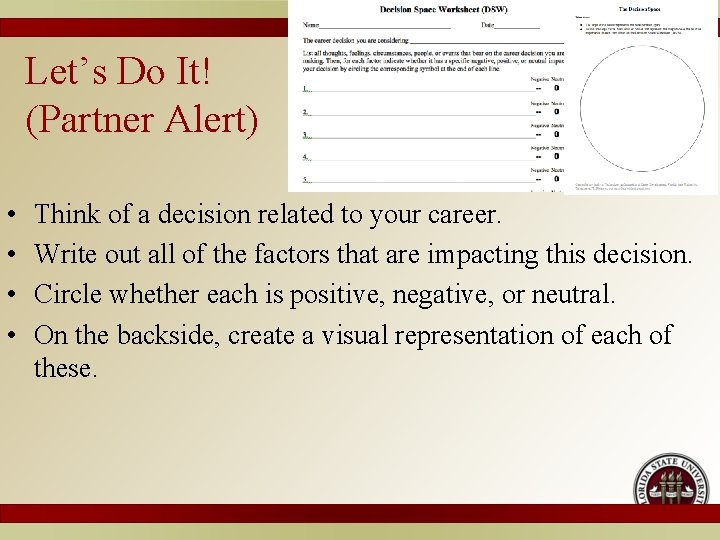
Let’s Do It! (Partner Alert) • • Think of a decision related to your career. Write out all of the factors that are impacting this decision. Circle whether each is positive, negative, or neutral. On the backside, create a visual representation of each of these.
Partnering • What was this experience like for you? Thoughts/feelings? May I ask you some questions about your responses? • State the decision that your partner indicated. – Ask: “Would you like to add anything to this statement? ” • Look at the list of elements and valences. – Ask: “What is your impression of this list? ” – “How does each item affect your career decision? Are some of the valences slightly stronger than others? ” • Look at diagram and note the top 3. Look for themes. – Are they all affective, or concern areas of interest, or suggest a negative self-concept, etc. ? • Summarize
Sample Summary • “So, from this, you’ve shared that in figuring out your major, there are three main elements that are impacting your choice: cost/time required, unsure of what majors might interest you, and fear of making the wrong choice. On the plus side, your parents are very supportive, you’ve got a strong GPA, and have some time to figure this out. Would you agree with this? Would you add anything to what I just said? ”
Group Debrief • • • What was the activity like? Which questions were most helpful? Where did you get stuck? What other questions would you add? What might you add? What issues can you see potentially emerging from this activity?
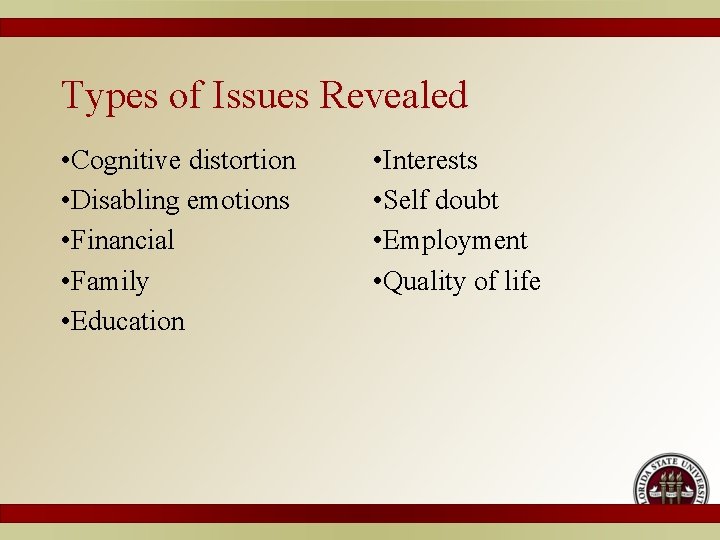
Types of Issues Revealed • Cognitive distortion • Disabling emotions • Financial • Family • Education • Interests • Self doubt • Employment • Quality of life
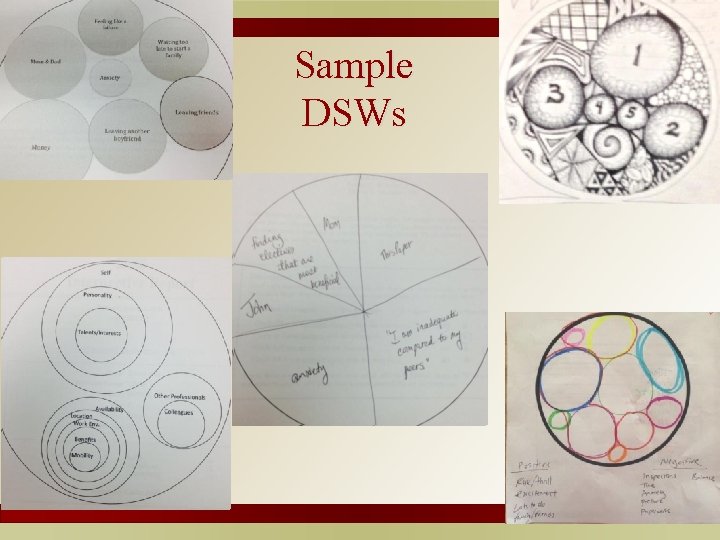
Sample DSWs
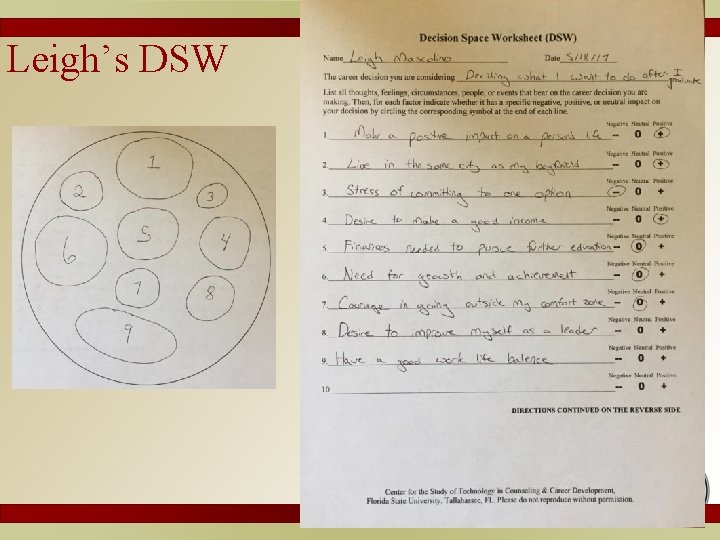
Leigh’s DSW
Next Steps with the DSW • Further readiness assessment? • Develop the ILP – – Readiness assessment Career assessment Options information Referrals for mental health concerns
Recap of Leigh’s Situation • • • What is the gap? Location in the pyramid Location in CASVE Cycle Readiness Considerations from DSW exercise
Individual Learning Plan
CIP Strategies & Interventions
Practical Strategies for Building Self -Knowledge?
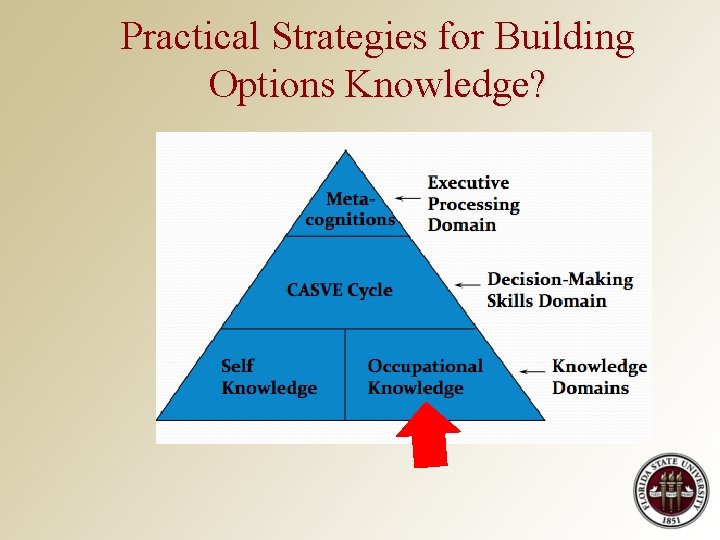
Practical Strategies for Building Options Knowledge?
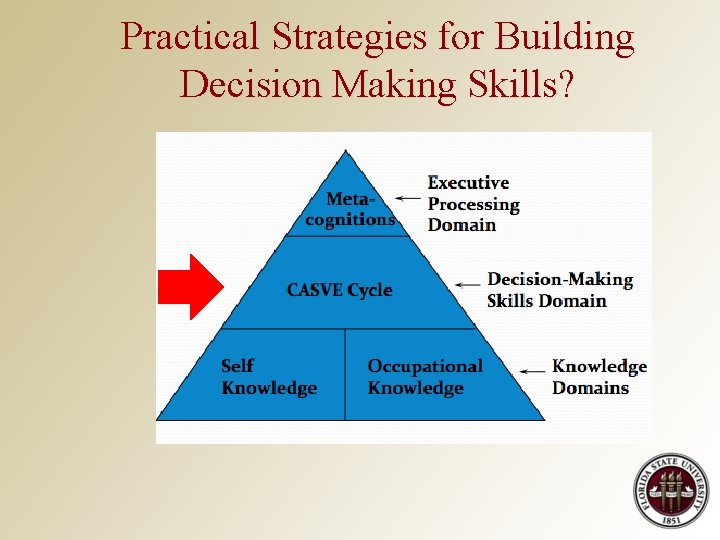
Practical Strategies for Building Decision Making Skills?
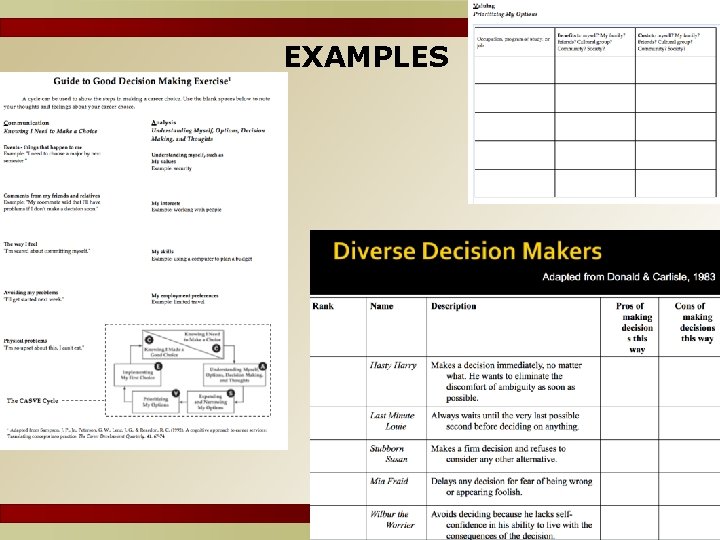
EXAMPLES
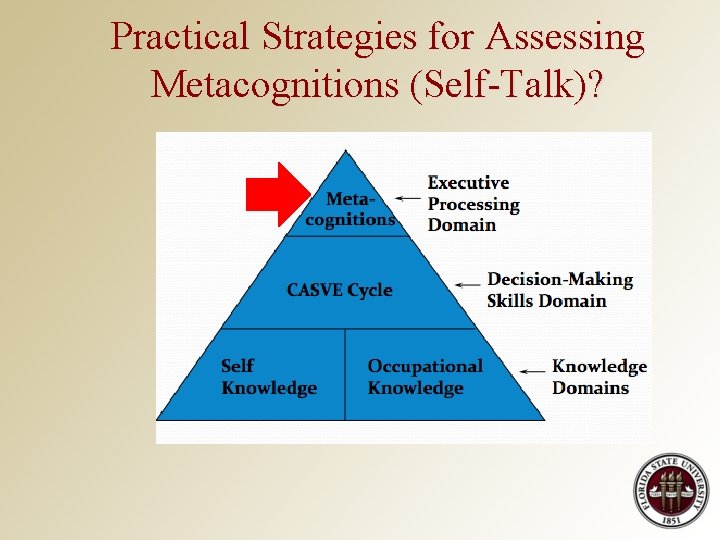
Practical Strategies for Assessing Metacognitions (Self-Talk)?
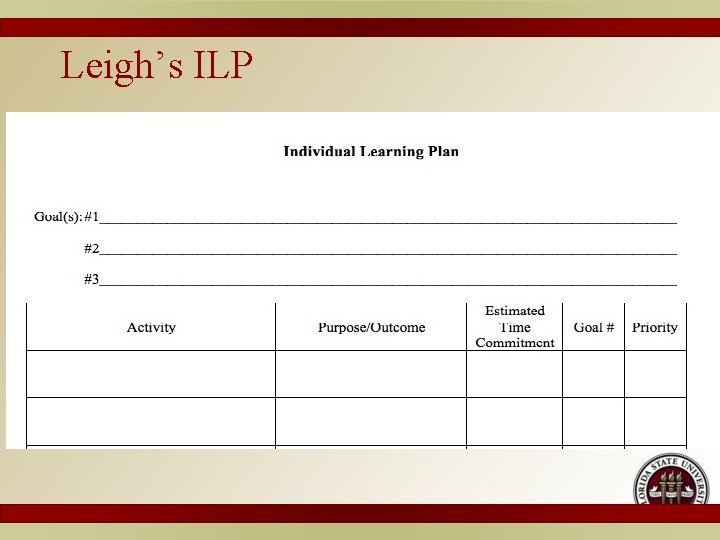
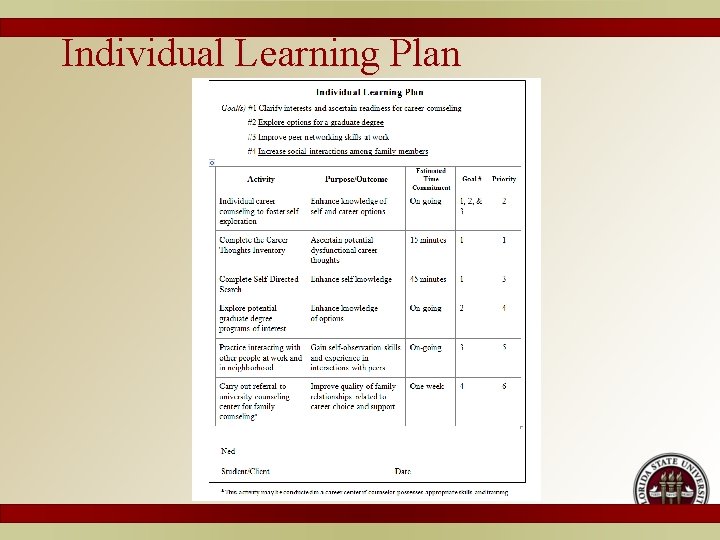
Leigh’s ILP
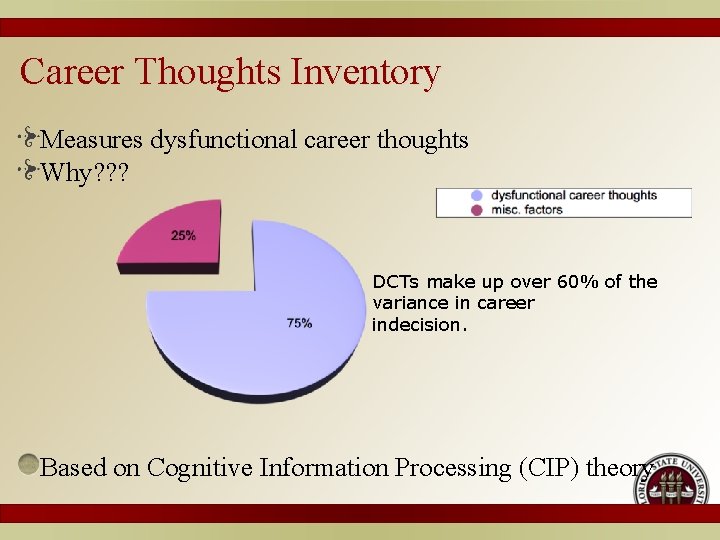
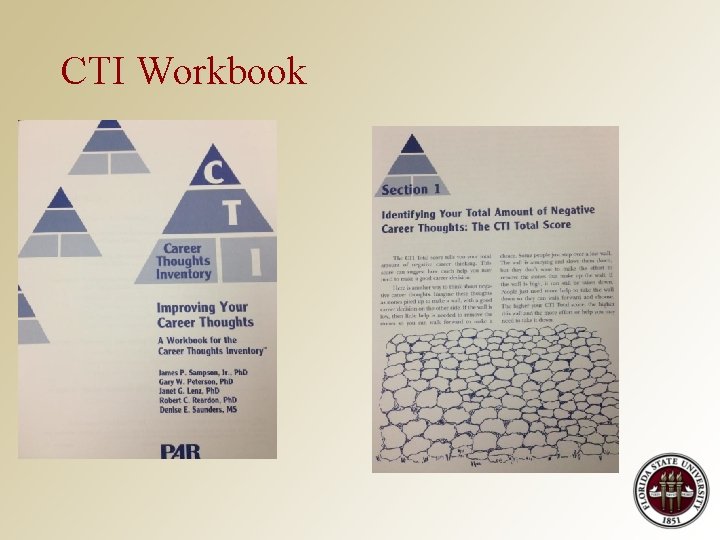
Career Thoughts Inventory Measures dysfunctional career thoughts Why? ? ? DCTs make up over 60% of the variance in career indecision. Based on Cognitive Information Processing (CIP) theory
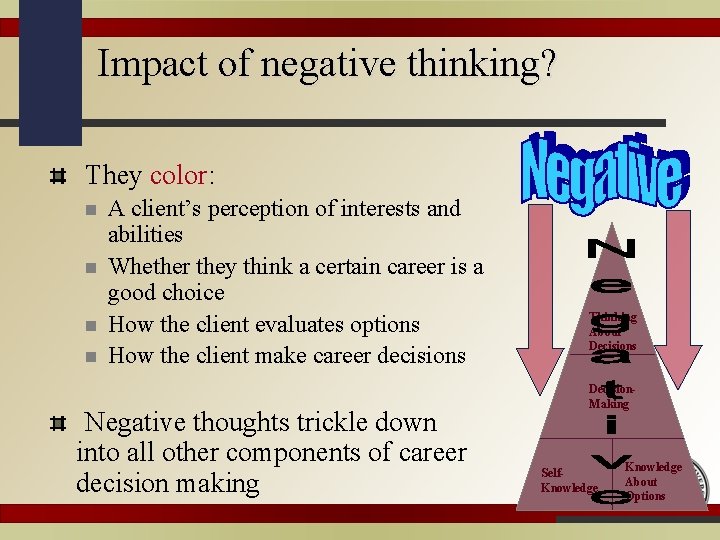
Impact of negative thinking? They color: n n A client’s perception of interests and abilities Whether they think a certain career is a good choice How the client evaluates options How the client make career decisions Negative thoughts trickle down into all other components of career decision making Thinking About Decisions Decision. Making Self. Knowledge About Options
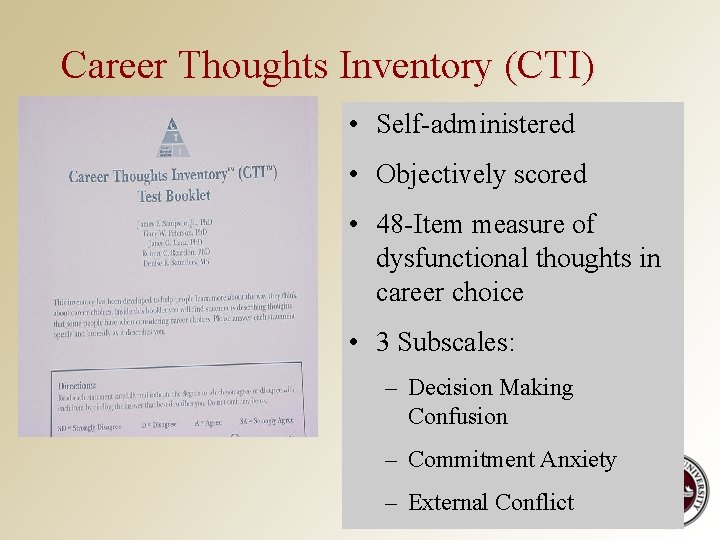
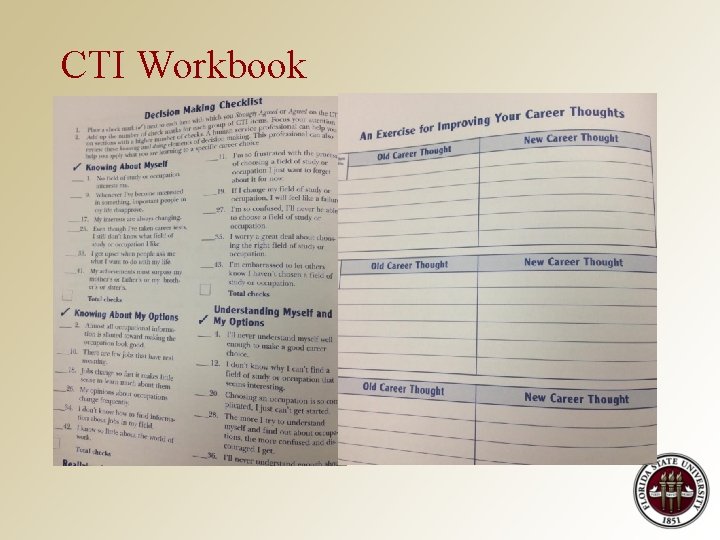
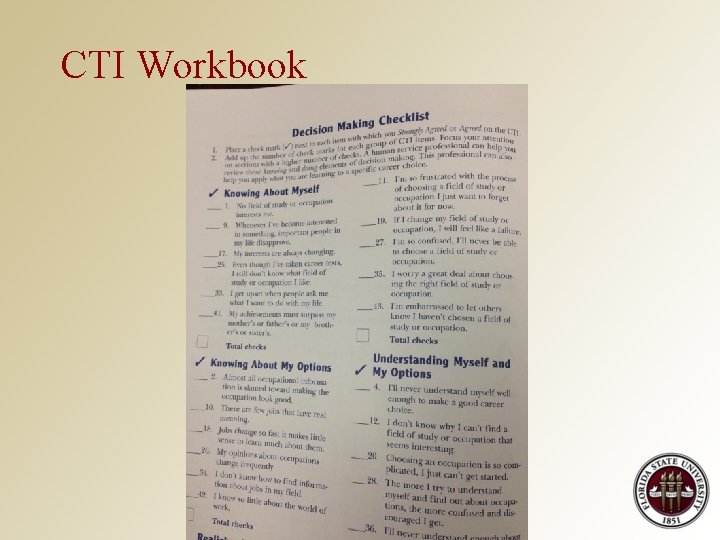
Career Thoughts Inventory (CTI) • Self-administered • Objectively scored • 48 -Item measure of dysfunctional thoughts in career choice • 3 Subscales: – Decision Making Confusion – Commitment Anxiety – External Conflict
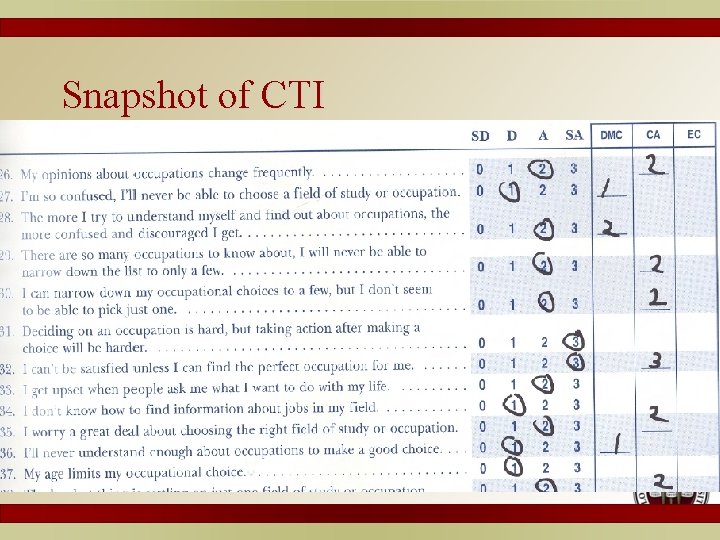
Snapshot of CTI
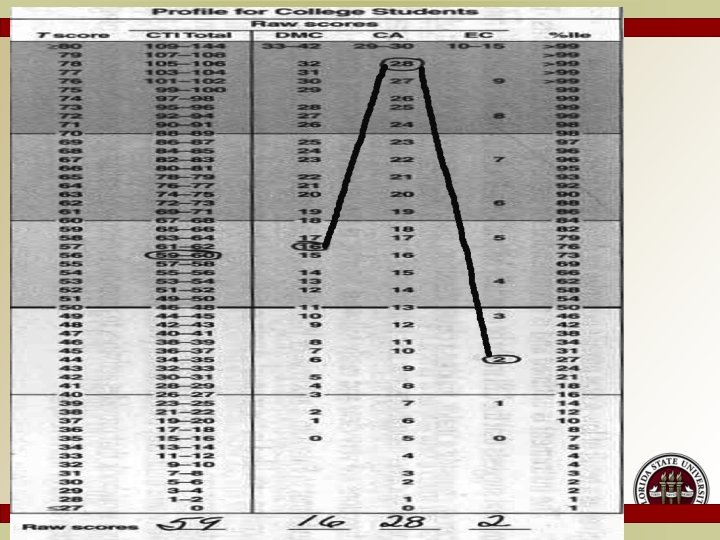
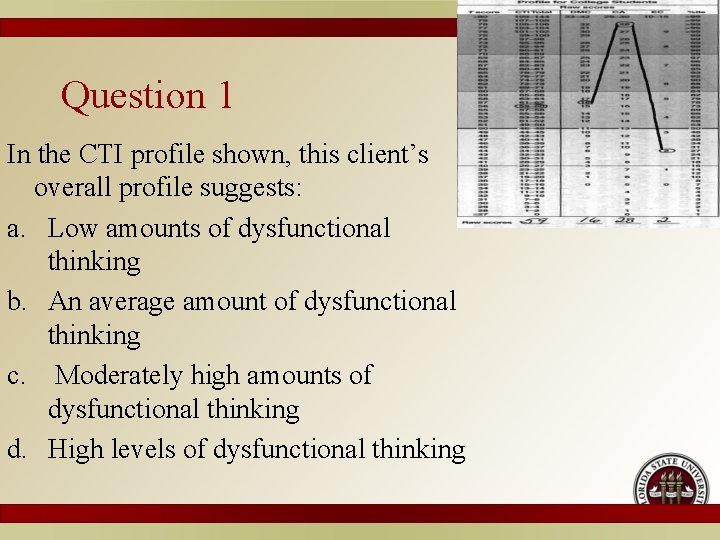
Question 1 In the CTI profile shown, this client’s overall profile suggests: a. Low amounts of dysfunctional thinking b. An average amount of dysfunctional thinking c. Moderately high amounts of dysfunctional thinking d. High levels of dysfunctional thinking
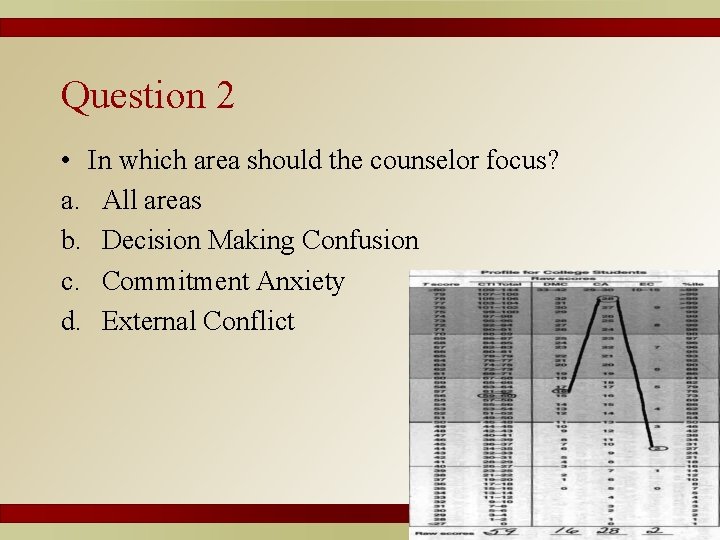
Question 2 • In which area should the counselor focus? a. All areas b. Decision Making Confusion c. Commitment Anxiety d. External Conflict
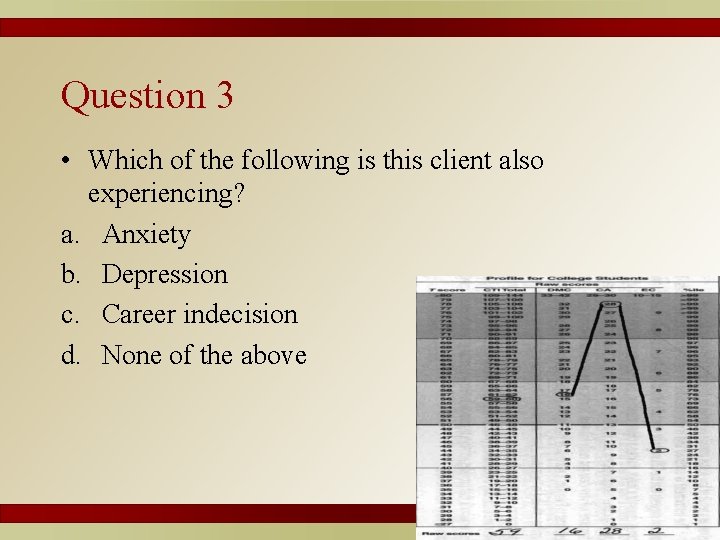
Question 3 • Which of the following is this client also experiencing? a. Anxiety b. Depression c. Career indecision d. None of the above
Question 4 • Which of the following item is most likely related to her highest area of concern? a. I’m afraid I’m overlooking an occupation. b. I get so depressed about making a decision that I can barely get started. c. My age limits my occupational choice. d. Whenever I become interested in something, important people in my life disagree. Reason for your answer?
Question 5 • Which is the best reframe for “My age limits my occupational choice”? a. It may make a difference to some, but others will see the benefit of my experience. b. If I don’t get a job offer, I can always file an age discrimination grievance. c. My age does not limit my choices. d. Nothing – it’s the truth. Reason for your answer?
Mental health constructs directly correlated with dysfunctional career thoughts indecision depression neuroticism hopelessness anxiety impulsivity angry hostility vulnerability
Sample Items • Finding a good job is just a matter of luck. • I’m embarrassed to let others know I haven’t chosen a career. • I know what job I want, but someone’s always putting obstacles in my way.
Case Study - Carolyn • Carolyn is a second semester Latina freshman at your university. • For as long as she can remember, she’s wanted to be a doctor, just like her grandmother. • When asked why, she says she wants to help people. • She was consistently on the Dean’s list in high school, and she’s received a scholarship for a pre-med scholarship. • She wants to be known as a medical leader within her community and serve as a mentor to other Latina high school students to go into medicine. • However, during her first semester, she struggled to make C’s in her science courses, despite hours of studying and working with a tutor. • During this current semester, she’s finding herself bored with her science courses, but enjoying her introduction to psychology course. • She says she’s terrified about failing out, and what everyone will think. • She’s talked with her parents about the dilemma, and while they say they’ll support anything she wants to do, they are quick to point out that there are lots of psychology majors flipping burgers at Mc. Donalds. • Her CTI Scores include Total (T=70), Decision Making Confusion (T = 71), Commitment Anxiety (T=51), External Conflict (T=80).
Consider… a) Where is the main problem located in the CIP pyramid? What proof do you have of this? b) Where is the client in the CASVE cycle? What is the evidence for this? c) Are dysfunctional thoughts evident? If so, in which area (decision-making confusion, commitment anxiety or external conflict)? What is the evidence for this? d) What is the client's level of readiness, and what type of support is needed? What is the evidence for this? e) What type of interventions would you recommend, and in what order? Give support for the interventions you suggest.
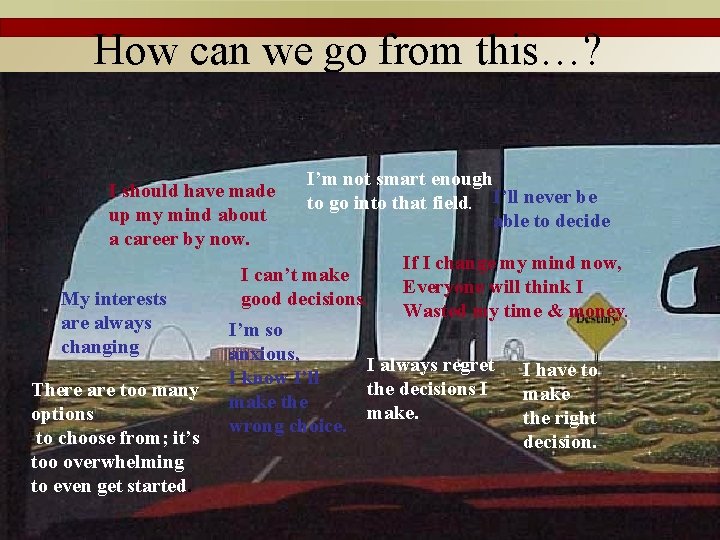
How can we go from this…? I should have made up my mind about a career by now. My interests are always changing There are too many options to choose from; it’s too overwhelming to even get started. I’m not smart enough to go into that field. I’ll never be able to decide I can’t make good decisions. I’m so anxious, I know I’ll make the wrong choice. If I change my mind now, Everyone will think I Wasted my time & money. I always regret the decisions I make. I have to make the right decision.

…To this? ? ?
CTI Workbook
CTI Workbook
CTI Workbook
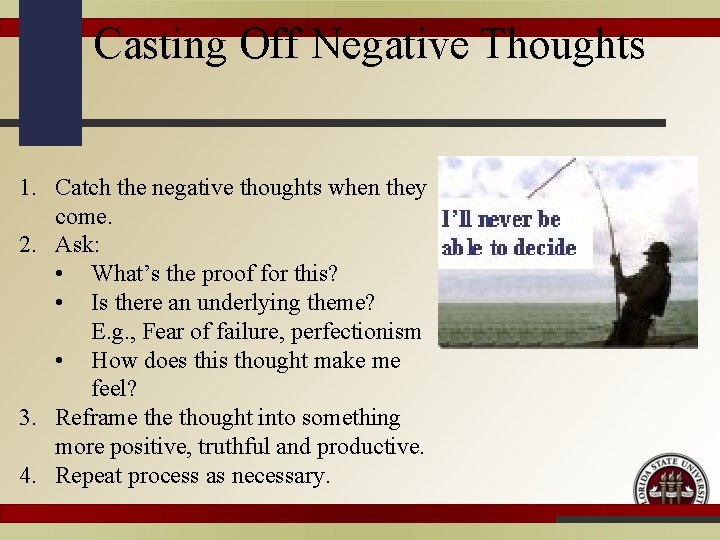
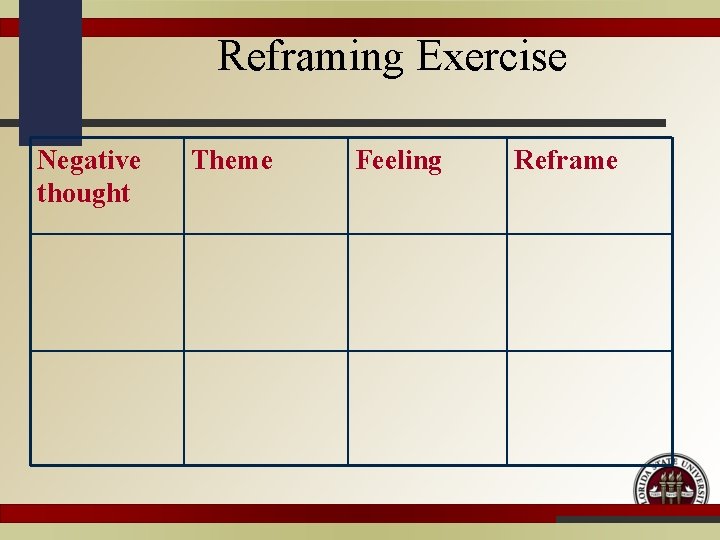
Casting Off Negative Thoughts 1. Catch the negative thoughts when they come. 2. Ask: • What’s the proof for this? • Is there an underlying theme? E. g. , Fear of failure, perfectionism • How does this thought make me feel? 3. Reframe thought into something more positive, truthful and productive. 4. Repeat process as necessary.
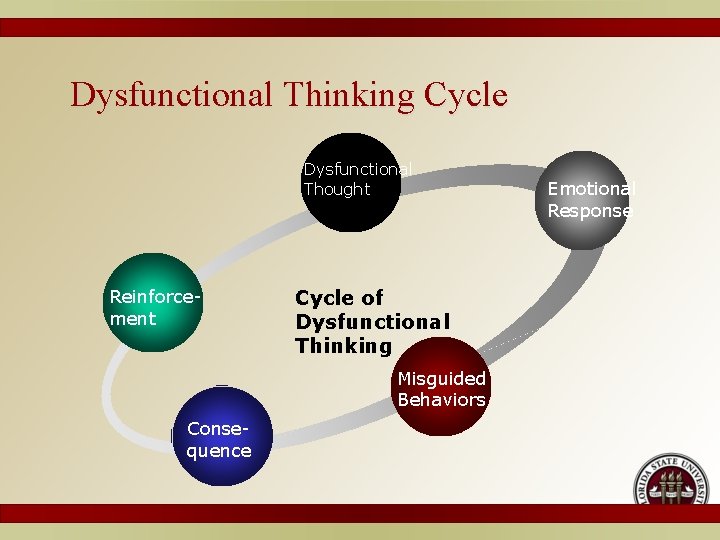
Dysfunctional Thinking Cycle Dysfunctional Thought Reinforcement Cycle of Dysfunctional Thinking Misguided Behaviors Consequence Emotional Response
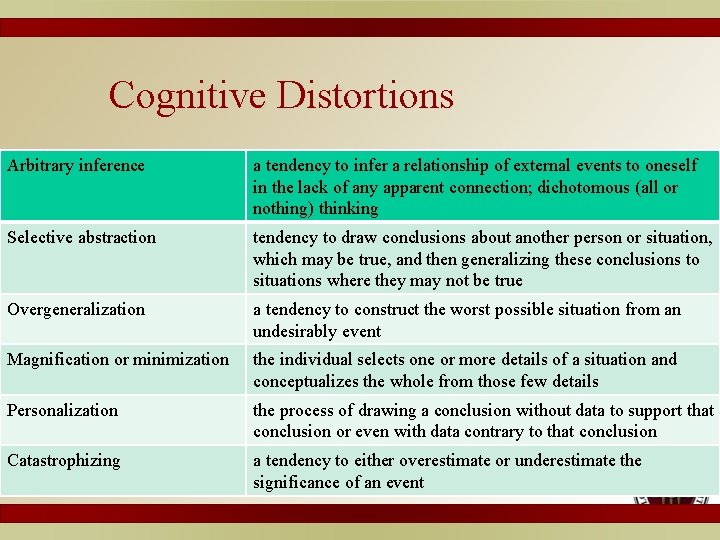
Cognitive Distortions Arbitrary inference a tendency to infer a relationship of external events to oneself in the lack of any apparent connection; dichotomous (all or nothing) thinking Selective abstraction tendency to draw conclusions about another person or situation, which may be true, and then generalizing these conclusions to situations where they may not be true Overgeneralization a tendency to construct the worst possible situation from an undesirably event Magnification or minimization the individual selects one or more details of a situation and conceptualizes the whole from those few details Personalization the process of drawing a conclusion without data to support that conclusion or even with data contrary to that conclusion Catastrophizing a tendency to either overestimate or underestimate the significance of an event
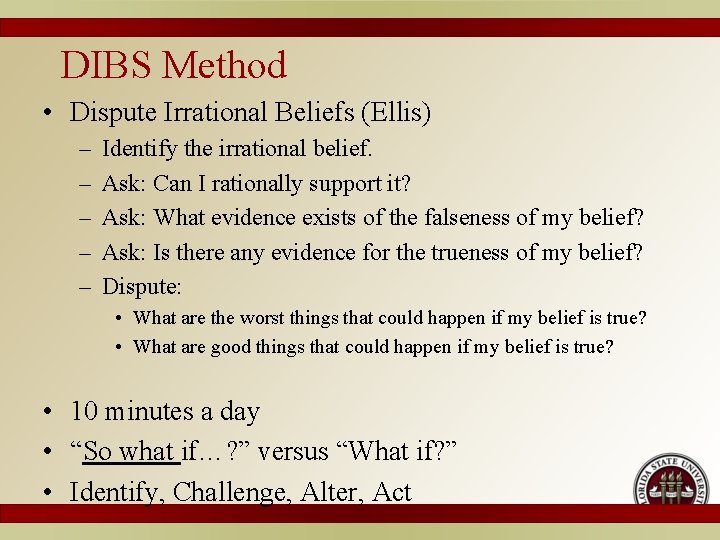
DIBS Method • Dispute Irrational Beliefs (Ellis) – – – Identify the irrational belief. Ask: Can I rationally support it? Ask: What evidence exists of the falseness of my belief? Ask: Is there any evidence for the trueness of my belief? Dispute: • What are the worst things that could happen if my belief is true? • What are good things that could happen if my belief is true? • 10 minutes a day • “So what if…? ” versus “What if? ” • Identify, Challenge, Alter, Act
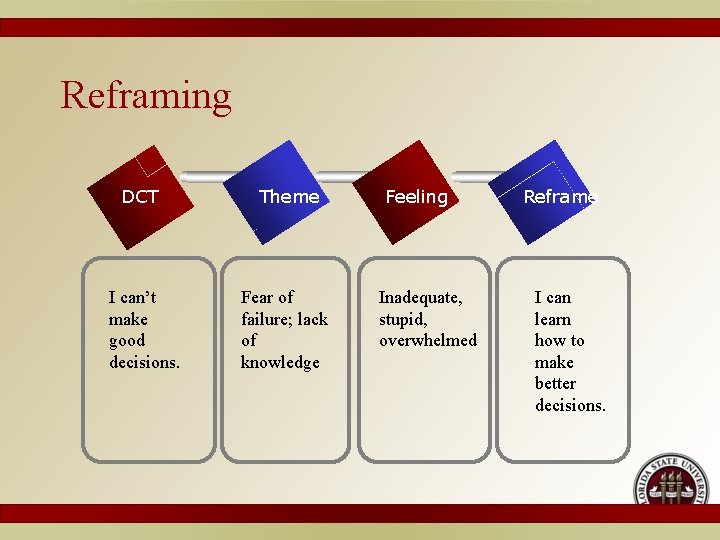
Reframing DCT I can’t make good decisions. Theme Fear of failure; lack of knowledge Feeling Inadequate, stupid, overwhelmed Reframe I can learn how to make better decisions.
Reframing Exercise Negative thought Theme Feeling Reframe
Summary • CIP offers simple structures to the sometimes chaotic and complex nature of career decision making. • CIP provides a guide for understanding where a client is and for pinpointing relevant interventions. • CIP offers tools to aid career practitioners in their work. • CIP continues to generate research and has an ongoing bibliography.
For More Information www. career. fsu. edu/techcenter dosborn@fsu. edu
- Slides: 60