
Cognitive grammar Cognitive grammar binds together the philosophical
Cognitive grammar

Cognitive grammar binds together the philosophical and practical sides of literary investigation.
It offers a grounding of critical theory in a philosophical position that is scientific in the modern sense: aiming for an account of natural phenomena (like reading) that represents our current best understanding while always being open to falsibility and a better explanation.
It avoids the trap of circularity by deriving analytical methods not from within literary reading but from fields of linguistics and psychology.
In general, cognitive grammar is concerned with addressing the central issue of how the conceptual structures are manifest and actualized in language.
Links with literary critical concepts The main direction in linguistic history is shown in the generation of abstract and highly theoretical models away from the actuality of language forms. These abstract structures are presented as conceptual constructs – sometimes as universals across all languages – that constrain and determine the forms in which different languages appear.
A cognitive grammar in particular must build its conceptual constructs out of language in its psychological and social circumstances of use.
Cognitive poetics = Cognitive Stylistics = Cognitive Rhetoric
Cognitive Poetics has been embraced first in literary studies by those who have practiced stylistics, that used to have a rigorous and systematic analysis of literature, But nowadays more recently stylistics has embraced advances in psychology, social theory and discourse analysis, as well as the philosophy of language and critical theory.
All this means, that a concern for ‘literary analysis’ includes the complex consideration of the connections between the particular texture of literary works, their relationship with other patterns in the literary and linguistic system, effects derived in the process of literary reading.
Stylistics has to be sensitive to many different disciplines. Interdisciplinary approach to literary analysis It means that the practical analysis of literary texture is placed at the forefront of study, rather than being an offshoot or consequence of it. Theoretical advances come partly out of detailed stylistic analysis, and language study is fast becoming the unified discipline at the center of the various literary studies.
Stylistic protopypicality This approach to grammatical realizations has been applied much more widely and radically in cognitive linguistics.
A subject in a clause can be regarded as prototypical if it is also the agent and topic. The topicality of subject can itself be understood as a prototype structure, along four dimensions as summarized in the diagram below.
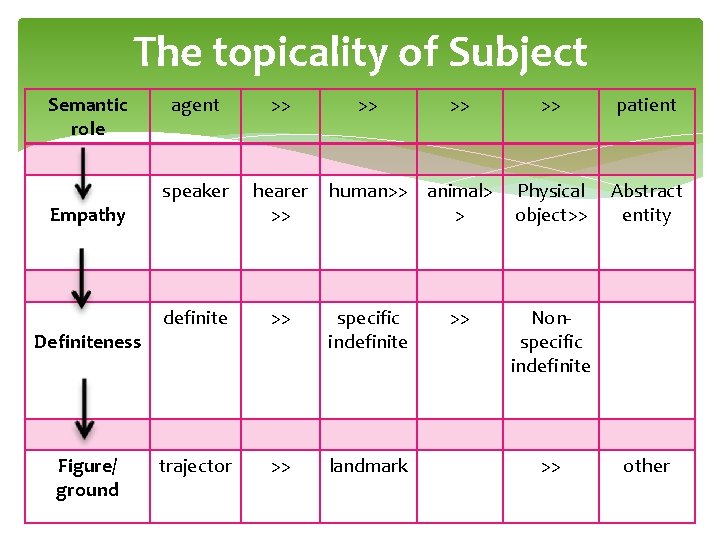
The topicality of Subject Semantic role Empathy Definiteness Figure/ ground agent >> speaker hearer >> definite trajector >> >> >> patient human>> animal> > Physical object>> Abstract entity >> specific indefinite Nonspecific indefinite >> landmark >> >> other
So, a subject depends primarily on its semantic role in the event that is being expressed, and secondarily on the degree of empathy that people typically have with the entity, then its definiteness, and finally its figure/ground organization as subjectively perceived.
Taking semantic role first, a subject is prototypically the agent in a clause, rather than functioning in the patient role. Choosing a patient as the subject (such as in a passive) is a marked expression that requires some special explanatory motivation: defamiliarisation, or evading active responsibility, or encoding secrecy, etc.

Subject is expected to be… Speaker >> Hearer >> Human >> >> Animal >> Physical object >> >>Abstract entity
Definiteness is more subjectively decided, depending on the reader`s prior contact with the subject. Definite subjects (‘the town’, ’that man’) are generally preferred to indefinites, and specific indefinites (‘a certain Mrs Jones’, ‘a girl I knew’ ) are preferred to non-specific ones (‘a girl’).
Lastly, subjects are usually seen as figures or trajectors, then as primary landmarks, and then as background or other secondary landmarks.
Action chains The roles that different participants (whether people, animal, rocks) play in the cognitive model underlying a clause are based on role archetypes. These roles constitute the basic thematic relationships expressed by a clause, and can be summarized in the following diagram:

zero Agent Patient Instrument Experiencer Mover absolute theme
An agent is an acting participant who wilfully causes things to move, in a whole range of situations that are generalizable. A patient is the participant that receives the energy of a predicate. It is changed in some identifiable and attributive way. An instrument is a participant which is used by the agent. An experiencer is a participant which is the location for a mental perception, such as thought, emotion, viewing or even saying. A mover is a participant which physically moves to another location.
Where the participant merely exists but does not actually do anything (‘His face was red’, ‘She was there’), no energy has been transmitted and its semantic role is zero. Since all participants begin fundamentally with existence and attributes, all roles are also zero by default.
Sometimes a participant is unchanged in a predication (the objects in ‘I love Paris’, ‘I have a copy of the book’) and it can then be called an absolute.
Events can be presented as if they occur autonomously (‘The glass broke’, ‘The tree fell over’) – here the participant is a theme, where the relationship to agent, patient, experiencer or mover is verbally expressed as action, change of state, mental experience or motion.
In cognitive linguistics, predications are seen in this way as action chains.
In an active clause, the agent acts as the head of an action chain, which moves through several stages perhaps including an instrument to arrive at the tail of the action chain with the patient.
A part of the background is called setting. The processes and roles are cognitively part of domains which can be realized in a variety of ways. It is a principle of cognitive linguistics that there is no necessary one-to-one link between a linguistic form and its cognitive domain.
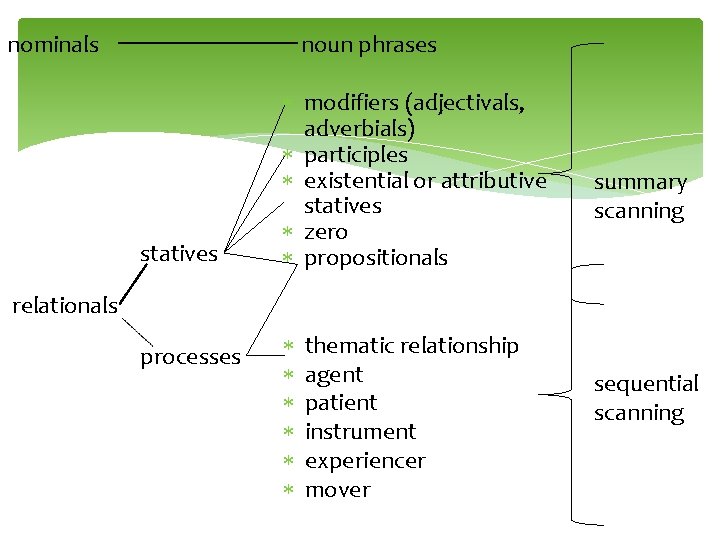
nominals noun phrases statives modifiers (adjectivals, adverbials) participles existential or attributive statives zero propositionals summary scanning relationals processes thematic relationship agent patient instrument experiencer mover sequential scanning

Summary scanning is typically what happens when the nominals are processed: attributes are collected into a single coherent gestalt that constitutes an element.
As a conclusion, we can distinguish different cognitive impacts between nominals and relationals, between stative processes and active processes, and between the different semantic roles played by participants in those processes, viewed against their non-participating settings.

Halliday`s systemic-functional linguistics Metafunctions in language: vthe interpersonal; vthe textual; vthe ideational
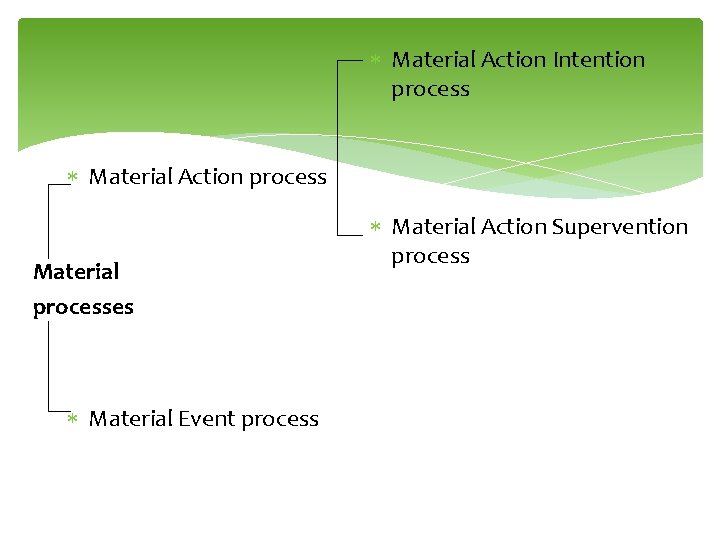
Material Action Intention process Material Action process Material processes Material Event process Material Action Supervention process
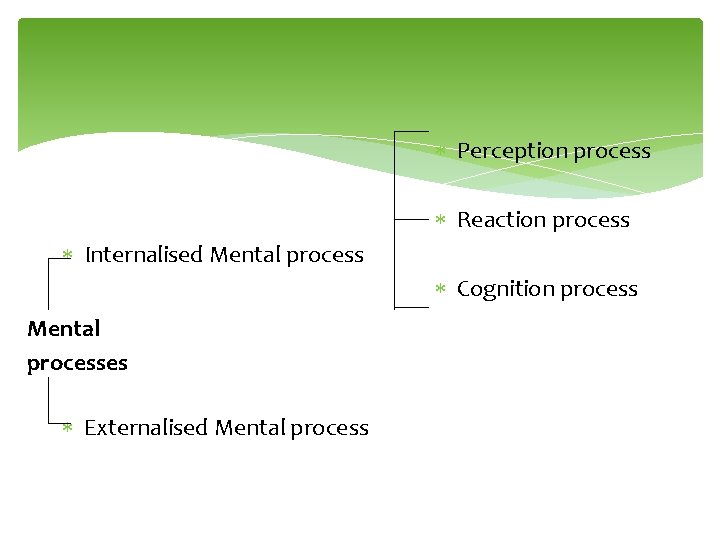
Perception process Reaction process Internalised Mental process Cognition process Mental processes Externalised Mental process
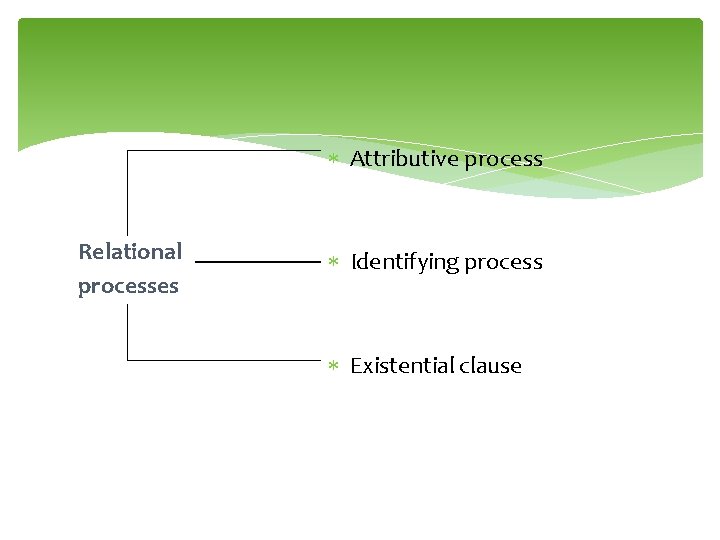
Attributive process Relational processes Identifying process Existential clause
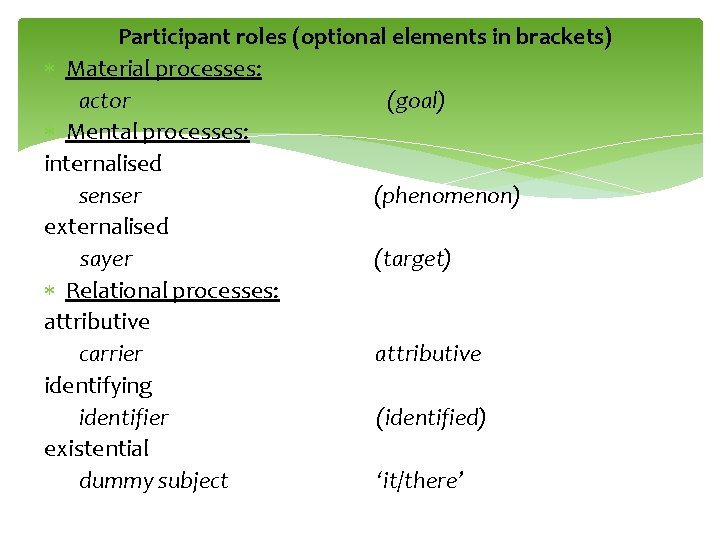
Participant roles (optional elements in brackets) Material processes: actor (goal) Mental processes: internalised senser (phenomenon) externalised sayer (target) Relational processes: attributive carrier attributive identifying identifier (identified) existential dummy subject ‘it/there’
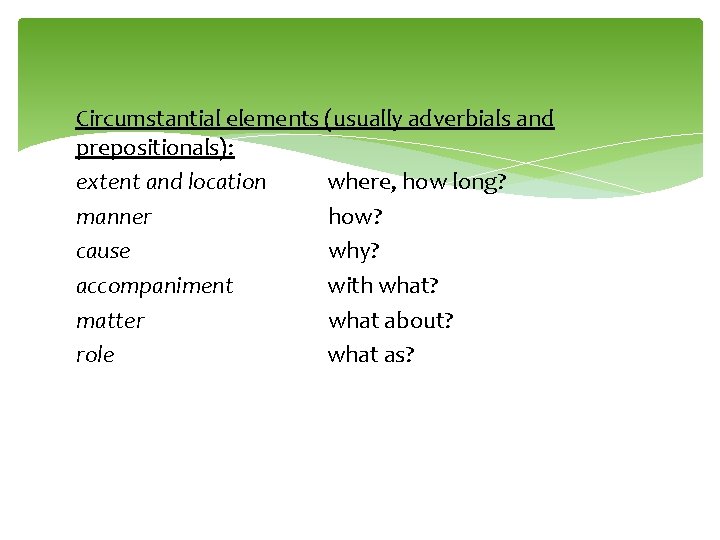
Circumstantial elements (usually adverbials and prepositionals): extent and location where, how long? manner how? cause why? accompaniment with what? matter what about? role what as?
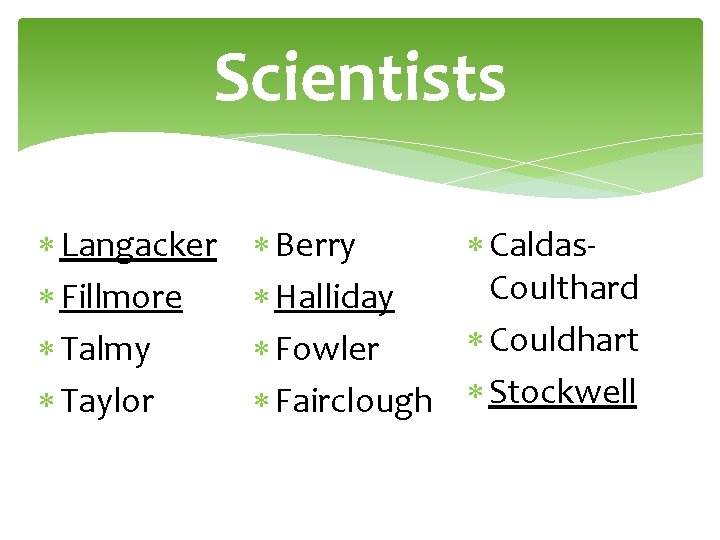
Scientists Langacker Fillmore Talmy Taylor Berry Caldas. Coulthard Halliday Couldhart Fowler Fairclough Stockwell
Thank you for attention! Have a nice after-uni-time!: )
- Slides: 39