
Cognitive Dimensions u Developed by Thomas Green Univ
Cognitive Dimensions u Developed by Thomas Green, Univ. of Leeds u Used to analyze the usability of information artifacts u Applied to discover useful things about usability problems that are not easily analyzed using conventional techniques u Framework (as opposed to model or theory)
Cognitive Dimensions (2) u Focused on notations, such as u And on information handling devices, such as – Music – Dance – Programming languages – Spreadsheets – Database query systems – Word-processors – VCRs and DVD players – Cell phones
Cognitive Dimensions (3) u Gives descriptions of aspects, attributes, or ways that a user thinks about a system, called dimensions u The 14 dimensions follow:
Viscosity u Resistance to change – Fixed mental model – Hard-coded structure u Examples: – Technical literature, with crossreferences and section headings (because introducing a new section requires many changes to crossreferences)

Visibility u Ability to view components easily u Non-encapsulation u Examples:
Premature Commitment u Constraints on order of operations – Noun/verb – Verb/noun – Syntax of operations u Examples: – Declarations required before problem analysis
Hidden Dependencies u Important not visible u Examples: links between entities are – class hierarchies – HTML links – spreadsheet cells
Role-Expressiveness u Purpose of an entity is readily inferred (or obvious) u Uniform vs. distinguishing appearance of objects u Examples:
Error-Proneness u Notations (or actions) invite mistakes and the system gives little protection u Examples:
Abstraction u Types and availability of abstraction mechanisms u Examples:
Secondary Notation u Extra information in means other than formal syntax u Examples: – Comments in programming languages – Pop-up boxes for icons – Well-designed icons
Closeness of Mapping u Closeness domain u Examples: of representation to
Consistency u Similar semantics are expressed in similar syntactic forms u Examples:
Diffuseness u Verbosity of language u Examples:
Hard Mental Operations u High demand on cognitive resources u Examples:
Provisionality u Degree of commitment to actions or marks u Examples:
Progressive Evaluation u Work to date can be checked at any time u Examples:
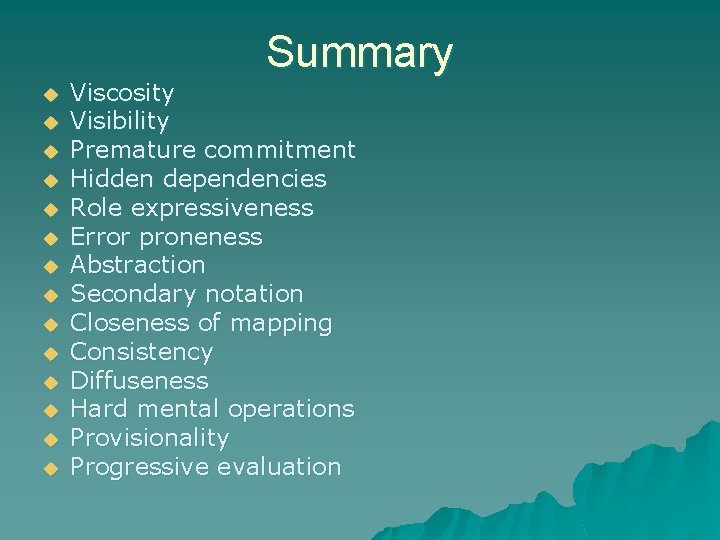
Summary u u u u Viscosity Visibility Premature commitment Hidden dependencies Role expressiveness Error proneness Abstraction Secondary notation Closeness of mapping Consistency Diffuseness Hard mental operations Provisionality Progressive evaluation

Supplementary Material u Cognitive Dimensions of Notations website www. cl. cam. ac. uk/~afb 21/Cognitive. Di mensions u 10 th Anniversary CD of Notations Workshop www. cl. cam. ac. uk/~afb 21/Cognitive. Di mensions/workshop 2005/index. html

Supplementary Material (2) u u Sally Fincher, Patterns in HCI Marian Petre, Expert Design Reasoning
- Slides: 20