
Cognitive Development Piaget believed that the driving force
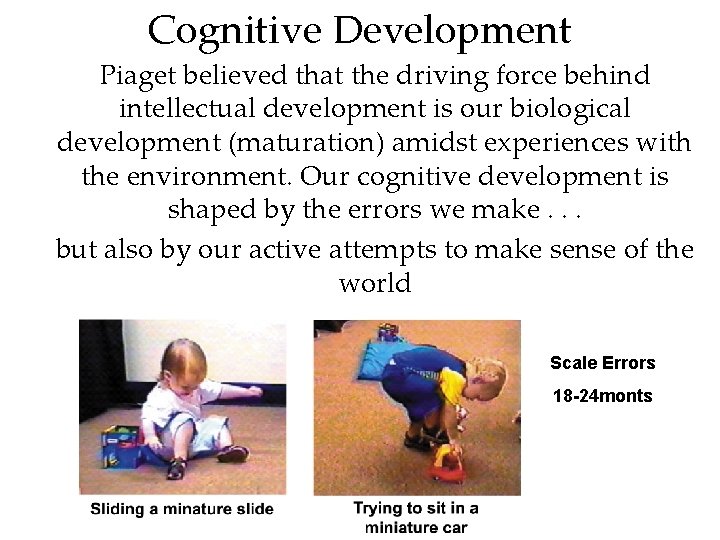
Cognitive Development Piaget believed that the driving force behind intellectual development is our biological development (maturation) amidst experiences with the environment. Our cognitive development is shaped by the errors we make. . . but also by our active attempts to make sense of the world Scale Errors 18 -24 monts
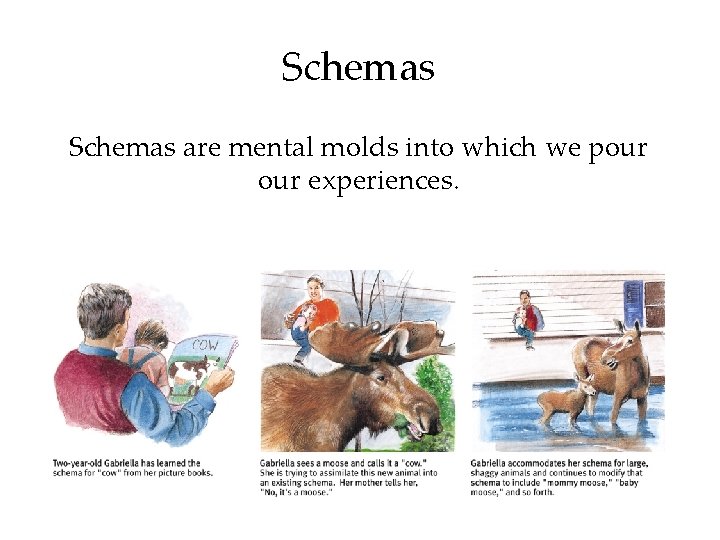
Schemas are mental molds into which we pour experiences.
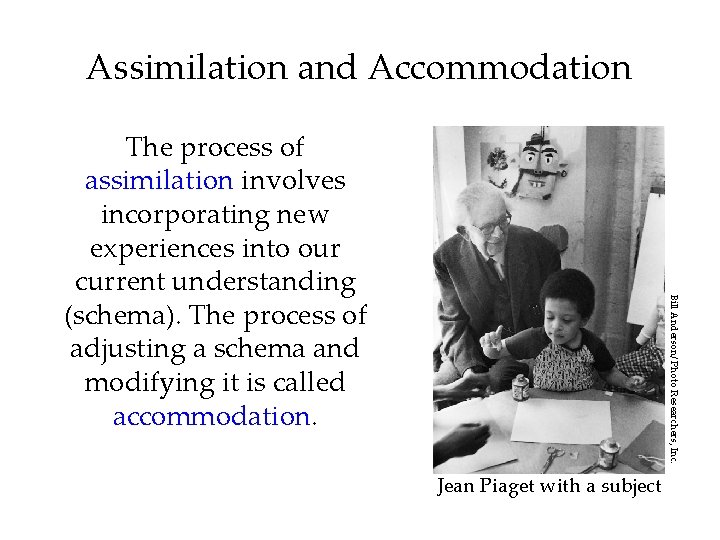
Assimilation and Accommodation Bill Anderson/ Photo Researchers, Inc. The process of assimilation involves incorporating new experiences into our current understanding (schema). The process of adjusting a schema and modifying it is called accommodation. Jean Piaget with a subject
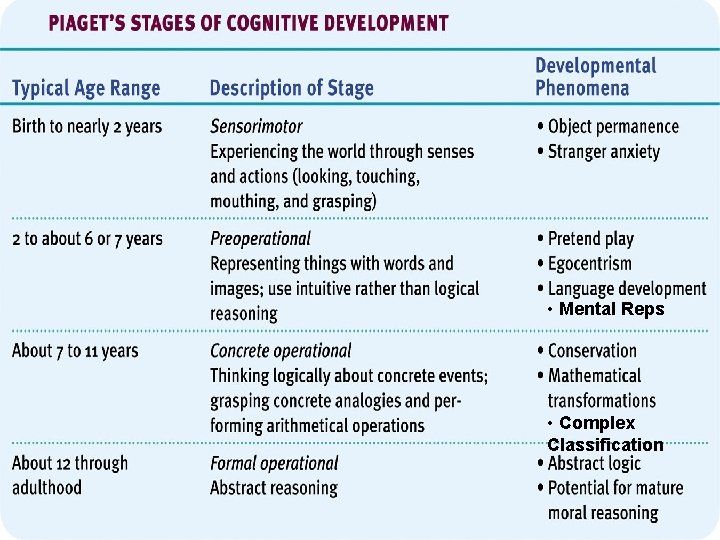
• Mental Reps • Complex Classification
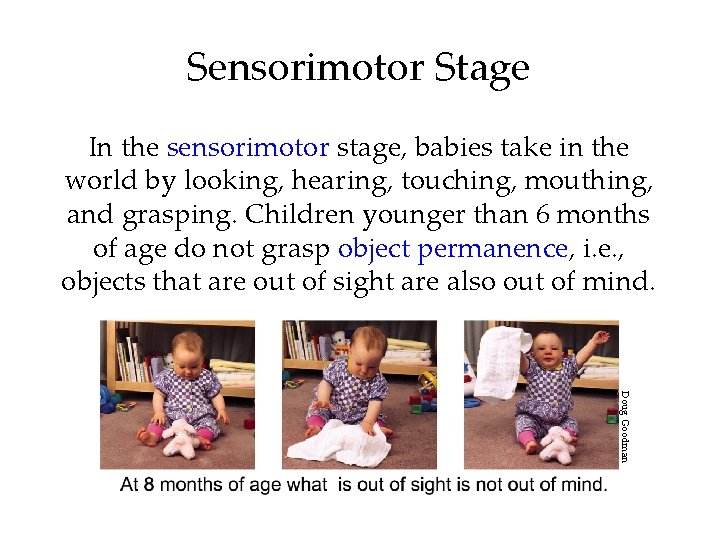
Sensorimotor Stage In the sensorimotor stage, babies take in the world by looking, hearing, touching, mouthing, and grasping. Children younger than 6 months of age do not grasp object permanence, i. e. , objects that are out of sight are also out of mind. Doug Goodman
Cognitive Phenomena • Stranger Anxiety • Separation Anxiety (depends on attachment to the parent) • Sense of Self
Sensorimotor Stage: Criticisms Piaget believed children in the sensorimotor stage could not think —they do not have any abstract concepts or ideas. However, recent research shows that children in the sensorimotor stage can think and count. 1. Children understand the basic laws of physics. They are amazed at how a ball can stop in midair or disappear.
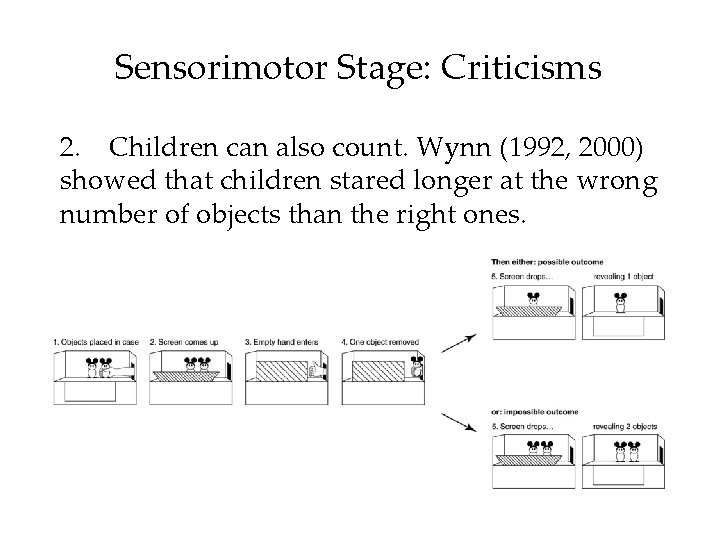
Sensorimotor Stage: Criticisms 2. Children can also count. Wynn (1992, 2000) showed that children stared longer at the wrong number of objects than the right ones.
Preoperational Stage Piaget suggested that from 2 years old to about 6 -7 years old, children are in the preoperational stage—too young to perform mental operations. Ontario Science Center
Preoperational Stage §De. Loache (1987) showed that children as young as 3 years of age are able to use metal operations. When shown a model of a dog’s hiding place behind the couch, a 2½-year-old could not locate the stuffed dog in an actual room, but the 3 -year-old did. §Mental Representations are fully formed §Hence language development and pretend play
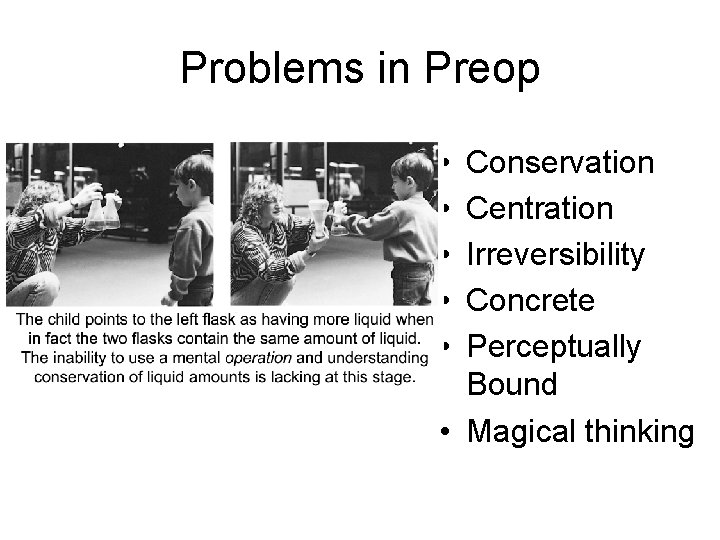
Problems in Preop • • • Conservation Centration Irreversibility Concrete Perceptually Bound • Magical thinking
Problems in Preop cont’d Egocentrism Children cannot perceive things from another’s point of view. When asked to show her picture to mommy, 2 year-old Gabriella holds the picture facing her own eyes, believing that her mother can see it through her eyes.
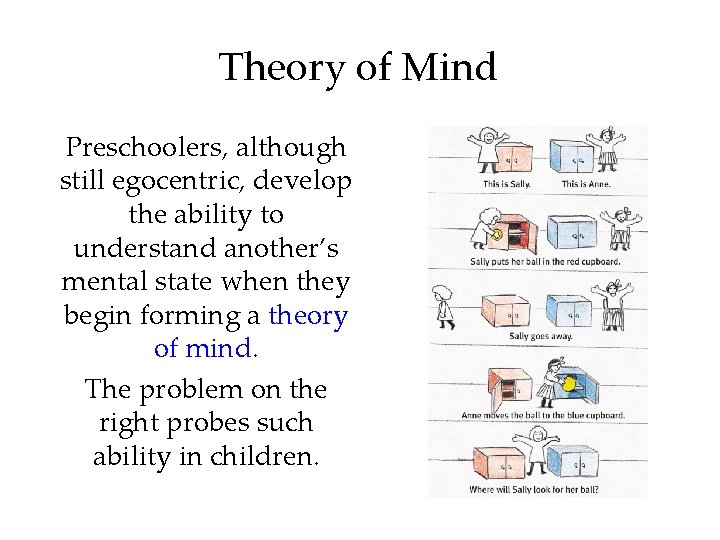
Theory of Mind Preschoolers, although still egocentric, develop the ability to understand another’s mental state when they begin forming a theory of mind. The problem on the right probes such ability in children.
Concrete Operational Stage In concrete operational stage, given concrete materials, 6 - to 7 -year-olds grasp conservation problems and mentally pour liquids back and forth into glasses of different shapes conserving their quantities. Children in this stage are also able to transform mathematical functions. So, if 4 + 8 = 12, then a transformation, 12 – 4 = 8, is also easily doable.
Formal Operational Stage Around age 12, our reasoning ability expands from concrete thinking to abstract thinking. We can now use symbols and imagined realities to systematically reason. Piaget called this formal operational thinking.
Formal Operational Stage Rudiments of such thinking begin earlier (age 7) than what Piaget suggested, since 7 -year-olds can solve the problem below (Suppes, 1982). If John is in school, Mary is in school. John is in school. What can you say about Mary?
Reflecting on Piaget’s Theory Piaget’s stage theory has been influential globally, validating a number of ideas regarding growth and development in many cultures and societies. However, today’s researchers believe the following: 1. Development is a continuous process. 2. Children express their mental abilities and operations at an earlier age. 3. Formal logic is a smaller part of cognition.
• Star Wars according to a 3 year old
- Slides: 18