
Cognitive Development in Infancy and Childhood Piagets Cognitive
- Slides: 19
Cognitive Development in Infancy and Childhood: Piaget’s Cognitive Stages
Question to ponder Do Kids think differently than adults? Do freshmen think differently than Seniors?
Cognition • All the mental activities associated with thinking, knowing, and remembering • Children think differently than adults
Jean Piaget (pee-ah-ZHAY) • Developmental psychologist who introduced a stage theory of cognitive development
Stage 1 - Sensorimotor Stage • From birth to about age two • Child gathers information about the world through senses and motor functions • Child learns object permanence
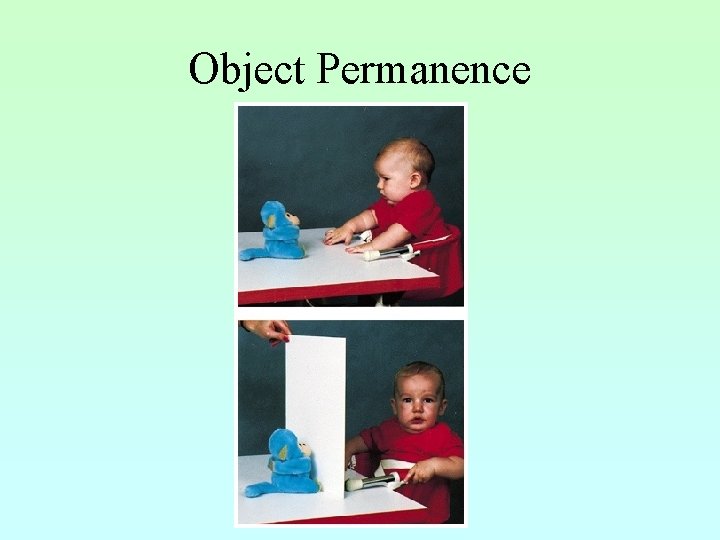
Object Permanence • The awareness that things continue to exist even when they cannot be sensed • “Out of sight, out of mind”
Object Permanence
Stage 2 - Preoperational Stage • From about age 2 to age 6 or 7 • Children can understand language but not logic • Fantasy Play
Preoperational 1. Symbolic functioning – is that a child uses to represent something that is not physically present like the use of mental symbols, words, or pictures
Preoperational - Egocentrism • The child’s inability to take another person’s point of view • Includes a child’s ability to understand that symbols can represent other objects
Stage 3 - Concrete Operational Stage • From about age 7 to 11 • Child learns to think logically and understands conservation • Present oriented
Concrete operational 1. Decentering – this is where a child considers all aspects of a problem to solve it 2. Elimination of egocentrism – kids can begin to see the others point of view
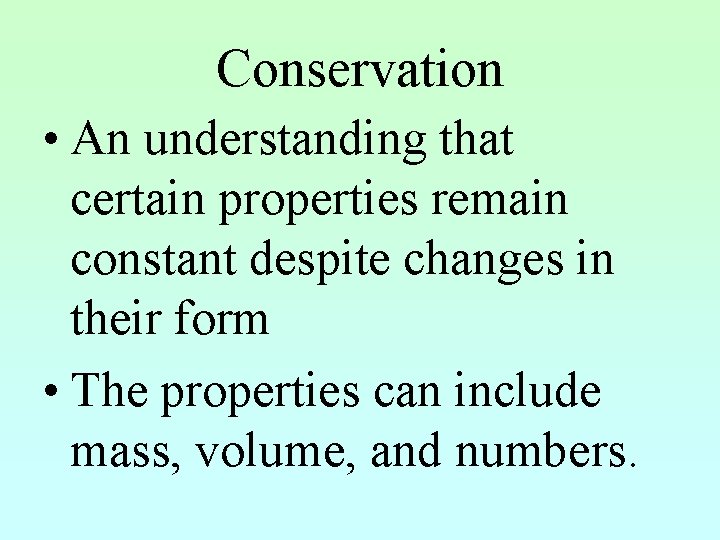
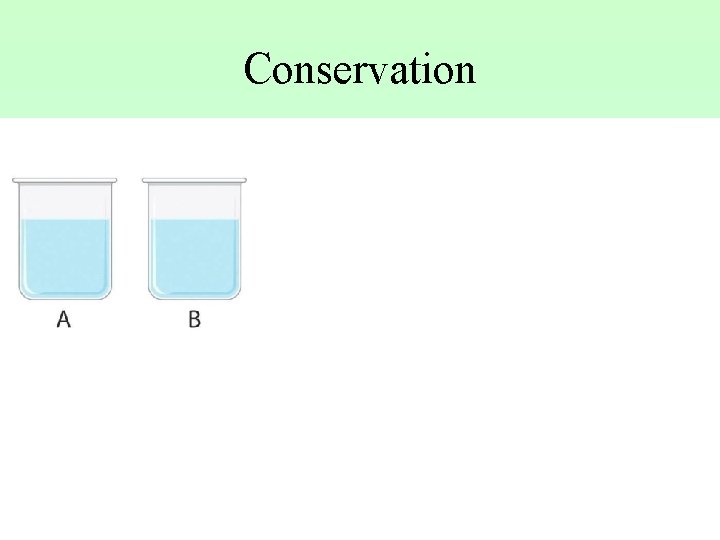
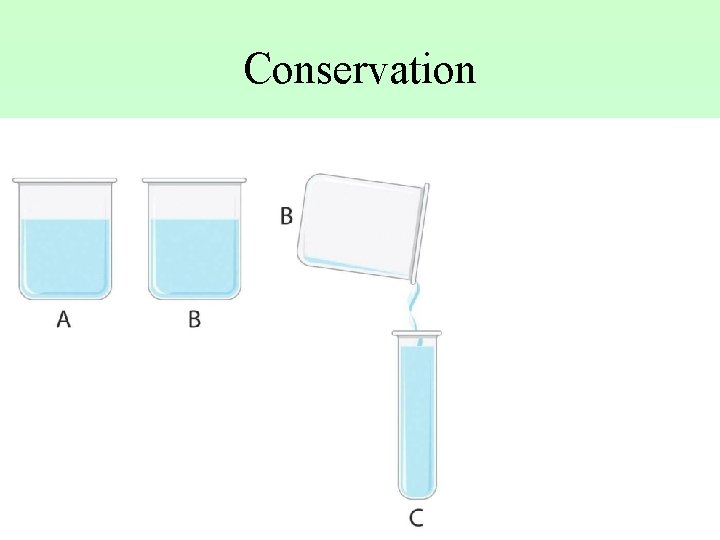
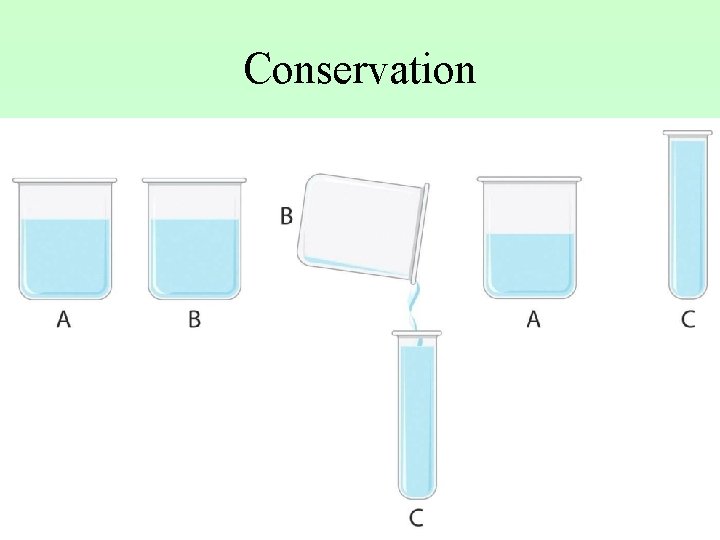
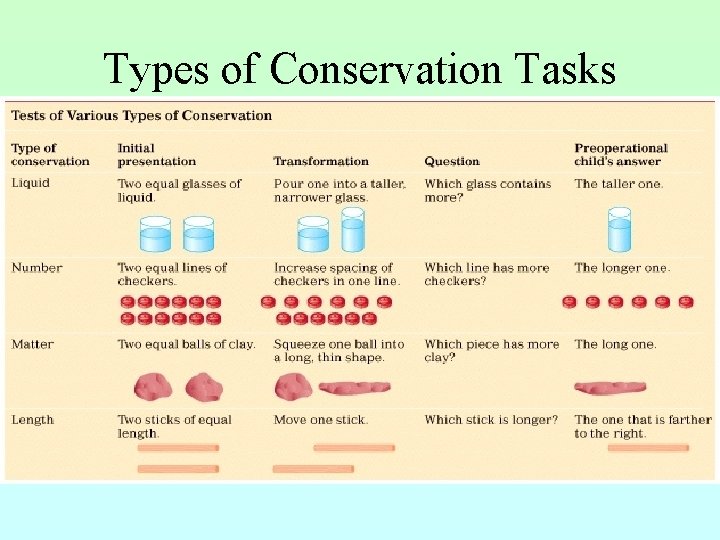
Conservation • An understanding that certain properties remain constant despite changes in their form • The properties can include mass, volume, and numbers.
Conservation
Conservation
Conservation
Types of Conservation Tasks
Stage 4 - Formal Operational Stage • Child can think logically and in the abstract • About age 12 on up • Can solve hypothetical problems (What if…. problems)
Assessing Piaget’s Theory • Piaget underestimated the child’s ability at various ages. Children can comprehend, but may not be able to report the information • Piaget’s theory doesn’t take into account culture and social differences.