
Cognitive Development during the First Three Years CHAPTER


- Slides: 38
Cognitive Development during the First Three Years CHAPTER 5 Copyright © 2015 Mc. Graw-Hill Education. All rights reserved. No reproduction or distribution without the prior written consent of Mc. Graw-Hill Education.
Learning Objectives 5. 1 Identify six approaches to the study of cognitive development 5. 2 Describe how infants learn and remember 5. 3 Discuss infant assessment measures and the prediction of intelligence 5. 4 Summarize and evaluate Piaget’s theory of cognitive development 5. 5 Explain how infants process information and begin to understand the characteristics of the physical world 5. 6 Describe the development of language infancy © 2015 Mc. Graw-Hill Education
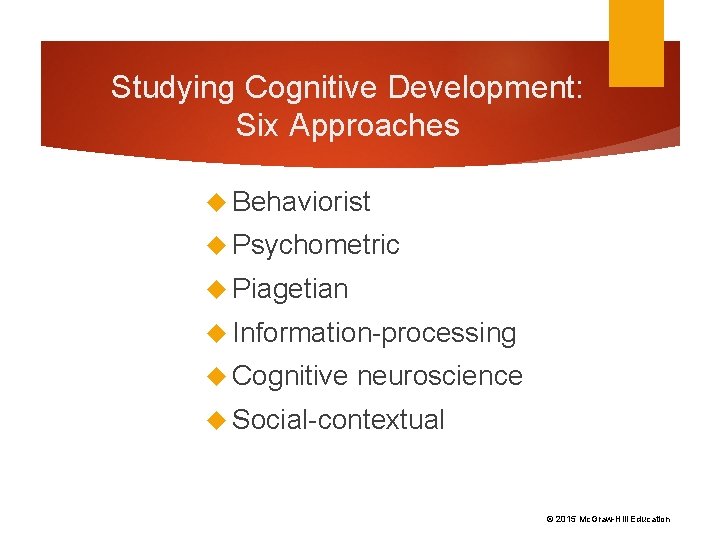
Studying Cognitive Development: Six Approaches Behaviorist Psychometric Piagetian Information-processing Cognitive neuroscience Social-contextual © 2015 Mc. Graw-Hill Education
Behaviorist Approach Babies are born with the ability to learn Classical Operant conditioning Reinforcement and punishment © 2015 Mc. Graw-Hill Education
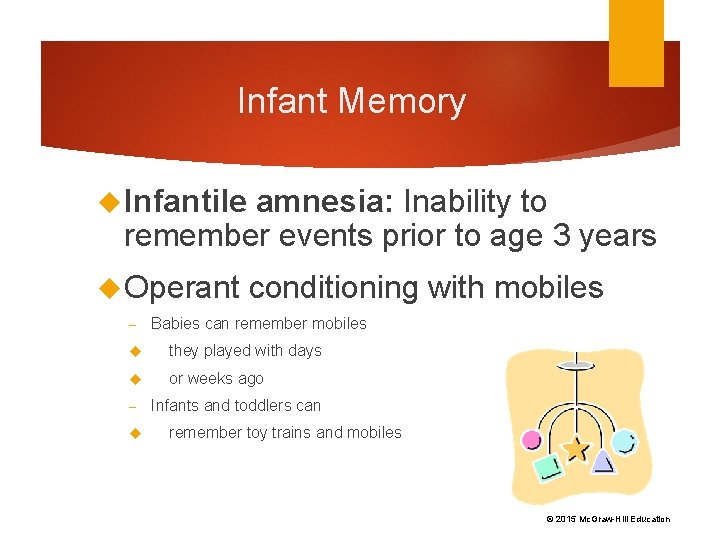
Infant Memory Infantile amnesia: Inability to remember events prior to age 3 years Operant – conditioning with mobiles Babies can remember mobiles they played with days or weeks ago – Infants and toddlers can remember toy trains and mobiles © 2015 Mc. Graw-Hill Education
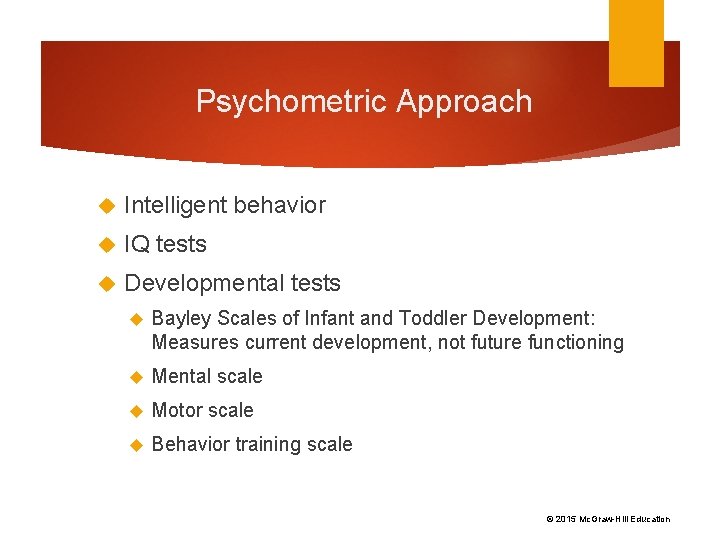
Psychometric Approach Intelligent behavior IQ tests Developmental tests Bayley Scales of Infant and Toddler Development: Measures current development, not future functioning Mental scale Motor scale Behavior training scale © 2015 Mc. Graw-Hill Education
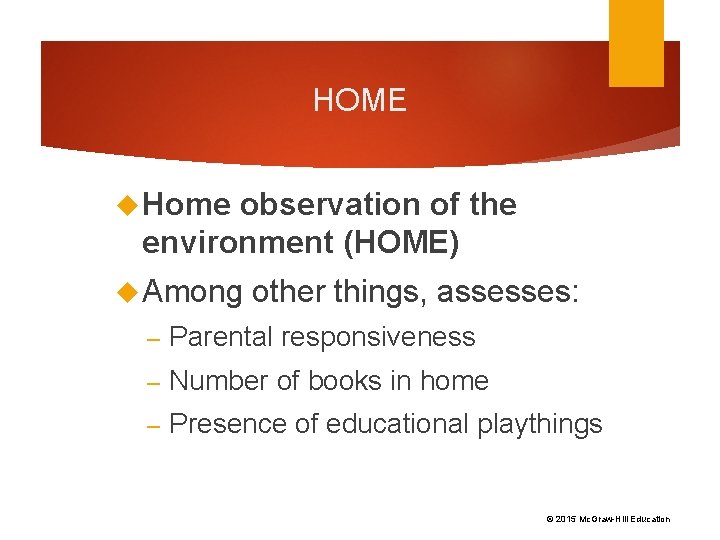
HOME Home observation of the environment (HOME) Among other things, assesses: – Parental responsiveness – Number of books in home – Presence of educational playthings © 2015 Mc. Graw-Hill Education
Early Intervention Project CARE Partners for Learning Most effective interventions: Start early and continue through preschool years Time-intensive Provide direct educational experiences Include health, family counseling, and social services Tailored to individual differences and needs © 2015 Mc. Graw-Hill Education
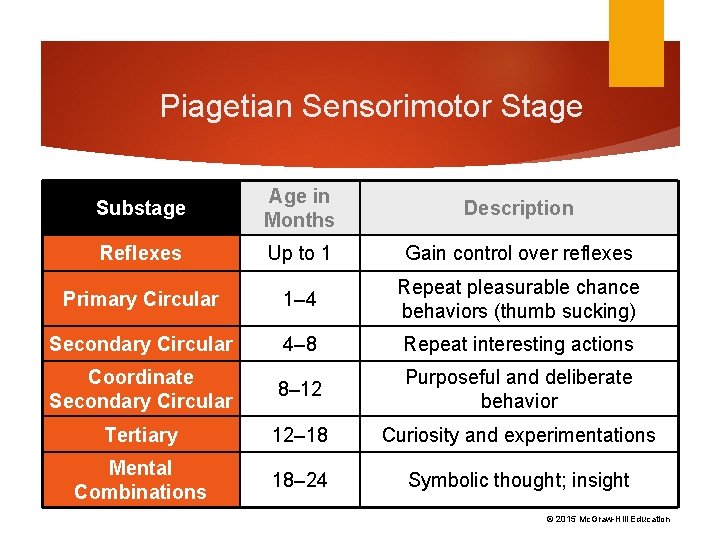
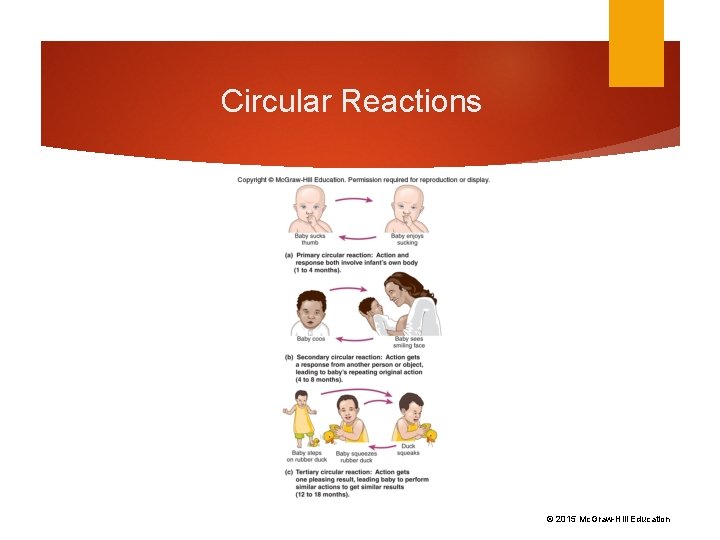
Piagetian Sensorimotor Stage Substage Age in Months Description Reflexes Up to 1 Gain control over reflexes Primary Circular 1– 4 Repeat pleasurable chance behaviors (thumb sucking) Secondary Circular 4– 8 Repeat interesting actions Coordinate Secondary Circular 8– 12 Purposeful and deliberate behavior Tertiary 12– 18 Curiosity and experimentations Mental Combinations 18– 24 Symbolic thought; insight © 2015 Mc. Graw-Hill Education
Circular Reactions © 2015 Mc. Graw-Hill Education
Types of Imitation Invisible Visible Hands and feet … parts baby can see Deferred Using body parts baby cannot see … like the mouth Imitation after a delay Elicited Imitating based on an explanation only © 2015 Mc. Graw-Hill Education
Object Permanence Realizing that an object exists even when out of sight Prior to 8 months If I drop my toy and I can’t see it … it is gone! … THIS is why peek-a-boo is so much fun! 8– 12 months You hid my toy … I’m looking for it the last place I saw it! After a year You hid my toy … I’m looking for it! © 2015 Mc. Graw-Hill Education
Object Permanence Dynamic systems theory Not about what babies know, but about what they do … and why © 2015 Mc. Graw-Hill Education
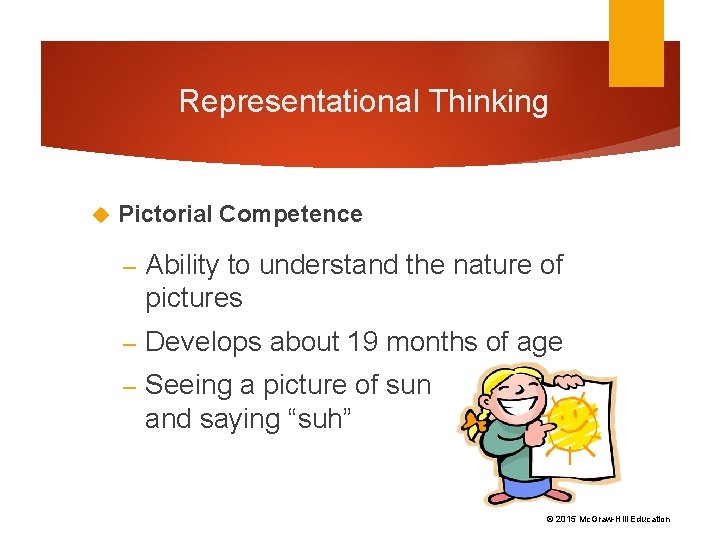
Representational Thinking Pictorial Competence – Ability to understand the nature of pictures – Develops about 19 months of age – Seeing a picture of sun and saying “suh” © 2015 Mc. Graw-Hill Education
Dual Representation Hypothesis Pictorial competence develops slowly because it is difficult for children to simultaneously mentally represent: – a picture AND – the object the picture represents © 2015 Mc. Graw-Hill Education
Info-Processing Approach Habituation A type of learning in which familiarity is indicated by reduced response Dishabituation Increase in responsiveness after presentation with a new stimulus © 2015 Mc. Graw-Hill Education
Visual Preferences Novelty preference – Paying more attention to new visual stimuli – Demonstrating ability to tell new from old, or visual recognition memory Visual recognition memory: capacity to form and refer to mental representations © 2015 Mc. Graw-Hill Education
Cross-Modal Transfer Using one or more senses to guide another sense Feeling your way through a dark room, then finding the way visually when lights are on © 2015 Mc. Graw-Hill Education
Research in Action: Do infants and toddles watch too much TV? American Academy of Pediatrics recommendations Developmental Actual Long risks behaviors and screen time terms effects? © 2015 Mc. Graw-Hill Education
Information Processing as Predictor of Intelligence Visual reaction time & Visual anticipation can be measured by visual paradigm Modest outcomes as best © 2015 Mc. Graw-Hill Education
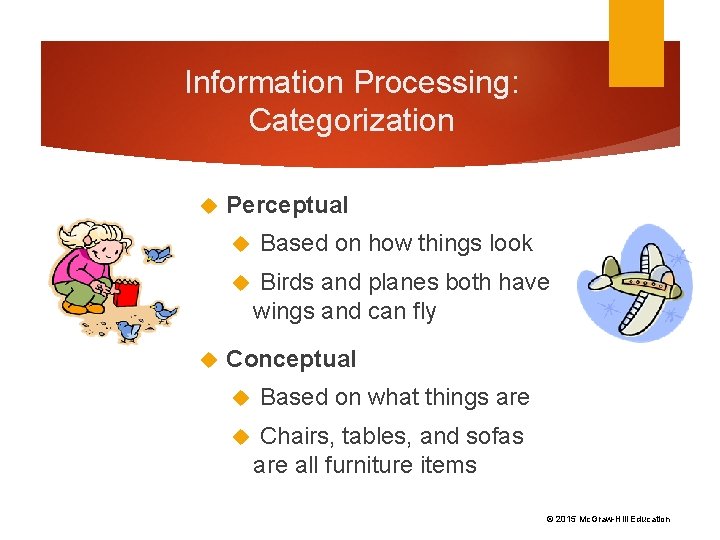
Information Processing: Categorization Perceptual Based on how things look Birds and planes both have wings and can fly Conceptual Based on what things are Chairs, tables, and sofas are all furniture items © 2015 Mc. Graw-Hill Education
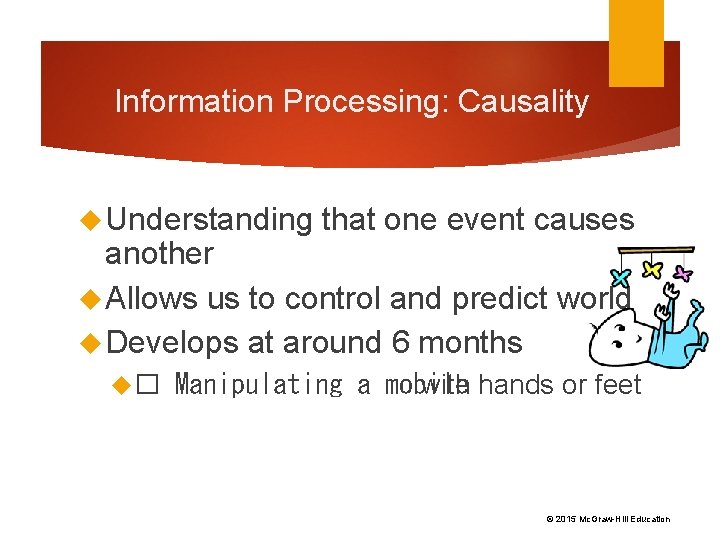
Information Processing: Causality Understanding that one event causes another Allows us to control and predict world Develops at around 6 months � Manipulating a mobile with hands or feet © 2015 Mc. Graw-Hill Education
Violation of Expectations Phase 1: Familiarization Phase 2: Violation of Expectation Infant watches as events happen normally The event is changed in a way that conflicts with past procedure If infant watches the conflict event longer, it is interpreted as noticing a change © 2015 Mc. Graw-Hill Education
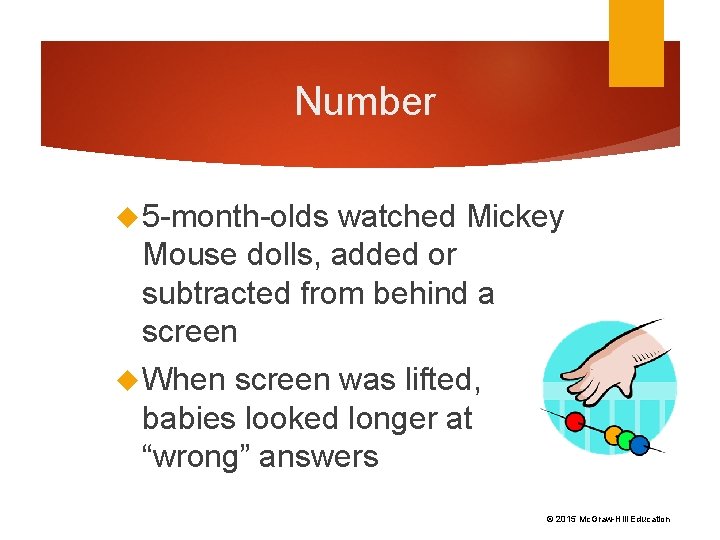
Number 5 -month-olds watched Mickey Mouse dolls, added or subtracted from behind a screen When screen was lifted, babies looked longer at “wrong” answers © 2015 Mc. Graw-Hill Education
Cognitive Neuroscience: Types of Memory Explicit – Conscious or intentional – Facts, names, and events Implicit – Unconscious recall – Habits and skills—procedural memory Working – Short-term storage of active information © 2015 Mc. Graw-Hill Education
Social Contextual Approach: Learning from Caregivers Guided participation: Interactions with adults during activities Helps bridge level of knowledge between adult and child Cultural differences – U. S. children engage in more play activities – Guatemalan children engage in more work activities © 2015 Mc. Graw-Hill Education
Language Development Language � A communication system based on word, grammar, and cognitive development Literacy � The ability to read and write © 2015 Mc. Graw-Hill Education
Early Vocalizations Crying Newborns Cooing Repeating vowel sounds: “ahhhh” 6– 8 weeks Babbling Repeating consonant sounds: “ma-ma-ma” 6– 10 months © 2015 Mc. Graw-Hill Education
Recognizing Language Sounds Precedes language ability Fetuses’ heart rates slow when they hear familiar nursery rhymes By 6 months, babies learn to recognize basic sounds of their native language— phonemes © 2015 Mc. Graw-Hill Education
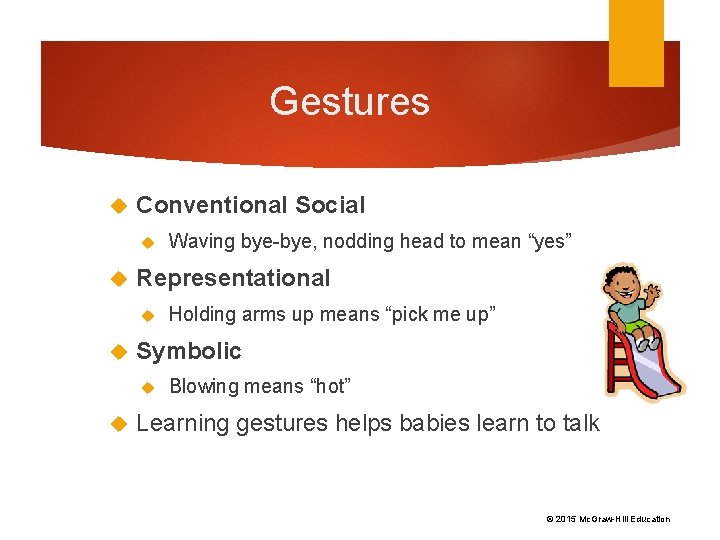
Gestures Conventional Social Representational Holding arms up means “pick me up” Symbolic Waving bye-bye, nodding head to mean “yes” Blowing means “hot” Learning gestures helps babies learn to talk © 2015 Mc. Graw-Hill Education
First Words Linguistic � Speech Verbal expression that conveys meaning Around 10– 14 months of age Holophrase Simple syllables that have complete meanings “Da” could mean “Where is Daddy? ” “Naming explosion” occurs at 16– 24 months © 2015 Mc. Graw-Hill Education
First Sentences Telegraphic Speech 2– 3 words expressing one idea “No do” means “Do not do that” Competence in syntax gradually increases—rules for putting sentences together © 2015 Mc. Graw-Hill Education
Early Speech Characteristics Understanding of grammar precedes use of it Underextension of word meanings � The word “doggy” only refers to your dog Overextension of word meanings � All men with gray hair are “Grampa” Overregularizing of rules � “I thinked about it!” © 2015 Mc. Graw-Hill Education
Theories of Language Acquisition Nature vs. nurture? Behaviorist view: Reinforcement and imitation Chomsky’s nativism – Brain has the innate capacity to learn language – Language acquisition device (LAD) Synthesis of innate capacity and behaviorist principles most likely © 2015 Mc. Graw-Hill Education
Influences on Early Language Development Maturation of the brain Social interaction with parents and caregivers © 2015 Mc. Graw-Hill Education
Language Is a Social Act Prelinguistic Adults repeat sounds baby makes Vocabulary Period Development Parent holds ball while saying “This is a ball” Bilingual “code mixing” and “code switching” © 2015 Mc. Graw-Hill Education
Child-Directed Speech Parentese—baby Simplified talk words Exaggerated vowel sounds May help children learn native tongue faster © 2015 Mc. Graw-Hill Education
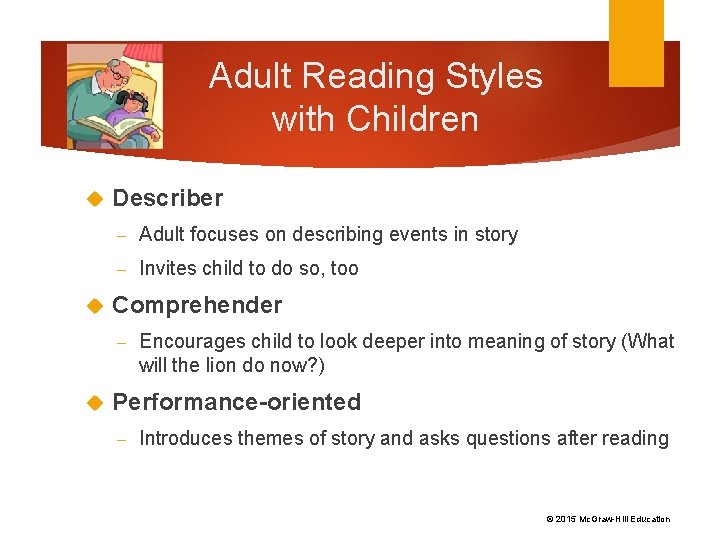
Adult Reading Styles with Children Describer – Adult focuses on describing events in story – Invites child to do so, too Comprehender – Encourages child to look deeper into meaning of story (What will the lion do now? ) Performance-oriented – Introduces themes of story and asks questions after reading © 2015 Mc. Graw-Hill Education