
Cognitive Capacities of the Sociolinguistic Monitor William Labov

Cognitive Capacities of the Sociolinguistic Monitor William Labov, University of Pennsylvania SS 17 March 20, 2008

How is sociolinguistic information perceived and where is it stored? www. ling. upenn. edu/~labov

The Sociolinguistic Monitor: some critical parameters • Temporal window: Over what span of time do listeners modify their sociolinguistic judgments? • Sensitivity: What is the just noticeable difference in frequencies that the SLM can detect? • Does this sensitivity vary with age, region, social class? • Linearity: Is the impact of successive instances of the variable constant or does it vary over time?
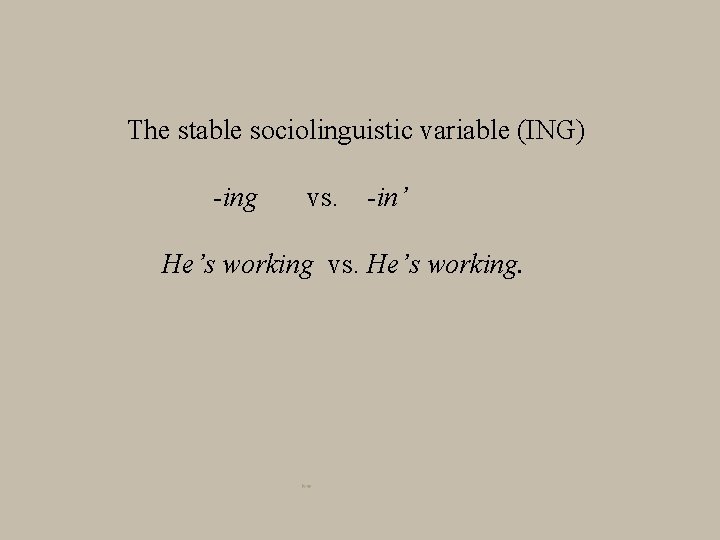
The stable sociolinguistic variable (ING) -ing vs. -in’ He’s working vs. He’s working. (ING)
Social and stylistic stratification of (ing) in the random sample of the Lower East Side of New York City adults [N=81] Source: Labov 1966
Social and stylistic stratification of (ing) in the random sample of the Lower East Side of New York City adults [N=81] Source: Labov 1966
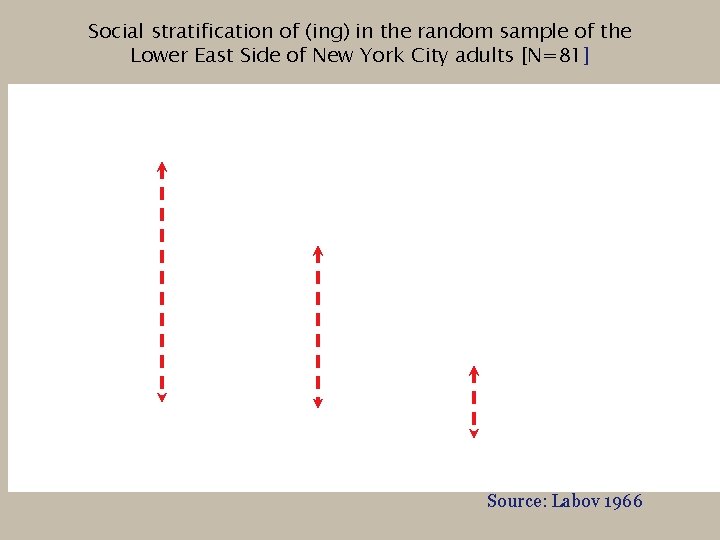
Social stratification of (ing) in the random sample of the Lower East Side of New York City adults [N=81] Source: Labov 1966
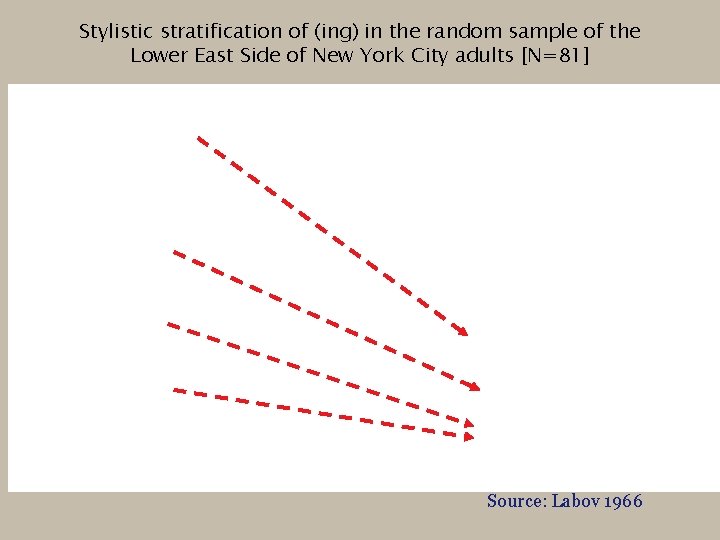
Stylistic stratification of (ing) in the random sample of the Lower East Side of New York City adults [N=81] Source: Labov 1966
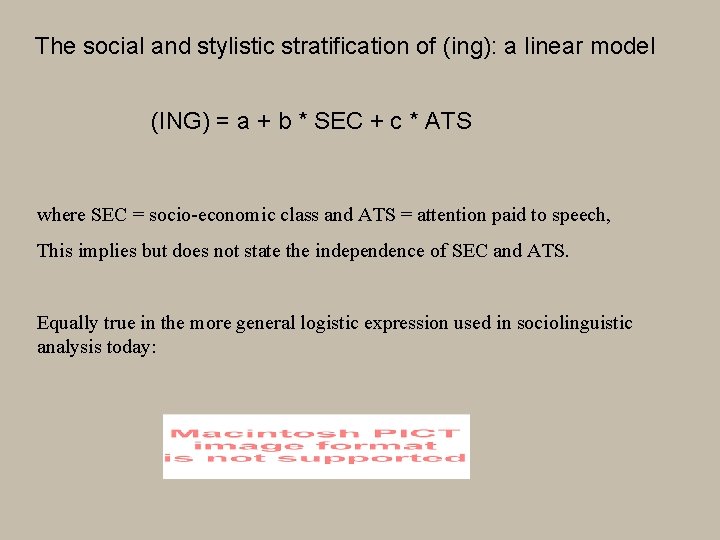
The social and stylistic stratification of (ing): a linear model (ING) = a + b * SEC + c * ATS where SEC = socio-economic class and ATS = attention paid to speech, This implies but does not state the independence of SEC and ATS. Equally true in the more general logistic expression used in sociolinguistic analysis today:
The variable (ING) Definition: The alternation of /in/ and /i. N/ in unstressed syllables Not only in working, swimming, interesting, during, but also something, nothing Characteristics of production High frequency Regular stylistic and social stratification Uniform across most English speech communities Characteristics of social evaluation A stereotype (“dropping the g”) Overtly and accurately associated with informality
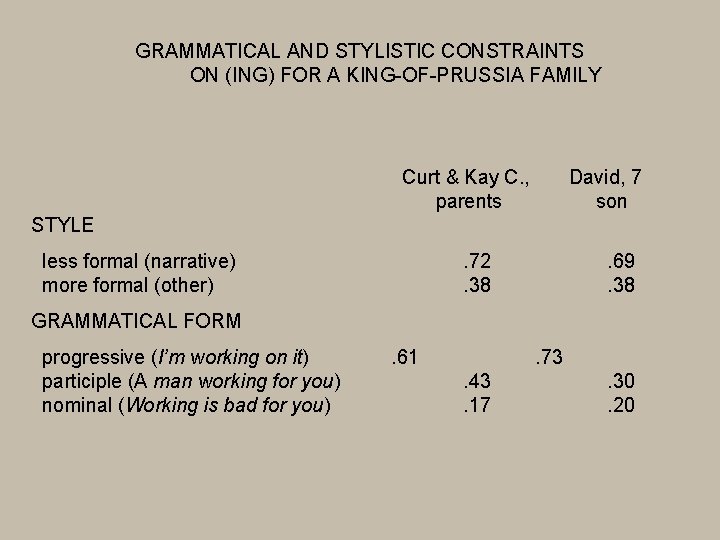
GRAMMATICAL AND STYLISTIC CONSTRAINTS ON (ING) FOR A KING-OF-PRUSSIA FAMILY Curt & Kay C. , parents David, 7 son STYLE less formal (narrative) more formal (other) . 72. 38 . 69. 38 GRAMMATICAL FORM progressive (I’m working on it) participle (A man working for you) nominal (Working is bad for you) . 61 . 73. 43. 17 . 30. 20

Experiment 1: Philadelphia • Site: University of Pennsylvania, Philadelphia • Experimenter: W. Labov • Subjects: U of Penn undergraduates • Speaker: SA [White, female, Chicago]
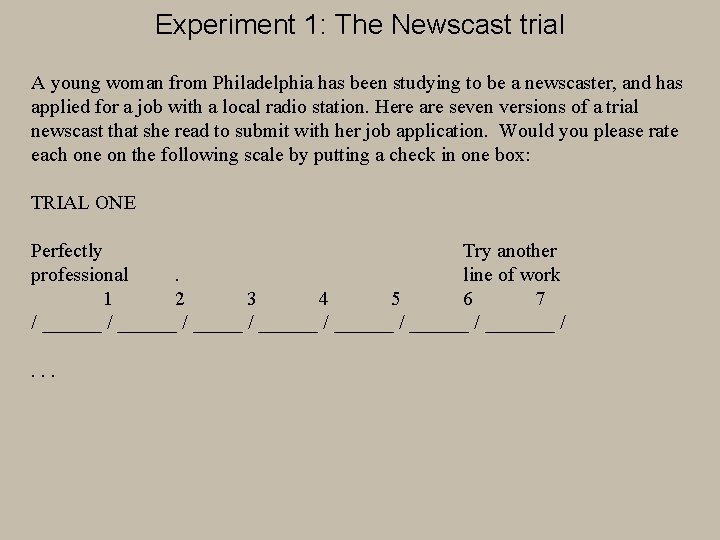
Experiment 1: The Newscast trial A young woman from Philadelphia has been studying to be a newscaster, and has applied for a job with a local radio station. Here are seven versions of a trial newscast that she read to submit with her job application. Would you please rate each one on the following scale by putting a check in one box: TRIAL ONE Perfectly Try another professional. line of work 1 2 3 4 5 6 7 / ______ / _______ /. . .

SA 50% /in/ SA 70% /in/ AH 50% /in/ The text for the Newscast experiment • President Bush announced tonight that he was putting all available White House resources into support for the new tax cut bill. • Democratic leaders of the House and Senate are preparing compromise legislation. • Republican spokespersons predicted that record numbers of working-class Americans would be receiving tax refund checks before the end of the year. • Senator Edward Kennedy’s staff announced that the tax cuts are creating a new elite who are excused from paying their fair share of the cost of government. • At the Office of Management of the Budget, officials are trying to estimate the size of the deficit that will be produced by the new legislation. • Federal Reserve Board chairman Alan Greenspan stated that he was not confirming that tax cuts would lead to a change in prime interest rates, nor was he denying it. • The Washington Post is publishing today a list of all members of Congress who will receive tax refunds greater than $1, 000 as a result of the proposed tax cuts.
Mean ratings for Newscast Experiment 1. Site = Philadelphia. Speaker: SA. N=23 prob block effect: =. 066
Logarithmic fit to data of Experiment 1 0 30 50 Percent apical /in/ 70 100
Another view of the results of Experiment 1 0 30 Percent apical /in/ 50 70 100
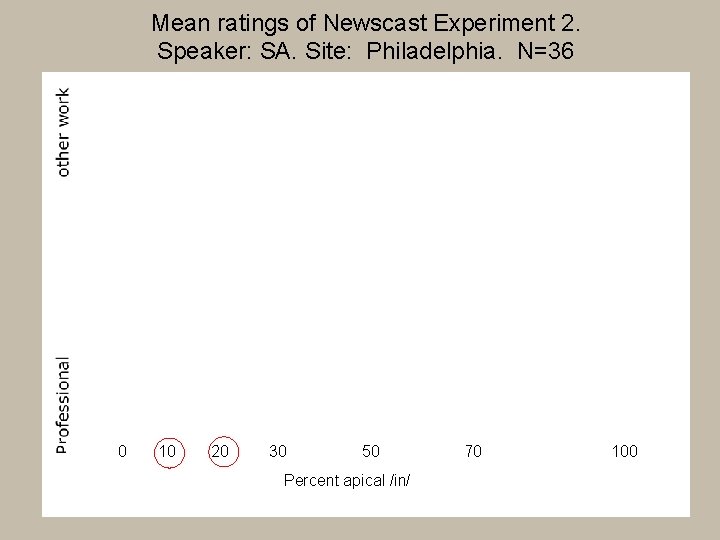
Mean ratings of Newscast Experiment 2. Speaker: SA. Site: Philadelphia. N=36 0 10 20 30 50 Percent apical /in/ 70 100
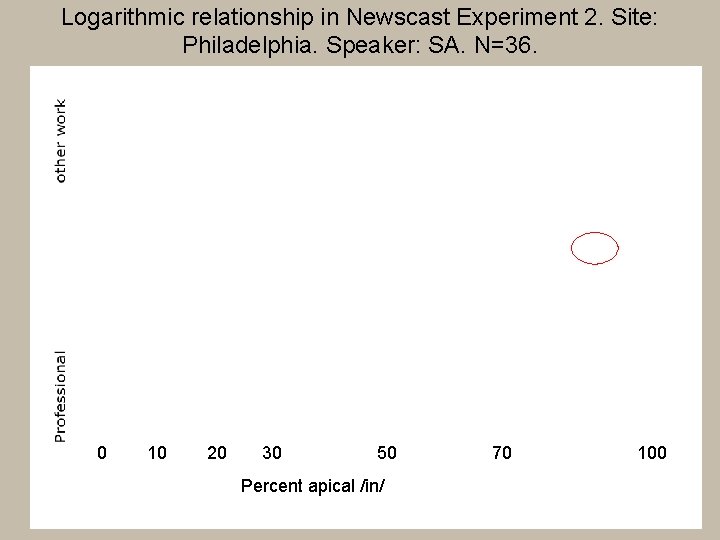
Logarithmic relationship in Newscast Experiment 2. Site: Philadelphia. Speaker: SA. N=36. 0 10 20 30 50 Percent apical /in/ 70 100
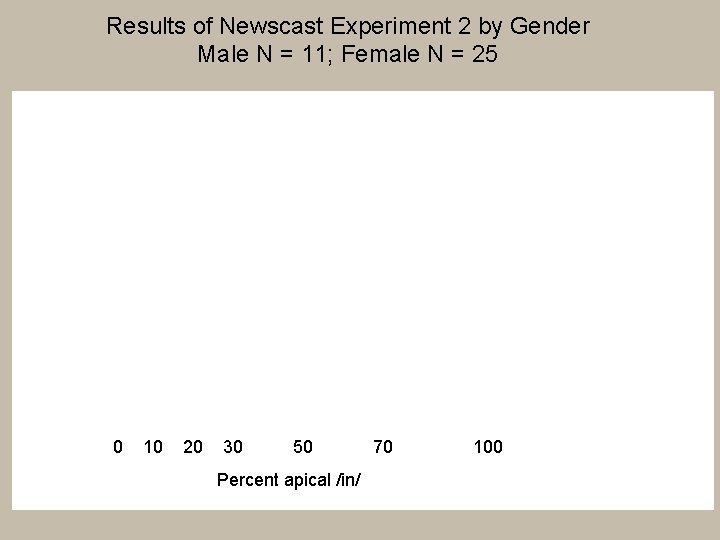
Results of Newscast Experiment 2 by Gender Male N = 11; Female N = 25 0 10 20 30 50 Percent apical /in/ 70 100
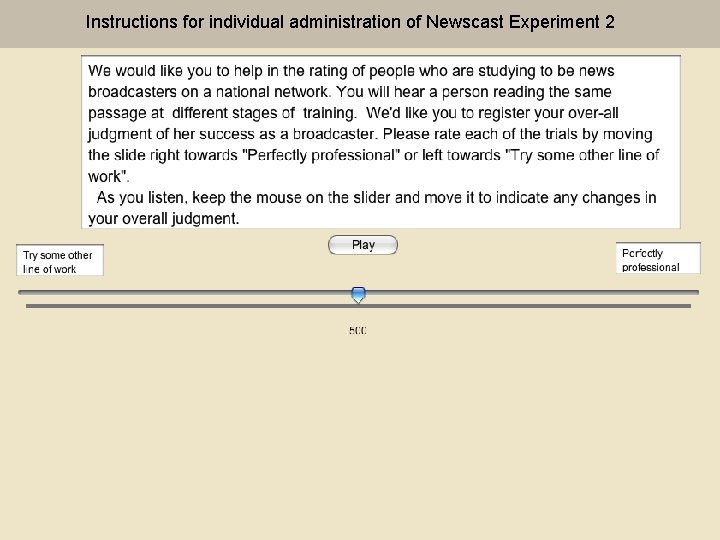
Instructions for individual administration of Newscast Experiment 2
![Mean ratings for individual subjects on Newscast experiment 2. Speaker: AH. Site: Philadelphia [N=56]](http://slidetodoc.com/presentation_image_h2/424d843b75d83207793864032b6ef9c5/image-22.jpg "Mean ratings for individual subjects on Newscast experiment 2. Speaker: AH. Site: Philadelphia [N=56]")
Mean ratings for individual subjects on Newscast experiment 2. Speaker: AH. Site: Philadelphia [N=56] 0 10 20 30 50 percent apical /in/ 70 100
Experiment 3: Regional comparison I • Site: University of South Carolina, Columbia • Experimenter: Prof. Tracey Weldon • Subjects: U. S. C. students • Speaker: SA [White, female, Chicago]
Experiment 3: Regional comparison I • Site: University of South Carolina, Columbia • Experimenter: Prof. Tracey Weldon • Subjects: U. S. C. students • Speaker: SA [White, female, Chicago]
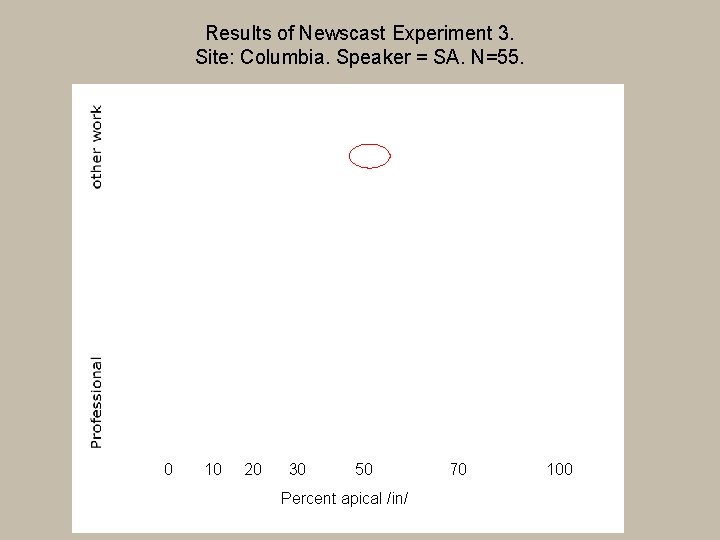
Results of Newscast Experiment 3. Site: Columbia. Speaker = SA. N=55. 0 10 20 30 50 Percent apical /in/ 70 100
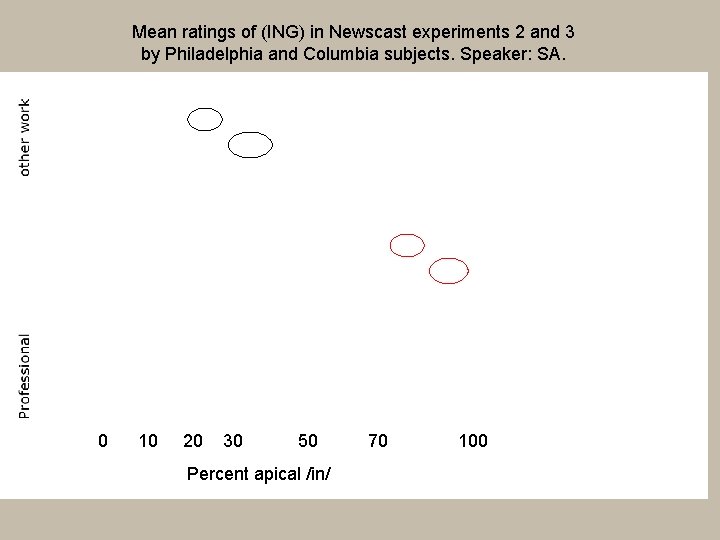
Mean ratings of (ING) in Newscast experiments 2 and 3 by Philadelphia and Columbia subjects. Speaker: SA. 0 101 10 8020 7030 90 50 50 Percent apical /in/ 70 30 100 0 Percent velar /ing/
Experiment 4: Regional comparison II • Site: University of South Carolina, Columbia • Experimenter: Prof. Tracey Weldon • Subjects: U. S. C. students • Regional speaker: JB (50%)
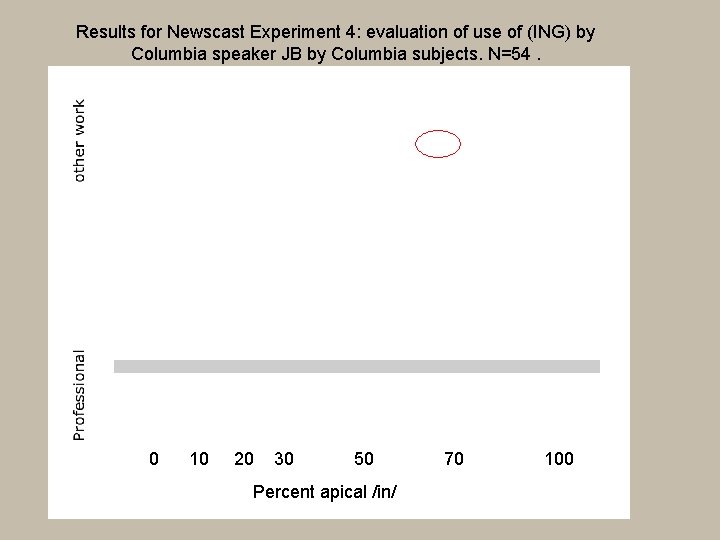
Results for Newscast Experiment 4: evaluation of use of (ING) by Columbia speaker JB by Columbia subjects. N=54. 0 10 20 30 50 Percent apical /in/ 70 100
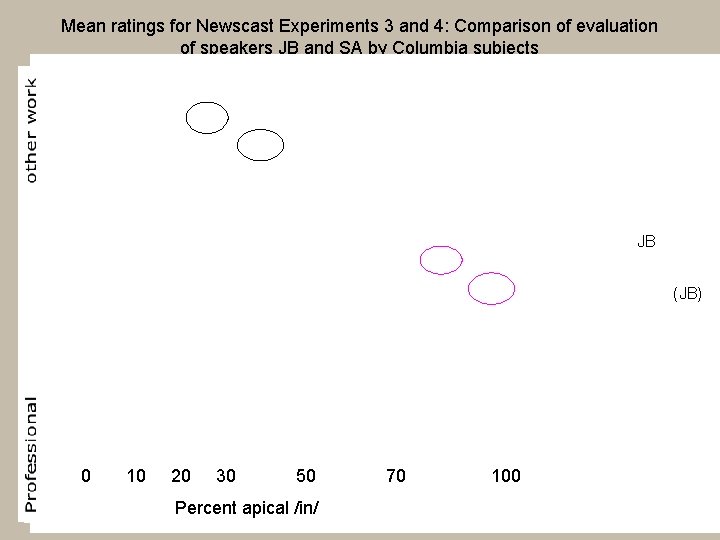
Mean ratings for Newscast Experiments 3 and 4: Comparison of evaluation of speakers JB and SA by Columbia subjects JB (JB) 0 10 20 30 50 Percent apical /in/ 70 100
Experiment 2: Regional comparison II • Site: University of New Hampshire, Durham • Experimenter: Prof. Naomi Nagy • Subjects: U. of NH students • Speaker: SA
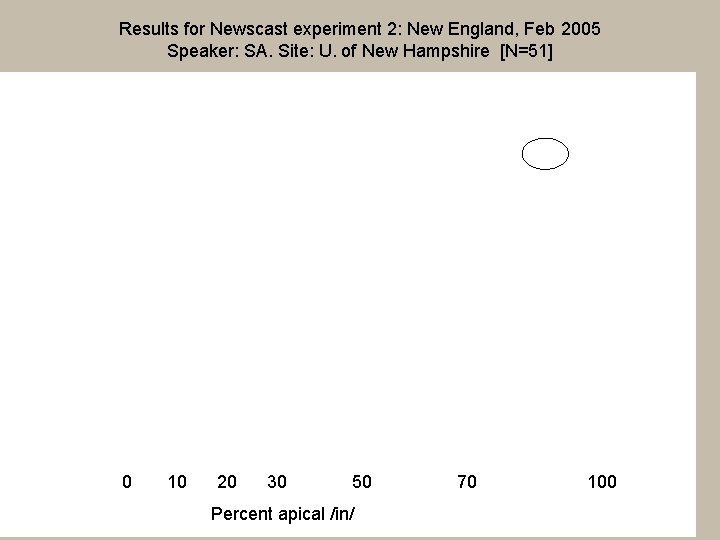
Results for Newscast experiment 2: New England, Feb 2005 Speaker: SA. Site: U. of New Hampshire [N=51] 0 10 20 30 50 Percent apical /in/ 70 100
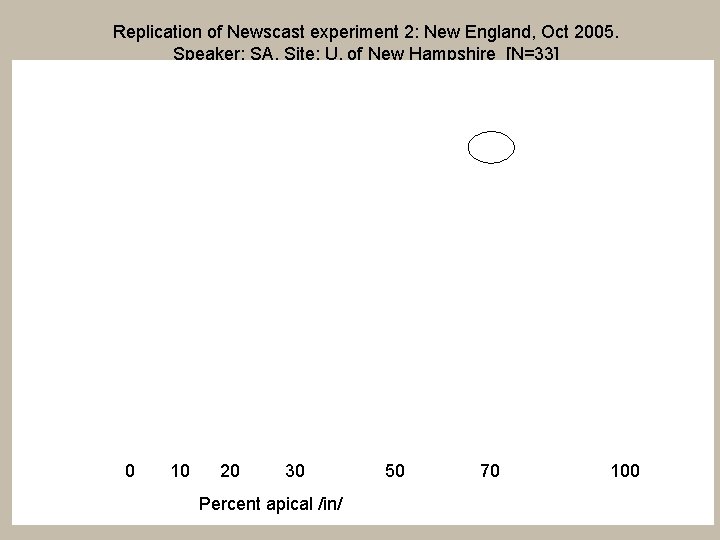
Replication of Newscast experiment 2: New England, Oct 2005. Speaker: SA. Site: U. of New Hampshire [N=33] 0 10 20 30 Percent apical /in/ 50 70 100

Experiment 5: Regional comparison II • Site: University of New Hampshire, Durham • Experimenter: Prof. Naomi Nagy • Subjects: U. of NH. students • Regional speaker: JD
Results for Newscast Experiment 5: evaluation of use of (ING) by New England speaker JD by New Hampshire subjects, N=27.

Why a logarithmic progression? Noting that it appears that the function 1/x may play a crucial role in generating these results
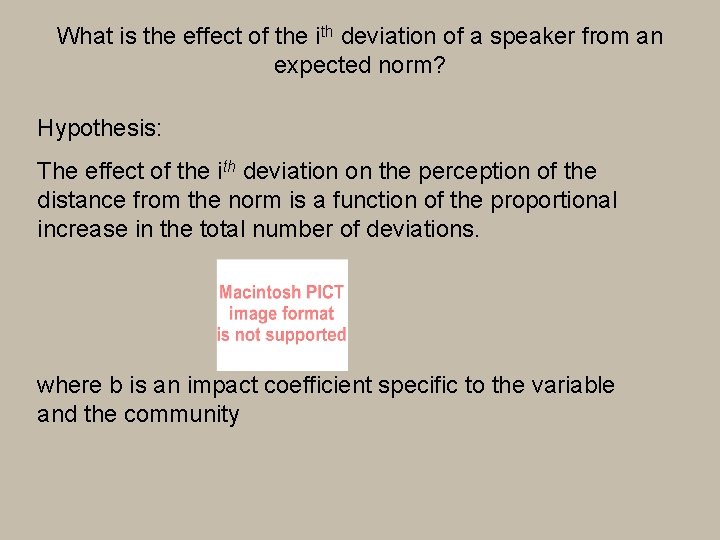
What is the effect of the ith deviation of a speaker from an expected norm? Hypothesis: The effect of the ith deviation on the perception of the distance from the norm is a function of the proportional increase in the total number of deviations. where b is an impact coefficient specific to the variable and the community
If the impact coefficient is 1, the 4 th deviation adds 1/3 to the total effect, the 5 th deviation 1/4, and so on. The total effect of n deviations is then or where a is the initial rating given to the speaker without any deviations from the norm and S is the sum of the proportional increase series.
The proportional increase series S = 1/1 + 1/2. . . 1/n S does not converge to a limit but increases to . The sum for a given number of terms is approximated by ln(n)+ , where constant] = . 5772156649… [Euler’s
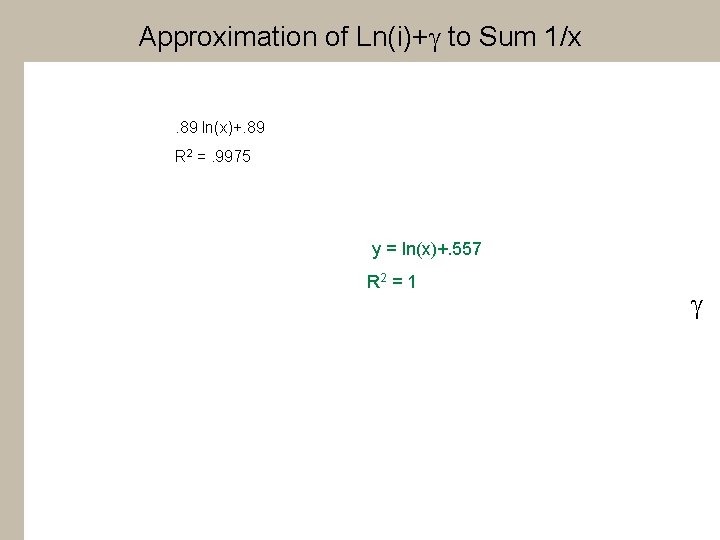
Approximation of Ln(i)+ to Sum 1/x. 89 ln(x)+. 89 R 2 =. 9975 y = ln(x)+. 557 R 2 = 1
Predicting the experimental outcome The experimental results which approximated a logarithmic progression were generated by the proportional increase function E. Then setting the initial rating a at 2. 00 and the impact coefficient b at 1. 25, we can predict the experimental outcomes.
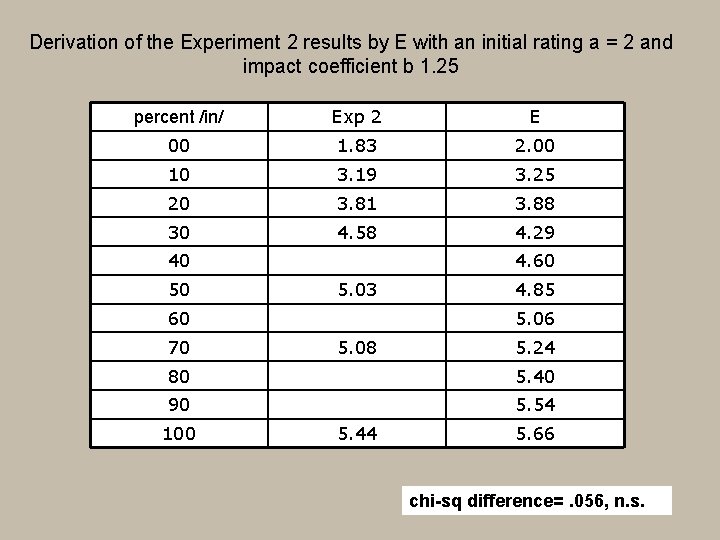
Derivation of the Experiment 2 results by E with an initial rating a = 2 and impact coefficient b 1. 25 percent /in/ Exp 2 E 00 1. 83 2. 00 10 3. 19 3. 25 20 3. 81 3. 88 30 4. 58 4. 29 40 50 4. 60 5. 03 60 70 4. 85 5. 06 5. 08 5. 24 80 5. 40 90 5. 54 100 5. 44 5. 66 chi-sq difference=. 056, n. s.
Generation of Experiment 2 results (Philadelphia) by E function 0 10 20 30 50 Percent apical /in/ 70 100

The (R) variable
Social and stylistic stratification of (R) in the random sample of the Lower East Side of New York City [N=81] The cross-over pattern SOCIOECONOMIC CLASS higher lower
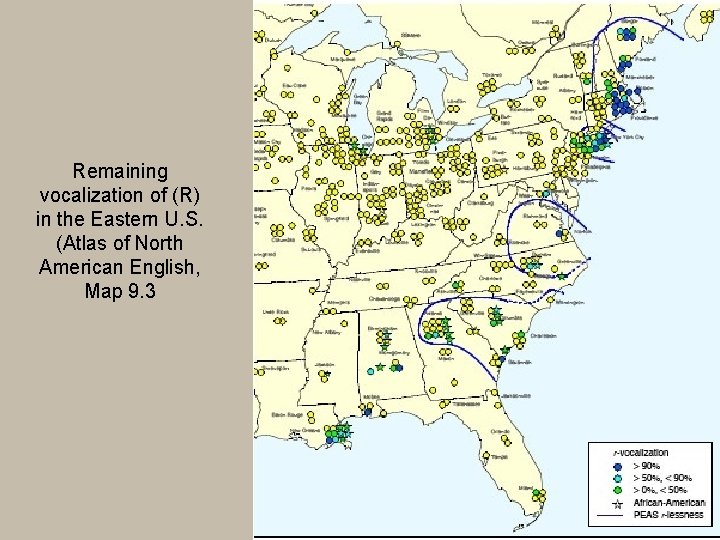
Remaining vocalization of (R) in the Eastern U. S. (Atlas of North American English, Map 9. 3
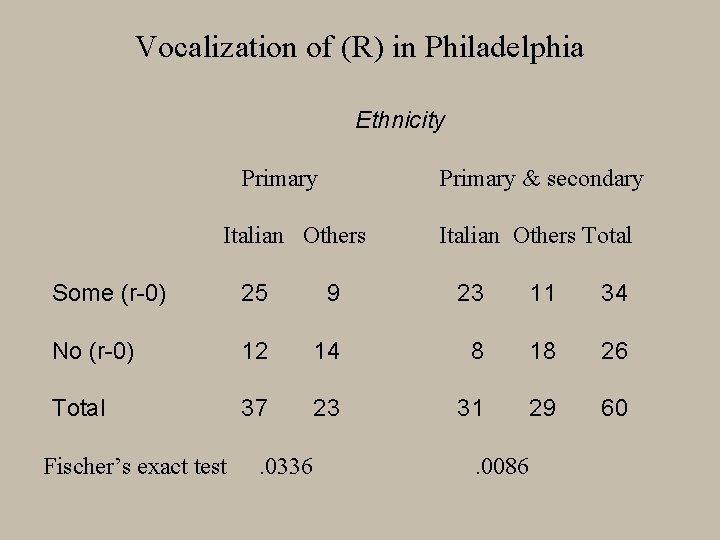
Vocalization of (R) in Philadelphia Ethnicity Primary & secondary Italian Others Total Some (r-0) 25 9 23 11 34 No (r-0) 12 14 8 18 26 Total 37 23 31 29 60 Fischer’s exact test . 0336 . 0086
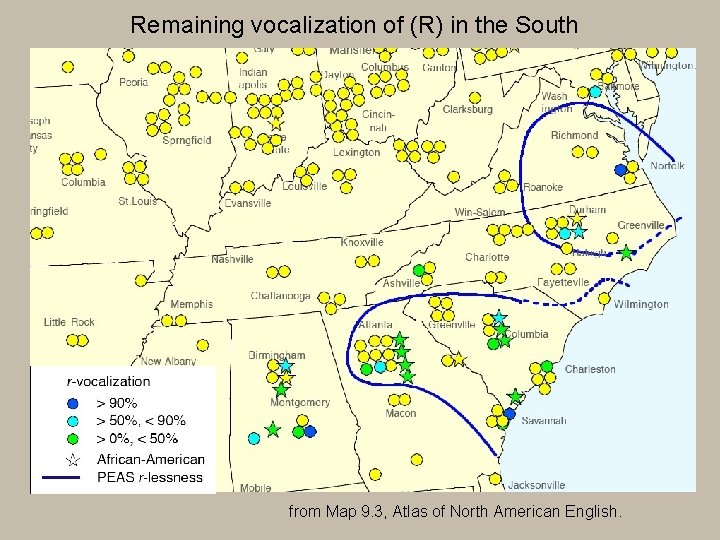
Remaining vocalization of (R) in the South from Map 9. 3, Atlas of North American English.
![Mean ratings of Newscast Experiment for (ING) and (R) by Philadelphia subjects [N=35] AH](http://slidetodoc.com/presentation_image_h2/424d843b75d83207793864032b6ef9c5/image-48.jpg "Mean ratings of Newscast Experiment for (ING) and (R) by Philadelphia subjects [N=35] AH")
Mean ratings of Newscast Experiment for (ING) and (R) by Philadelphia subjects [N=35] AH (ING) AH(R)
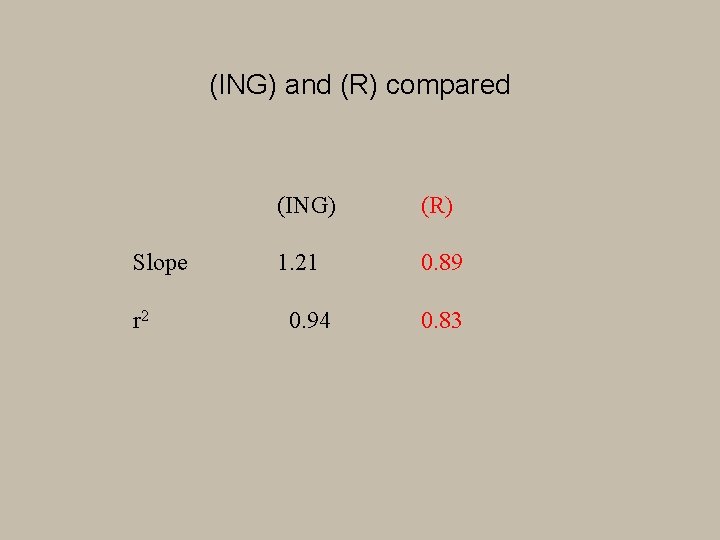
(ING) and (R) compared Slope r 2 (ING) (R) 1. 21 0. 89 0. 94 0. 83
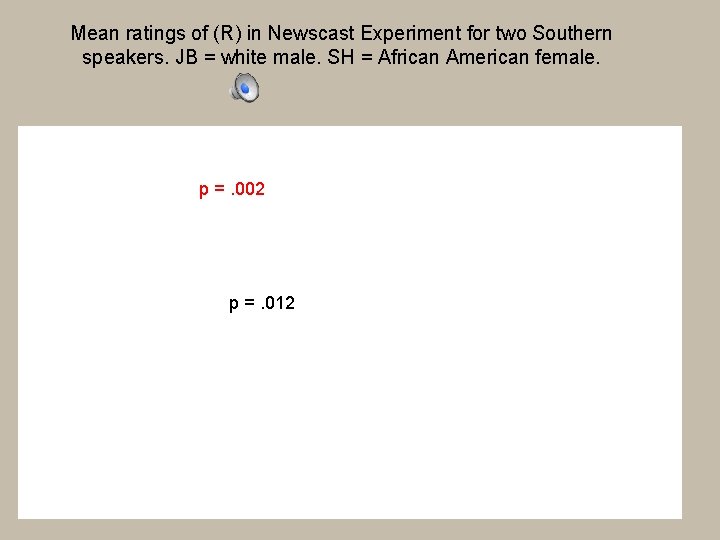
Mean ratings of (R) in Newscast Experiment for two Southern speakers. JB = white male. SH = African American female. p =. 002 p =. 012
Differential response by age and social class
Mean ratings of Newscast Experiment on (ING) for high school student groups of three different class backgrounds

r 2 fit to logarithmic function for 56 individual subjects by age

r 2 distribution for 56 individual subjects of Experiment 2

r 2 distribution for 56 individual subjects of Experiment 2 >23 years old

r 2 distribution for 31 individual subjects under 23 years old
Slope of logarithmic function for 56 individual subjects by r 2
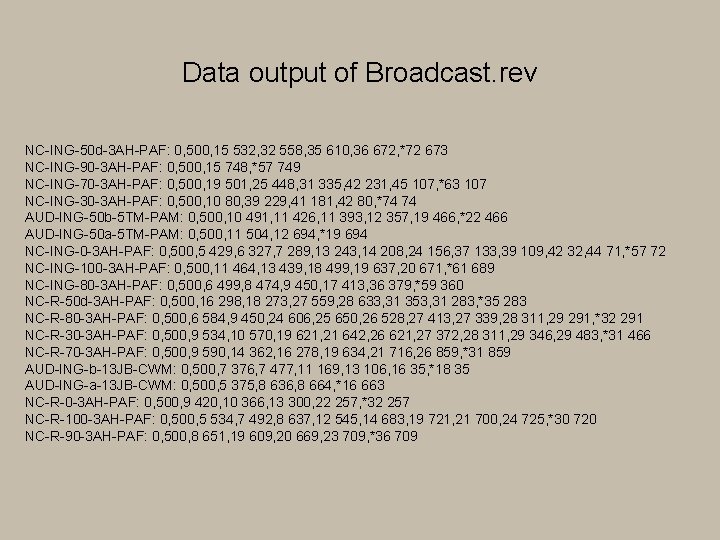
Data output of Broadcast. rev NC-ING-50 d-3 AH-PAF: 0, 500, 15 532, 32 558, 35 610, 36 672, *72 673 NC-ING-90 -3 AH-PAF: 0, 500, 15 748, *57 749 NC-ING-70 -3 AH-PAF: 0, 500, 19 501, 25 448, 31 335, 42 231, 45 107, *63 107 NC-ING-30 -3 AH-PAF: 0, 500, 10 80, 39 229, 41 181, 42 80, *74 74 AUD-ING-50 b-5 TM-PAM: 0, 500, 10 491, 11 426, 11 393, 12 357, 19 466, *22 466 AUD-ING-50 a-5 TM-PAM: 0, 500, 11 504, 12 694, *19 694 NC-ING-0 -3 AH-PAF: 0, 500, 5 429, 6 327, 7 289, 13 243, 14 208, 24 156, 37 133, 39 109, 42 32, 44 71, *57 72 NC-ING-100 -3 AH-PAF: 0, 500, 11 464, 13 439, 18 499, 19 637, 20 671, *61 689 NC-ING-80 -3 AH-PAF: 0, 500, 6 499, 8 474, 9 450, 17 413, 36 379, *59 360 NC-R-50 d-3 AH-PAF: 0, 500, 16 298, 18 273, 27 559, 28 633, 31 353, 31 283, *35 283 NC-R-80 -3 AH-PAF: 0, 500, 6 584, 9 450, 24 606, 25 650, 26 528, 27 413, 27 339, 28 311, 29 291, *32 291 NC-R-30 -3 AH-PAF: 0, 500, 9 534, 10 570, 19 621, 21 642, 26 621, 27 372, 28 311, 29 346, 29 483, *31 466 NC-R-70 -3 AH-PAF: 0, 500, 9 590, 14 362, 16 278, 19 634, 21 716, 26 859, *31 859 AUD-ING-b-13 JB-CWM: 0, 500, 7 376, 7 477, 11 169, 13 106, 16 35, *18 35 AUD-ING-a-13 JB-CWM: 0, 500, 5 375, 8 636, 8 664, *16 663 NC-R-0 -3 AH-PAF: 0, 500, 9 420, 10 366, 13 300, 22 257, *32 257 NC-R-100 -3 AH-PAF: 0, 500, 5 534, 7 492, 8 637, 12 545, 14 683, 19 721, 21 700, 24 725, *30 720 NC-R-90 -3 AH-PAF: 0, 500, 8 651, 19 609, 20 669, 23 709, *36 709

Timing of /in/ variants in the Broadcast experiment
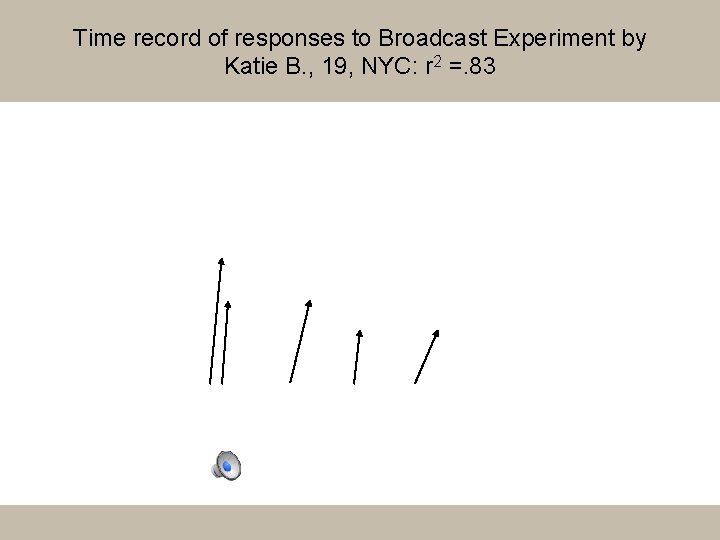
Time record of responses to Broadcast Experiment by Katie B. , 19, NYC: r 2 =. 83
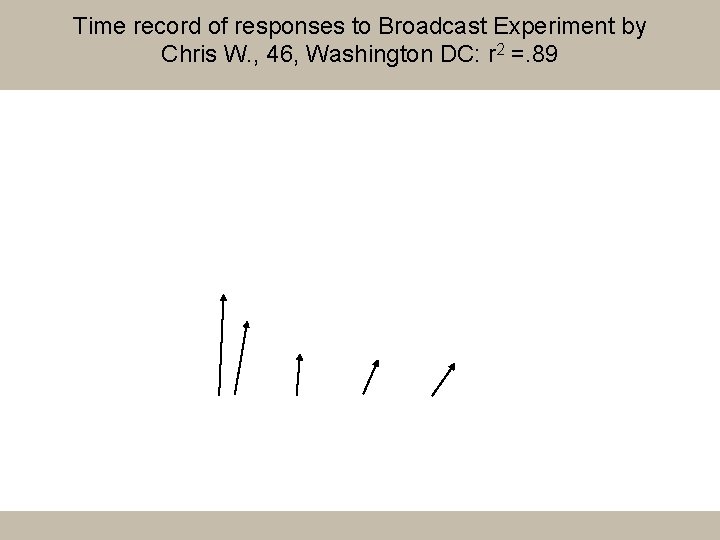
Time record of responses to Broadcast Experiment by Chris W. , 46, Washington DC: r 2 =. 89
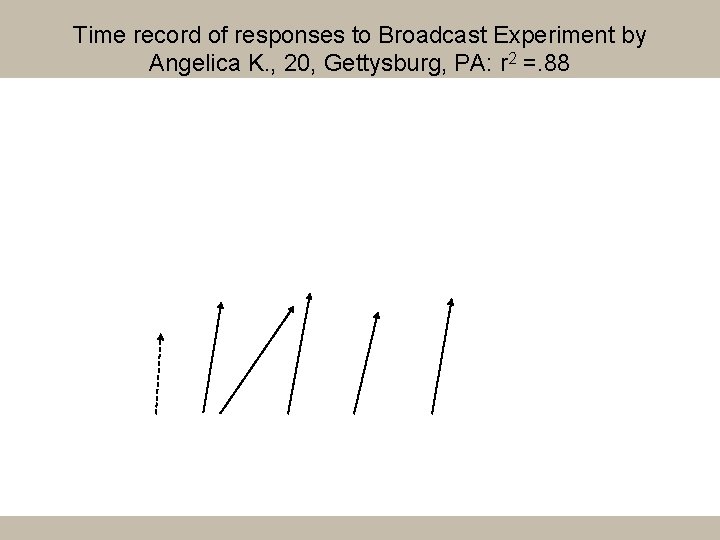
Time record of responses to Broadcast Experiment by Angelica K. , 20, Gettysburg, PA: r 2 =. 88
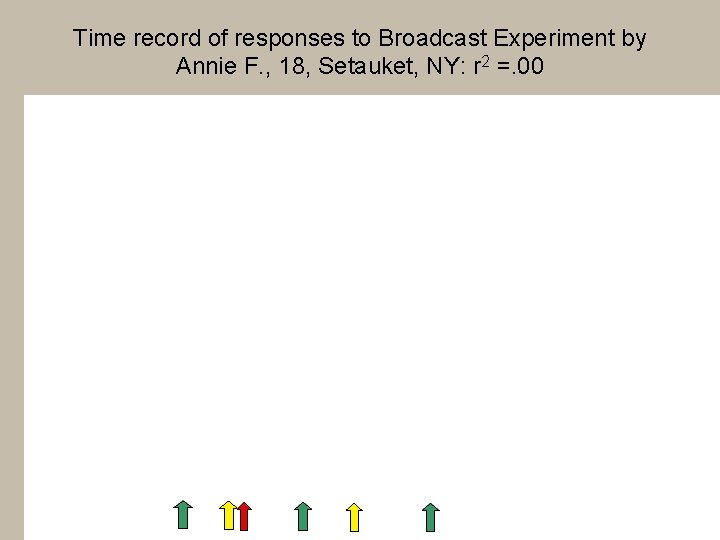
Time record of responses to Broadcast Experiment by Annie F. , 18, Setauket, NY: r 2 =. 00
Time record of responses to Broadcast Experiment by Daphne L. , 18, Los Angeles, CA: r 2 =. 00
Sensitivity to internal constraints
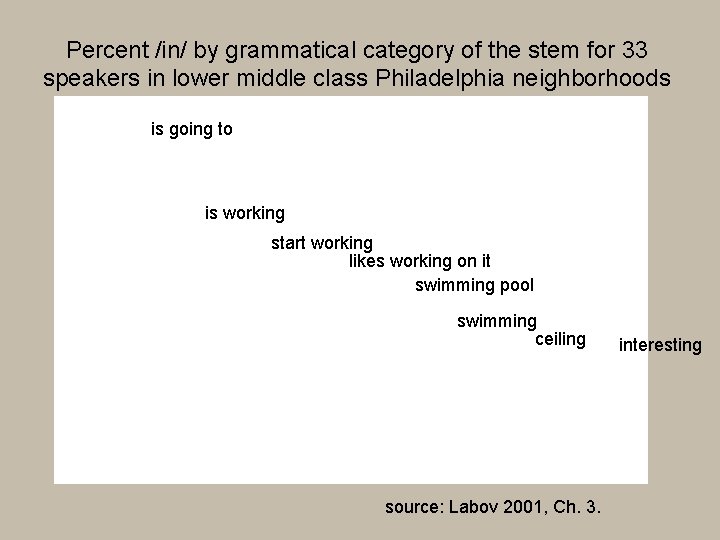
Percent /in/ by grammatical category of the stem for 33 speakers in lower middle class Philadelphia neighborhoods is going to is working start working likes working on it swimming pool swimming ceiling source: Labov 2001, Ch. 3. interesting
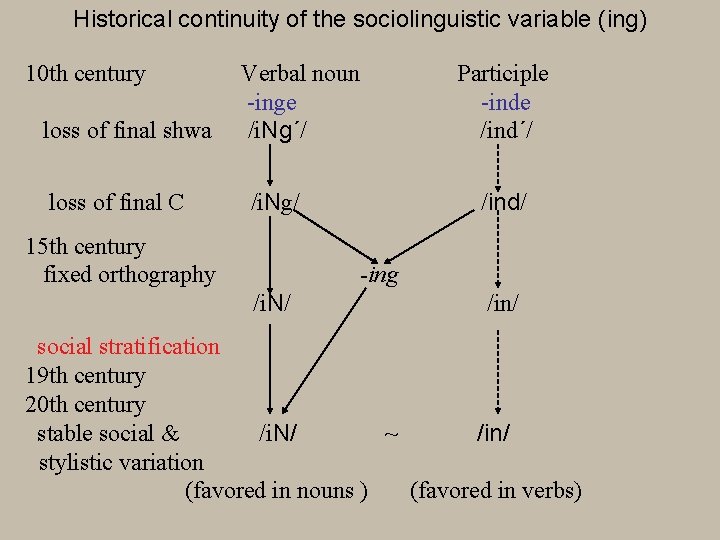
Historical continuity of the sociolinguistic variable (ing) 10 th century loss of final shwa loss of final C Verbal noun -inge /i. Ng´/ /i. Ng/ 15 th century fixed orthography Participle -inde /ind´/ /ind/ -ing /i. N/ /in/ social stratification 19 th century 20 th century stable social & /i. N/ ~ /in/ stylistic variation (favored in nouns ) (favored in verbs)

The Audition Protocol A young actor from a highly educated family is reading for the part of a construction worker in a Philadelphia play. There are two trials in his audition for the part. Please rate each of his trials on the scales below (from perfectly natural to very unnatural) by putting a check in one box. Perfectly Very natural. unnatural 1 2 3 4 5 6 7 / ______ / _______ / Husband [to wife]: Look baby, I know I was supposed to be painting the ceiling tonight. But they had me working since six in the morning on the god forsaken federal building. We were fixing the wiring on the west wall, and I was hanging onto the pipe railing all day. My back is killing me.
Responses to the Audition Experiment for (ING). TM = AA Northern male speaker. AH = AA Northern female speaker. Significance of normal vs reversed by t-test: solid line: p <. 01; dashed line p <. 05; dotted line, not significant.
The (R) variable pre-consonantal and final (syllable coda) > four, forty word final before a vowel (syllable initial) > four of word internal before a vowel (syllable initial) forage
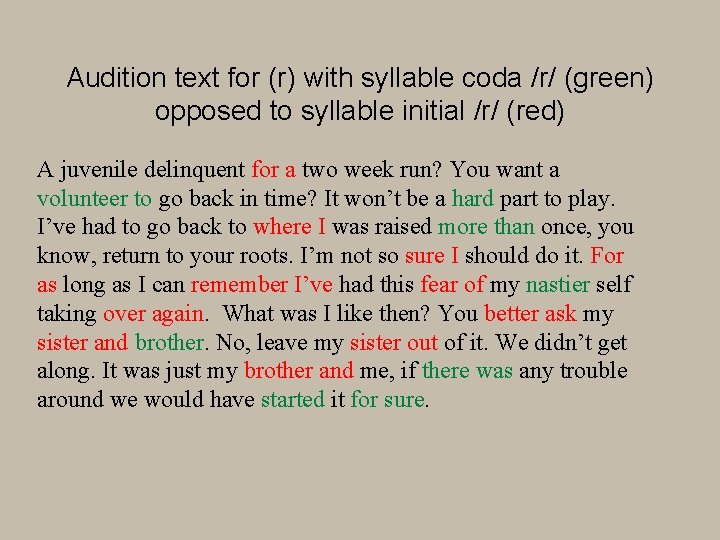
Audition text for (r) with syllable coda /r/ (green) opposed to syllable initial /r/ (red) A juvenile delinquent for a two week run? You want a volunteer to go back in time? It won’t be a hard part to play. I’ve had to go back to where I was raised more than once, you know, return to your roots. I’m not so sure I should do it. For as long as I can remember I’ve had this fear of my nastier self taking over again. What was I like then? You better ask my sister and brother. No, leave my sister out of it. We didn’t get along. It was just my brother and me, if there was any trouble around we would have started it for sure.
Audition results for (R) in responses to White Southern speaker JB in Columbia and Philadelphia. Solid line p <. 01, Dotted line n. s.
The properties of the sociolinguistic monitor • Within the limited range of our experiments, the temporal window of the sociolinguistic monitor is reasonably wide: it operates continuously across the time frame of the experiment. • Subjects show a striking consistency in their evaluation of sociolinguistic variables, clearly sensitive to differences in frequency as small as 10%. • Response of the SLM to sociolinguistic variants is not symmetrical: it is sensitive primarily to the frequency of marked forms rather than the frequency of unmarked forms.
The properties of the sociolinguistic monitor • The response of the SLM is not linear, but is determined by the proportional increase in the frequency of marked forms observed. • Uniform sensitivity of the SLM is characteristic of the adult population, developing considerably later than other sociolinguistic functions. • The SLM is sensitive to structural constraints on linguistic variables as well as frequency of marked variants.
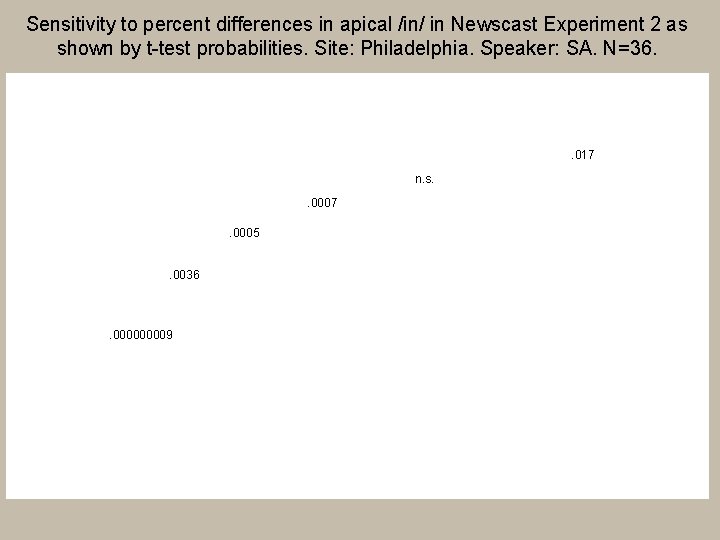
Sensitivity to percent differences in apical /in/ in Newscast Experiment 2 as shown by t-test probabilities. Site: Philadelphia. Speaker: SA. N=36. . 017 n. s. . 0007. 0005. 0036 . 00009
- Slides: 75