
Cognitive Behavioural Therapy Developed by Beck Aim Teach
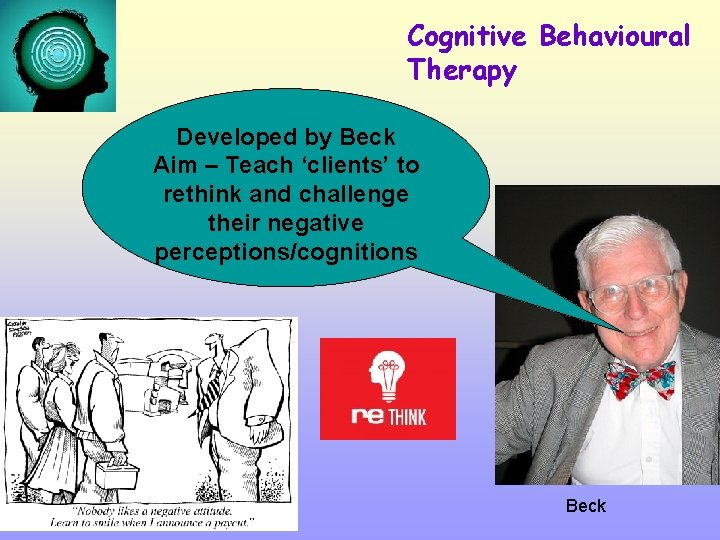
Cognitive Behavioural Therapy Developed by Beck Aim – Teach ‘clients’ to rethink and challenge their negative perceptions/cognitions Beck
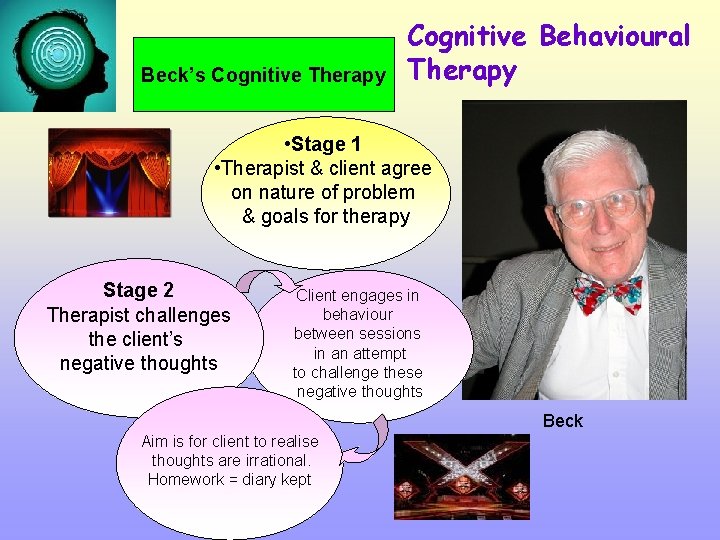
Beck’s Cognitive Therapy Cognitive Behavioural Therapy • Stage 1 • Therapist & client agree on nature of problem & goals for therapy Stage 2 Therapist challenges the client’s negative thoughts Client engages in behaviour between sessions in an attempt to challenge these negative thoughts Beck Aim is for client to realise thoughts are irrational. Homework = diary kept
Most common features of CBT are: 1. Client monitors their negative, automatic thoughts (cognitions) 3. Client examines evidence for and against their distorted thoughts Cognitive Behavioural Therapy 2. Client recognises the connection between cognitions, affect (mood) and behaviour 4. Client learns to substitute biased cognitions for more realistic ones 5. Client learns to identify & alter their beliefs that predispose them to distort their experiences
Further developed to include challenging behaviour too Cognitive Behavioural Therapy Usually a series of 20 sessions over 16 weeks Homework set Thought-catching
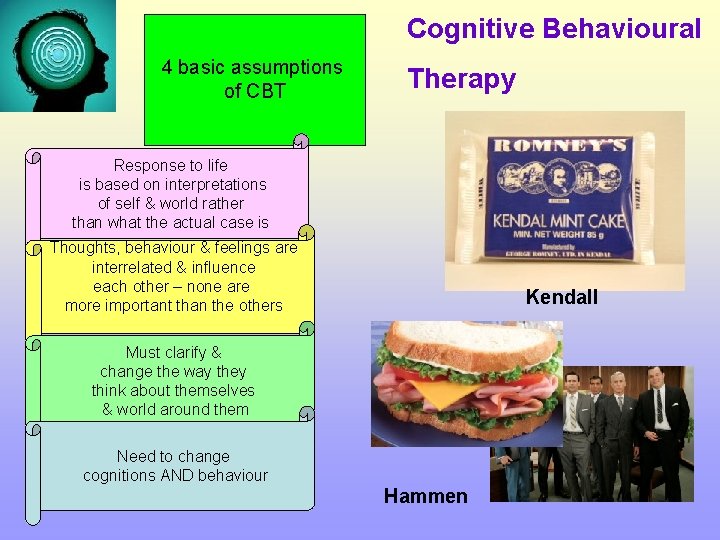
Cognitive Behavioural 4 basic assumptions of CBT Therapy Response to life is based on interpretations of self & world rather than what the actual case is Thoughts, behaviour & feelings are interrelated & influence each other – none are more important than the others Kendall Must clarify & change the way they think about themselves & world around them Need to change cognitions AND behaviour Hammen

Cognitive Behavioural Effectiveness Therapy Compared depressed • Beck’s CT patients receiving • IPT a range of therapies • Tricyclics 60 pts randomly • Placebo - no allocated treatment All treatments – 16 wks Assessed: Assessed before, • Symptoms of dep • Overall symptoms & during, life functionin at end & follow ups Improvement IPT = 55% Drugs = 57% CT = 51% Placebo = 29% Drug = fastest to reduce symptoms Placebo = better for mildly dep than severely IPT = best for social functioning CT = best for dysfunctional attitudes Elkin et al (1989) 18 mths later = only 20 -30% dep free IPT = most satisfied with treatment IPT & CT = able to recognise sources of dep & better social rels LT = psychological better Relapse higher for drugs than CT (47% - 31%)
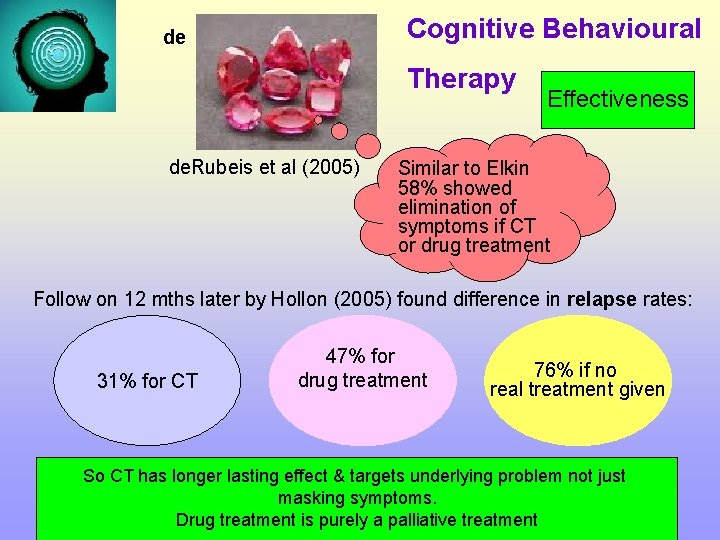
Cognitive Behavioural de Therapy de. Rubeis et al (2005) Effectiveness Similar to Elkin 58% showed elimination of symptoms if CT or drug treatment Follow on 12 mths later by Hollon (2005) found difference in relapse rates: 31% for CT 47% for drug treatment 76% if no real treatment given So CT has longer lasting effect & targets underlying problem not just masking symptoms. Drug treatment is purely a palliative treatment

Effectiveness Rush (1977) – CBT at least as effective as drugs Cognitive Behavioural Therapy Blackburn & Moorhead (2000) CBT superior to drugs in particular 1 year + Kupfer & Frank (2001) Most effective treatment is A combi of CBT & anti-depressants
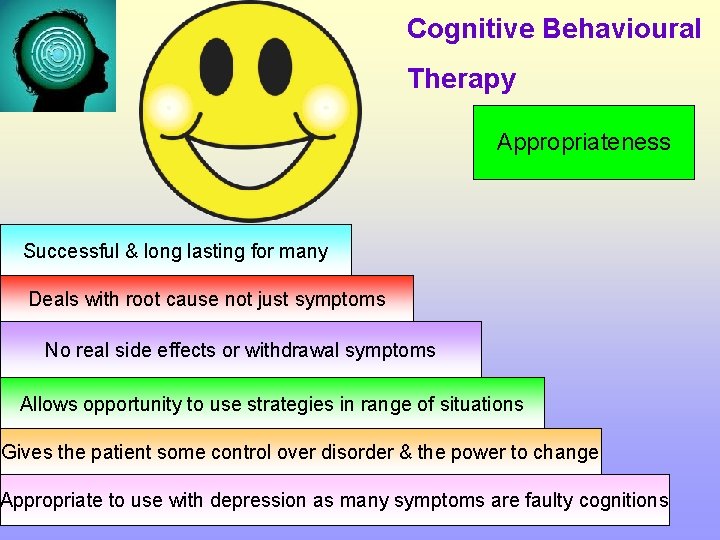
Cognitive Behavioural Therapy Appropriateness Successful & long lasting for many Deals with root cause not just symptoms No real side effects or withdrawal symptoms Allows opportunity to use strategies in range of situations Gives the patient some control over disorder & the power to change Appropriate to use with depression as many symptoms are faulty cognitions
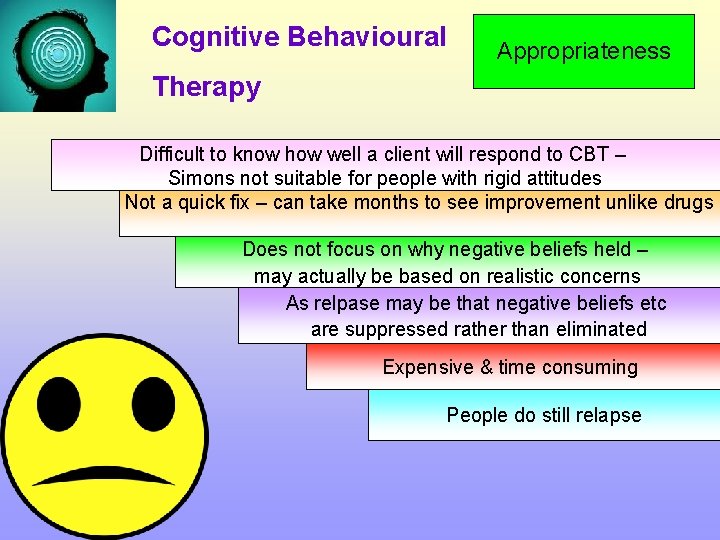
Cognitive Behavioural Appropriateness Therapy Difficult to know how well a client will respond to CBT – Simons not suitable for people with rigid attitudes Not a quick fix – can take months to see improvement unlike drugs Does not focus on why negative beliefs held – may actually be based on realistic concerns As relpase may be that negative beliefs etc are suppressed rather than eliminated Expensive & time consuming People do still relapse
Cognitive Behavioural Therapy Take notes from textbook on p 238 -9 to expand evaluation & studies
- Slides: 11