
Cognitive Behavioral Therapy Rational Emotive Behavior Therapy REBT
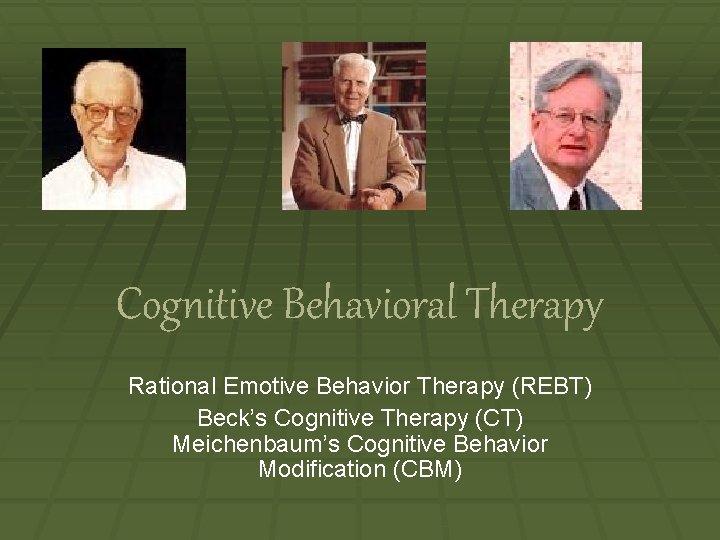
Cognitive Behavioral Therapy Rational Emotive Behavior Therapy (REBT) Beck’s Cognitive Therapy (CT) Meichenbaum’s Cognitive Behavior Modification (CBM)

From Behavior Theory Comes… § Albert Ellis’ REBT § Aaron T. Beck’s CT § Donald Meichenbaum’s CBT § These are the more prominent cognitive behavioral approaches, however, there are over 20 therapies that are considered “cognitive” or “cognitive behavioral”

History of REBT § Developed by Albert Ellis (1955) § Incorporated cognition, emotion, and behavior into techniques § Maintains that cognition governs emotions, feelings (i. e. , “We feel what we think”) § Considered “active-directive” therapeutic process that focuses on client empowerment and education § Goal is to get clients to feel and think more positively, thus attaining their personal goals
History of CT § Developed by Aaron Beck § Clients misinterpret certain life situations, which leads to cognitive distortions or “logical errors” § Logical errors lead to emotional difficulties by distorting reality to validate previously held negative beliefs

History of CBM § Developed by Donald Meichenbaum § Focus on changing client’s selfverbalizations § In order to change, clients must listen to their “self-speak” and notice how they think, feel, and behave

Basic Principles REBT CT CBM A-B-C-D-E-F model Logical errors lead to emotional difficulties Clients must become aware of how they think, feel, and behave and how this impacts others around them Irrational beliefs Faulty thinking, incorrect inferences, fantasy vs. reality negative scripts impact behavior Thoughts are characterized by Musts, Shoulds, and Oughts Arbitrary inferences, selective abstraction, overgeneralization, magnification/minimalization, perosnalization, (mis)labeling, polarized thinking
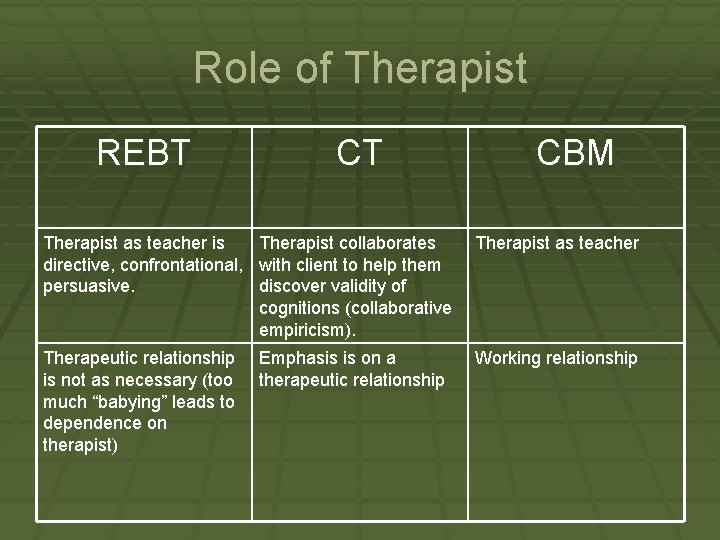
Role of Therapist REBT CT CBM Therapist as teacher is Therapist collaborates directive, confrontational, with client to help them persuasive. discover validity of cognitions (collaborative empiricism). Therapist as teacher Therapeutic relationship is not as necessary (too much “babying” leads to dependence on therapist) Working relationship Emphasis is on a therapeutic relationship

Therapeutic Process REBT CT CBM Help client’s identify irrational oughts, shoulds, musts Clients take an active role in therapy Self-instructional training that focuses on helping clients become aware of self-talk Help client understand their role in maintaining irrational beliefs and help clients modify thinking Client and therapist collaborate to form testable hypotheses and design “experiments” to test hypotheses Clients are taught to make positive self-statements and modify self-instruction in order to cope with stress Challenge clients to develop rational thinking Client is encouraged to selfdiscover faulty thinking and behavior Cognitive restructuring 1. Self-observation 2. New internal dialogue 3. New skills
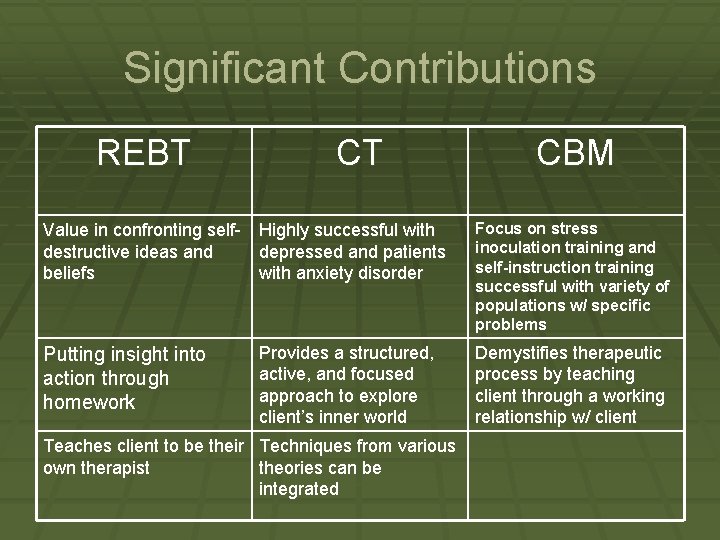
Significant Contributions REBT CT Value in confronting self- Highly successful with destructive ideas and depressed and patients beliefs with anxiety disorder Putting insight into action through homework Provides a structured, active, and focused approach to explore client’s inner world Teaches client to be their Techniques from various own therapist theories can be integrated CBM Focus on stress inoculation training and self-instruction training successful with variety of populations w/ specific problems Demystifies therapeutic process by teaching client through a working relationship w/ client

Limitations of Cognitive-Behavioral Therapy q. Cultural considerations q. Theory is Eurocentric in that it relies heavily on “logic” as defined by Western principles § If a client comes from a culture that does not encourage direct confrontation § If a client’s culture focuses on “being” rather than “thinking” § ? ? ?
- Slides: 10