
Cognitive Behavioral Therapy for Teen Substance Use Sara
Cognitive Behavioral Therapy for Teen Substance Use Sara Becker, Ph. D Project Director, New England ATTC Assistant Professor, Brown School of Public Health 3 rd Annual New England Adolescent Conference
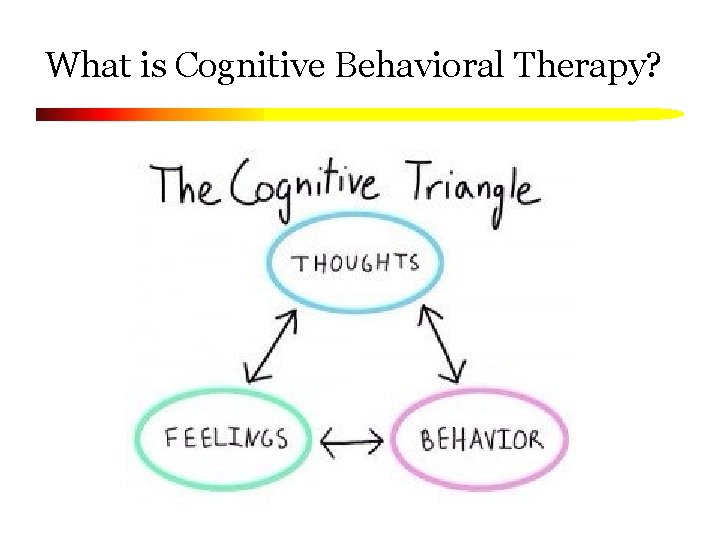
What is Cognitive Behavioral Therapy?
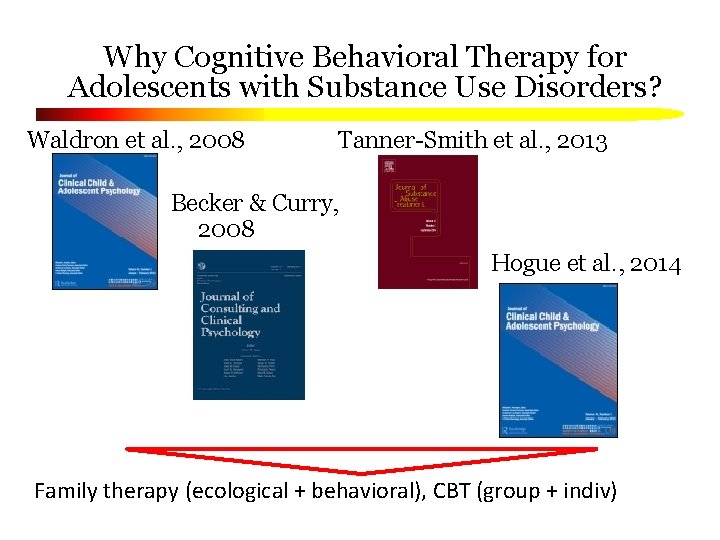
Why Cognitive Behavioral Therapy for Adolescents with Substance Use Disorders? Waldron et al. , 2008 Tanner-Smith et al. , 2013 Becker & Curry, 2008 Hogue et al. , 2014 Family therapy (ecological + behavioral), CBT (group + indiv)
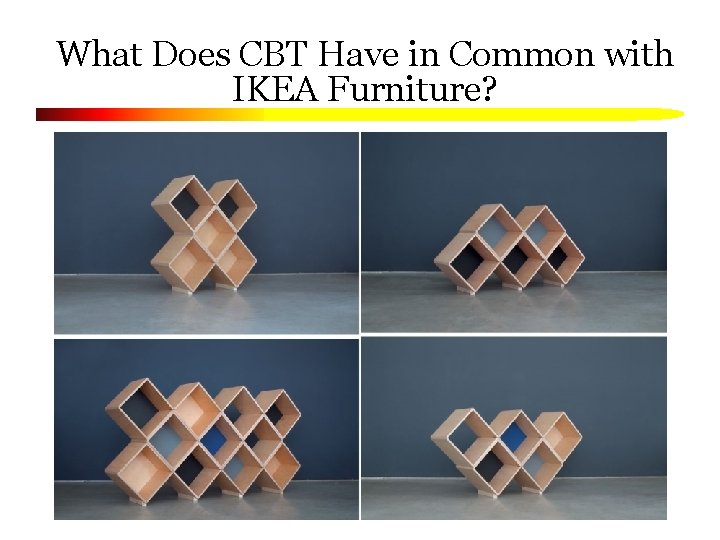
What Does CBT Have in Common with Modular CBT IKEA Furniture?
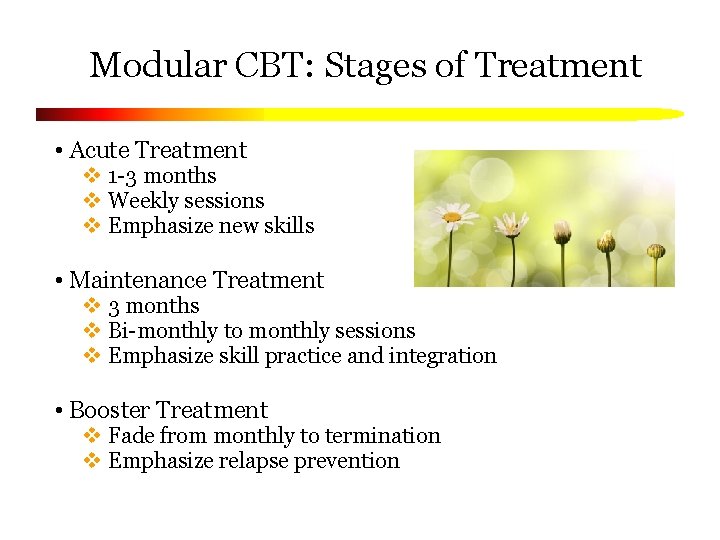
Modular CBT: Stages of Treatment • Acute Treatment v 1 -3 months v Weekly sessions v Emphasize new skills • Maintenance Treatment v 3 months v Bi-monthly to monthly sessions v Emphasize skill practice and integration • Booster Treatment v Fade from monthly to termination v Emphasize relapse prevention
Parent Involvement • In all 3 phases of treatment • Acute v Diagnosis, conceptualization, and treatment explained v Brought in to help coach teen in skill use v Address parenting and communication skills as needed • Maintenance v Continued coaching and skills practice • Booster Treatment v Preventing relapse v Identifying when future treatment is needed
Structure of CBT sessions: 3 S’s • Set the stage v Assess patient’s substance use and safety over past week v Review homework completed over past week v Set agenda Is there anything you want to make sure we cover today? • Skill – teaching and practice! • Summarize v Review core components of skill v Assign homework to practice skill in real-world
CASE STUDY: BREE
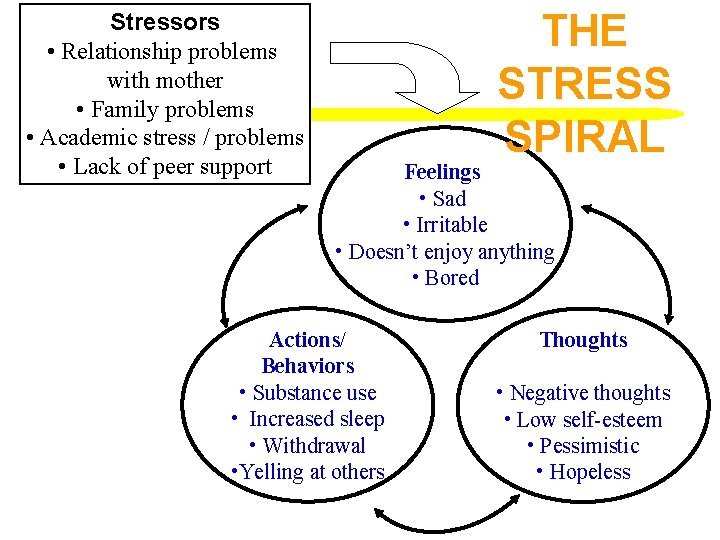
Stressors • Relationship problems with mother • Family problems • Academic stress / problems • Lack of peer support THE STRESS SPIRAL Feelings • Sad • Irritable • Doesn’t enjoy anything • Bored Actions/ Behaviors • Substance use • Increased sleep • Withdrawal • Yelling at others Thoughts • Negative thoughts • Low self-esteem • Pessimistic • Hopeless
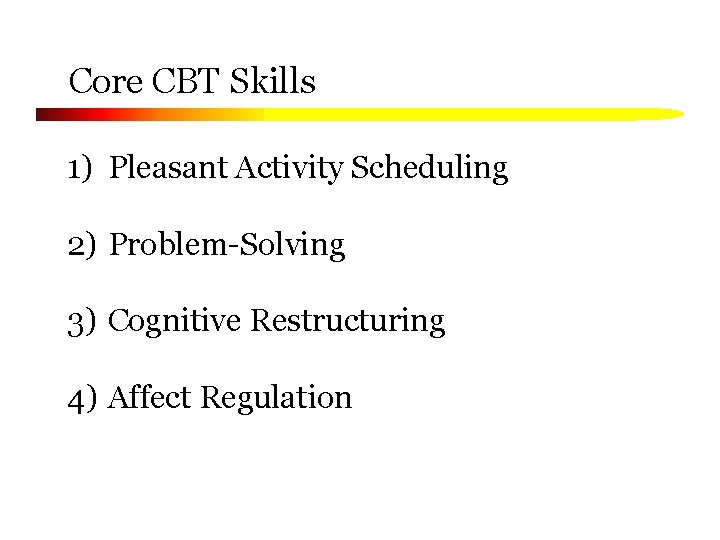
Core CBT Skills 1) Pleasant Activity Scheduling 2) Problem-Solving 3) Cognitive Restructuring 4) Affect Regulation
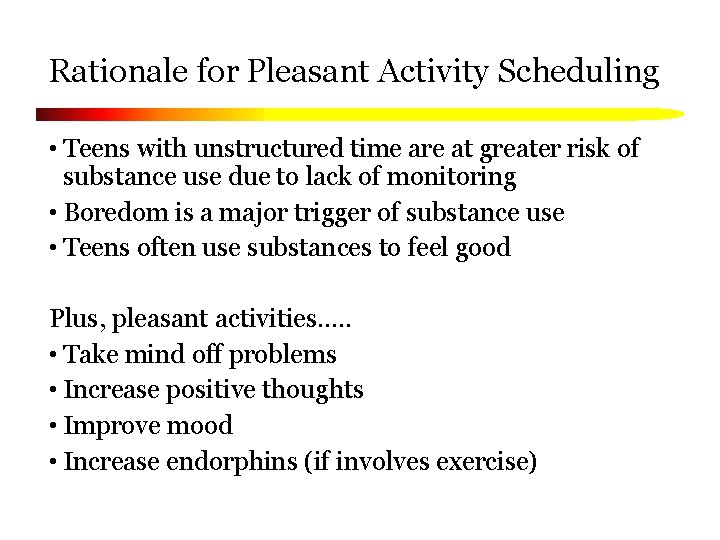
Rationale for Pleasant Activity Scheduling • Teens with unstructured time are at greater risk of substance use due to lack of monitoring • Boredom is a major trigger of substance use • Teens often use substances to feel good Plus, pleasant activities…. . • Take mind off problems • Increase positive thoughts • Improve mood • Increase endorphins (if involves exercise)
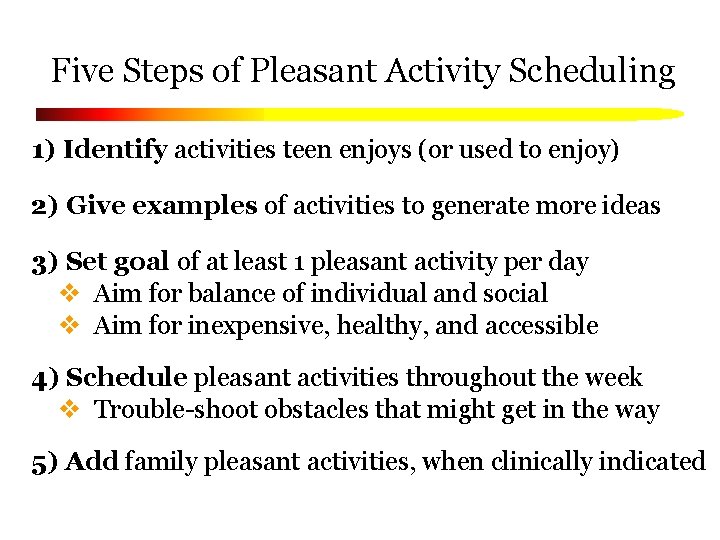
Five Steps of Pleasant Activity Scheduling 1) Identify activities teen enjoys (or used to enjoy) 2) Give examples of activities to generate more ideas 3) Set goal of at least 1 pleasant activity per day v Aim for balance of individual and social v Aim for inexpensive, healthy, and accessible 4) Schedule pleasant activities throughout the week v Trouble-shoot obstacles that might get in the way 5) Add family pleasant activities, when clinically indicated
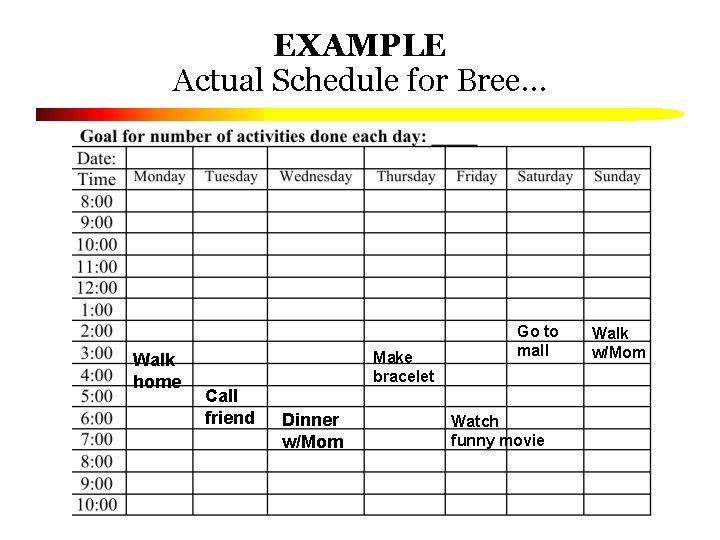
EXAMPLE Actual Schedule for Bree… Walk home Make bracelet Call friend Dinner w/Mom Go to mall Watch funny movie Walk w/Mom
GROUP PRACTICE! Brief Pleasant Activity Scheduling Worksheet Review
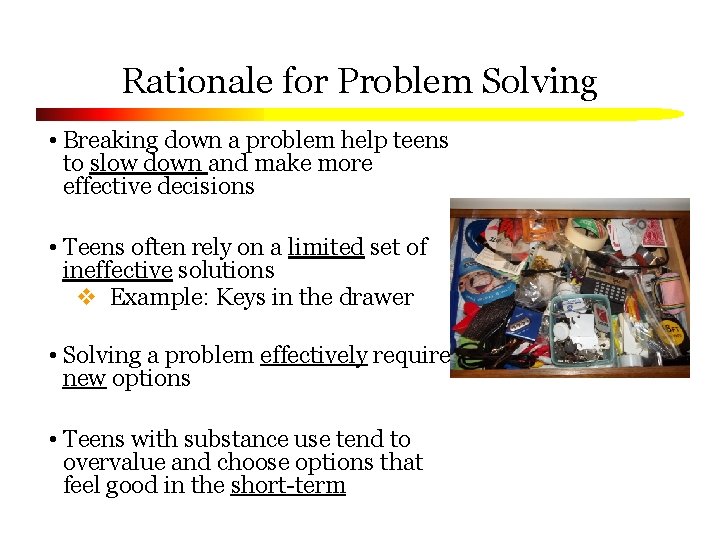
Rationale for Problem Solving • Breaking down a problem help teens to slow down and make more effective decisions • Teens often rely on a limited set of ineffective solutions v Example: Keys in the drawer • Solving a problem effectively requires new options • Teens with substance use tend to overvalue and choose options that feel good in the short-term
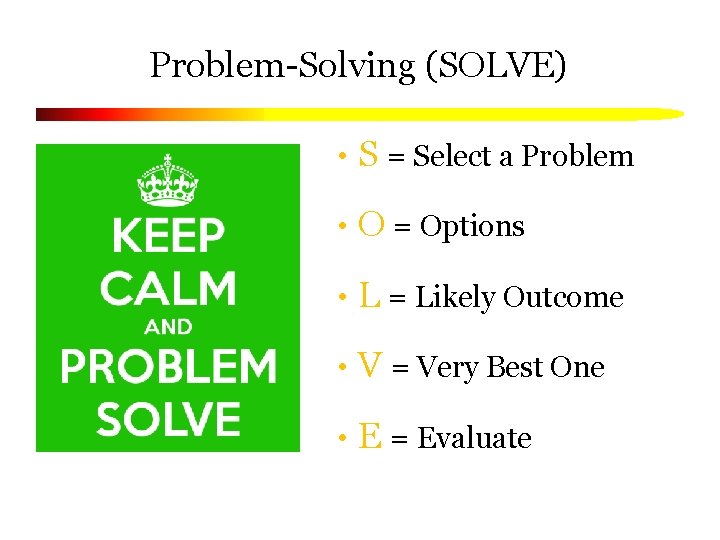
Problem-Solving (SOLVE) • S = Select a Problem • O = Options • L = Likely Outcome • V = Very Best One • E = Evaluate
CASE MATERIAL REVIEW Problem-Solving Worksheet Review
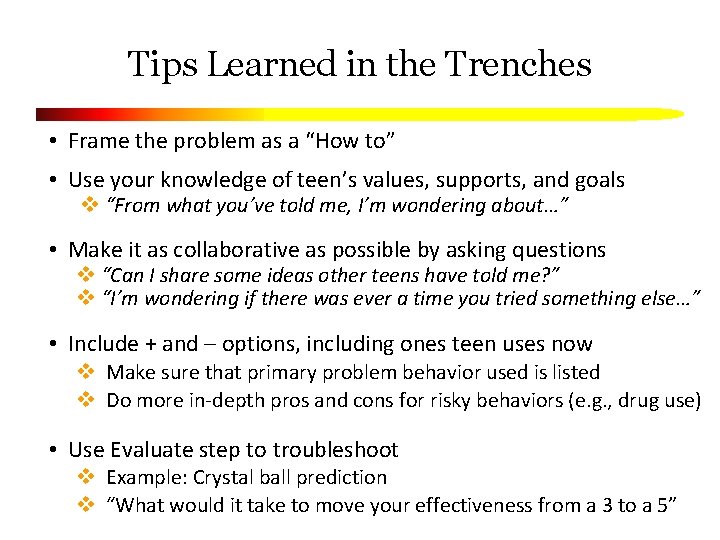
Tips Learned in the Trenches • Frame the problem as a “How to” • Use your knowledge of teen’s values, supports, and goals v “From what you’ve told me, I’m wondering about…” • Make it as collaborative as possible by asking questions v “Can I share some ideas other teens have told me? ” v “I’m wondering if there was ever a time you tried something else…” • Include + and – options, including ones teen uses now v Make sure that primary problem behavior used is listed v Do more in-depth pros and cons for risky behaviors (e. g. , drug use) • Use Evaluate step to troubleshoot v Example: Crystal ball prediction v “What would it take to move your effectiveness from a 3 to a 5”
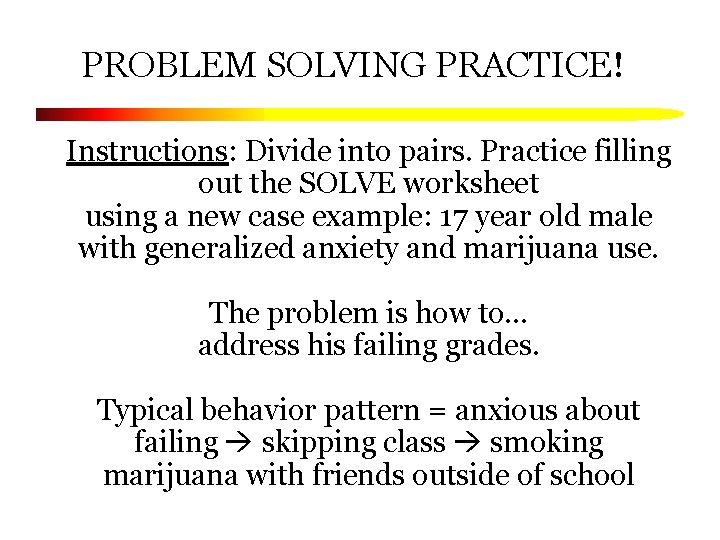
PROBLEM SOLVING PRACTICE! Instructions: Divide into pairs. Practice filling out the SOLVE worksheet using a new case example: 17 year old male with generalized anxiety and marijuana use. The problem is how to… address his failing grades. Typical behavior pattern = anxious about failing skipping class smoking marijuana with friends outside of school
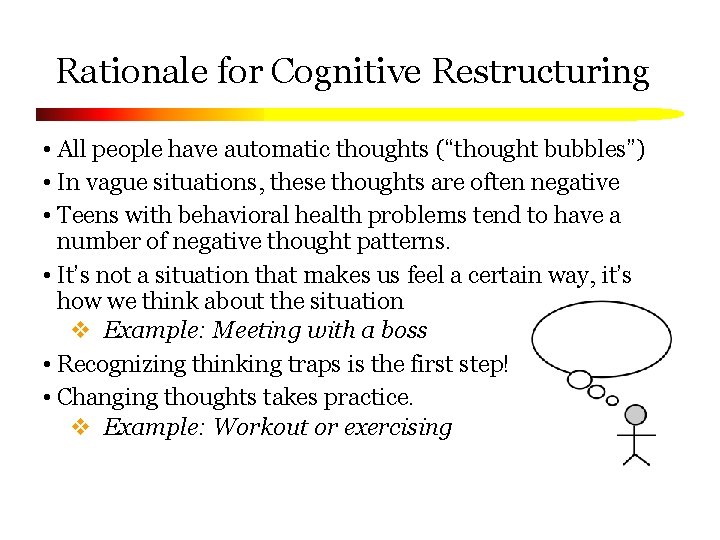
Rationale for Cognitive Restructuring • All people have automatic thoughts (“thought bubbles”) • In vague situations, these thoughts are often negative • Teens with behavioral health problems tend to have a number of negative thought patterns. • It’s not a situation that makes us feel a certain way, it’s how we think about the situation v Example: Meeting with a boss • Recognizing thinking traps is the first step! • Changing thoughts takes practice. v Example: Workout or exercising
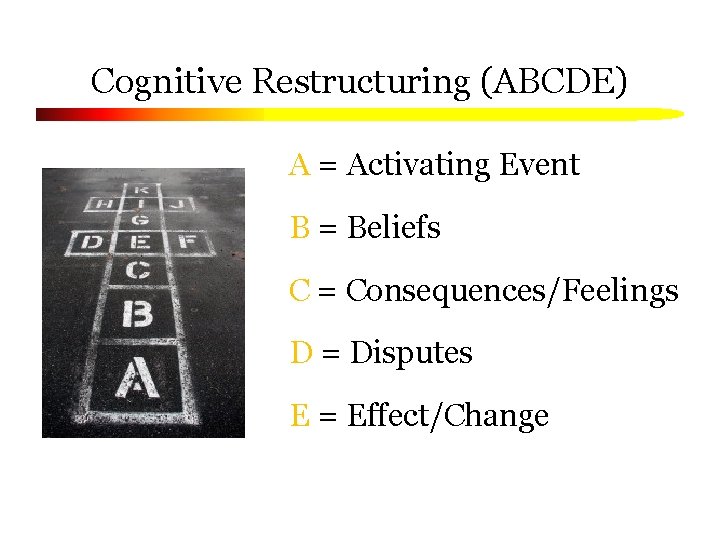
Cognitive Restructuring (ABCDE) A = Activating Event B = Beliefs C = Consequences/Feelings D = Disputes E = Effect/Change
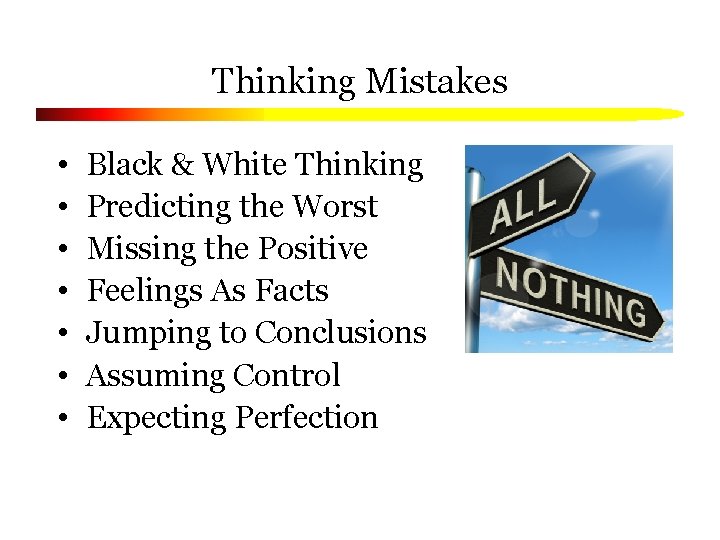
Thinking Mistakes • • Black & White Thinking Predicting the Worst Missing the Positive Feelings As Facts Jumping to Conclusions Assuming Control Expecting Perfection
CASE MATERIAL REVIEW ABCDE Worksheet Review
Tips from the Trenches • Make sure you identify the “hot thought!” v Onion analogy • If you can’t find a hot thought, look for a judgment v Example: “I am…” • Beware black and white disputes • Help with disputing… v Is this thought TRUE? v Is this thought HELPFUL? v What would you say to a FRIEND in the same situation?
ABCDE PRACTICE! Instructions: Divide into pairs. Practice filling out the ABCDE worksheet using our new case: 17 year old male with generalized anxiety and marijuana use. The situation/antecedent is… he overhears that a bunch of friends are heading out after to school, but no one invited him
Rationale for Affect Regulation • Helps teens to identify and understand their emotions, by slowing down the process v Example: I don’t know what happened. I was calm and the next thing I knew, I was screaming at my Mom. • Intense emotions can get in the way of making good decisions or using skills • Recognizing “body talk” and thoughts can help teens feel more in control
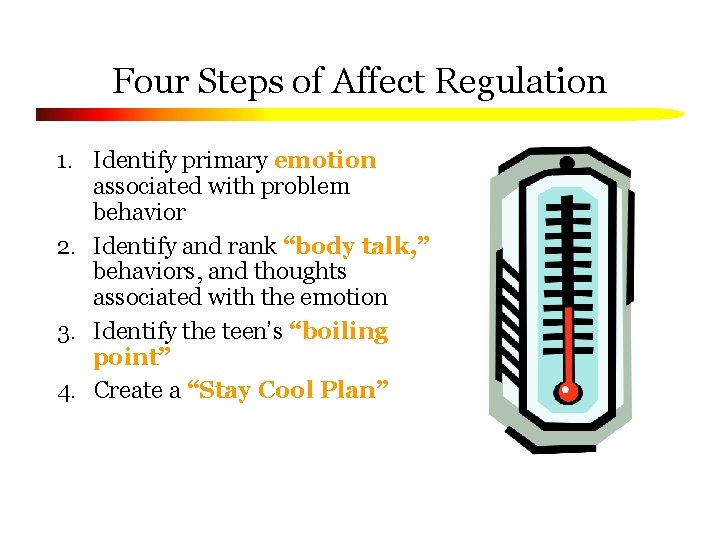
Four Steps of Affect Regulation 1. Identify primary emotion associated with problem behavior 2. Identify and rank “body talk, ” behaviors, and thoughts associated with the emotion 3. Identify the teen’s “boiling point” 4. Create a “Stay Cool Plan”
Tips from the Trenches • For teens who have trouble identifying signs v Ask for signs before and after an anchor Example: Clench my fists, face turns red… v Ask what others would notice v Depersonalize emotion –what have they seen others do? • For “Stay Cool Plan” v Start with strategies that have worked in the past v Build on strategies teen from SOLVE and ABCDE
CASE MATERIAL REVIEW Affect Regulation Worksheet Review …and Q & A
Other Helpful Skills For Teens �Skill Review/Practice �Increasing Social Supports �Communication Training �Relapse Prevention (Family Sessions
CBT Skills for Parents �Communication Training �Parental Monitoring �Family/ Collaborative Problem Solving �Contracting
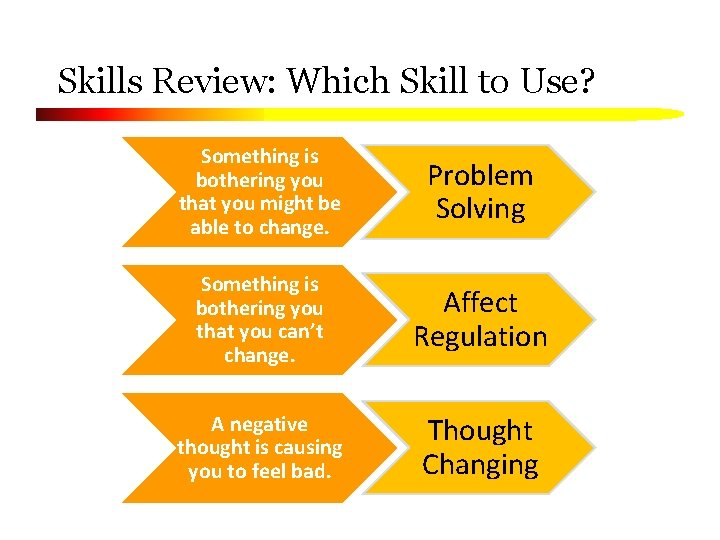
Skills Review: Which Skill to Use? Something is bothering you that you might be able to change. Problem Solving Something is bothering you that you can’t change. Affect Regulation A negative thought is causing you to feel bad. Thought Changing
Wrap-Up ANY QUESTIONS? Contact Me: Sara Becker, Ph. D. 401 -863 -6604 sara_becker@brown. edu
- Slides: 33