
Cognitive Behavioral Therapy for Psychosis A Workshop for
Cognitive Behavioral Therapy for Psychosis: A Workshop for Clinicians Kim T. Mueser Center for Psychiatric Rehabilitation Boston University (With contributions by Cori Cather, Jen Gottlieb, Eric Granholm, and Kate Hardy)
REVIEW: PRIMARY ASSUMPTIONS UNDERLYING CBT • What you think in a situation influences how you feel in that situation • How you feel influences your behavior, or how you act in that situation or related situations in the future • Sometimes how you feel in a situation influences what you think about it • Learning how to evaluate and correct inaccurate thoughts/beliefs related to negative feelings can reduce those feelings and lead to more effective behavior
EXAMPLE • You are sleeping in your ground floor apartment and you hear scratching on the window. You think someone might be trying to break into your apartment. • How would you feel in this situation? • What might you do? • What if you remembered that you let your cat out before you went to bed, and she didn’t come back in, so you think maybe it’s your cat at the window? • How would you feel? What might you do?
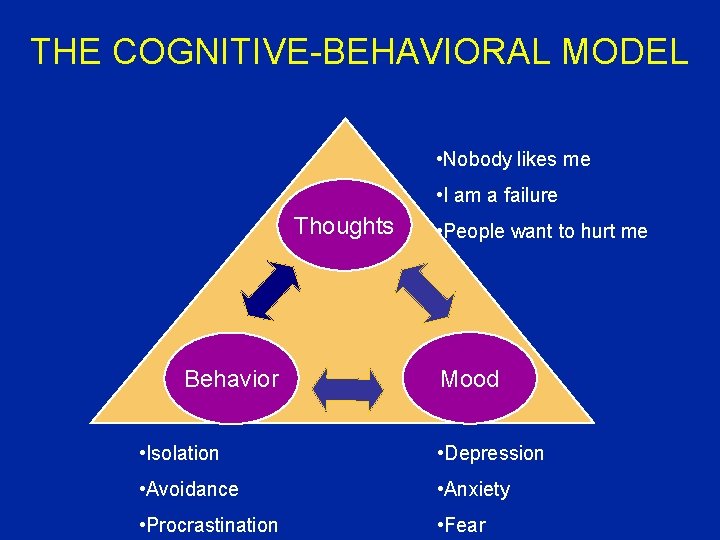
THE COGNITIVE-BEHAVIORAL MODEL • Nobody likes me • I am a failure Thoughts Behavior • People want to hurt me Mood • Isolation • Depression • Avoidance • Anxiety • Procrastination • Fear
CBTp PHILOSOPHY ¨ Not so different from CBT for depression and anxiety, really ¨ Human experience and behavior exists on a continuum ¨ Psychotic symptoms (and other schizophrenia symptoms) are amenable to cognitive and behavioral interventions ¨ Reduction of symptoms/distress tied directly to personal goals
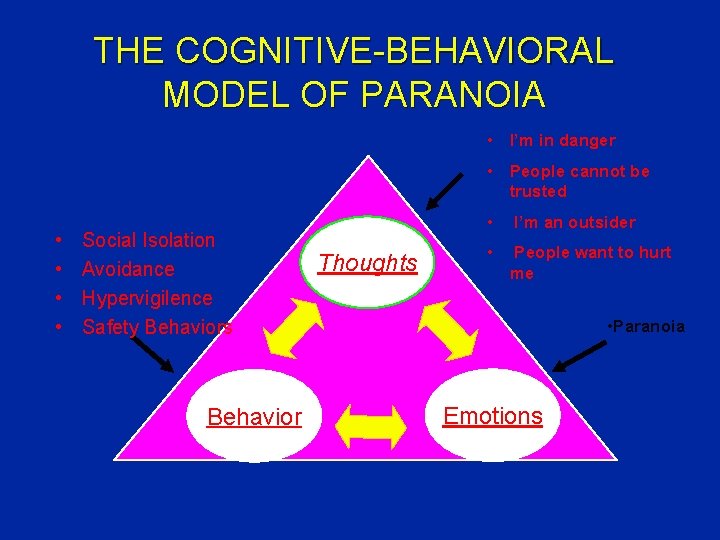
THE COGNITIVE-BEHAVIORAL MODEL OF PARANOIA • I’m in danger • People cannot be trusted • • Social Isolation Avoidance Hypervigilence Safety Behaviors Behavior Thoughts • I’m an outsider • People want to hurt me • Paranoia Emotions
MAIN TENETS OF CBTp ¨ Symptoms are maintained by appraisal and behavior ¨ Distortions are amenable to cognitive and behavioral approaches ¨ Psychotic symptoms (e. g. , delusions) represent an attempt to make sense of negative affect
WHICH ACT CLIENTS ARE MOST LIKELY TO BENEFIT FROM CBTp? • Persons with persistent psychotic symptoms • High levels of distress related to symptoms • Preferable if person has some degree of doubt or is able to consider alternative explanations, but not absolutely required • Can be engaged in talk for 30+ min. • Good working relationship with ACT team member(s)
OVERARCHING GOALS OF CBTp • Foster a curious attitude about symptoms • Decrease distress about symptoms (but not necessarily frequency or intensity of symptoms themselves!) • Adopt a “living with illness” strategy • Improve sense of personal control • Enhance healthy, effective coping with symptoms • Improve day-to-day functioning • Prevent severe relapse
STRUCTURE OF CBTp SESSIONS • • • Collaborative agenda setting Review of previous session Review of homework Practice new skill in session Assign homework related to new skill area Session review and feedback
SELECTIVE CBTp SKILLS • • • Engagement and befriending Goal setting Normalization Coping strategy enhancement Cognitive restructuring – Cognitive distortions – Socratic questioning – Behavioral experiments
ENGAGEMENT AND BEFRIENDING • Essential to developing therapeutic relationship • Ongoing process throughout therapy • May require increased amounts of befriending depending on symptoms –Paranoia –Hallucinations –Severe negative symptoms
BEFRIENDING (Cont’d) • Befriending -Focus on neutral non threatening topics -No active formulation or treatment -Non-confrontational -Empathic -Supportive -Accepting -Non-colluding • Assertive engagement
COMMON ENGAGEMENT DIFFICULTIES IN CBTp • Poor session attendance • Lack of enthusiasm for treatment • Paranoia or low disclosure at outset • Difficulty formulating problems or goals
SOLUTIONS: ASSESS UNDERLYING CAUSES • Organizational difficulties: problem-solve solutions • Are you working on what is important to the client? ? ? • Is low enthusiasm simply negative symptoms? • Take it slow, build trust, get to know the person, seek to align with their goals or interests
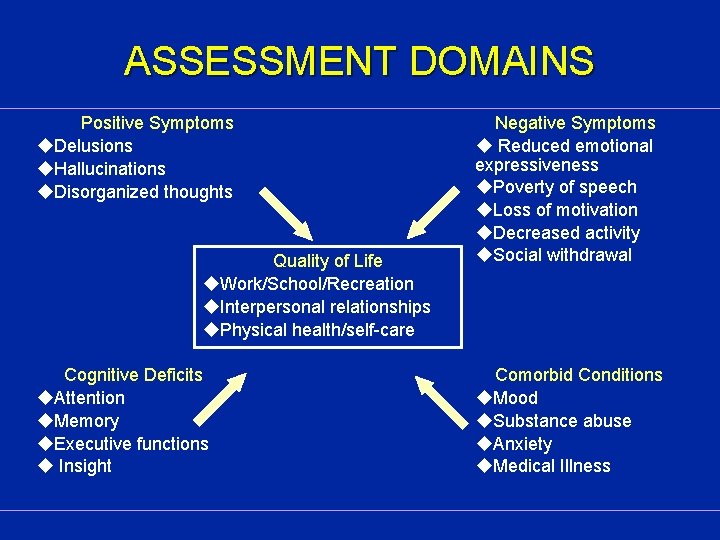
ASSESSMENT DOMAINS Positive Symptoms u. Delusions u. Hallucinations u. Disorganized thoughts Quality of Life u. Work/School/Recreation u. Interpersonal relationships u. Physical health/self-care Cognitive Deficits u. Attention u. Memory u. Executive functions u Insight Negative Symptoms u Reduced emotional expressiveness u. Poverty of speech u. Loss of motivation u. Decreased activity u. Social withdrawal Comorbid Conditions u. Mood u. Substance abuse u. Anxiety u. Medical Illness
AND… • Suicidality/homicidality • Short and longer term life goals • Values • Understanding of psychosis and associated symptoms • Medication adherence
DEVELOPING A PROBLEM/GOAL LIST • Collaboration is key • Elicit problem areas by discussing what is distressing to the person and what interferes with the goals or desires • Assess what is most important to guide goal development • Shows the client you are listening and creates a sense that difficulties are contained rather than infinite
DEVELOP A PROBLEM/GOAL LIST (Cont’d) • Brainstorm and be broad initially, then focus and become more specific • Prioritize and maintain a focus throughout work with person • Include at least one goal related to a psychotic symptom • Other goals may be functional goals related to interference from psychosis or simply life goals
SAMPLE PROBLEM LIST Bryant 1. “Neighbors are using wireless technology against me. ” 2. “The voices keep me from getting a job. ” 3. “I don’t have anything to do all day. ” 4. “I used to drive and now am worried about doing anything other than walking around the block with my mom. ” 5. “I’m confused about these experiences. ”
Charlotte SAMPLE PROBLEM LIST 1. “Neighbors are watching me and informing the police about me. ” 2. “I am being controlled by their instructions. ” 3. “I feel like my family does not care about me. ” 4. “I need to lose weight. ”
NORMALIZATION • CBT is inherently normalizing – We all experience negative thoughts – We all engage in unhelpful thinking – We all use coping strategies that aren’t always the most healthy choices • Allows for normalizing of psychotic symptoms as well
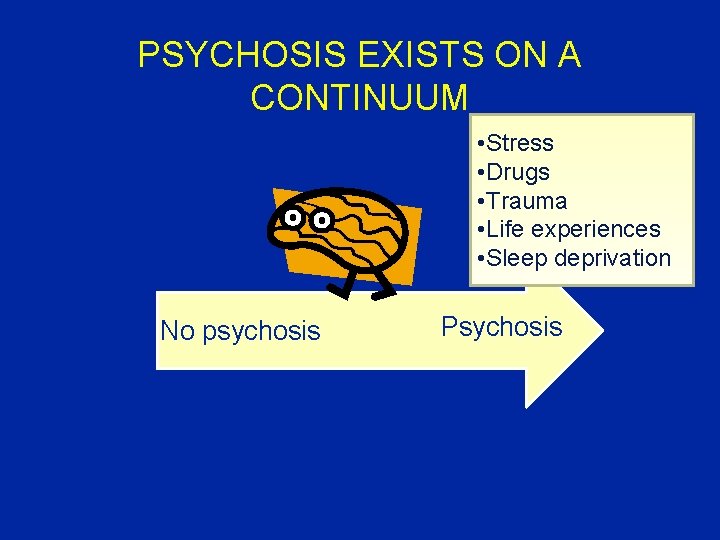
PSYCHOSIS EXISTS ON A CONTINUUM • Stress • Drugs • Trauma • Life experiences • Sleep deprivation No psychosis Psychosis
NORMALIZATION OF PSYCHOTIC SYMPTOMS • “Normalization is the antidote to stigma” – Avoid catastrophizing • Mental Illness is a common experience (1 in 4 people) • Psychosis can affect anyone regardless of age, ethnicity, gender, SES • Large number of people can overcome symptoms • Symptoms may be viewed positively in different cultures • Normalizing experiences – not dismissing them • Check in how the information is received (invalidating? )
NORMALIZING: HOW • Encourage people to research and read personal recovery stories – Elyn Saks – John Nash – Eleanor Longden – Rufus May – Develop library of recovery stories
NORMALIZING: HOW • Research prevalence of symptoms (depression, hearing voices, paranoia etc. ) • 15 -20% population experience frequent paranoid thoughts without significant distress • 3 -5% population have more severe paranoia (Freeman, 2006) • 5% of population hear voices (Tien 1991) • People hear voices without seeking mental health services (Romme & Escher 1989) • 9% people hold delusional beliefs (van Os, 2000) • Common to see or hear loved one following bereavement (Grimby 1993) • Connect with other people experiencing psychosis –Intervoice –Psycope. co. uk –Paranoia. com

VIDEO DEMONSTRATION OF NORMALIZATION
RATIONALE FOR COPING STRATEGY ENHANCEMENT • Focus on distressing symptoms • Does not require insight into hallucinations or delusions • Use analogies to other distressing experiences (e. g. , migraine headaches, bullying) • Express empathy that this has been difficult and client has done best he/she can • Express optimism that together you can improve coping
ASSESS CURRENT AND PAST COPING RESPONSES • Evaluate behavioral, cognitive, affective strategies person has used in the past • Categorize as “helpful” “unhelpful” and “unknown” • Aggressive engagement and extreme avoidance are usually unhelpful strategies • Assign a coping monitoring log • Example (next page) of helpful and not helpful coping strategies for hallucinations
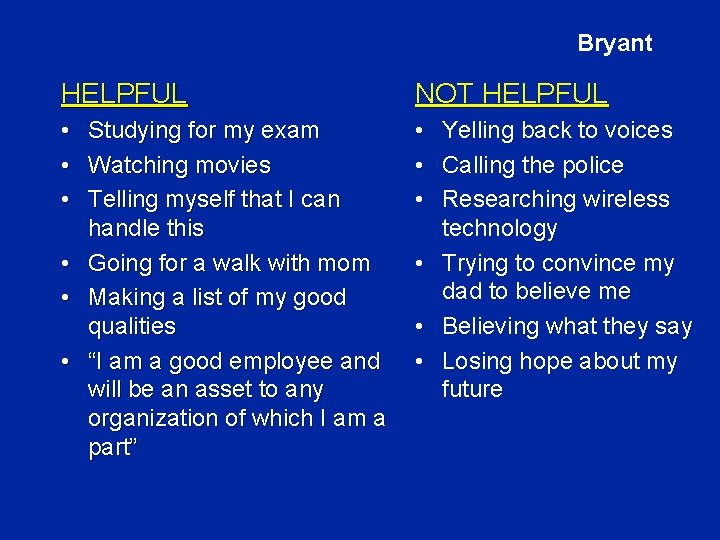
Bryant HELPFUL NOT HELPFUL • • • Studying for my exam Watching movies Telling myself that I can handle this • Going for a walk with mom • Making a list of my good qualities • “I am a good employee and will be an asset to any organization of which I am a part” Yelling back to voices Calling the police Researching wireless technology • Trying to convince my dad to believe me • Believing what they say • Losing hope about my future
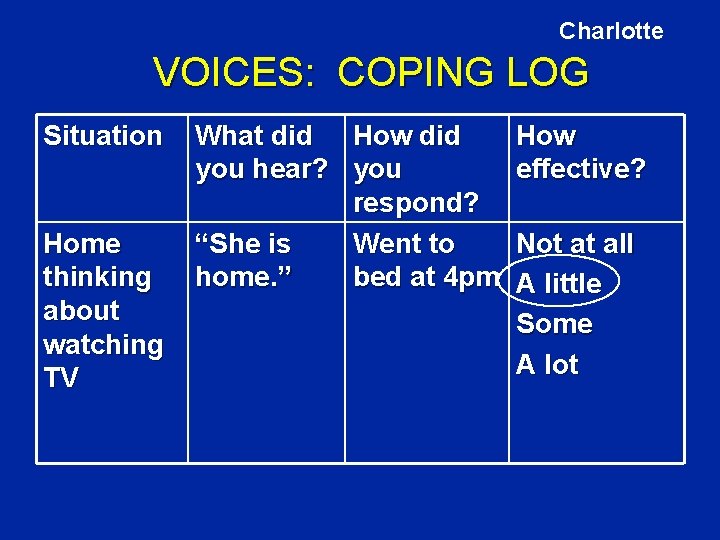
Charlotte VOICES: COPING LOG Situation Home thinking about watching TV What did How did you hear? you respond? “She is Went to home. ” bed at 4 pm How effective? Not at all A little Some A lot
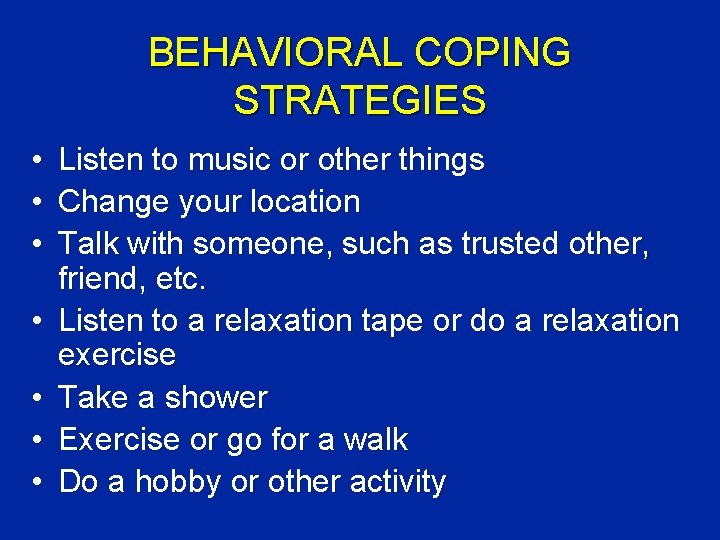
BEHAVIORAL COPING STRATEGIES • • Listen to music or other things Change your location Talk with someone, such as trusted other, friend, etc. Listen to a relaxation tape or do a relaxation exercise Take a shower Exercise or go for a walk Do a hobby or other activity
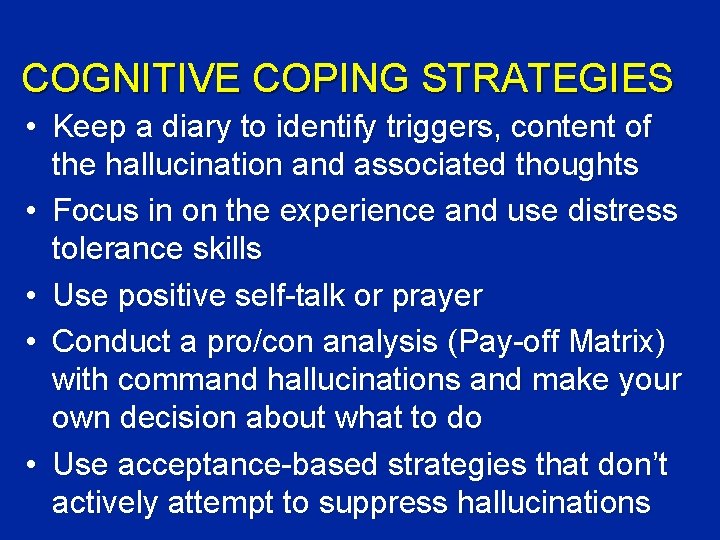
COGNITIVE COPING STRATEGIES • Keep a diary to identify triggers, content of the hallucination and associated thoughts • Focus in on the experience and use distress tolerance skills • Use positive self-talk or prayer • Conduct a pro/con analysis (Pay-off Matrix) with command hallucinations and make your own decision about what to do • Use acceptance-based strategies that don’t actively attempt to suppress hallucinations
ACCEPTANCE AND COMMITMENT THERAPY: THE OTHER ACT • Developed by Stephen Hayes, related to CBTp, but not the same • Agrees with CBT that thoughts are the cause of much misery, but disagrees that solution is to modify the thoughts • Acceptance = understanding of the essential uncontrollability of thoughts • Commitment = commitment to one’s values and goals, and behavior aligned towards them • Suppression of thoughts ineffective • Alternative: “just notice” thoughts, and get on with one’s life • Example: “Thanking” one’s brain for the hallucination
COGNITIVE COPING STRATEGIES (Cont’d) • Hallucination scheduling (permit for period of time during day like worry scheduling) • Review reattribution ideas that have been helpful

VIDEO DEMONSTRATION OF UNDERSTANDING VOICES
COGNITIVE RESTRUCTURING • Teach clients the connection between thoughts and feelings • Explain that the thoughts people have are often “automatic” and are often related to past experiences (e. g. , traumatic) and self-perceptions • Facilitate the examination of evidence supporting thoughts and beliefs underlying strong negative feelings
COGNITIVE RESTRUCTURING (Cont’d) • Help clients challenge and modify upsetting thoughts and beliefs that are not supported by evidence by: – Socratic questioning – Exploring alternative beliefs – Behavioral experiments – Teaching how to recognize distorted thinking styles
CR TARGETS IN CBTp • • • Accuracy of distressing belief Utility of holding onto belief Beliefs about the power and controllability of voices/persecutors Negative core beliefs about self, other’s perceptions of self, future Self-stigmatized beliefs related to illness Beliefs about medications and treatment
SOCRATIC QUESTIONING OVERVIEW -Build rapport, engagement -Can be an MI technique -Explore how person understand an event, voice, thought, etc. -Explore possible consequences of staying with particular maladaptive thoughts or behaviors -Help clients to question own inaccurate or distressing assumptions, beliefs and behaviors -Help clients arrive at a new view of the situation that is more in line with evidence
SOCRATIC QUESTIONING STYLE • Colombo-like style: freely admit confusion when trying to understand something, ask for client’s help in resolving confusion • Ask, don’t tell • Probe questions • Gentle, non-judgmental curious style – don’t interrogate! • Foster client’s curiosity too
HOW TO: SOCRATIC QUESTIONING • Explore meaning client attaches to a specific event, voice, thought… “What does it say about you that you are being watched by the government? If this were not the case, what would that say about you as a person? ” • Explore possible consequences of staying with particular maladaptive thoughts or behaviors “So, what happens if you continue to yell at your voices in public? ” “You spend a lot of time thinking about the idea that you need to develop superpowers to read others minds in order to be happy. I wonder if that gets in the way of you pursuing other meaningful things in life? ”
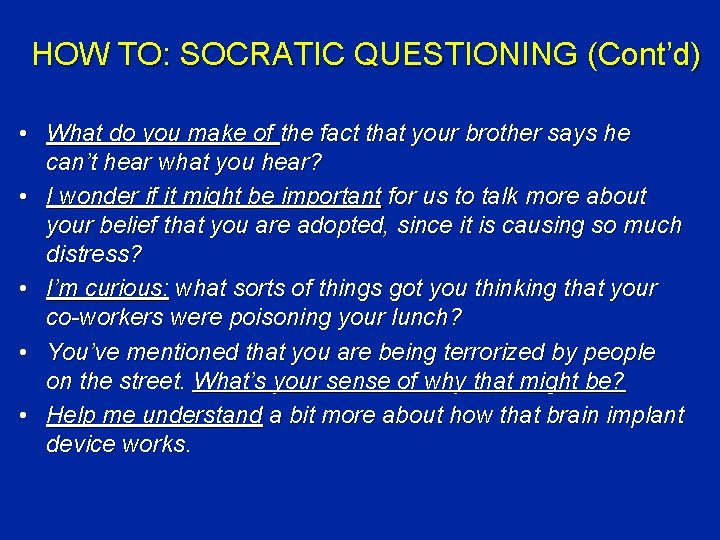
HOW TO: SOCRATIC QUESTIONING (Cont’d) • What do you make of the fact that your brother says he can’t hear what you hear? • I wonder if it might be important for us to talk more about your belief that you are adopted, since it is causing so much distress? • I’m curious: what sorts of things got you thinking that your co-workers were poisoning your lunch? • You’ve mentioned that you are being terrorized by people on the street. What’s your sense of why that might be? • Help me understand a bit more about how that brain implant device works.
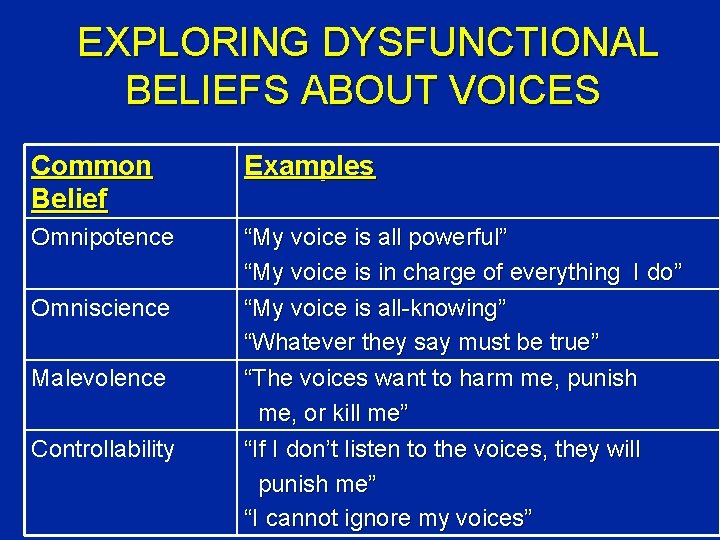
EXPLORING DYSFUNCTIONAL BELIEFS ABOUT VOICES Common Belief Examples Omnipotence “My voice is all powerful” “My voice is in charge of everything I do” “My voice is all-knowing” “Whatever they say must be true” “The voices want to harm me, punish me, or kill me” “If I don’t listen to the voices, they will punish me” “I cannot ignore my voices” Omniscience Malevolence Controllability
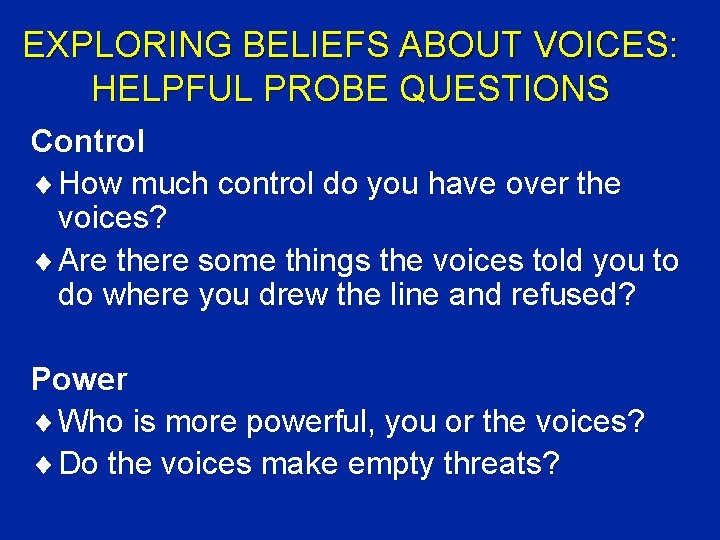
EXPLORING BELIEFS ABOUT VOICES: HELPFUL PROBE QUESTIONS Control ¨ How much control do you have over the voices? ¨ Are there some things the voices told you to do where you drew the line and refused? Power ¨ Who is more powerful, you or the voices? ¨ Do the voices make empty threats?
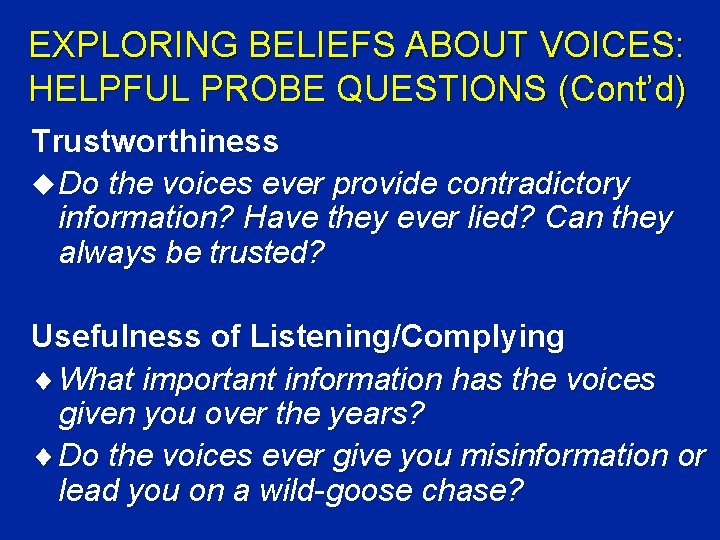
EXPLORING BELIEFS ABOUT VOICES: HELPFUL PROBE QUESTIONS (Cont’d) Trustworthiness u Do the voices ever provide contradictory information? Have they ever lied? Can they always be trusted? Usefulness of Listening/Complying ¨ What important information has the voices given you over the years? ¨ Do the voices ever give you misinformation or lead you on a wild-goose chase?
EXPLORING BELIEFS ABOUT VOICES: HELPFUL PROBE QUESTIONS (Cont’d) Malevolence • Have the voices ever been helpful or kind? • Is there anything you might miss about the voices if they were gone?
OVERVIEW: EXPLORING ALTERNATIVE BELIEFS • Teach cognitive flexibility as a skill • Pre-cursor to CR • Begin with coaching around generating alternative beliefs for everyday scenarios • Then progress to scenarios that are tailored to the individual’s delusional or paranoid beliefs
EXPLORING ALTERNATIVE BELIEFS (Cont’d) • “Behavioral scaffolding” • Start with identified alternative responses to situation, move toward coaching of additional responses, then to independence with the exercise items • Helpful probe questions: “What’s another possible explanation for why this may have happened? ” “What factors related to____(the situation/the way the world works/the person involved in the scenario/you) may have caused or contributed to this happening? ”
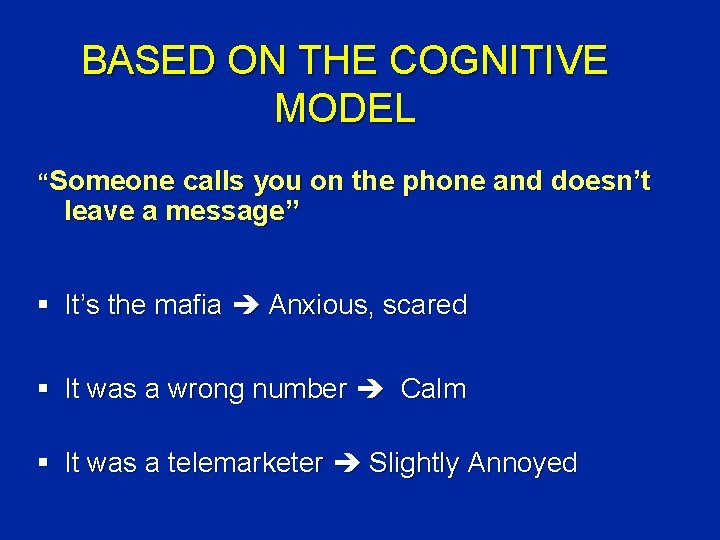
BASED ON THE COGNITIVE MODEL “Someone calls you on the phone and doesn’t leave a message” § It’s the mafia Anxious, scared § It was a wrong number Calm § It was a telemarketer Slightly Annoyed
TIPS ON ALTERNATIVE BELIEFS EXERCISE • Coach remains completely neutral about explanations • Goal is not to come to the “correct” appraisal, but rather to acknowledge that most of the time we do not really know why something happens the way it does • Help client “loosen up” their thinking rigidity and reduce “jumping to conclusions”
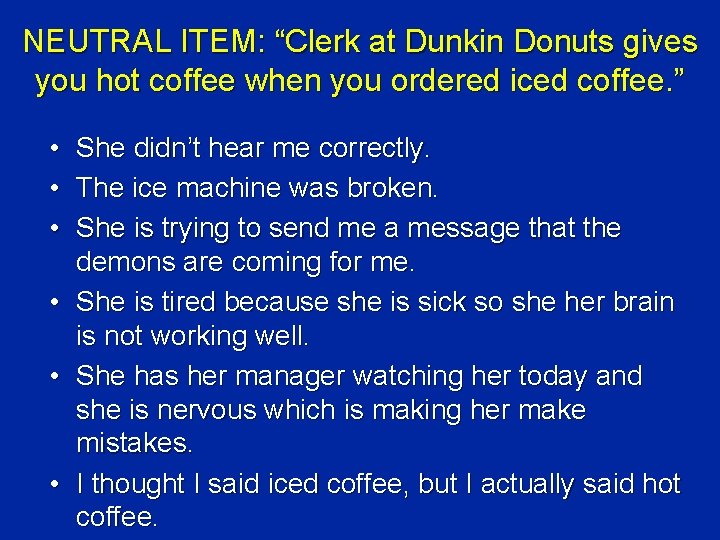
NEUTRAL ITEM: “Clerk at Dunkin Donuts gives you hot coffee when you ordered iced coffee. ” • She didn’t hear me correctly. • The ice machine was broken. • She is trying to send me a message that the demons are coming for me. • She is tired because she is sick so she her brain is not working well. • She has her manager watching her today and she is nervous which is making her make mistakes. • I thought I said iced coffee, but I actually said hot coffee.
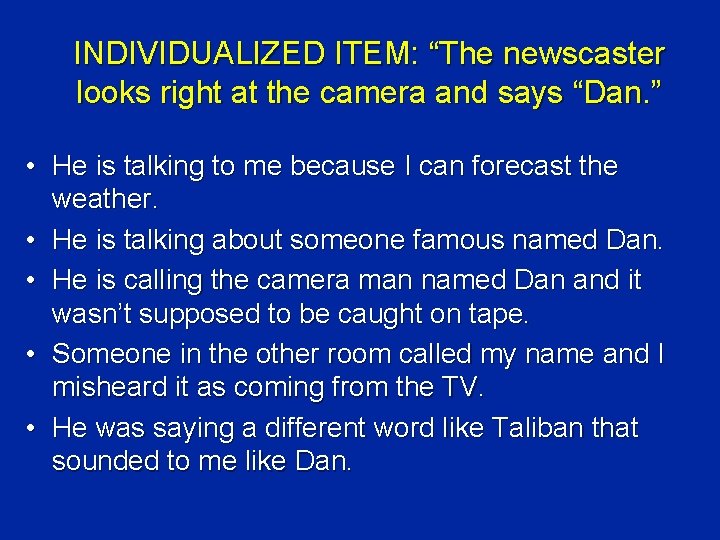
INDIVIDUALIZED ITEM: “The newscaster looks right at the camera and says “Dan. ” • He is talking to me because I can forecast the weather. • He is talking about someone famous named Dan. • He is calling the camera man named Dan and it wasn’t supposed to be caught on tape. • Someone in the other room called my name and I misheard it as coming from the TV. • He was saying a different word like Taliban that sounded to me like Dan.
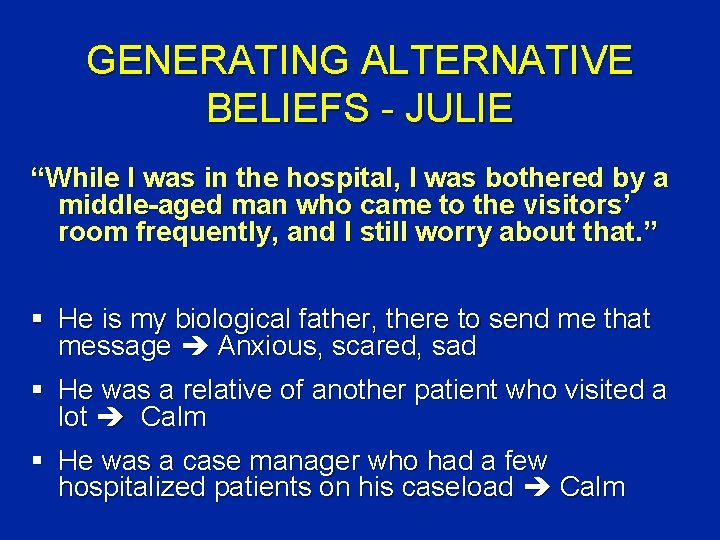
GENERATING ALTERNATIVE BELIEFS - JULIE “While I was in the hospital, I was bothered by a middle-aged man who came to the visitors’ room frequently, and I still worry about that. ” § He is my biological father, there to send me that message Anxious, scared, sad § He was a relative of another patient who visited a lot Calm § He was a case manager who had a few hospitalized patients on his caseload Calm
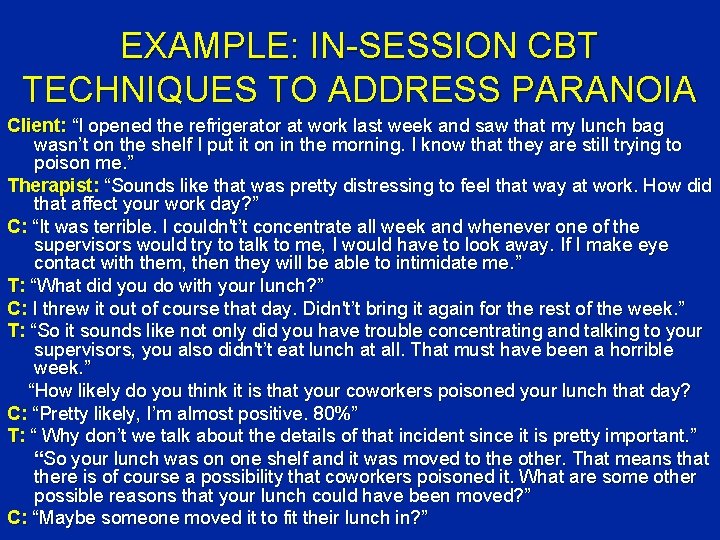
EXAMPLE: IN-SESSION CBT TECHNIQUES TO ADDRESS PARANOIA Client: “I opened the refrigerator at work last week and saw that my lunch bag wasn’t on the shelf I put it on in the morning. I know that they are still trying to poison me. ” Therapist: “Sounds like that was pretty distressing to feel that way at work. How did that affect your work day? ” C: “It was terrible. I couldn't’t concentrate all week and whenever one of the supervisors would try to talk to me, I would have to look away. If I make eye contact with them, then they will be able to intimidate me. ” T: “What did you do with your lunch? ” C: I threw it out of course that day. Didn't’t bring it again for the rest of the week. ” T: “So it sounds like not only did you have trouble concentrating and talking to your supervisors, you also didn't’t eat lunch at all. That must have been a horrible week. ” “How likely do you think it is that your coworkers poisoned your lunch that day? C: “Pretty likely, I’m almost positive. 80%” T: “ Why don’t we talk about the details of that incident since it is pretty important. ” “So your lunch was on one shelf and it was moved to the other. That means that there is of course a possibility that coworkers poisoned it. What are some other possible reasons that your lunch could have been moved? ” C: “Maybe someone moved it to fit their lunch in? ”
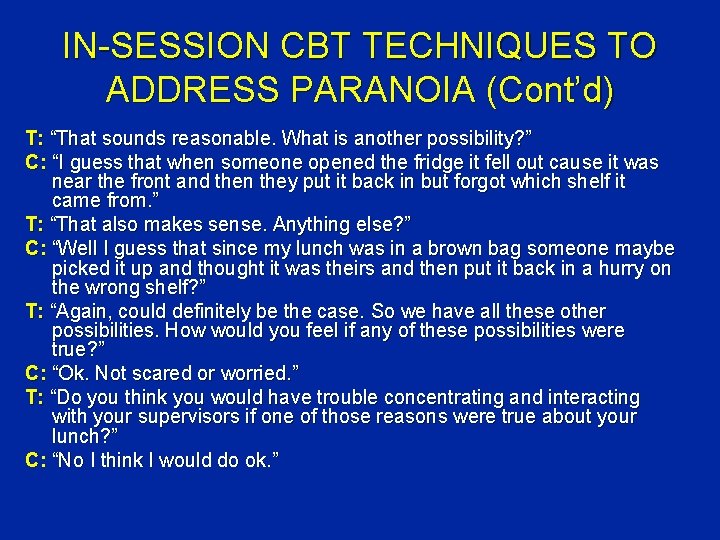
IN-SESSION CBT TECHNIQUES TO ADDRESS PARANOIA (Cont’d) T: “That sounds reasonable. What is another possibility? ” C: “I guess that when someone opened the fridge it fell out cause it was near the front and then they put it back in but forgot which shelf it came from. ” T: “That also makes sense. Anything else? ” C: “Well I guess that since my lunch was in a brown bag someone maybe picked it up and thought it was theirs and then put it back in a hurry on the wrong shelf? ” T: “Again, could definitely be the case. So we have all these other possibilities. How would you feel if any of these possibilities were true? ” C: “Ok. Not scared or worried. ” T: “Do you think you would have trouble concentrating and interacting with your supervisors if one of those reasons were true about your lunch? ” C: “No I think I would do ok. ”
BEHAVIORAL EXPERIMENTS • Goal is to get additional information about a belief in a “scientific, ” mutually agreed upon fashion • Frequently used to examine “safety behaviors” and then to systematically move toward reducing or dropping them • Re-evaluate client’s level of conviction, distress, preoccupation following each experiment • Julie (fear of people spying): “Keep shades up between hours of 1 -2 pm each day and evaluate mood, thoughts, and consequences”
BEHAVIORAL EXPERIMENTS (Cont’d) § In vivo, outside of the office § Sample experiment (“Other people can read my mind”) § Prediction: all people on campus will stare at me and laugh at me if I think a sexual thought § Confirmed if: they look at me and begin laughing within 3 seconds § Procedure: § Find a “high anxiety” (high density) spot on campus § Monitor reactions of people § Debrief with therapist
VIDEO DEMONSTRATION OF BEHAVIORAL EXPERIMENTS
TEACHING HOW TO RECOGNIZE COGNITIVE DISTORTIONS • Easily learned strategy for dealing with negative feelings • As client’s skill at catching and changing cognitive distortions in everyday situations increases, focus gradually shifts to psychotic symptoms • Begin with discussion of how thoughts in a situation affect feelings (and behaviors), and not all thoughts are equally accurate
RECOGNITION OF COGNITIVE DISTORTIONS (Cont’d) • Normalize cognitive distortions as common styles of inaccurate thinking that everyone engages in to some extent • Explain how correcting cognitive distortions can reduce negative feelings associated with them • For each type of distortion, briefly explain it, try to elicit a personal example from client • When example elicited, explore why it is a distortion (i. e. , why inaccurate) • Then, identify a more accurate thought, and discuss differences in feelings related to the two thoughts
COMMON COGNITIVE DISTORTIONS (AKA “COMMON STYLES OF THINKING”) • All or Nothing Thinking – “If I wake up with some symptoms, my week will be ruined. ” • “Must, ” “should, ” or “never” statements – “I should be able to live on my own at this age. ” • Overgeneralization – “The receptionist at the clinic didn’t smile at me today: that means everyone hates me there and wants me to go into the hospital. ” • Catastrophizing – “The man on the train looked at me sideways when I got on; he is going to try to stab me when I get to my stop. ”
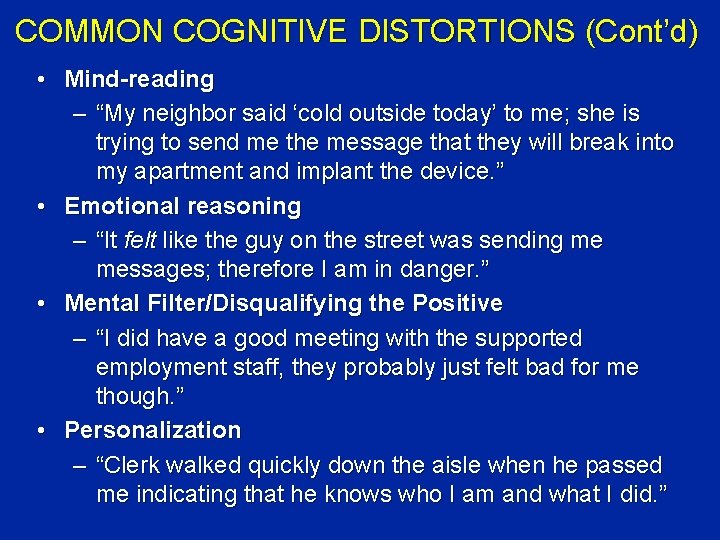
COMMON COGNITIVE DISTORTIONS (Cont’d) • Mind-reading – “My neighbor said ‘cold outside today’ to me; she is trying to send me the message that they will break into my apartment and implant the device. ” • Emotional reasoning – “It felt like the guy on the street was sending me messages; therefore I am in danger. ” • Mental Filter/Disqualifying the Positive – “I did have a good meeting with the supported employment staff, they probably just felt bad for me though. ” • Personalization – “Clerk walked quickly down the aisle when he passed me indicating that he knows who I am and what I did. ”
- Slides: 63