
Cognitive Architectures Brain Functional Organization Based on book
Cognitive Architectures Brain Functional Organization Based on book Cognition, Brain and Consciousness ed. Bernard J. Baars courses taught by Prof. Randall O'Reilly, University of Colorado, and Prof. Włodzisław Duch, Uniwersytet Mikołaja Kopernika and http: //wikipedia. org/ http: //grey. colorado. edu/Comp. Cog. Neuro/index. php/CECN_CU_Boulder_OReilly http: //grey. colorado. edu/Comp. Cog. Neuro/index. php/Main_Page Janusz A. Starzyk EE 141 1
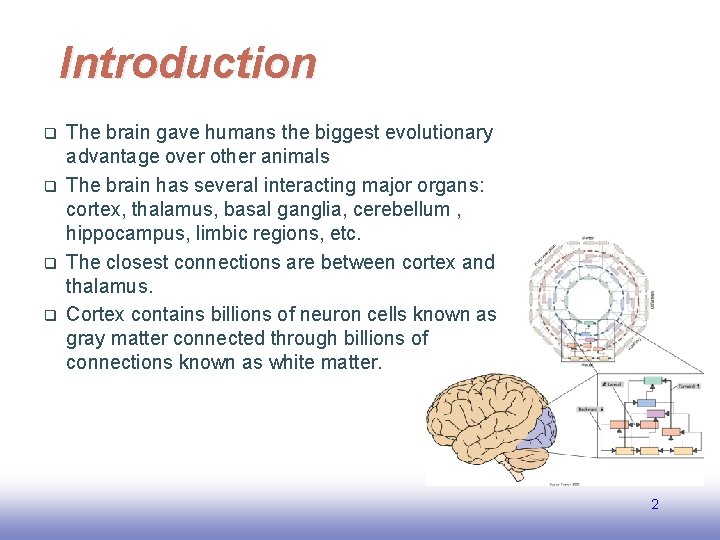
Introduction q q The brain gave humans the biggest evolutionary advantage over other animals The brain has several interacting major organs: cortex, thalamus, basal ganglia, cerebellum , hippocampus, limbic regions, etc. The closest connections are between cortex and thalamus. Cortex contains billions of neuron cells known as gray matter connected through billions of connections known as white matter. 2 EE 141
Rules q q q The brain is not a universal computer. Neurons are adjusted evolutionally to detect specific properties of analyzed signals. Compromise between specificity, built-in expectations, and generality. Compromise between speed of the hippocampus representing temporal sequences, and slowness of the cortex integrating many events. Compromise between active memory, knowledge, and understanding. How to build, using neurons, all necessary elements - specific and universal? Dynamic rules on the macro level: q Constraint satisfaction (including internal), prior knowledge. q Contrast reinforcement, attractors, active memory. q Attention mechanisms, inhibitory competition. 3 EE 141
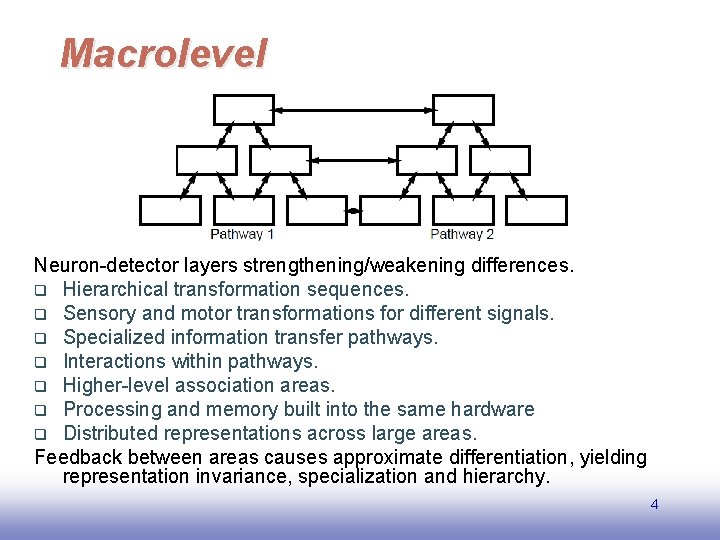
Macrolevel Neuron-detector layers strengthening/weakening differences. q Hierarchical transformation sequences. q Sensory and motor transformations for different signals. q Specialized information transfer pathways. q Interactions within pathways. q Higher-level association areas. q Processing and memory built into the same hardware q Distributed representations across large areas. Feedback between areas causes approximate differentiation, yielding representation invariance, specialization and hierarchy. 4 EE 141
Hierarchy and specialization Mental processes: the result of hierarchical and specialized transformation of sensory signals, internal states (categories) and undertaken actions. Sensory layers process signals coming to them from receptors, strengthening/weakening differences. Emerging internal states provide interpretations of environmental states - hierarchical processing is necessary to attain invariant representations, despite variable origin of signals, eg. aural (phonemes), visual (colors, objects), or tactile (pain). Transformations and information processing streams stimulate internal representations of categories and provide data for taking action. Processed information modifies the means of information processing. 5 EE 141
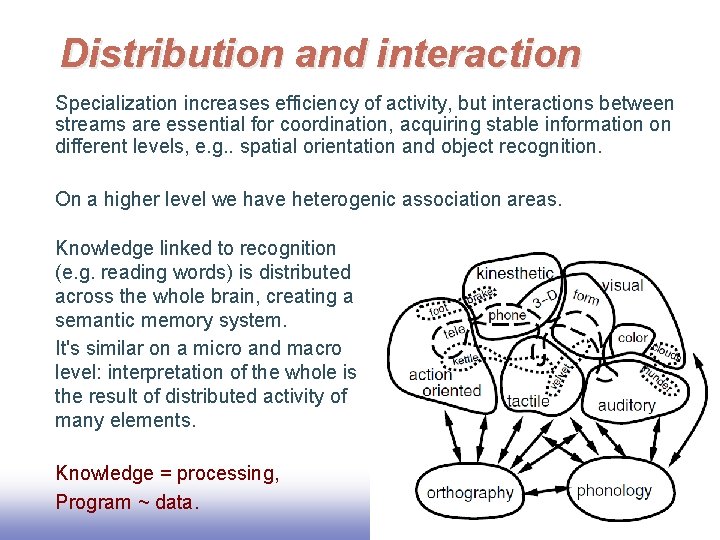
Distribution and interaction Specialization increases efficiency of activity, but interactions between streams are essential for coordination, acquiring stable information on different levels, e. g. . spatial orientation and object recognition. On a higher level we have heterogenic association areas. Knowledge linked to recognition (e. g. reading words) is distributed across the whole brain, creating a semantic memory system. It's similar on a micro and macro level: interpretation of the whole is the result of distributed activity of many elements. Knowledge = processing, Program ~ data. EE 141 6
Dynamic principles Well-known inputs trigger an immediate reaction. New inputs require searches for a compromise satisfying constraints resulting from possessed knowledge = possible to attain dynamic states of the brain. There exist many local, alternative, solutions => local context changes the interpretation. Time flies like an arrow Fruit flies like a banana Long-term memory is the result of learning, this is a synaptic memory. Active memory (dynamic) is the result of activations of neurons; It is short-term because the neurons get tired; Neuron activations influences processes in other areas of the brain. This mechanism causes uniqueness of experiences = internal interpretations, and contextual states are always somewhat diverse. Concentration is the result of inhibitory interactions. 7 EE 141
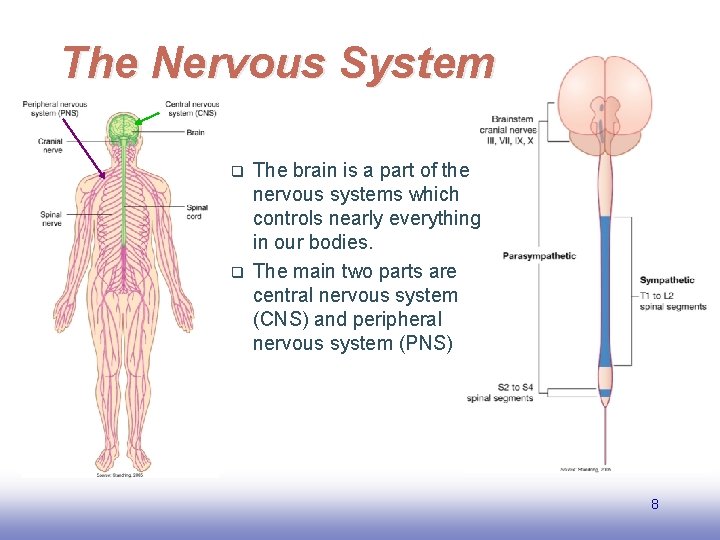
The Nervous System q q The brain is a part of the nervous systems which controls nearly everything in our bodies. The main two parts are central nervous system (CNS) and peripheral nervous system (PNS) 8 EE 141
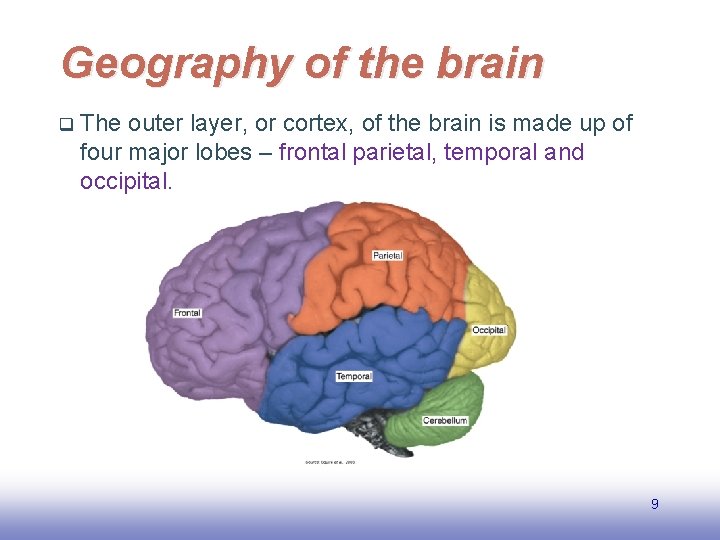
Geography of the brain q The outer layer, or cortex, of the brain is made up of four major lobes – frontal parietal, temporal and occipital. 9 EE 141

Geography of the brain q There are many important “landmarks” used to identify the brain regions. Lateral left panel and right Mid-sagittal view 10 EE 141
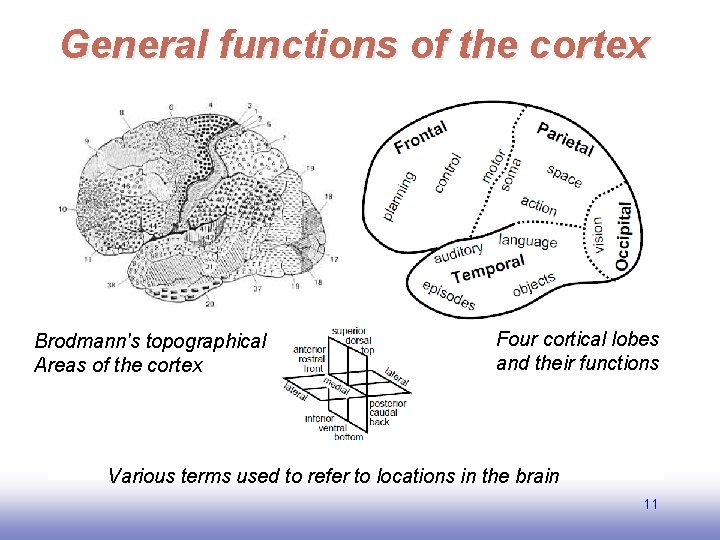
General functions of the cortex Brodmann's topographical Areas of the cortex Four cortical lobes and their functions Various terms used to refer to locations in the brain 11 EE 141
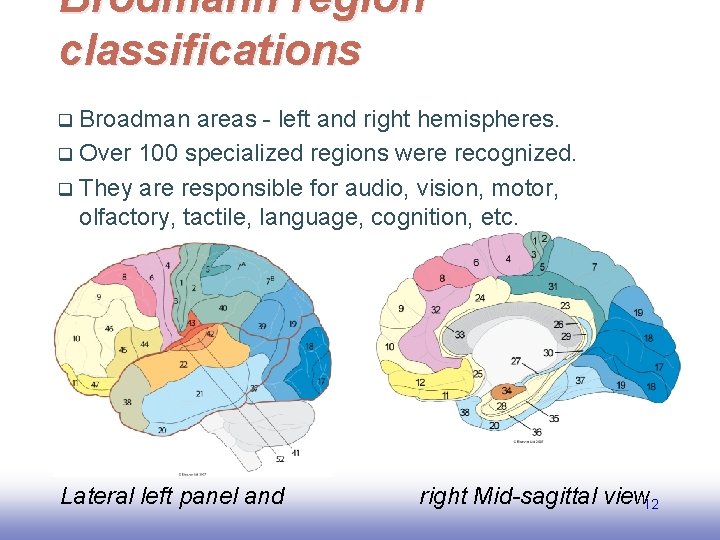
Brodmann region classifications Broadman areas - left and right hemispheres. q Over 100 specialized regions were recognized. q They are responsible for audio, vision, motor, olfactory, tactile, language, cognition, etc. q Lateral left panel and EE 141 right Mid-sagittal view 12

The layers of the cortex The neocortex has the six major layers organized in cortical columns. q Layer I consists mostly of dendrites (input fibers). q Columns may be clustered into hypercolumns. q The image projects to Area 17 of the V 1 visual cortex. q The paleocortex (older region of cortex) has five layers. q Neurons in cortex grow, migrate, connect, disconnect, and die changing its topology and function. q EE 141 13
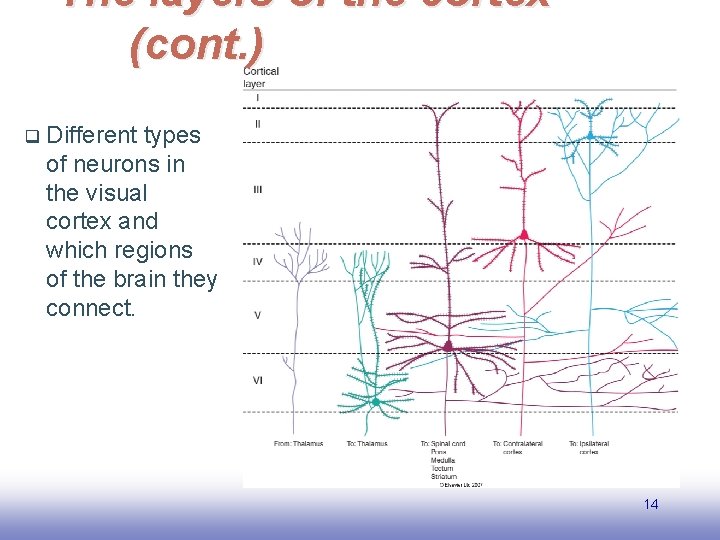
The layers of the cortex (cont. ) q Different types of neurons in the visual cortex and which regions of the brain they connect. 14 EE 141
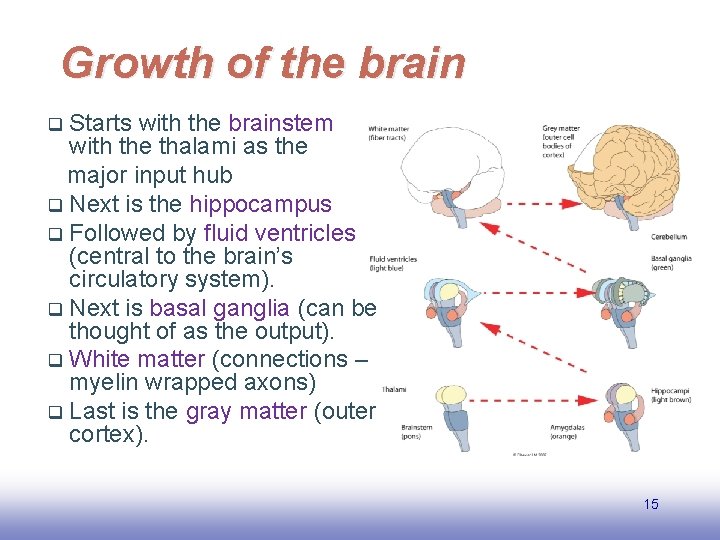
Growth of the brain Starts with the brainstem with the thalami as the major input hub q Next is the hippocampus q Followed by fluid ventricles (central to the brain’s circulatory system). q Next is basal ganglia (can be thought of as the output). q White matter (connections – myelin wrapped axons) q Last is the gray matter (outer cortex). q 15 EE 141
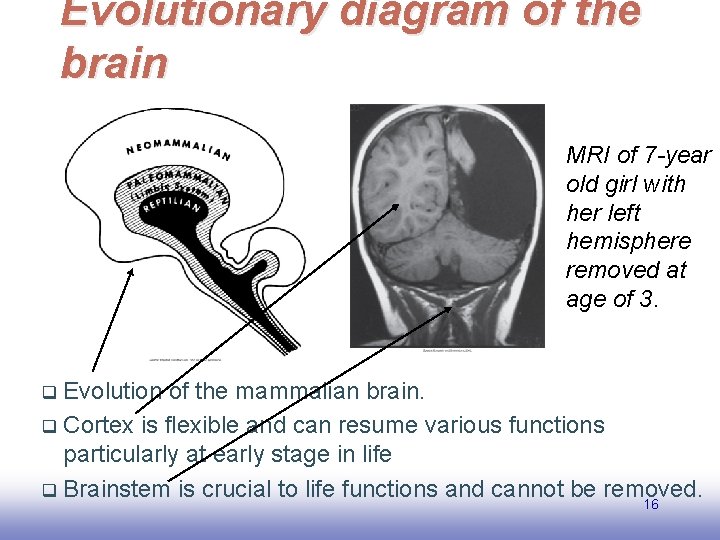
Evolutionary diagram of the brain MRI of 7 -year old girl with her left hemisphere removed at age of 3. Evolution of the mammalian brain. q Cortex is flexible and can resume various functions particularly at early stage in life q Brainstem is crucial to life functions and cannot be removed. q 16 EE 141
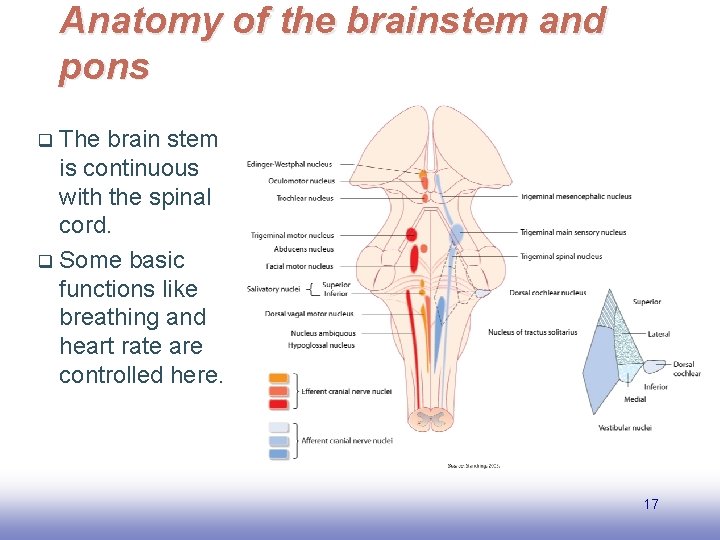
Anatomy of the brainstem and pons The brain stem is continuous with the spinal cord. q Some basic functions like breathing and heart rate are controlled here. q 17 EE 141
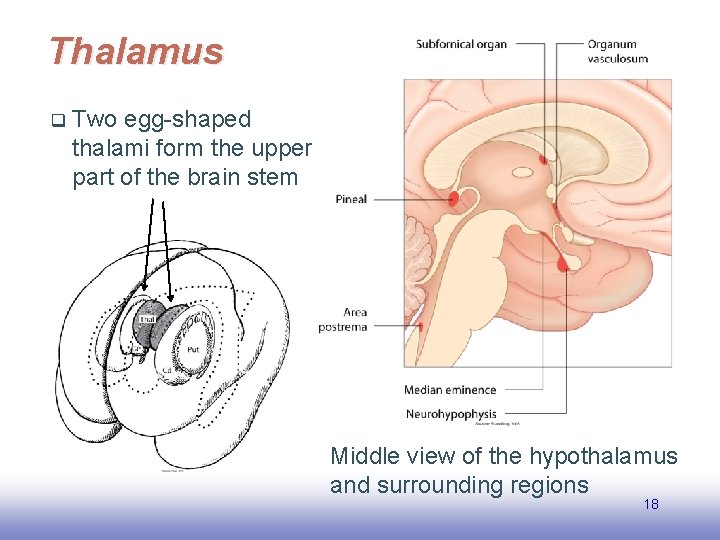
Thalamus q Two egg-shaped thalami form the upper part of the brain stem Middle view of the hypothalamus and surrounding regions 18 EE 141
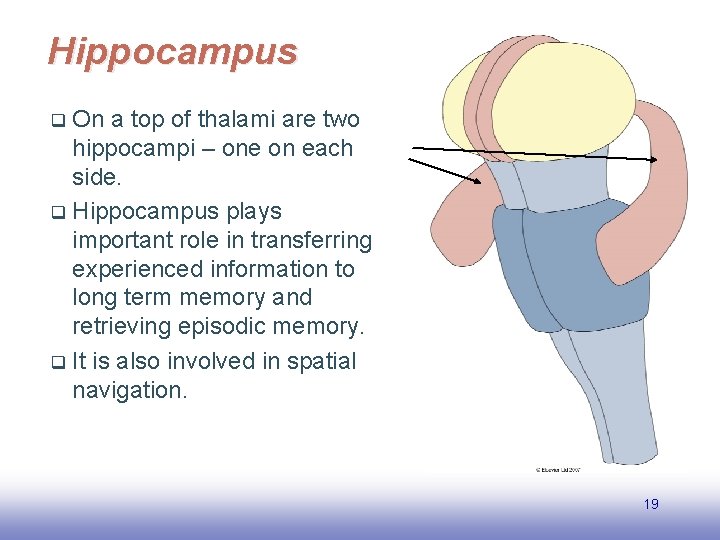
Hippocampus On a top of thalami are two hippocampi – one on each side. q Hippocampus plays important role in transferring experienced information to long term memory and retrieving episodic memory. q It is also involved in spatial navigation. q 19 EE 141
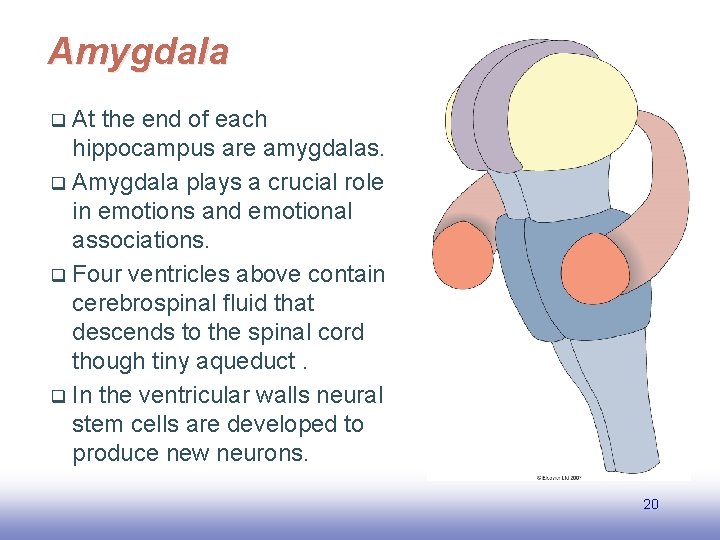
Amygdala At the end of each hippocampus are amygdalas. q Amygdala plays a crucial role in emotions and emotional associations. q Four ventricles above contain cerebrospinal fluid that descends to the spinal cord though tiny aqueduct. q In the ventricular walls neural stem cells are developed to produce new neurons. q 20 EE 141
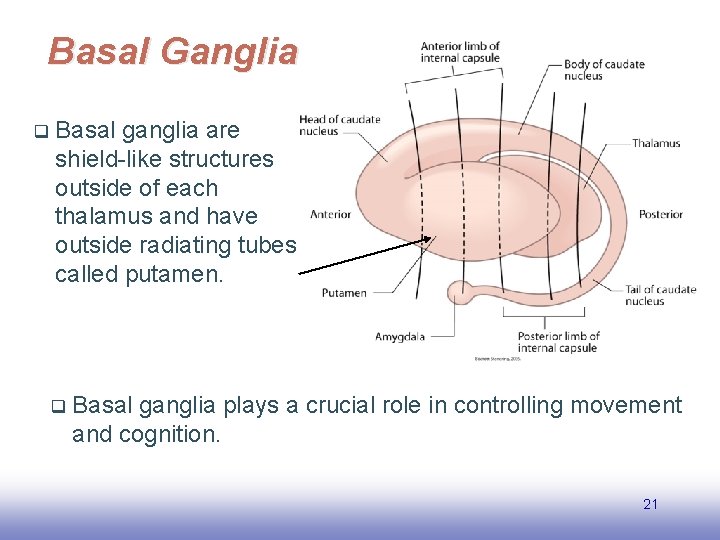
Basal Ganglia q Basal ganglia are shield-like structures outside of each thalamus and have outside radiating tubes called putamen. q Basal ganglia plays a crucial role in controlling movement and cognition. 21 EE 141
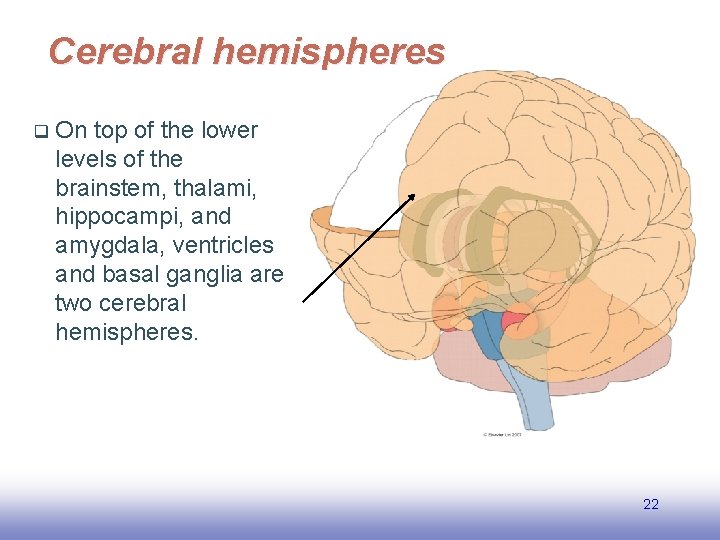
Cerebral hemispheres q On top of the lower levels of the brainstem, thalami, hippocampi, and amygdala, ventricles and basal ganglia are two cerebral hemispheres. 22 EE 141
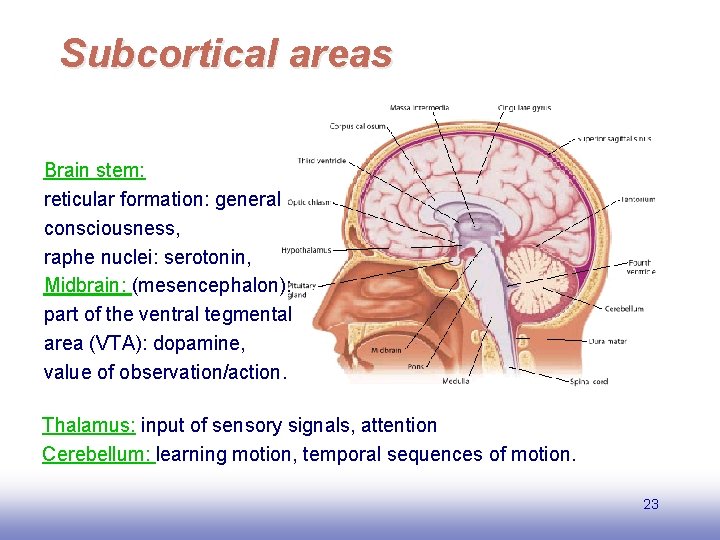
Subcortical areas Brain stem: reticular formation: general consciousness, raphe nuclei: serotonin, Midbrain: (mesencephalon): part of the ventral tegmental area (VTA): dopamine, value of observation/action. Thalamus: input of sensory signals, attention Cerebellum: learning motion, temporal sequences of motion. 23 EE 141
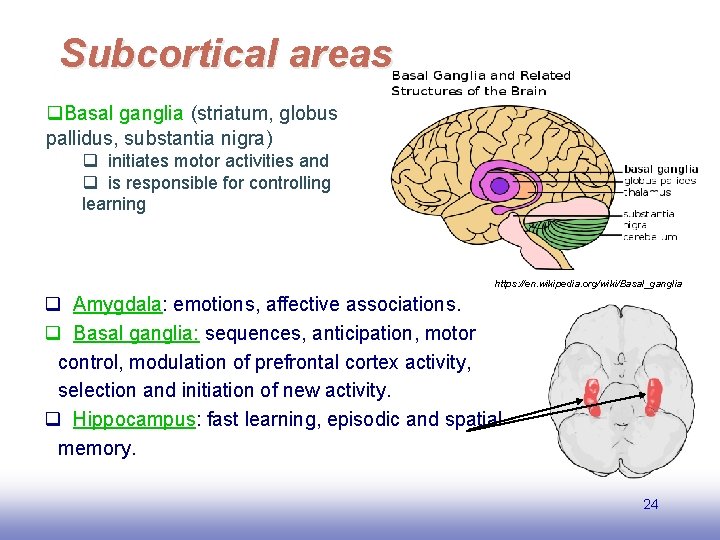
Subcortical areas q. Basal ganglia (striatum, globus pallidus, substantia nigra) q initiates motor activities and q is responsible for controlling learning https: //en. wikipedia. org/wiki/Basal_ganglia q Amygdala: emotions, affective associations. q Basal ganglia: sequences, anticipation, motor control, modulation of prefrontal cortex activity, selection and initiation of new activity. q Hippocampus: fast learning, episodic and spatial memory. 24 EE 141
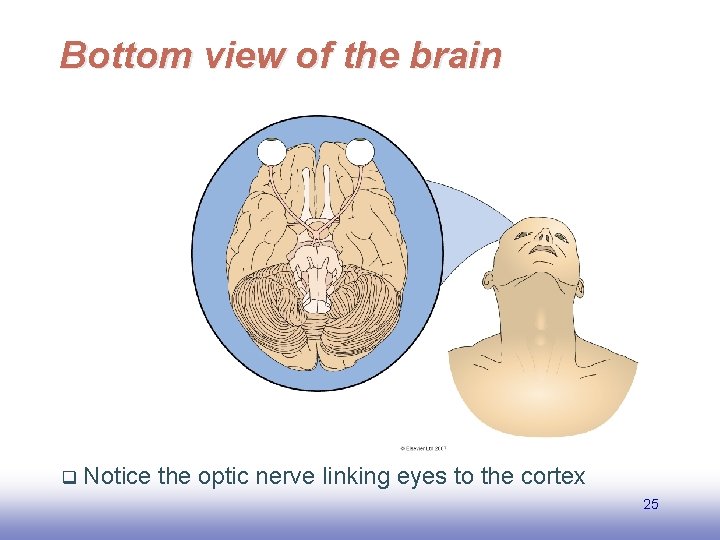
Bottom view of the brain q Notice the optic nerve linking eyes to the cortex 25 EE 141
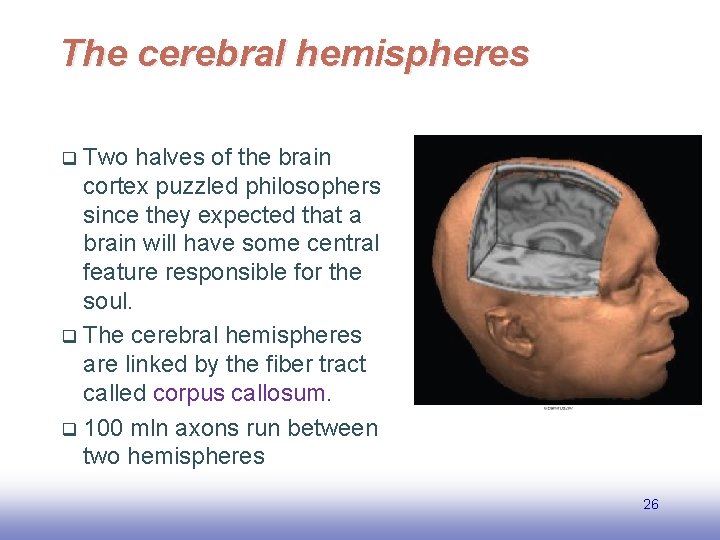
The cerebral hemispheres Two halves of the brain cortex puzzled philosophers since they expected that a brain will have some central feature responsible for the soul. q The cerebral hemispheres are linked by the fiber tract called corpus callosum. q 100 mln axons run between two hemispheres q 26 EE 141
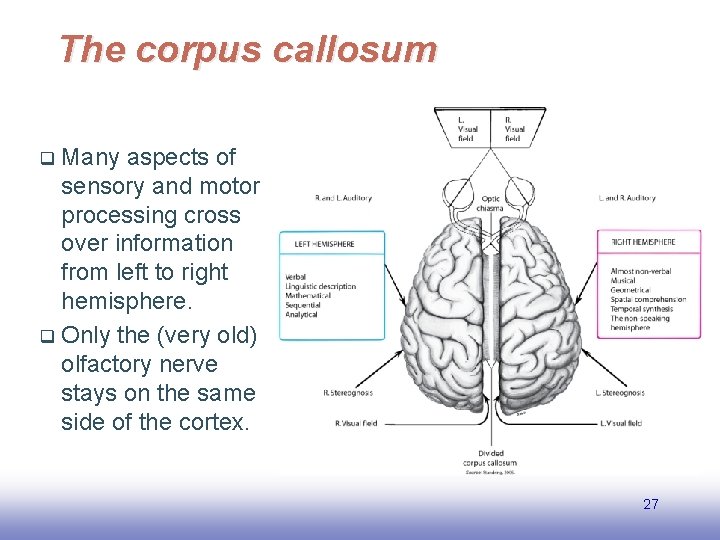
The corpus callosum Many aspects of sensory and motor processing cross over information from left to right hemisphere. q Only the (very old) olfactory nerve stays on the same side of the cortex. q 27 EE 141
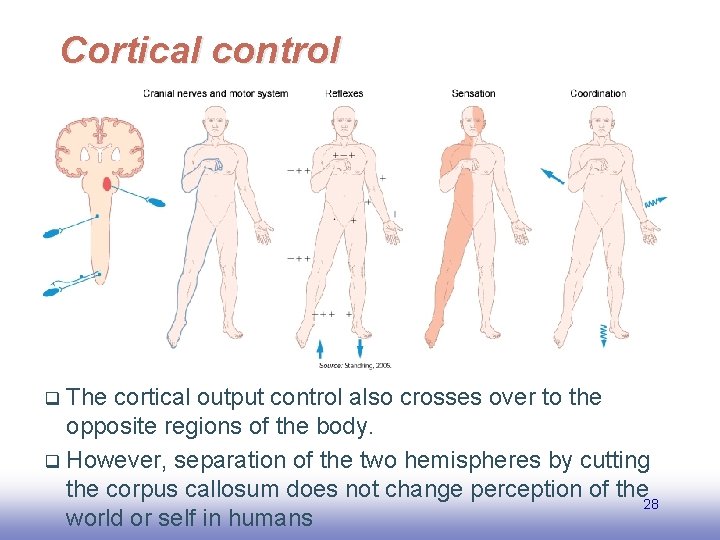
Cortical control The cortical output control also crosses over to the opposite regions of the body. q However, separation of the two hemispheres by cutting the corpus callosum does not change perception of the 28 EE 141 world or self in humans q
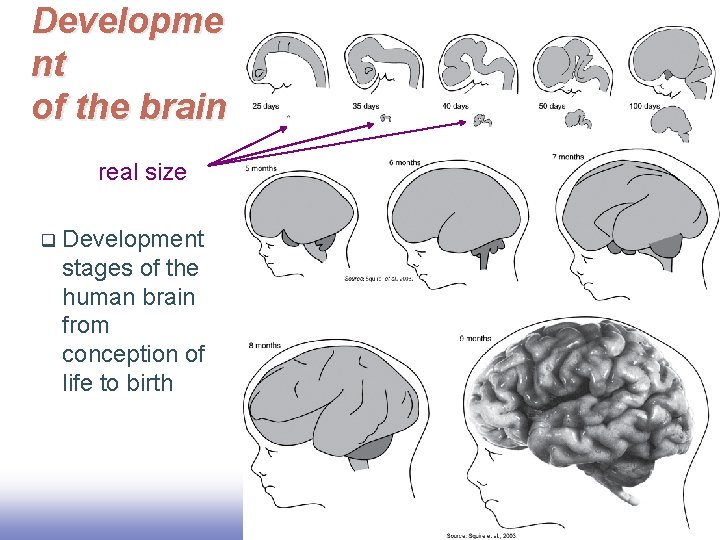
Developme nt of the brain real size q Development stages of the human brain from conception of life to birth 29 EE 141
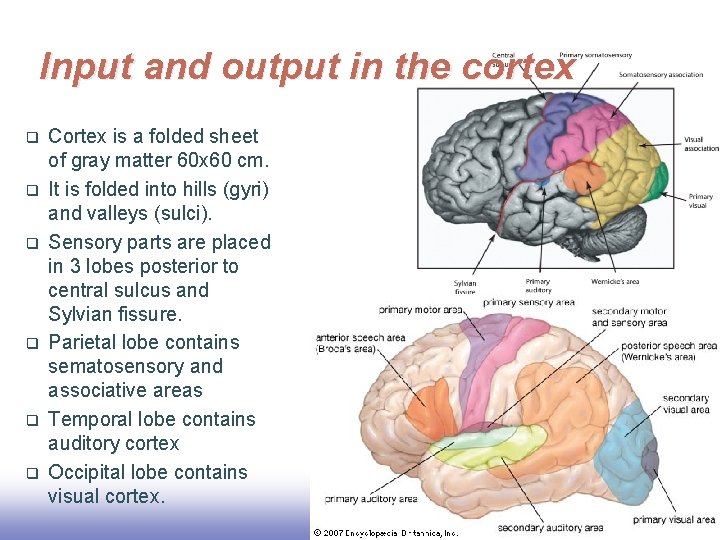
Input and output in the cortex q q q Cortex is a folded sheet of gray matter 60 x 60 cm. It is folded into hills (gyri) and valleys (sulci). Sensory parts are placed in 3 lobes posterior to central sulcus and Sylvian fissure. Parietal lobe contains sematosensory and associative areas Temporal lobe contains auditory cortex Occipital lobe contains visual cortex. EE 141 30
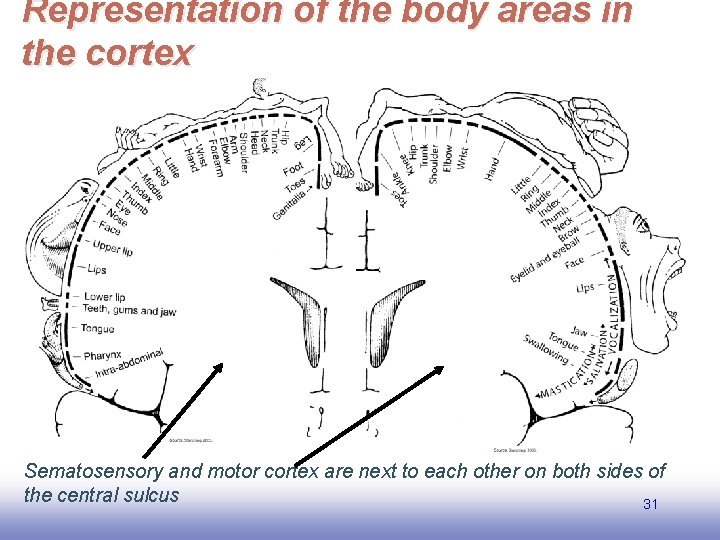
Representation of the body areas in the cortex Sematosensory and motor cortex are next to each other on both sides of the central sulcus 31 EE 141
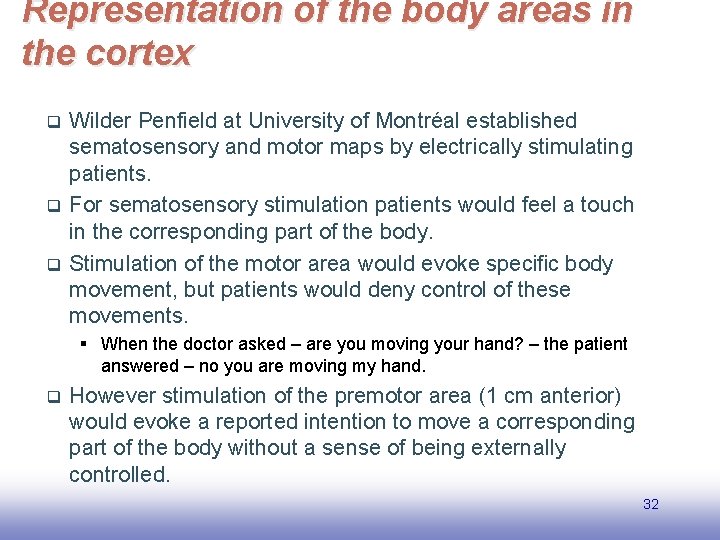
Representation of the body areas in the cortex q q q Wilder Penfield at University of Montréal established sematosensory and motor maps by electrically stimulating patients. For sematosensory stimulation patients would feel a touch in the corresponding part of the body. Stimulation of the motor area would evoke specific body movement, but patients would deny control of these movements. § When the doctor asked – are you moving your hand? – the patient answered – no you are moving my hand. q However stimulation of the premotor area (1 cm anterior) would evoke a reported intention to move a corresponding part of the body without a sense of being externally controlled. 32 EE 141
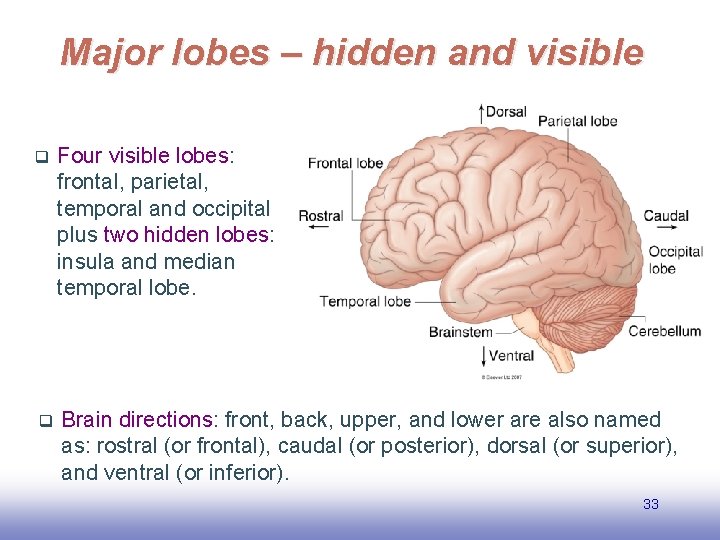
Major lobes – hidden and visible q Four visible lobes: frontal, parietal, temporal and occipital plus two hidden lobes: insula and median temporal lobe. q Brain directions: front, back, upper, and lower are also named as: rostral (or frontal), caudal (or posterior), dorsal (or superior), and ventral (or inferior). 33 EE 141
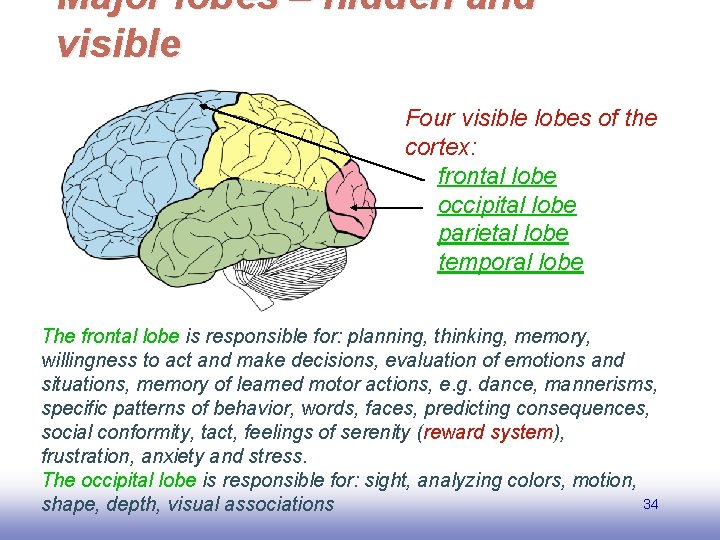
Major lobes – hidden and visible Four visible lobes of the cortex: frontal lobe occipital lobe parietal lobe temporal lobe The frontal lobe is responsible for: planning, thinking, memory, willingness to act and make decisions, evaluation of emotions and situations, memory of learned motor actions, e. g. dance, mannerisms, specific patterns of behavior, words, faces, predicting consequences, social conformity, tact, feelings of serenity (reward system), frustration, anxiety and stress. The occipital lobe is responsible for: sight, analyzing colors, motion, 34 shape, depth, visual associations EE 141
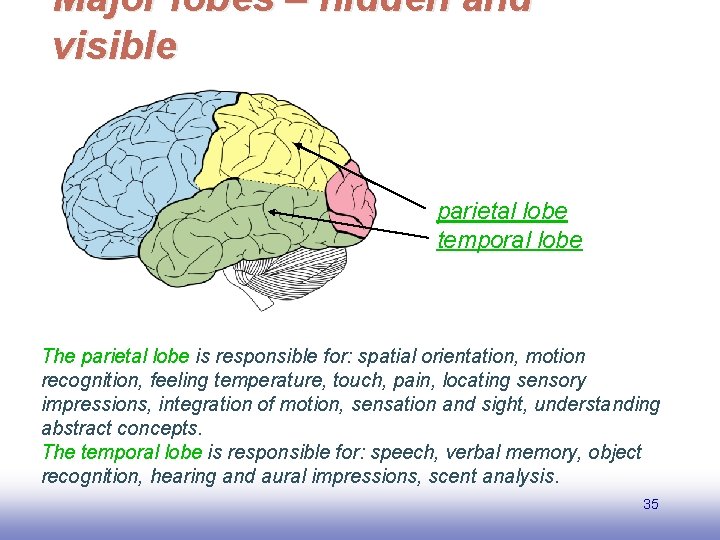
Major lobes – hidden and visible parietal lobe temporal lobe The parietal lobe is responsible for: spatial orientation, motion recognition, feeling temperature, touch, pain, locating sensory impressions, integration of motion, sensation and sight, understanding abstract concepts. The temporal lobe is responsible for: speech, verbal memory, object recognition, hearing and aural impressions, scent analysis. 35 EE 141
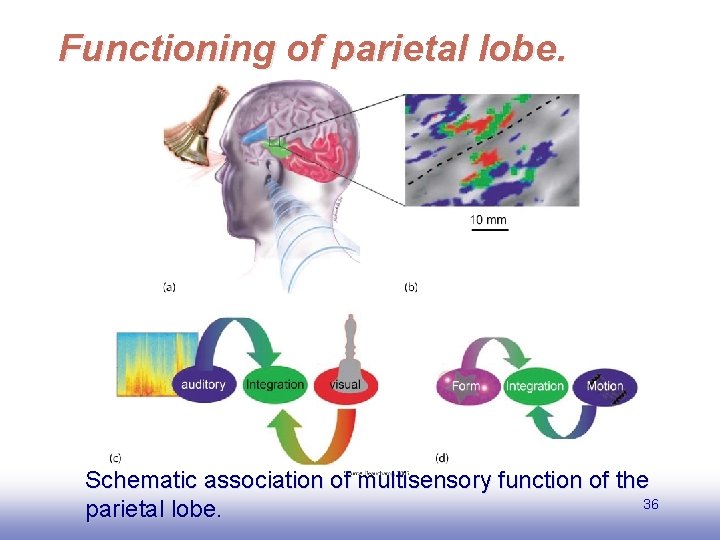
Functioning of parietal lobe. EE 141 Schematic association of multisensory function of the 36 parietal lobe.
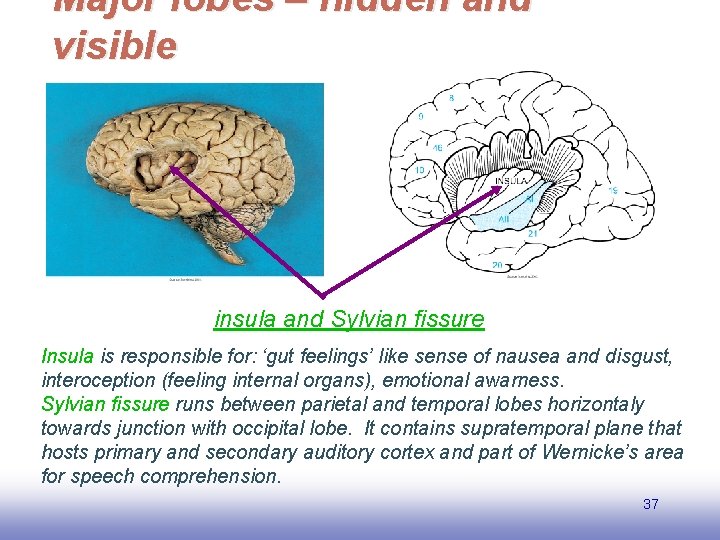
Major lobes – hidden and visible insula and Sylvian fissure Insula is responsible for: ‘gut feelings’ like sense of nausea and disgust, interoception (feeling internal organs), emotional awarness. Sylvian fissure runs between parietal and temporal lobes horizontaly towards junction with occipital lobe. It contains supratemporal plane that hosts primary and secondary auditory cortex and part of Wernicke’s area for speech comprehension. 37 EE 141
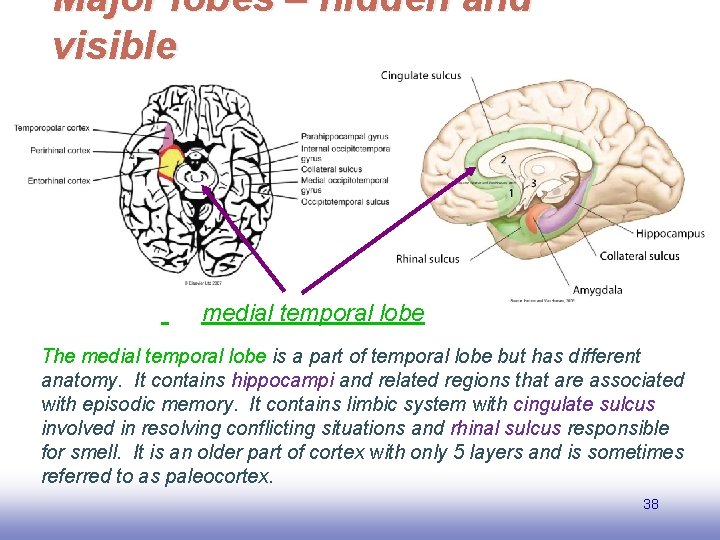
Major lobes – hidden and visible medial temporal lobe The medial temporal lobe is a part of temporal lobe but has different anatomy. It contains hippocampi and related regions that are associated with episodic memory. It contains limbic system with cingulate sulcus involved in resolving conflicting situations and rhinal sulcus responsible for smell. It is an older part of cortex with only 5 layers and is sometimes referred to as paleocortex. 38 EE 141
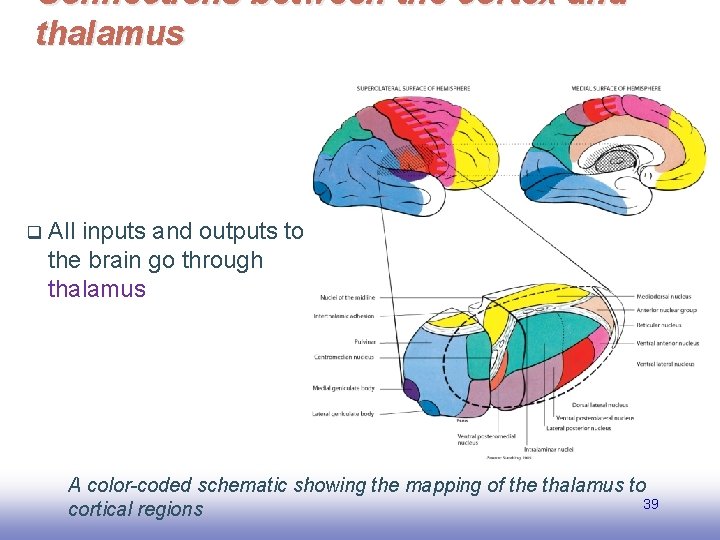
Connections between the cortex and thalamus q All inputs and outputs to the brain go through thalamus A color-coded schematic showing the mapping of the thalamus to 39 cortical regions EE 141
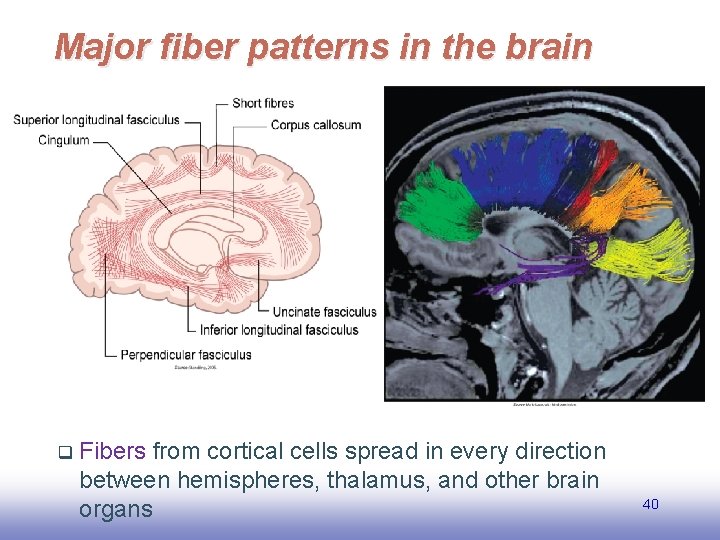
Major fiber patterns in the brain Fibers from cortical cells spread in every direction between hemispheres, thalamus, and other brain organs EE 141 q 40
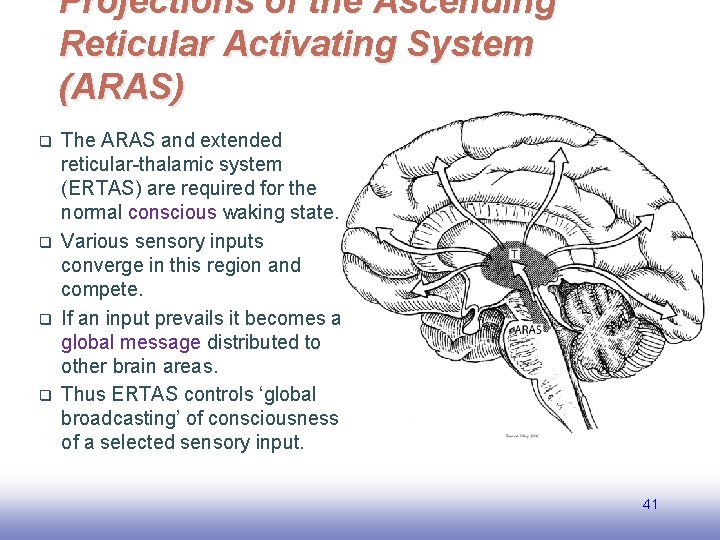
Projections of the Ascending Reticular Activating System (ARAS) q q The ARAS and extended reticular-thalamic system (ERTAS) are required for the normal conscious waking state. Various sensory inputs converge in this region and compete. If an input prevails it becomes a global message distributed to other brain areas. Thus ERTAS controls ‘global broadcasting’ of consciousness of a selected sensory input. 41 EE 141
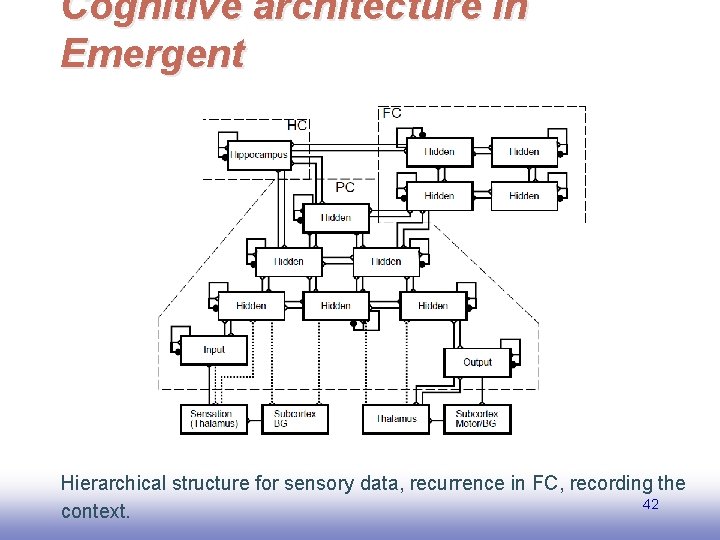
Cognitive architecture in Emergent Hierarchical structure for sensory data, recurrence in FC, recording the 42 context. EE 141
Activity Parietal cortex: learns slowly, creates extensive, overlapping representations in a densely connected network. Dynamic PC states are short-term memory, mainly of spatial relations, quickly yielding to disorder and disintegration. Frontal cortex: learns slowly, stores isolated representations, activation of memory is more stable, the reward mechanism dynamically switches its activity, allowing a longer active memory. The hippocampus learns quickly, creating sparse representations, differentiating even similar events. This simplified architecture allows the modeling of many phenomena relevant to perception, memory, using language, and the effects of the 43 interaction of different areas. EE 141
Controlled/automatic action Automatic: routine, simple, low level, sensory-motor, conditional reflexes, associations – easy to model with a network. Controlled: conscious, elastic, requiring sequences of actions, selection of elements from a large set of possibilities – usually realized in a descriptive way with the help of systems of rules and symbols. Models postulating central processes: like in a computer, working memory with a central monitor, having influence over many areas. Here: emergent processes, the result of global constraint fulfillment, lack of a central mechanism. The prefrontal cortex controls the activity of other areas, so it's involved in controlled actions, including the representation of "me" vs. "others", social relationships etc. 44 EE 141
Other distinctions consciousness q Declarative vs. procedural knowledge Declarative: often expressed symbolically (words, gestures). Procedural: more oriented towards sequences of actions. q Explicit vs. implicit knowledge Controlled action relies on explicit and declarative knowledge. Automatic actions rely on implicit and procedural knowledge. Consciousness => states existing for a noticeable period of time, integrating reportable sensory information about different modalities, with an influence on other processes in the brain. Ø Each system, which has internal states and is complex enough to comment on them, will claim that it's conscious. Ø Processes in the prefrontal cortex and the hippocampus can be recalled as a brain state or an episode, can be interpreted (associated with concept representation). 45 EE 141
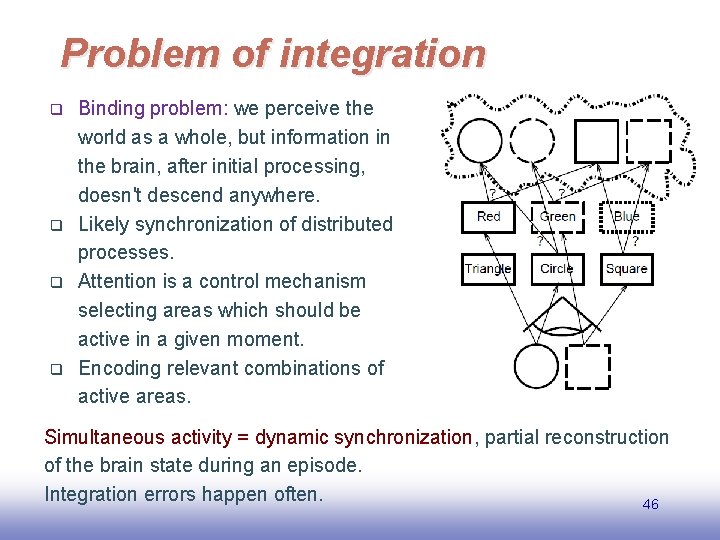
Problem of integration q q Binding problem: we perceive the world as a whole, but information in the brain, after initial processing, doesn't descend anywhere. Likely synchronization of distributed processes. Attention is a control mechanism selecting areas which should be active in a given moment. Encoding relevant combinations of active areas. Simultaneous activity = dynamic synchronization, partial reconstruction of the brain state during an episode. Integration errors happen often. 46 EE 141
Challenges q q Disruptions: Multi-level transition from one activity to another and back to the first, or recurrent multiple repetition of the same activity. This is easy for a computer program (loops, subroutines), where data and programs are separated, but it's harder for a network, where there is no such separation. PFC remembers the previous state and returns to it. Difficult task, we often forget what we wanted to say when we listen to someone, sentences are not nested too deeply. The rat the cat the dog bit chased squeaked. How and what should be generalized? Distributed representations connect different features. Dogs bite, and not only Spot, not only mongrels, not only black dogs. . . 47 EE 141
Summary q q q We discussed basic structures and regions of the brain and their role in human cognition. Remember that brain developed over millions of years and changed through time. Newer, more advanced parts of the brain are built around and on the top of the older brain. Cortex or neocortex represents recent development in the human brain and the frontal and parietal lobes are expanded comparing to other primates. Brain is highly interconnected with millions of fibers linking two hemispheres. There is no clear explanation why brain has dual structure. 48 EE 141
- Slides: 48