
COGNITIVE AND SOCIAL DEVELOPMENT COGNITIVE DEVELOPMENT https www


- Slides: 23
COGNITIVE AND SOCIAL DEVELOPMENT
COGNITIVE DEVELOPMENT https: //www. youtube. com/watch? v=8 nz 2 dtv-ok&list=PLNo 419 yvw. UDDu. GEek. LWgdl. JPUA 3 WOVeig&index=18
COGNITIVE DEVELOPMENT Cognition refers to all the mental activities associated with thinking, knowing, remembering, and communicating.
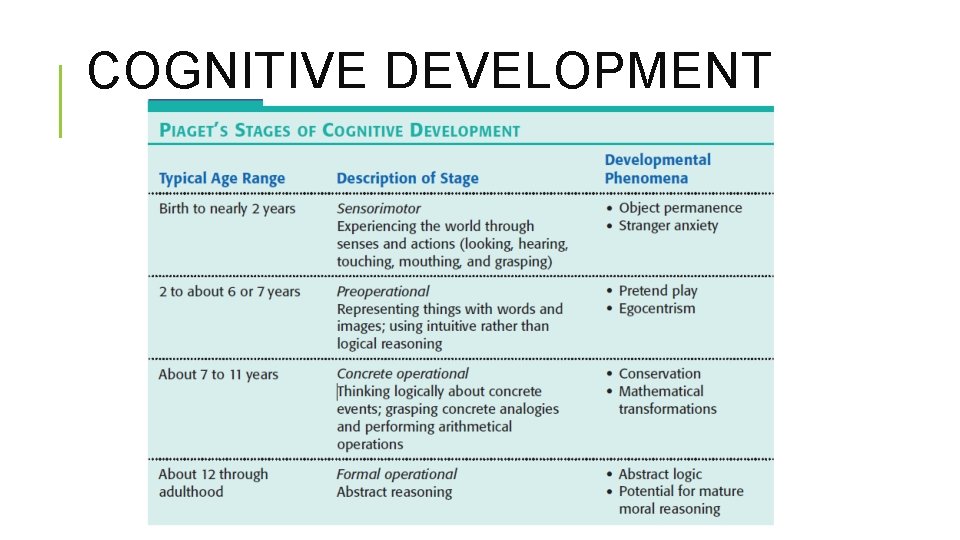
COGNITIVE DEVELOPMENT
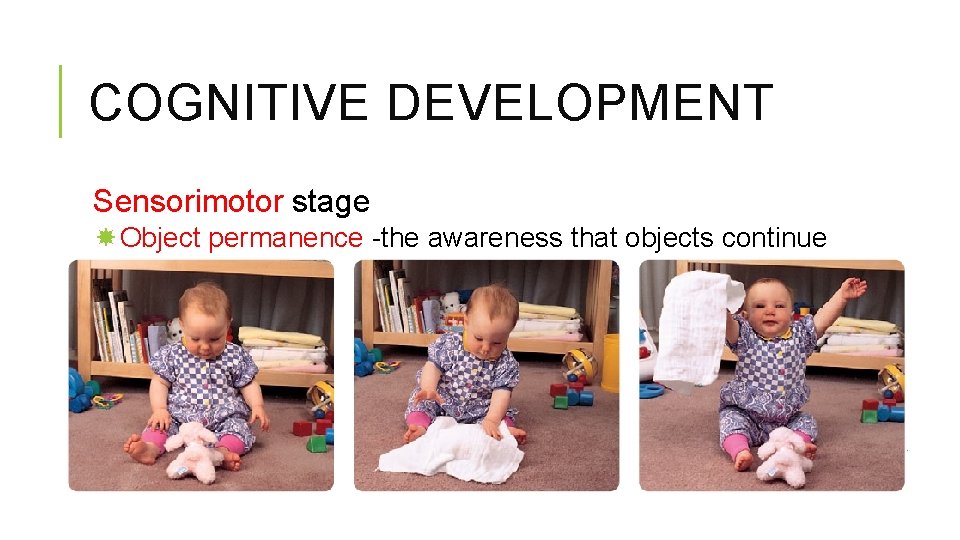
COGNITIVE DEVELOPMENT Sensorimotor stage Object permanence -the awareness that objects continue to exist when not perceived
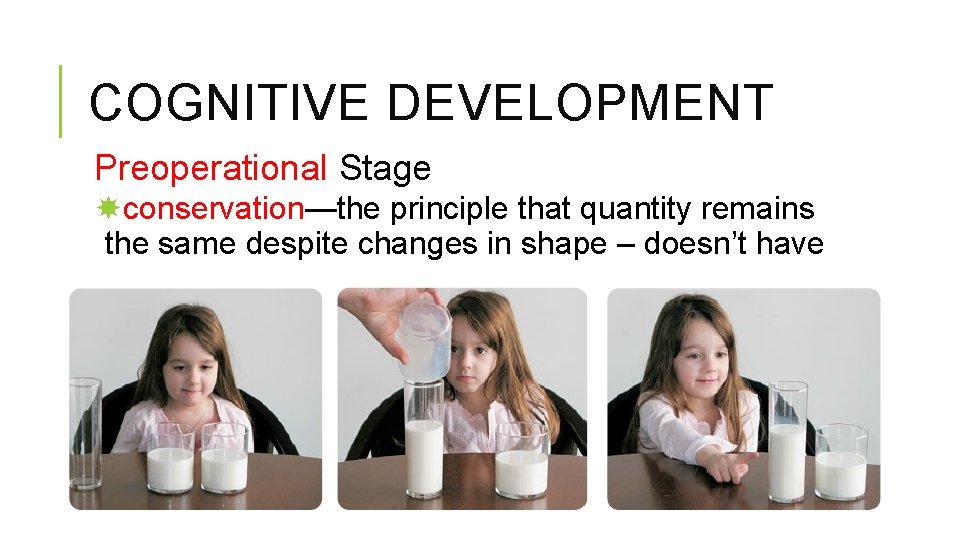
COGNITIVE DEVELOPMENT Preoperational Stage conservation—the principle that quantity remains the same despite changes in shape – doesn’t have
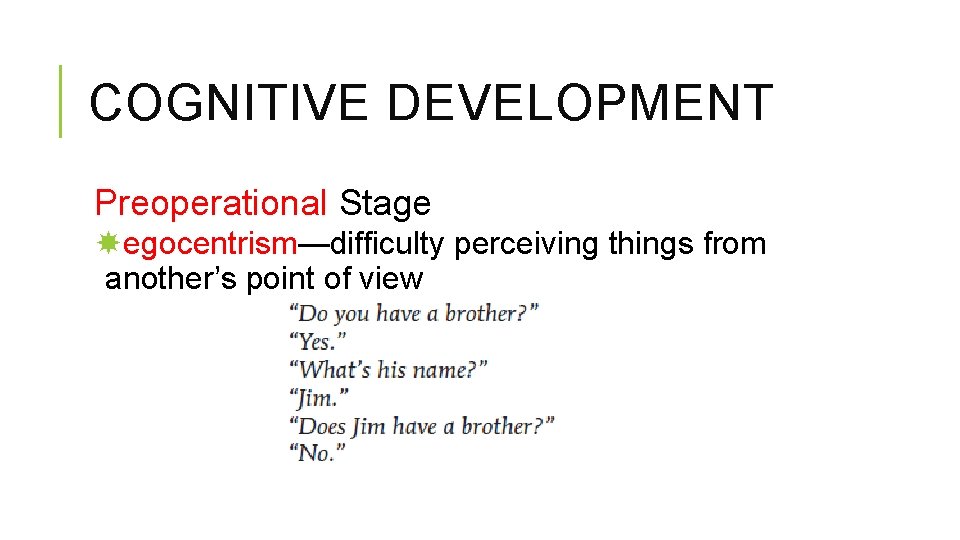
COGNITIVE DEVELOPMENT Preoperational Stage egocentrism—difficulty perceiving things from another’s point of view
COGNITIVE DEVELOPMENT Concrete Operational Stage Piaget believed that during the concrete operational stage, children fully gain the mental ability to comprehend mathematical transformations and conservation.
COGNITIVE DEVELOPMENT Formal Operational Stage By age 12, our reasoning expands from the purely concrete (involving actual experience) to encompass abstract thinking (involving imagined realities and symbols).
COGNITIVE DEVELOPMENT Reflecting on Piaget Development is moreso seen as continuous now Less focus on formal logic
SOCIAL DEVELOPMENT Need to learn the rules of behaviour of the culture – socialization Every society classifies people according to their family, age, sex, skills, personality characteristics, etc
SOCIAL DEVELOPMENT https: //www. youtube. com/watch? v=Yc. Qg 1 Eshf. IE&index=19&list=PLNo 419 yv w. UDDu. GEek. LWgdl. JPUA 3 WOVeig
SOCIAL DEVELOPMENT At about 8 months, babies develop stranger anxiety. At about this age, children have schemas for familiar faces; when they cannot assimilate the new face into these remembered schemas, they become distressed We see an important principle: The brain, mind, and social-emotional behavior develop together.
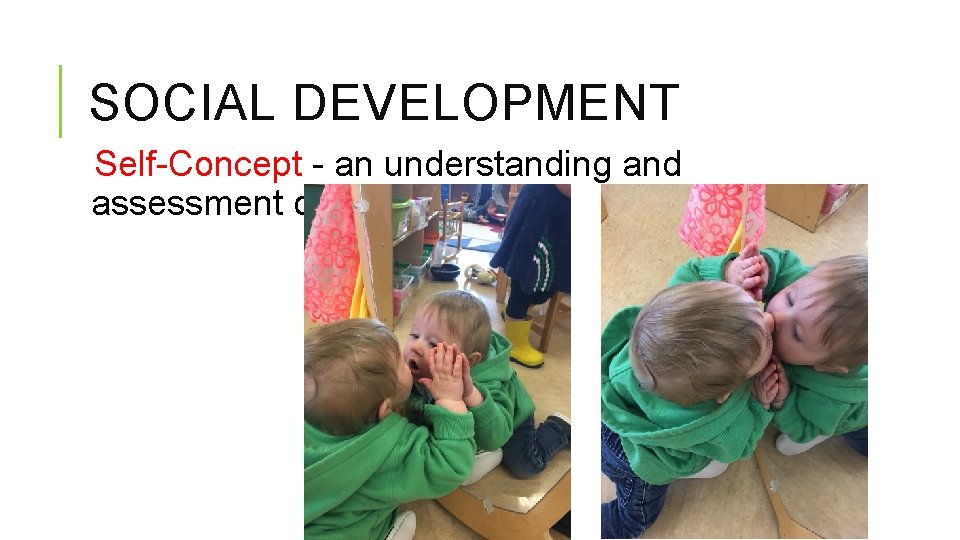
SOCIAL DEVELOPMENT Self-Concept - an understanding and assessment of who they are.
SOCIAL DEVELOPMENT
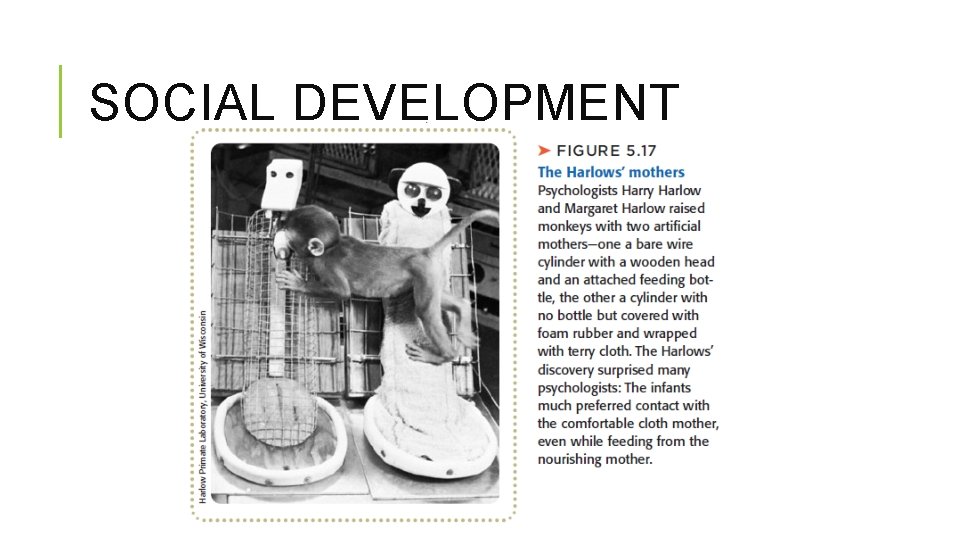
HARLOW’S MONKEY Wanted to study why the mother is so important Monkeys taken away as soon as they were born – given two sets of surrogate mothers Monkeys strongly attached to the cloth mother – whether she gave food or not – would run to cloth mother for security. The touching was important “contact comfort”
SOCIAL DEVELOPMENT Parenting Styles 1. Authoritarian parents impose rules and expect obedience: “Don’t interrupt. ”“Keep your room clean. ” “Don’t stay out late or you’ll be grounded. ” “Why? Because I said so. ” 2. Permissive parents submit to their children’s desires. They make few demands and use little punishment. 3. Authoritative parents are both demanding and responsive. They exert control by setting rules and enforcing them, but they also explain the reasons for rules. And, especially with older children, they encourage open discussion when making the rules and allow exceptions. Too hard, too soft, and just right, these styles 4. Uninvolved Parents are parents were egocentric in their child rearing and seemed uncommitted to their roles and distant from their children
Children from democratic families – more confident in their own goals and values. May be due to establishments of limits on the child and responding with warmth and support. More likely to want to make decisions with or without advice – due to gradual responsibility and allowed to exercise judgment
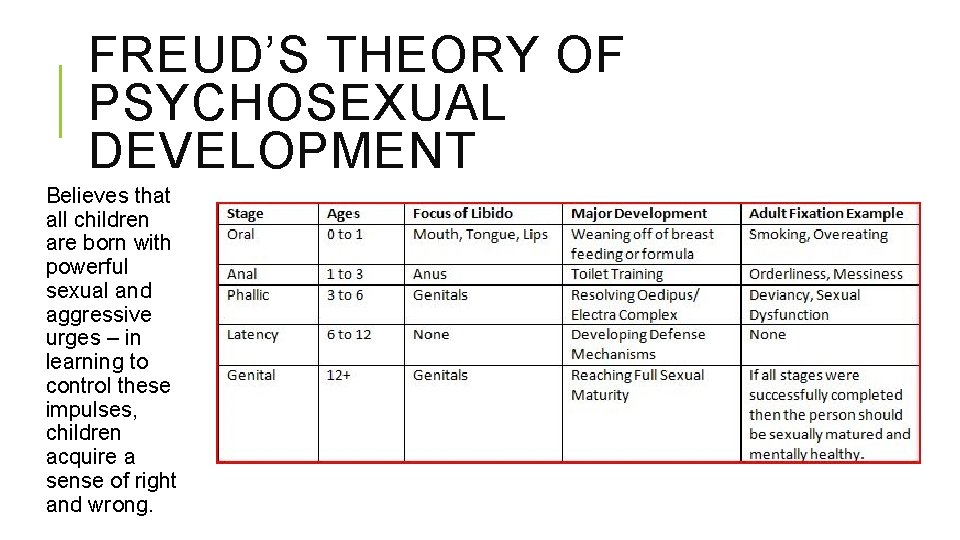
FREUD’S THEORY OF PSYCHOSEXUAL DEVELOPMENT Believes that all children are born with powerful sexual and aggressive urges – in learning to control these impulses, children acquire a sense of right and wrong.
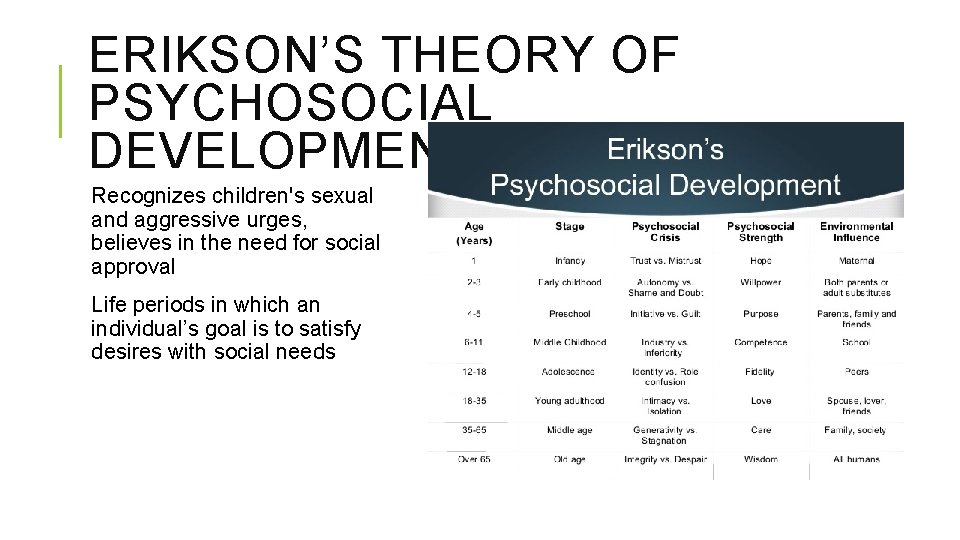
ERIKSON’S THEORY OF PSYCHOSOCIAL DEVELOPMENT Recognizes children's sexual and aggressive urges, believes in the need for social approval Life periods in which an individual’s goal is to satisfy desires with social needs
LAWRENCE KOHLBERG – MORAL DEVELOPMENT Being able to see other people’s point of view is vitally important – knowing right from wrong in society Presented the following story to children of all ages: “In Europe, a woman was near death of cancer. One drug might save her, in the form of radium that a druggist in the same town had recently discovered. The druggist was charging $2, 000, ten times when the drug cost him to make. The sick woman’s husband, Heinz, went to everyone he knew to borrow the money, but he could only get together half of what the drug cost. He told the druggist that his wife was dying and sked him to sell it cheaper or let him pay later. But the druggist said “no”. The husband got desperate and broke into the man’s store to steal the drug for his wife. Should the husband have done that? Why? (Kohlberg 1969)
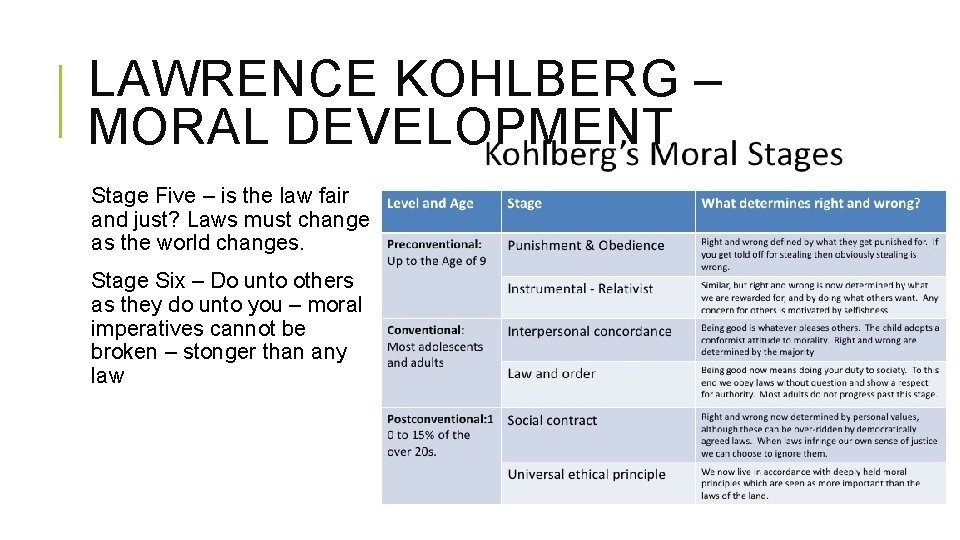
LAWRENCE KOHLBERG – MORAL DEVELOPMENT Stage One – children egocentric – they don’t consider other peoples point of view. Their main concern is avoiding punishment. A child in this stage would say the man should steal because other people will blame him for his wife’s death, or he should not steal because he’ll go to jail. Stage Two – use the “Golden Rule” – help someone if he helps you, and hurt him if he hurts you. Evaluate in terms of consequence, not right and wrong. Stage Three – sensitive to what others think. It would be cruel to let the wife die. He shouldn’t steal because he would be a criminal. Stage Four - less concerned with approval of others. Law and order. Law = moral rule and obeyed because of established authority.
LAWRENCE KOHLBERG – MORAL DEVELOPMENT Stage Five – is the law fair and just? Laws must change as the world changes. Stage Six – Do unto others as they do unto you – moral imperatives cannot be broken – stonger than any law