
Cognitive and physical training in normal aging Introduced
- Slides: 16
Cognitive and physical training in normal aging Introduced by Clémence Joubert Supervisor : Pr. Hanna Chainay 1 Collaborator : Pr. Patrick Davidson 2 1. Laboratoire d’Etude des Mécanismes Cognitifs, Université Lumière Lyon 2 (Équipe Mémoire Émotion Action) 2. School of Psycholgy, University of Ottawa
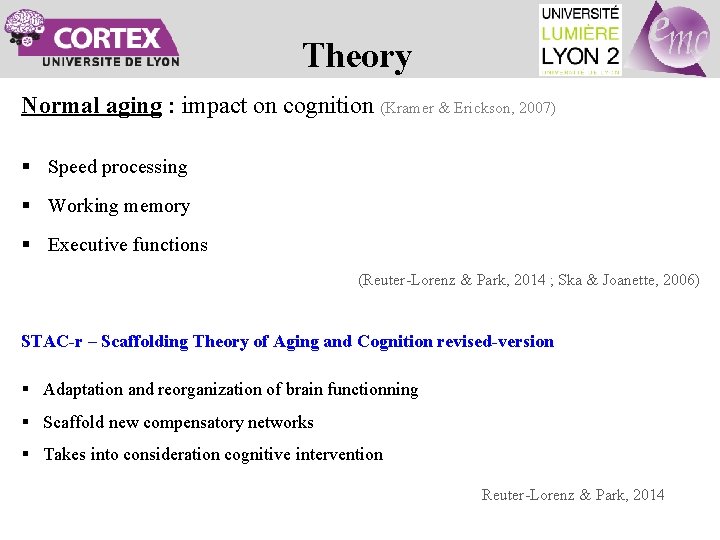
Theory Normal aging : impact on cognition (Kramer & Erickson, 2007) § Speed processing § Working memory § Executive functions (Reuter-Lorenz & Park, 2014 ; Ska & Joanette, 2006) STAC-r – Scaffolding Theory of Aging and Cognition revised-version § Adaptation and reorganization of brain functionning § Scaffold new compensatory networks § Takes into consideration cognitive intervention Reuter-Lorenz & Park, 2014
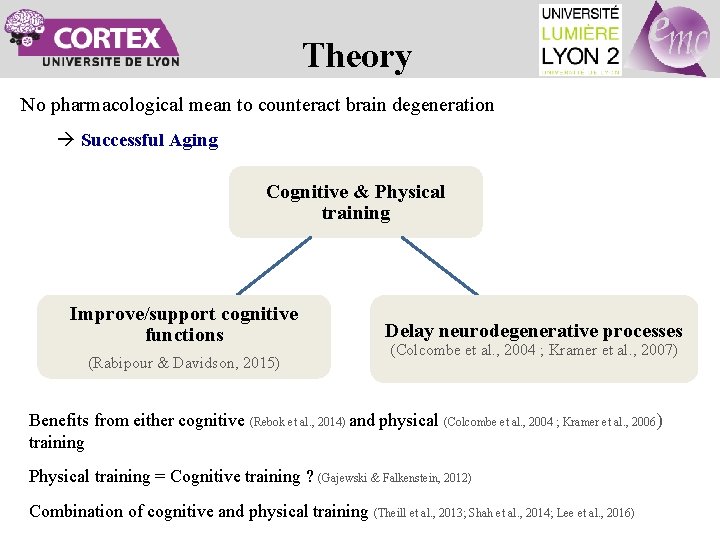
Theory No pharmacological mean to counteract brain degeneration Successful Aging Cognitive & Physical training Improve/support cognitive functions (Rabipour & Davidson, 2015) Delay neurodegenerative processes (Colcombe et al. , 2004 ; Kramer et al. , 2007) Benefits from either cognitive (Rebok et al. , 2014) and physical (Colcombe et al. , 2004 ; Kramer et al. , 2006 ) training Physical training = Cognitive training ? (Gajewski & Falkenstein, 2012) Combination of cognitive and physical training (Theill et al. , 2013; Shah et al. , 2014; Lee et al. , 2016)
Theory Evaluate the contribution of physical activity to cognitive training Cognitive benefits should be better in the condition that combine cognitive and physical aspects
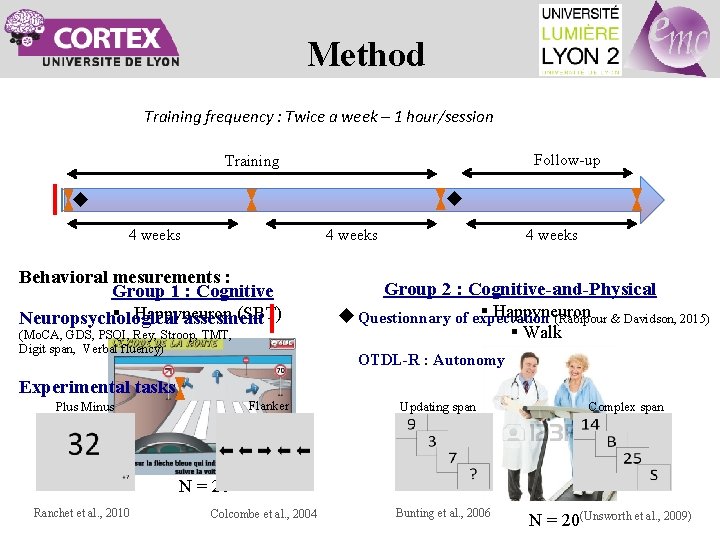
Method Training frequency : Twice a week – 1 hour/session Follow-up Training 4 weeks Behavioral mesurements : Group 1 : Cognitive § Happyneuron (SBT) Neuropsychological assesment (Mo. CA, GDS, PSQI, Rey, Stroop, TMT, Digit span, Verbal fluency) 4 weeks Group 2 : Cognitive-and-Physical § Happyneuron Questionnary of expectation (Rabipour & Davidson, 2015) § Walk OTDL-R : Autonomy Experimental tasks Flanker Plus Minus Updating span Complex span N = 20 Ranchet et al. , 2010 Colcombe et al. , 2004 Bunting et al. , 2006 N = 20 (Unsworth et al. , 2009)
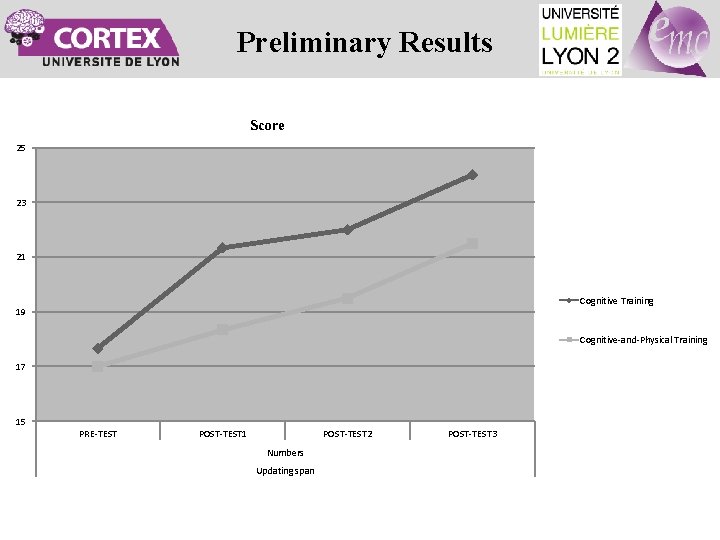
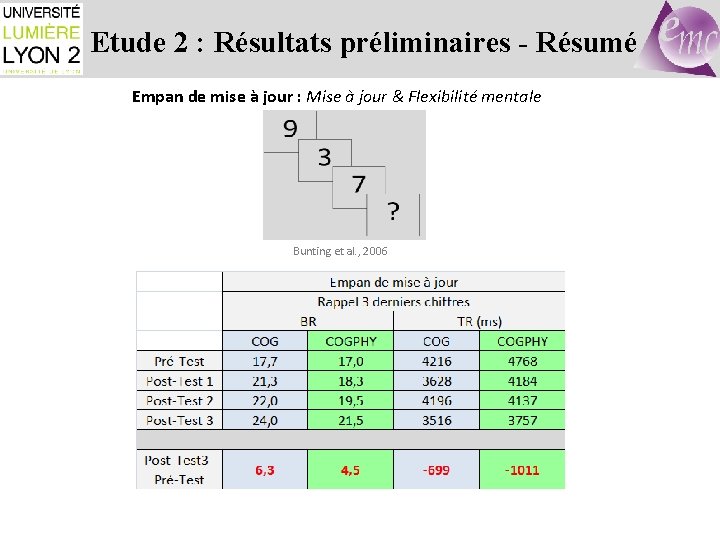
Preliminary Results Score 25 23 21 Cognitive Training 19 Cognitive-and-Physical Training 17 15 PRE-TEST POST-TEST 1 POST-TEST 2 Numbers Updating span POST-TEST 3
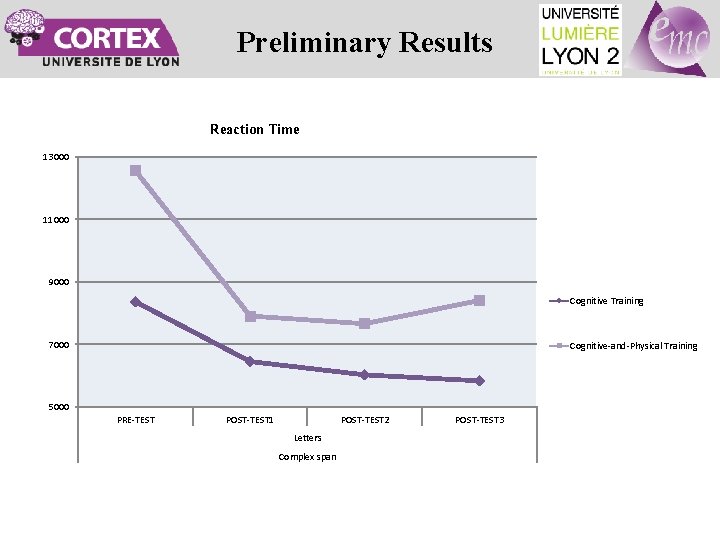
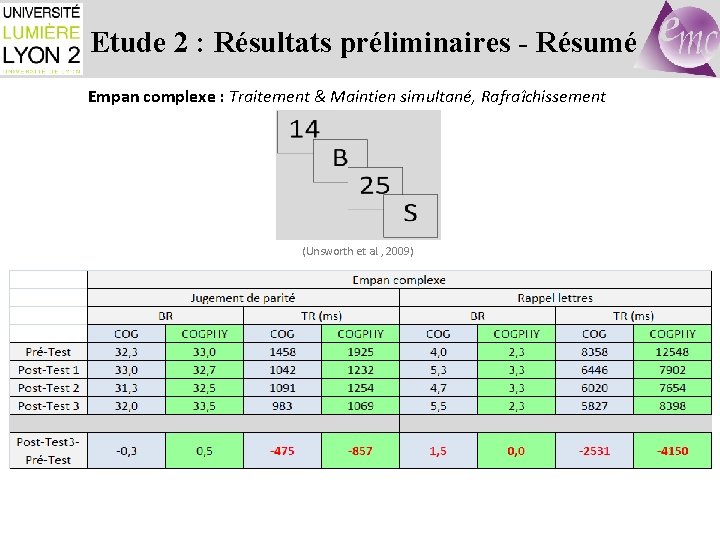
Preliminary Results Reaction Time 13000 11000 9000 Cognitive Training 7000 Cognitive-and-Physical Training 5000 PRE-TEST POST-TEST 1 POST-TEST 2 Letters Complex span POST-TEST 3
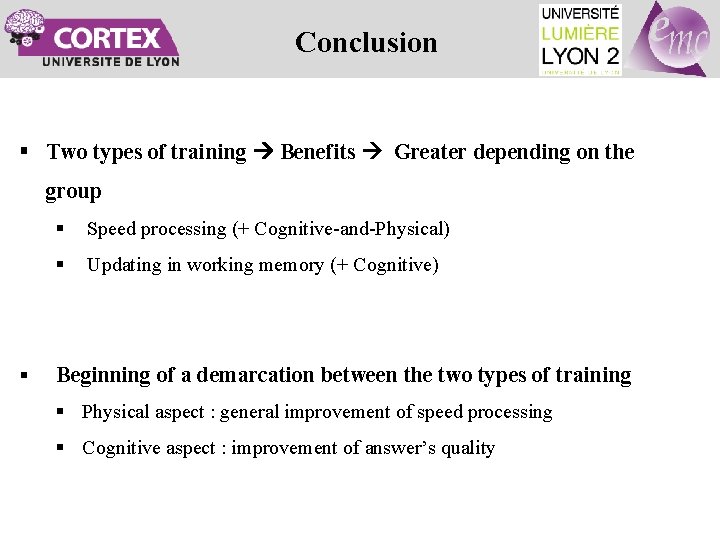
Conclusion § Two types of training Benefits Greater depending on the group § Speed processing (+ Cognitive-and-Physical) § Updating in working memory (+ Cognitive) § Beginning of a demarcation between the two types of training § Physical aspect : general improvement of speed processing § Cognitive aspect : improvement of answer’s quality
Directions § Neurophysiological measurement § EEG § Alpha § Theta § Positive. Negativeworkingmemory § 2 nd study § Physical vs Cognitive training groups § Role of social interactions : Active vs Passive control groups
Thank you for your attention
Annexes
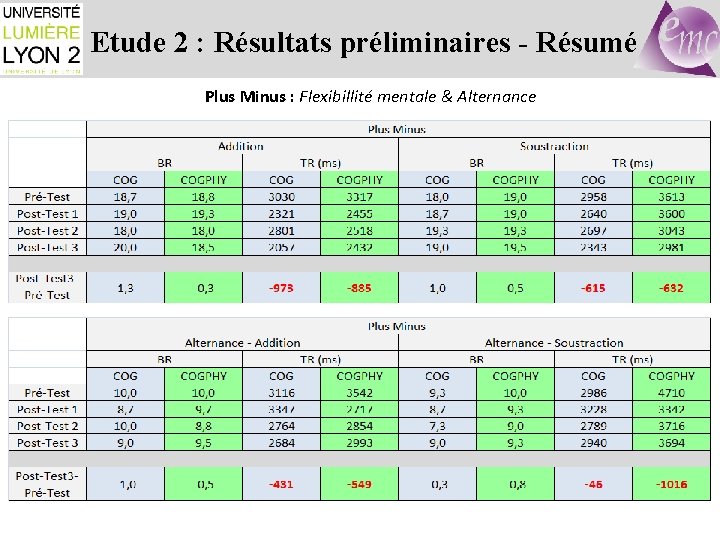
Etude 2 : Résultats préliminaires - Résumé Plus Minus : Flexibillité mentale & Alternance
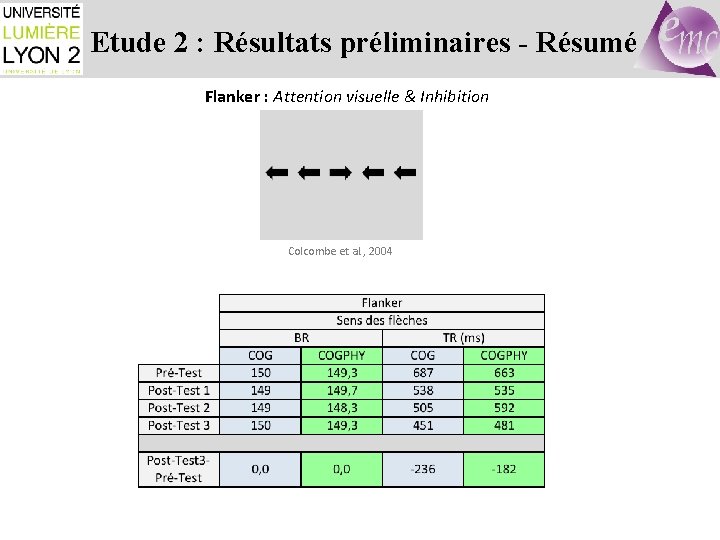
Etude 2 : Résultats préliminaires - Résumé Flanker : Attention visuelle & Inhibition Colcombe et al. , 2004
Etude 2 : Résultats préliminaires - Résumé Empan complexe : Traitement & Maintien simultané, Rafraîchissement (Unsworth et al. , 2009)
Etude 2 : Résultats préliminaires - Résumé Empan de mise à jour : Mise à jour & Flexibilité mentale Bunting et al. , 2006
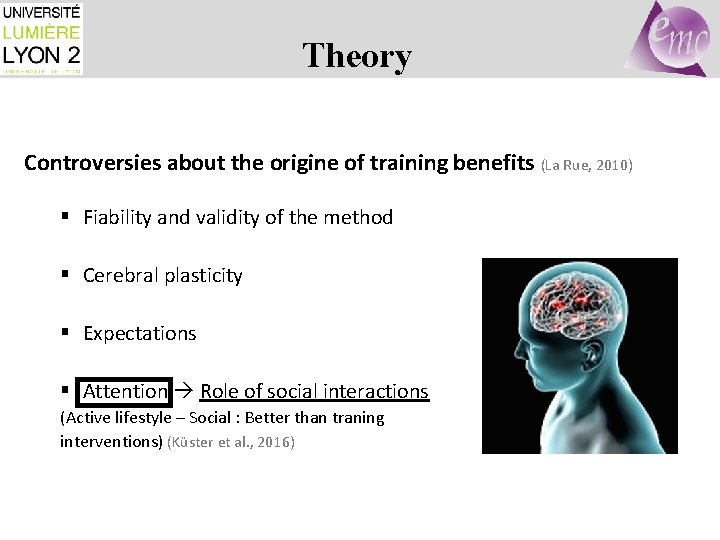
Theory Controversies about the origine of training benefits (La Rue, 2010) § Fiability and validity of the method § Cerebral plasticity § Expectations § Attention Role of social interactions (Active lifestyle – Social : Better than traning interventions) (Küster et al. , 2016)