
Cognitive and Motivational Biases in Risk and Decision
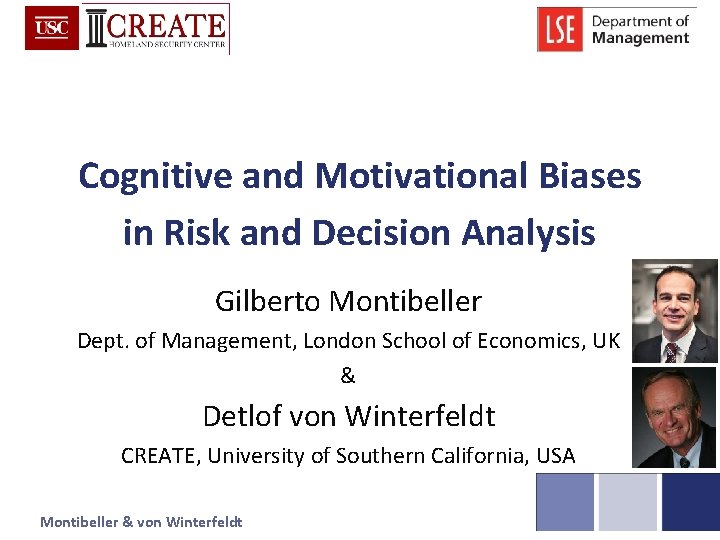
Cognitive and Motivational Biases in Risk and Decision Analysis Gilberto Montibeller Dept. of Management, London School of Economics, UK & Detlof von Winterfeldt CREATE, University of Southern California, USA Montibeller & von Winterfeldt IFORS 2014
The Prescriptive-Descriptive Split in Decision Analysis • All research prior to the 1950 s (from • • Bernoulli to Savage) was prescriptive Some researchers criticized the DA principles of descriptive grounds (Ellsberg, Allais) already in the 50 s Edwards laid the foundation of scientific descriptive work, but with a prescriptive agenda Montibeller & von Winterfeldt IFORS 2014
The Prescriptive-Descriptive Split of the 70 s • Prescriptive work since 1960: • 60’s: experimental applications of DA • 70’s: Multiattribute utility theory and influence diagrams • 80’s: Major applications • 90’s Computerization • 2000 and beyond: Specialization • Descriptive work • 50 s and 60 s: Early violations of SEU (Allais, Ellsberg) • 70 s: Probability Biases and Heuristics • 80 s: Utility biases and Prospect Theory • 90 s: Generalized expected utility theories and experiments Montibeller & von Winterfeldt IFORS 2014
Two Ways Decision Analysts Deal with Biases • The easy way • Biases exist and are harmful • Decision analysis helps people overcome these biases • The hard way • Some biases can occur in the decision analysis • process whenever a judgment is needed in the model and may distort the analysis Need to understand correct for these biases in decision analysis Montibeller & von Winterfeldt IFORS 2014
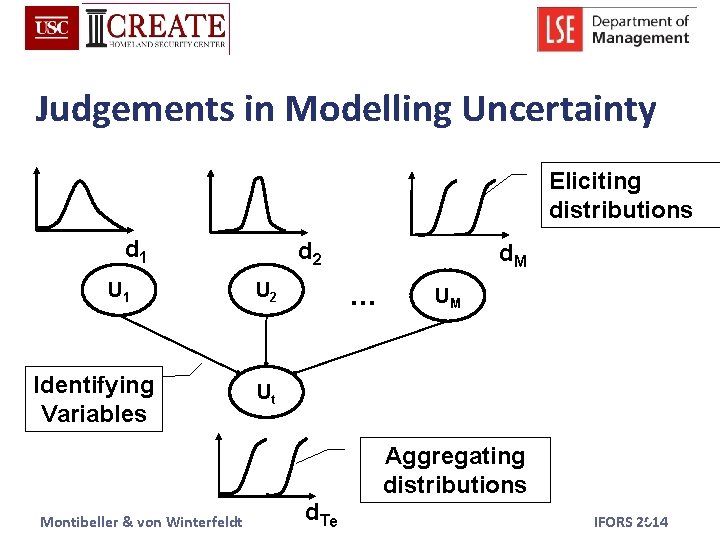
Judgements in Modelling Uncertainty Eliciting distributions d 1 U 1 Identifying Variables d 2 d. M . . . U 2 UM Ut Aggregating distributions Montibeller & von Winterfeldt d Te 5 IFORS 2014
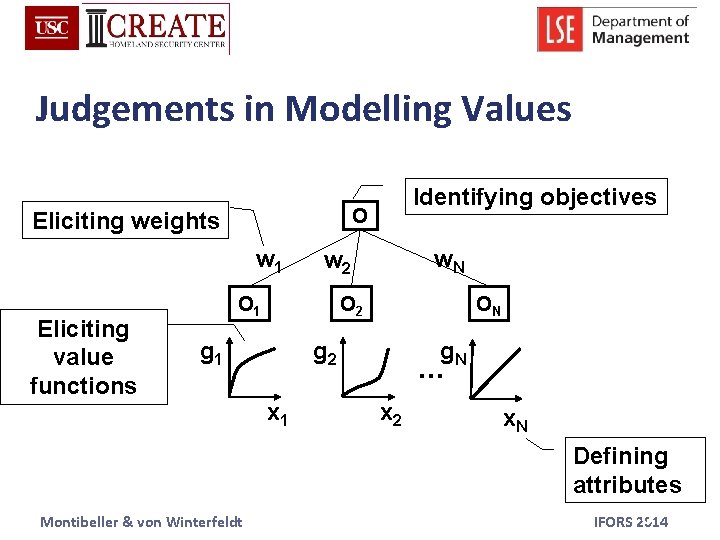
Judgements in Modelling Values O Eliciting weights w 1 Eliciting value functions Identifying objectives O 1 O 2 g 1 Montibeller & von Winterfeldt w. N w 2 ON g 2 x 1 g. N . . . x 2 x. N Defining attributes 6 IFORS 2014
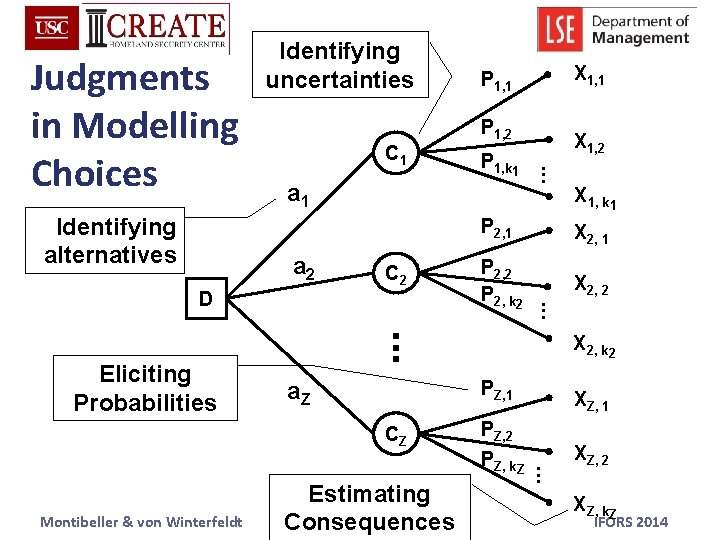
P 1, 2 a 1 a 2 Eliciting Probabilities X 1, k 1 C 2 X 2, 1 P 2, 2 P 2, k 2 X 2, k 2 PZ, 1 a. Z CZ Montibeller & von Winterfeldt P 2, 1 . . . D P 1, k 1 X 1, 2 . . . C 1 . . . Identifying alternatives X 1, 1 P 1, 1 Estimating Consequences XZ, 1 PZ, 2 PZ, k. Z . . . Judgments in Modelling Choices Identifying uncertainties XZ, 2 XZ, k. Z IFORS 2014 7
Biases that Matter vs. Those that Don’t Biases that matter • They occur in the tasks of eliciting inputs into a decision and risk analysis (DRA) from experts and decision makers. • Thus they can significantly distort the results of an analysis. Biases that don’t matter • They do not occur or can easily be avoided in the usual tasks of eliciting inputs for DRA Montibeller & von Winterfeldt IFORS 2014
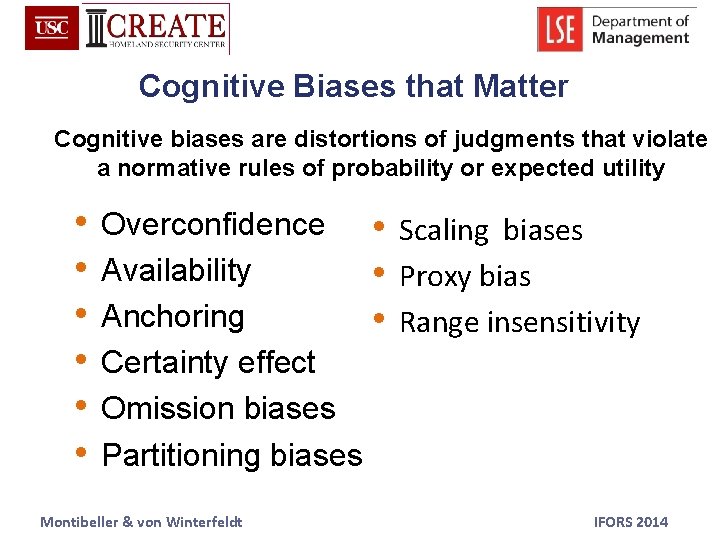
Cognitive Biases that Matter Cognitive biases are distortions of judgments that violate a normative rules of probability or expected utility • • • Overconfidence • Scaling biases Availability • Proxy bias Anchoring • Range insensitivity Certainty effect Omission biases Partitioning biases Montibeller & von Winterfeldt IFORS 2014

Cognitive Biases That Don’t Matter • • Base rate bias Conjunction fallacy Ambiguity aversion Conservatism Gambler’s fallacy Hindsight bias Hot hand fallacy Insensitivity to sample size Montibeller & von Winterfeldt • • Loss aversion Non-regressiveness Status quo biases Sub/Superadditivity of probabilities IFORS 2014
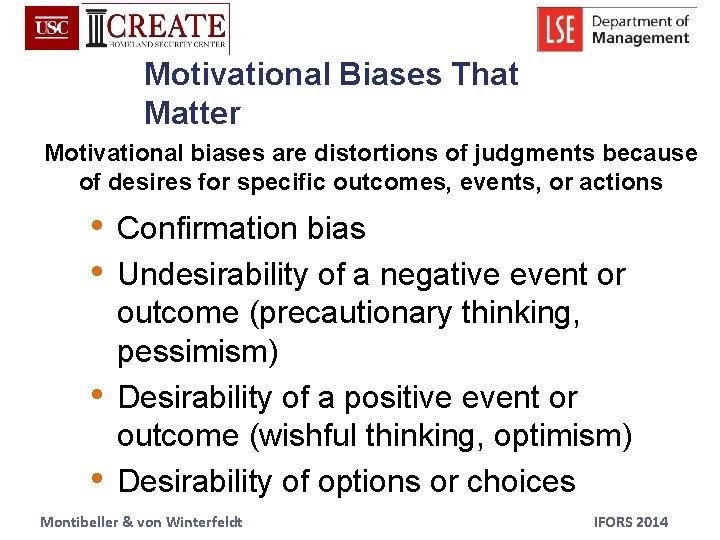
Motivational Biases That Matter Motivational biases are distortions of judgments because of desires for specific outcomes, events, or actions • Confirmation bias • Undesirability of a negative event or • • outcome (precautionary thinking, pessimism) Desirability of a positive event or outcome (wishful thinking, optimism) Desirability of options or choices Montibeller & von Winterfeldt IFORS 2014

Mapping Biases Montibeller & von Winterfeldt a 1 P 1, k 1 X 1, 2 . . . C 1 X 1, k 1 C 2 X 2, 1 P 2, 2 P 2, k 2 X 2, 2 . . . a 2 P 2, 1 X 2, k 2 a. Z PZ, 1 CZ XZ, 1 PZ, 2 PZ, k. Z . . . • Anchoring bias (C) D • Availability bias (C) • Confirmation bias (M) • Desirability biases (M) • Gain-loss bias (C) • Overconfidence bias (C) • Equalizing bias (C) • Splitting bias (C) P 1, 2 . . . Eliciting Probabilities X 1, 1 P 1, 1 XZ, 2 XZ, k. Z IFORS 2014 12
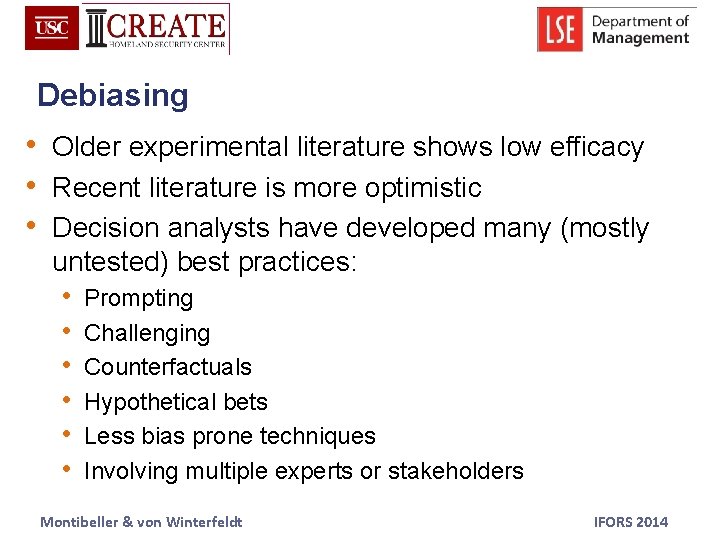
Debiasing • Older experimental literature shows low efficacy • Recent literature is more optimistic • Decision analysts have developed many (mostly untested) best practices: • Prompting • Challenging • Counterfactuals • Hypothetical bets • Less bias prone techniques • Involving multiple experts or stakeholders Montibeller & von Winterfeldt IFORS 2014
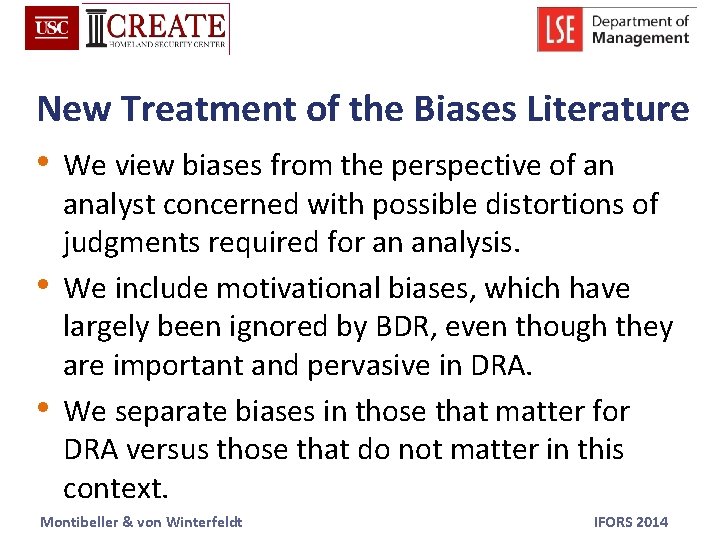
New Treatment of the Biases Literature • We view biases from the perspective of an • • analyst concerned with possible distortions of judgments required for an analysis. We include motivational biases, which have largely been ignored by BDR, even though they are important and pervasive in DRA. We separate biases in those that matter for DRA versus those that do not matter in this context. Montibeller & von Winterfeldt IFORS 2014 14
New Treatment of the Bias Literature (continued) • We provide guidance on debiasing techniques • which includes not only the behavioral literature on debiasing, • but also the growing set of “best practices” in the decision and risk analysis field. Montibeller & von Winterfeldt IFORS 2014 15

Thank you for your attention! Contact: Dr Gilberto Montibeller Email: g. montibeller@lse. ac. uk Address: Department of Management London School of Economics Houghton St. , London, WC 2 A 2 AE Montibeller & von Winterfeldt IFORS 2014
- Slides: 16